Insights
Market intelligence for Salesforce buyers.
Benchmarks, playbooks, and field notes from inside live negotiations across EMEA.
What I heard at my first IT Procurement & Sourcing Summit
Six themes from two days at the IT Procurement & Sourcing Summit in Amsterdam: data first, one voice to the vendor, AI readiness and more.
When Does Your Salesforce Renewal Actually Start?
Waiting for a renewal quote leaves little time to check what you actually need. Learn how to verify contract dates, build a licence baseline and organise Salesforce renewal preparation before commercial discussions begin.
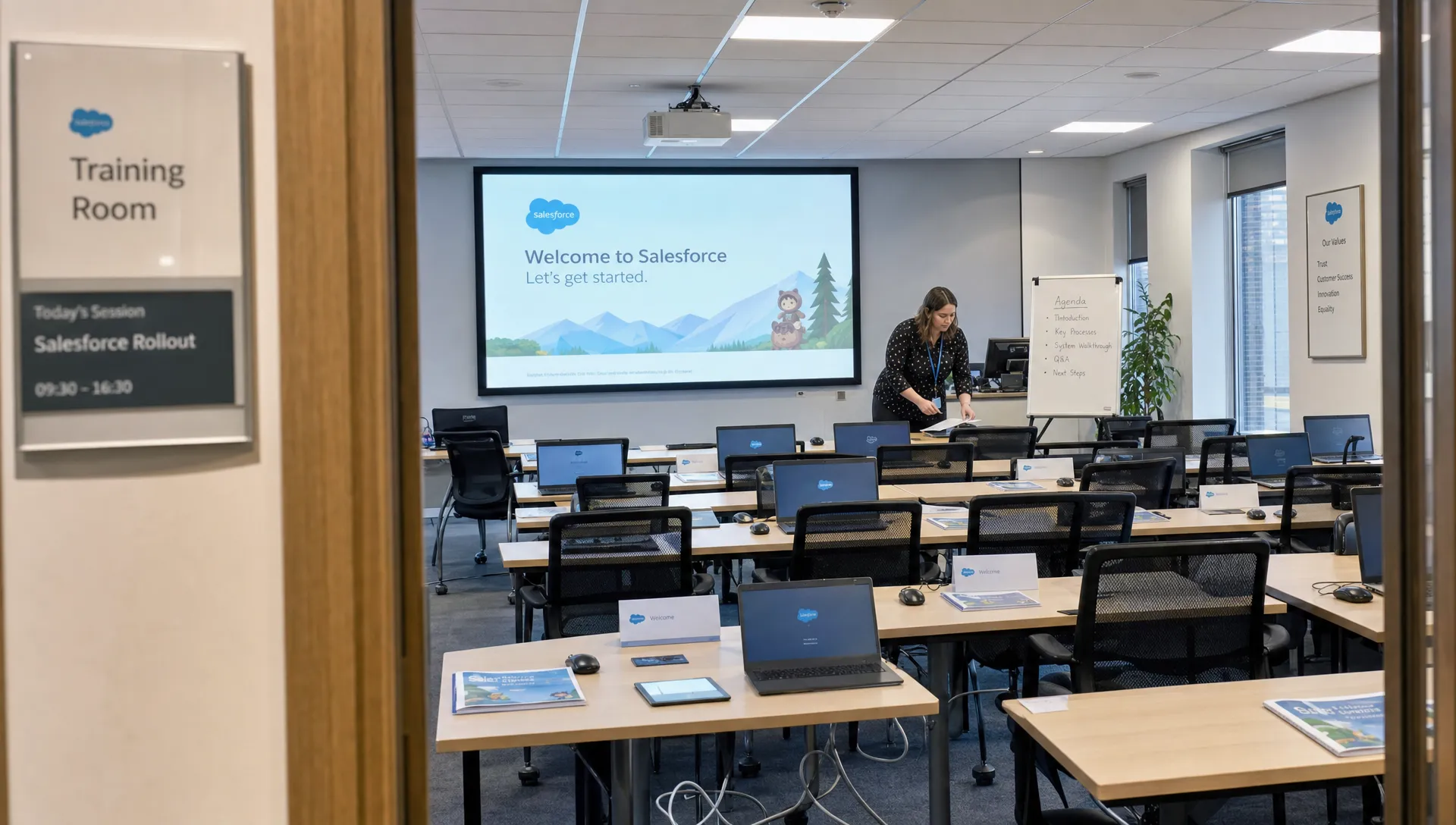
A SaaS Strategy That Keeps Growth From Becoming Waste
Growth does not have to mean buying ahead of demand. Learn how to connect Salesforce spending to confirmed requirements, use existing capacity and preserve flexibility as hiring, deployment and business plans change.
The questions
CFOs & CIOs
actually ask.
No jargon. No sales pitch. Just what you need to know before your next Salesforce renewal — written by people who've spent years on both sides of the table.
When and how to create the conditions for a better deal
Six months before renewal — minimum. If you wait until 90 days out, your leverage is structurally limited. Salesforce knows you won't migrate a CRM in three months, and they'll negotiate accordingly.
The second variable is Salesforce's fiscal year, which runs February to January. The best moments to sign are at the end of their quarters: end of April, July, October, or January. Sales teams are under pressure to close, and that pressure translates into commercial flexibility you won't see mid-quarter.
Salesforce's fiscal year ends in January. Q4 — November through January — is when the largest proportion of annual revenue closes. The pressure on AEs and their managers to hit quota is highest during this window, which gives buyers more room.
That said, the effect is tiered by deal size. If you're spending millions annually, you will move the needle in every quarter — fiscal timing matters less. If your contract is under $500K per product, timing becomes more important because your deal only meaningfully affects the AE's numbers at peak pressure moments.
End of month also matters, not just end of quarter. An AE who has committed a deal to their manager needs to close it. If your go-live date creates a genuine internal deadline, that can become a useful structural lever — or a liability, if Salesforce senses the urgency is real.
Yes — but it depends on context, not just contract size. A useful benchmark: if your deal represents 50% or more of your AE's annual quota, you have their genuine attention. AEs in SMB segments carry quotas from around $600K. Enterprise AEs typically sit at $1.5M or more.
If you're a small deal in an Enterprise segment, the AE may not be prioritising your renewal. In that case, the renewal team and customer success managers often care more than the AE — their metrics are tied to retention, not growth. That's worth understanding.
The key is not to overstate leverage you don't have. Don't make threats you can't execute. Salesforce has seen every tactic and they know your actual position. What works is being well-prepared, knowing your usage data cold, and having a clear, consistent internal narrative.
What's realistic, how approval works, and where the money actually comes from
There is no universal number — discount depth depends on deal size, product, region, timing, and whether this is new business or a renewal. What we can tell you is the structural reality: there are six approval levels inside Salesforce, and each level unlocks incrementally more room.
Your AE (Level 0) has a limited, tightly managed band. Managers and directors (Levels 1–3) each hold a few percentage points. Deal Desk (Level 4) is where most negotiations actually stop — they are there specifically to protect Salesforce's pricing in the market, and they are unemotional. Level 5 (senior executives) comes into play primarily for very large deals or when a region is underperforming.
The practical implication: to get meaningful discounts, you need to give L0–L3 the business justification to take to Deal Desk. That case — your usage data, your alternatives, your internal roadmap — is what gets deals approved. Pressure alone doesn't work at L4.
Deal Desk is the internal team inside Salesforce that approves any discount above what managers and directors can approve unilaterally. It exists to prevent AEs from over-discounting to hit their quota — and it is very effective at that job.
Deal Desk does not have a relationship with you. They do not know your account, your history, or your business. Their job is to protect Salesforce's pricing position. Every request that comes to them needs a business justification — a reason why Salesforce should make a commercial exception in your case.
This is where most companies lose ground without realising it. They focus on negotiating with their AE, who genuinely cannot give more than Level 0 allows. The AE then takes a poorly structured case to Deal Desk, gets rejected, and comes back to the customer empty-handed. The preparation you do months in advance — your usage audit, your competitive evaluation, your internal roadmap — is what gets Deal Desk to say yes.
Sometimes — but the decision is rarely as straightforward as Salesforce's AE will present it. Multi-year deals improve the unit price, which looks good in the initial negotiation. What they also do is remove your optionality for several years.
The questions to ask before committing: Is your organisation actually using what you already have? Have you reached the adoption levels that justify the current stack, let alone an expanded one? A multi-year deal that locks in unused seats or unimplemented products creates sunk costs, not savings.
We've seen multi-year deals sold on the back of Agentforce credits or other new products being bundled in early "because it creates a better discount story over three years." If your team hasn't adopted what you already own, buying optimism over three years at a discount is still expensive.
What to know about your own contract before you negotiate anything
Own your usage data before Salesforce does. Your AE is already building a picture of your account — active users, product engagement, which teams are using what. Make sure your picture is more accurate than theirs. That means understanding which licenses are active, which are sitting idle, and which users are on the wrong edition for what they actually do.
Get your internal story straight. Salesforce operates across multiple levels of your organisation simultaneously — C-suite relationship management, technical conversations with architects and admins, commercial discussions with procurement. If your departments have different views on what you need, that incoherence gets used commercially. A single, aligned internal narrative is worth more than most negotiation tactics.
Surface friction early. If something isn't working — poor adoption, integration problems, a product that hasn't delivered — raise it now, not at renewal. A genuine ongoing problem that's been visible for 12 months is real. A complaint raised 90 days before renewal looks like a tactic, and Salesforce will treat it as one.
Check your in-term add-ons. Products added mid-contract almost always carry lower discounts than your original deal. Most organisations don't check these. You should, before the renewal quote lands.
Eight out of ten companies we speak to are overpaying — not always in list price, but in scope. They're paying for licenses that aren't used, editions that are over-provisioned, or products that were bought on a growth plan that hasn't materialised.
The signals to look for: seats assigned to users who rarely log in; premium licenses on users who only need basic functionality; products that were bundled into the original deal but were never fully implemented; add-ons purchased mid-term that duplicated functionality already in the existing stack.
Salesforce will not proactively tell you about underutilisation. That information is available to them, but surfacing it would reduce their renewal value. Understanding your own usage position is, in practice, the most reliable foundation for any commercial conversation.
Shelfware is software you're paying for but not using — licenses that are assigned, contracted, and invoiced, but generating no operational value. It is extremely common in Salesforce contracts, and it tends to accumulate at renewal when companies buy for a future state rather than their current one.
A good example is Marketing Cloud Account Engagement (formerly Pardot). Most teams use it for basic email and a few nurture flows. But they're paying for a platform built for lead scoring, account-based marketing, and sales alignment. The features exist. The adoption doesn't. That gap is money.
The fix is straightforward once you know what to look for: a usage audit maps active users, idle seats, and overprovisioned roles. In most cases, this surfaces restructuring opportunities even within existing contractual terms — and gives you a grounded, factual basis for the renewal conversation.
How negotiations actually work and where companies lose ground
Salesforce is very good at multi-threading — managing separate conversations with different stakeholders inside your organisation simultaneously. Your CIO hears one thing. Your Salesforce admin hears another. Your procurement lead is getting different information. Your CFO is being engaged at an executive level.
This isn't nefarious — it's how enterprise sales works. But it creates a real problem in negotiations: different parts of your team may be in different stages of their wish lists, with different tolerances for change. An internal stakeholder who wants a new product can, without intending to, become a commercial liability during renewal discussions.
The counter is straightforward in principle: a single point of contact for all commercial communications, and a clear internal alignment on what you want from this negotiation and what you've agreed to leave for later. Salesforce doesn't need to know your future roadmap. Keep it internal until it's useful to surface.
SELA stands for Salesforce Enterprise License Agreement. The pitch is flexibility: instead of buying individual SKUs, you get broader access to a defined set of products, often with a consumption or user-based model.
The appeal is real for some organisations. If you have genuine economies of scale, if your usage patterns are genuinely unpredictable, or if you're running a complex multi-product implementation — an enterprise agreement can make commercial sense.
The risk is that the flexibility pitch often comes from the Salesforce account team and the internal champions who want access to more products. That's not the same as it making commercial sense for your organisation. Before pursuing one, ask: is there a genuine economy of scale that benefits us, or does this primarily benefit Salesforce's revenue growth on our account? Would pay-as-you-go with slightly more administration actually be better for how we buy?
Sometimes. The honest answer is that at Level 0, AEs genuinely do exhaust their discretionary discount authority. The better, more experienced AEs hold their discounts tightly until you actually ask — they won't volunteer margin they don't have to give. Less experienced AEs often give more up front, which is its own problem.
But when an AE says they've given everything they can, the question isn't whether they've exhausted Level 0 — it's whether you've given them a strong enough case to take to Levels 1–4. Deal Desk doesn't approve exceptions based on relationship or pressure. They approve them based on business justification: what is the commercial reason for Salesforce to accept a lower price here?
If you haven't built that justification — through usage data, a credible internal roadmap, competitive context, timing — then the AE genuinely may not be able to move further. The constraint isn't their willingness. It's the absence of a case.
What we do and when it makes sense to bring us in
We are the only procurement advisory in EMEA focused entirely on Salesforce commercial negotiations. We work with mid-to-large enterprises — typically companies spending between $1M and $10M annually on Salesforce — who want to know they're getting a fair deal and don't want the commercial complexity to land on their internal team.
In practice, we do three things. We audit your current contract and usage so you know your actual position before any negotiation starts. We advise on or directly lead the negotiation process, either visibly or as a silent partner behind your team. And we help you build the internal alignment and documentation that turns a vague dissatisfaction into a negotiable position.
We only take on engagements where we believe we can make a material difference. Our capacity at any given time is limited to six concurrent negotiations. That's a deliberate constraint — not a growth target.
Ideally, six to nine months before renewal. The most effective work happens before formal negotiation starts — in the period where you're building leverage, surfacing friction with your AE, and aligning internally. By the time a renewal quote lands, the conditions for a good deal have usually already been set or missed.
That said, if you're already inside the 90-day window and you haven't started: call us anyway. There's still work to do. The options are narrower, but they exist. What doesn't work is starting the day before the contract expires.
However, mid-contract additions change the picture significantly. If you need to expand — adding Agentforce in year two of a three-year contract, for example — your AE will almost always position this as an early renewal opportunity. It is not. It is a new commercial event, and it carries the same risks as any negotiation: an incomplete picture of your usage, an unvalidated product mix, and no benchmark for what a fair price looks like in your current position. Coming in without that preparation is how mid-contract expansions end up costing more than they should, and locking in terms you'll be managing for longer than you planned.
In most cases, it is more effective to have us visibly at the table. It signals immediately that you are approaching this seriously, that you have specialist expertise in your corner, and that the commercial process will be structured and well-prepared. Salesforce knows what that means. It changes the dynamic before the first conversation starts.
In other cases — where internal politics, existing relationships, or the nature of the engagement make a lower profile more appropriate — we work behind your team. We advise on strategy, prepare the commercial case, review offers, and brief your negotiators before each stage. The outcome is the same; our presence just isn't the one in the room.
We will listen and advise on the right approach for your situation.
Not sure where you stand?
No obligation — just a clear view of your current position before your next renewal.