Is Salesforce a SaaS Platform? What Buyers Need to Know
Salesforce is delivered as SaaS, but that label does not make the buying decision simple. This guide explains what the model changes for cost control, renewals, governance and negotiation.
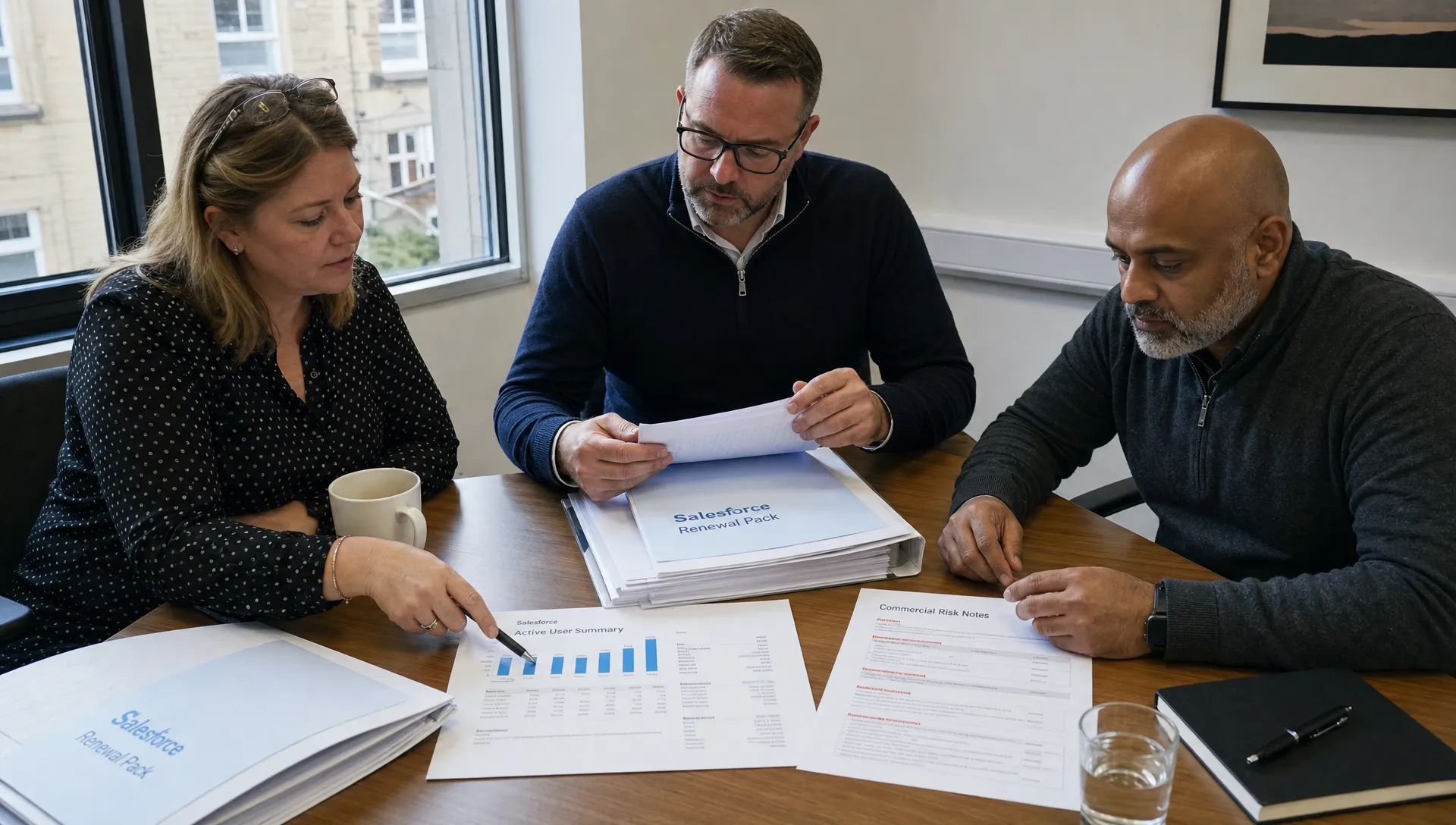
Short answer: yes. Salesforce is SaaS because its core applications are delivered over the internet, hosted and updated by Salesforce, licensed by subscription and accessed through a browser, mobile app or API rather than installed on your own servers.
That answer is true, but too thin for a buyer. For CFOs, CIOs, IT leads and procurement teams, the useful question is not only whether Salesforce fits the software as a service definition. It is what that model does to cost, control, renewal leverage, technical dependency and long-term flexibility.
When a board asks whether Salesforce is SaaS, the underlying concern is often more commercial than technical. Will we be locked into recurring spend? Can we remove what we do not use? Are updates controlled by us or by the vendor? How do we compare value across Sales Cloud, Service Cloud, Marketing Cloud, Data Cloud, Agentforce and the wider ecosystem?
This guide answers those questions in buyer language, without treating Salesforce as a simple line item.
What it means when Salesforce is SaaS
Saying Salesforce is SaaS does not mean it is just a website with a login. It means Salesforce operates the underlying application infrastructure, delivers updates centrally and sells access through a subscription model. Customers configure and extend the platform, but they do not usually own or maintain the core application stack.
Salesforce's own explanation of SaaS describes the model in familiar terms: software delivered through the cloud, commonly by subscription, without customers needing to install and maintain the application locally.
For buyers, the defining traits are practical:
- Access is remote, normally through browser, mobile app and API.
- Core infrastructure is managed by Salesforce.
- Product releases are controlled by Salesforce on a regular schedule.
- Pricing is usually subscription-based, often with add-ons and usage elements.
- Value depends heavily on adoption, configuration, data quality and governance.
That last point is where many Salesforce budgets drift. The subscription model is easy to expand, but not always easy to unwind. New products, extra editions, sandbox environments, premium support, integration tools and AI or data services can enter the estate at different moments, owned by different teams and justified by different business cases.
Salesforce is not only one SaaS product
Salesforce started as cloud CRM, but enterprise buyers are now usually buying a portfolio. The words SaaS, platform, CRM and cloud can blur together in internal approvals. That creates risk because each label carries a different commercial question.
| Term | What it usually means in a Salesforce context | Buyer question |
|---|---|---|
| SaaS | Hosted software bought by subscription, such as Sales Cloud or Service Cloud | Are we paying for the right users, editions and terms? |
| Platform | Tools to configure, automate, integrate and build on Salesforce | What are we building, who owns it and how portable is it? |
| CRM | Customer data and workflows for sales, service and marketing | Which revenue or service outcomes justify the spend? |
| Multi-cloud estate | Several Salesforce products used together | Are the SKUs connected by a plan or accumulated through renewals? |
| Consumption service | Usage-based elements such as data, AI or messaging capacity | Can we forecast demand and control overage risk? |
This is why the buying motion matters. A single SaaS subscription can be governed by IT and procurement. A Salesforce estate often touches sales, service, marketing, finance, legal, data teams, security and external implementation partners.
If you are still deciding whether Salesforce is the right enterprise commitment, it helps to start with the operating problem before the product bundle. SaaSed has written more on that in its guide to what to know before you get Salesforce at enterprise scale.
The buying implications are more important than the label
A SaaS model changes the economics of software. It reduces some infrastructure burden, but it also turns software into a recurring commercial commitment that needs evidence, ownership and renewal discipline.
1. Subscription spend compounds quietly
Because Salesforce is SaaS, spend tends to grow through additions rather than one-off capital approvals. Extra users, higher editions, new Clouds, add-ons and contract amendments may each look sensible in isolation. Together they can create a renewal baseline that no longer matches actual use.
The issue is not that subscription pricing is bad. It gives flexibility when governed well. The issue is that many organisations approve new Salesforce scope faster than they retire old scope. Shelfware then becomes part of the run rate.
At renewal, Salesforce will usually anchor discussions around the current contract, product roadmap and growth assumptions. Buyers need their own view of usage, value and future demand before those conversations begin.
2. Updates are easier, but change control still belongs to the customer
SaaS removes the need to run major on-premise upgrade projects. Salesforce releases updates centrally, which can be a real advantage for security, innovation and product continuity.
It does not remove the need for internal change management. Admin teams still need to assess release impact, test business-critical workflows, manage integrations and educate users. Customisations can turn a standard SaaS platform into a complex internal operating system.
For CIOs, the question is not whether Salesforce can scale. It can. The question is whether the organisation has the governance model to keep configuration, architecture, security and commercial decisions aligned. That is why governing Salesforce as enterprise software matters long before renewal pressure arrives.
3. Vendor-managed infrastructure does not remove customer responsibility
Salesforce manages the core infrastructure, availability model and platform security controls. Customers still remain responsible for users, permissions, data access, integrations, configuration, identity controls and internal process design.
For live service status, maintenance information and trust resources, Salesforce Trust is the official source buyers and IT teams should know. It is useful in governance conversations because it separates vendor-side operational transparency from customer-side accountability.
A SaaS contract can sometimes make responsibility feel abstract. In practice, the split is concrete. Salesforce runs the platform. You decide who can access what, how data flows, which apps are connected, what gets automated and which controls are tested.
4. Multi-cloud buying needs an architecture and a commercial map
Salesforce estates rarely stay limited to Sales Cloud. Service Cloud, Marketing Cloud, Commerce, Data Cloud, Slack, MuleSoft, Tableau and Agentforce may all appear in the conversation. Some are core to the operating model. Others are attractive but optional.
A multi-cloud purchase can be sensible when the products support a connected process. It can also become an expensive bundle if the organisation has not defined ownership, data flow, implementation effort and measurable value by Cloud.
This is especially relevant in 2026 as AI and data products change the shape of Salesforce buying. Seat-based licensing remains important, but consumption-based services can make forecasting harder. For example, Agentforce should not be assessed only as an AI feature. It needs a commercial view of usage, guardrails and operating impact, a topic covered in SaaSed's piece on what enterprise leaders need to know about Salesforce Agentforce.
5. Renewal leverage depends on evidence, not frustration
Many renewal discussions start too late and with too little data. By then, internal stakeholders may be worried about disruption, Salesforce may already understand the account dynamics and procurement may be left negotiating from a weak evidence base.
The SaaS model gives buyers renewal moments. Those moments only create leverage if the organisation can show what is used, what is not used, which products are critical, which products are replaceable and which future requirements are genuinely funded.
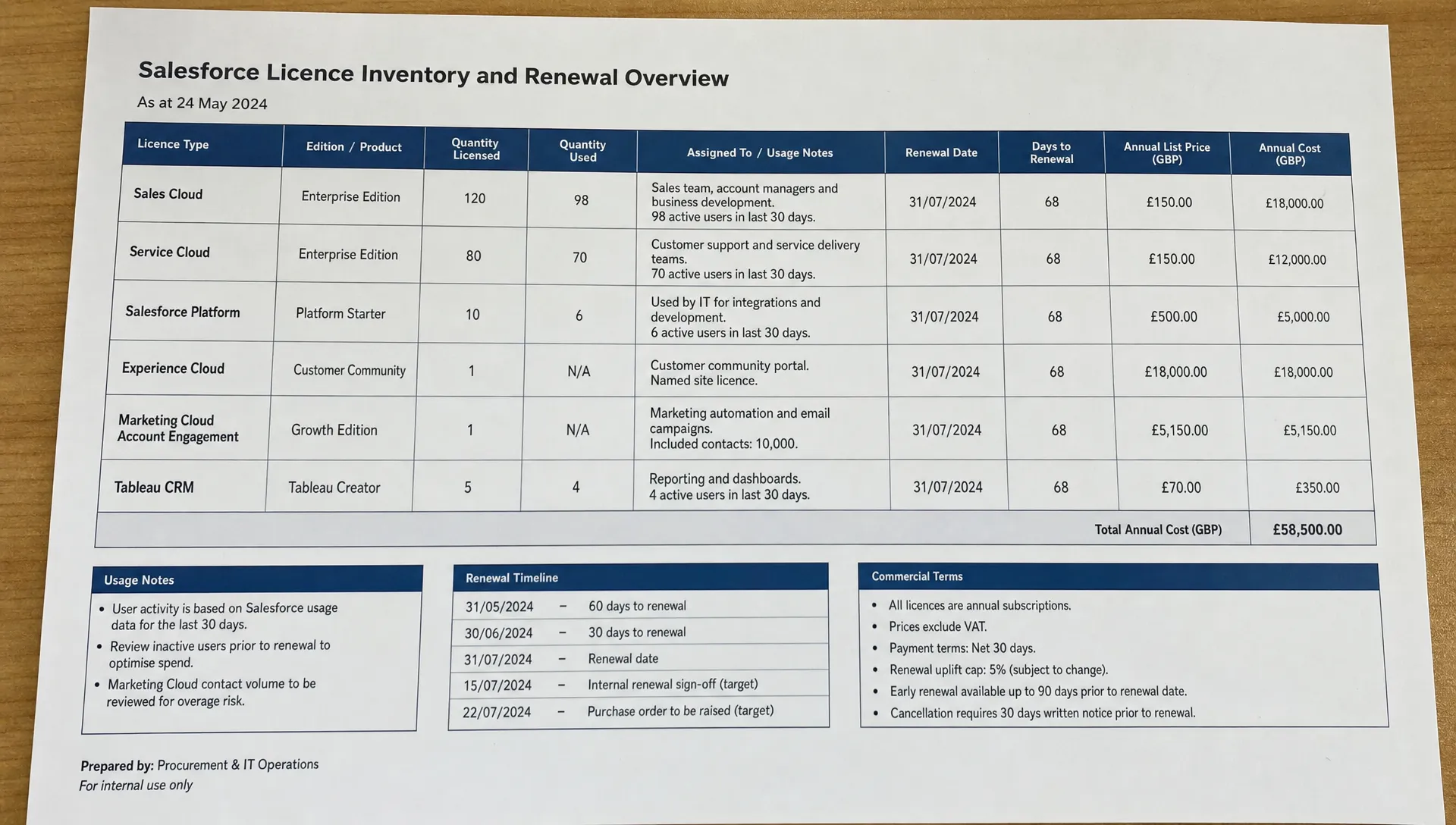
A good Salesforce renewal file should include contract terms, order forms, SKU inventory, assigned users, active users, edition mapping, product owners, roadmap assumptions, implementation status, support needs and known risks. That file should be built months before the renewal date, not during the final commercial round.
How buyers should assess Salesforce as a SaaS platform
The strongest buyers do not start with a discount target. They start with clarity. Discount matters, but only after you understand the estate you are negotiating.
A disciplined review should answer six questions.
| Review area | What to check | Why it matters |
|---|---|---|
| Contract baseline | Current order forms, renewal dates, price protections, uplift clauses and termination rules | Prevents surprises and shows where flexibility exists |
| SKU inventory | Products, editions, add-ons, support plans, sandboxes and usage-based services | Reveals duplication, unnecessary scope and hidden commitments |
| User adoption | Assigned licences compared with active, meaningful users | Identifies shelfware and rightsizing opportunities |
| Business value | Outcomes linked to each major Cloud or product | Separates core infrastructure from nice-to-have spend |
| Roadmap fit | Future needs that are approved, funded and technically realistic | Stops speculative growth from becoming contracted spend |
| Negotiation position | Alternatives, timing, internal alignment and executive sponsorship | Improves leverage before commercial talks begin |
This is where CFO, CIO and procurement roles should meet rather than pass documents between each other. Finance brings cost discipline. IT brings architecture and risk context. Business owners explain value and adoption. Procurement turns that evidence into a negotiation position.
Common misconceptions that weaken Salesforce buying decisions
The first misconception is that SaaS is automatically flexible. It can be, but enterprise Salesforce contracts often contain committed volumes, fixed terms, renewal mechanics and bundled products. Flexibility depends on the negotiated terms, not on the SaaS label.
The second is that unused licences are the main source of waste. They are visible, but not always the largest issue. Over-editioning, unused add-ons, duplicate capabilities, underused premium support, poor data foundations and unfunded roadmap products can matter just as much.
The third is that Salesforce value can be judged only by login counts. Usage is essential, but it is not enough. A small group of users in a critical revenue or service process may justify more spend than a large group of light users. The right question is whether each product supports a process the organisation still values and funds.
The fourth is that a renewal is mainly a procurement event. It is a business decision with procurement discipline. If sales, service, marketing, IT, security and finance are not aligned, the negotiation will expose those gaps.
What this means for CFOs, CIOs and procurement leaders
For CFOs, the SaaS model means Salesforce sits in the recurring cost base. The focus should be on run-rate accuracy, contracted growth, price protections, value by product and the ability to remove unused scope.
For CIOs and IT leads, the concern is control. Salesforce can become a core operating platform with deep integrations and business-critical workflows. That calls for architecture discipline, release management, security governance and a clear view of technical debt.
For procurement leaders, the task is to avoid negotiating in the dark. Salesforce account teams often know which stakeholders want which products, where deadlines sit and what has been discussed informally. Procurement needs a single internal position based on usage, future demand and walk-away options.
When these roles are aligned, the conversation changes. The buyer is no longer asking whether Salesforce is expensive in the abstract. The buyer can say which services are essential, which are underused, which are candidates for removal and which commercial terms need to change.
Frequently Asked Questions
Is Salesforce SaaS or PaaS? Salesforce is SaaS for its core business applications such as Sales Cloud and Service Cloud. It also has platform capabilities that allow customers to configure, automate, integrate and build applications. Buyers should treat it as both a SaaS subscription estate and an enterprise platform decision.
Is Salesforce a cloud platform? Yes. Salesforce is delivered through the cloud and includes a wider platform for CRM, automation, data, analytics, integration and AI-related services. The commercial question is which parts of that platform your organisation actually needs.
Does SaaS make Salesforce cheaper than traditional software? Not automatically. SaaS can reduce infrastructure and upgrade burden, but subscription spend can compound over time. Total cost depends on licence volumes, editions, add-ons, implementation effort, support, integrations and renewal terms.
Why does the SaaS model matter at renewal? SaaS renewals reset the commercial baseline. If usage and value are not reviewed before renewal talks, unused products and inflated assumptions can roll into the next term. Evidence gives the buyer more control.
What should buyers review before renewing Salesforce? Review contracts, SKUs, active usage, product ownership, business value, roadmap needs, pricing protections, uplift clauses and negotiation timing. The earlier this is done, the more useful it becomes.
Conclusion: SaaS changes the commercial discipline
Salesforce is SaaS, but it should not be bought like a simple subscription app. It is often a core business platform with recurring commercial commitments, operational dependencies and multiple stakeholder agendas.
The right response is not to resist the SaaS model. It is to govern it properly. Know what you own, know what is used, know what creates value and know what can be changed before renewal pressure narrows your options.
If you are approaching a renewal or considering a wider Salesforce commitment, SaaSed can help you review contracts, SKUs and usage before talks harden. You can book a complimentary Salesforce audit conversation with us.
Want this kind of intel on your renewal?
Don’t head into your next software negotiation alone
Contact Us