How to Govern Salesforce as Enterprise Software
Salesforce governance is not an admin problem once the platform touches revenue, data and finance. This guide gives CFOs, CIOs and procurement leaders a practical model for owning scope, cost, risk and renewal readiness.
Salesforce rarely stays as “the CRM”. In most enterprise environments, it becomes part of the operating system for revenue, service, marketing, customer data, approvals, reporting and increasingly AI-assisted work.
That changes the governance question.
If Salesforce is treated as a departmental tool, the organisation usually governs it through admin queues, project tickets and renewal panic. If it is treated as enterprise software, the conversation becomes broader: who owns value, who controls scope, who approves spend, who protects the data model and who challenges the contract before the renewal date makes challenge expensive?
Good Salesforce governance is not about slowing teams down. It is about making the right decisions visible early enough that finance, IT, procurement and business leaders can act before cost, risk or complexity hardens into the estate.
What changes when Salesforce becomes enterprise software
At enterprise scale, Salesforce sits across commercial process, identity, data, integration and compliance. A small configuration choice in one business unit can affect reporting quality elsewhere. A harmless-looking add-on can create a new support burden. A bundled commercial proposal can make the renewal feel simpler while hiding shelfware, overlap or usage assumptions that no one has tested.
That is why Salesforce enterprise software needs governance that covers four connected layers:
| Governance layer | Core question | Typical owner |
|---|---|---|
| Business process | What should Salesforce actually do for the organisation? | Revenue, service, marketing and operations leaders |
| Technical architecture | How should Salesforce connect, scale and stay maintainable? | CIO, enterprise architecture, platform lead |
| Commercial control | What are we buying, using, renewing and retiring? | CFO, procurement, IT commercial lead |
| Risk and compliance | What data, access and change risks must be controlled? | Security, legal, data protection, audit |
Most Salesforce problems appear technical only at the surface. The root cause is often a weak decision model. No one is sure who can say no to a new SKU. No one owns the boundary between Salesforce and the data warehouse. No one tracks whether licence allocations still match the operating model.
Governance gives those decisions a home.
Start with ownership, not administration
An admin team can keep Salesforce running, but it cannot govern enterprise trade-offs alone. It should not be asked to.
The first governance move is to separate platform ownership from queue management. Platform ownership means deciding how Salesforce should serve the enterprise, which capabilities belong inside it, how change is prioritised and how commercial decisions are prepared. Administration is the day-to-day work of maintaining users, fields, flows, permissions and support requests.
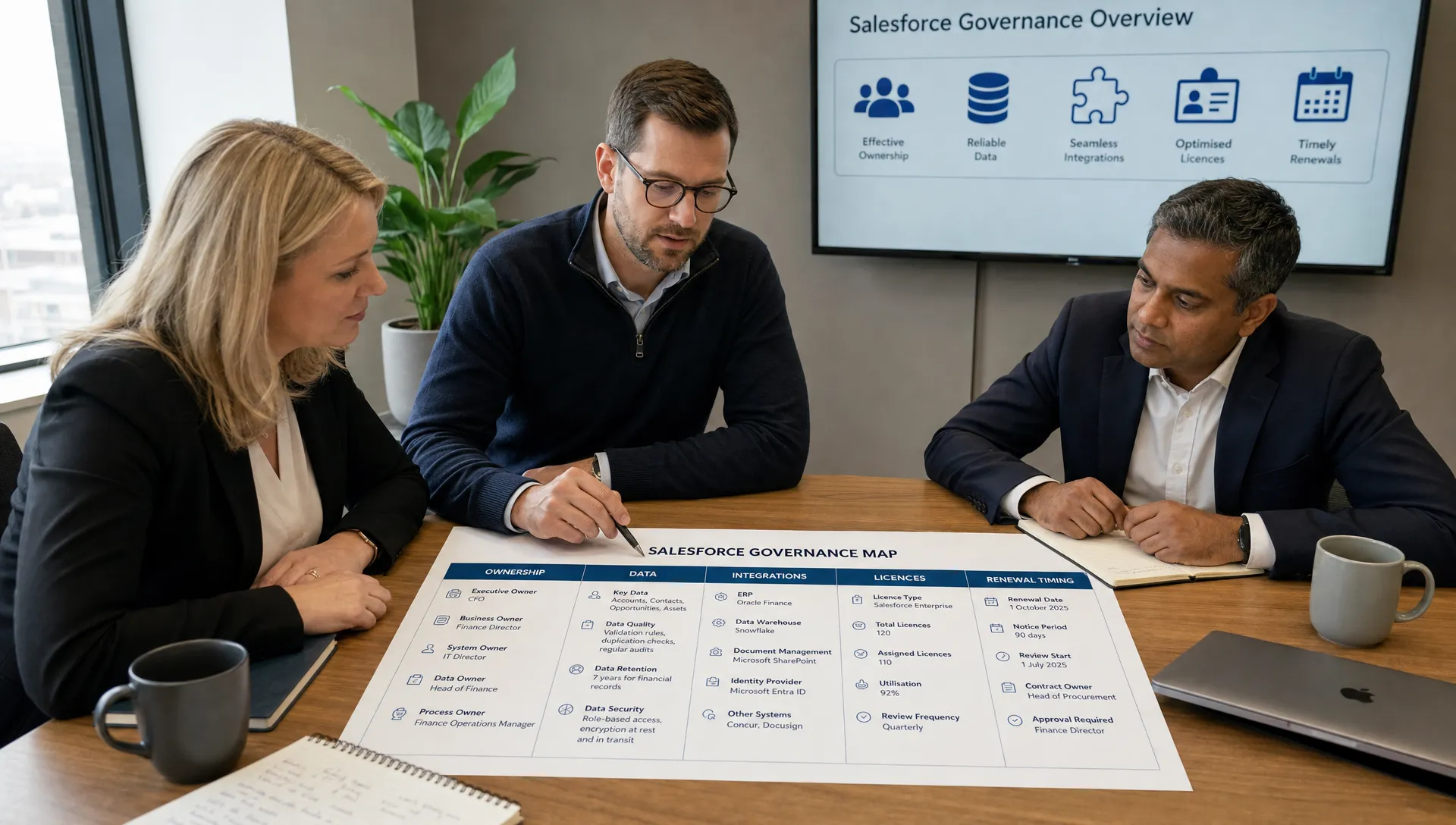
A practical ownership model usually includes:
| Role | What this role should decide | What this role should not carry alone |
|---|---|---|
| Executive sponsor | Direction, investment tolerance and escalation | Detailed SKU choices or configuration debates |
| Salesforce platform owner | Roadmap, prioritisation, governance cadence and change intake | Full financial accountability without procurement support |
| Business product owners | Process value, adoption and requirements quality | Technical architecture decisions |
| Enterprise architecture | Integration patterns, data boundaries and technical standards | Business case ownership |
| Procurement and finance | Commercial challenge, renewal strategy and value tracking | Operational adoption problems |
| Security and data teams | Access, retention, compliance and risk controls | Fixing poor process design |
This is also where many organisations discover a quiet gap. Salesforce is too important for one department to own informally, but not quite formalised enough to sit in the enterprise governance rhythm. Closing that gap early prevents a long list of expensive small decisions.
If your organisation is still forming its enterprise view, SaaSed has also covered the buying foundations in what to know before you get Salesforce at enterprise scale. Governance is easier when the original scope, value case and licence baseline were built with discipline.
Define what Salesforce is and what it is not
A healthy Salesforce estate has boundaries. Without them, every adjacent problem becomes a Salesforce problem: master data, forecasting, service knowledge, marketing consent, workflow, analytics, partner portals, AI, document generation and sometimes even finance process.
Some of those capabilities may belong in Salesforce. Some may not. The point is not to keep the platform small for its own sake. The point is to stop accidental sprawl.
CFOs and CIOs should ask a simple set of questions before approving major Salesforce expansion:
| Question | Why it matters |
|---|---|
| Is Salesforce the system of record, the system of engagement or both for this process? | Confusion here creates duplicate data and reporting disputes. |
| What existing platform or contract does this overlap with? | Overlap is one of the easiest ways to overspend on enterprise software. |
| Which users will use this capability every week? | Weak usage assumptions become shelfware after the first quarter. |
| What integration or data quality work is required? | Licence cost is rarely the full cost of adoption. |
| What will be retired if this is approved? | New spend should usually remove old complexity, not sit beside it. |
This boundary-setting matters even more for global organisations, regulated sectors and groups operating across multiple data jurisdictions. In some markets, Salesforce may be one part of a wider architecture where sovereignty, data residency and open source alternatives also deserve attention. For example, African organisations reviewing their digital architecture may look at digital sovereignty and data engineering partners alongside their CRM strategy, especially where data governance, analytics and infrastructure independence are board-level concerns.
The best Salesforce governance models do not assume Salesforce must absorb every problem. They ask whether Salesforce is the right place for the work.
Build commercial governance into the operating model
Many enterprises only examine Salesforce commercially in the months before renewal. By then, the account team has a proposal, internal stakeholders have wish lists and the business has often normalised spend that was never properly challenged.
Commercial governance should run throughout the contract term. It does not need to be heavy, but it does need to be regular.
At minimum, procurement and IT should maintain a live view of:
- Current products, editions, add-ons and contracted quantities
- Licence allocation versus active usage
- Users with low or no activity
- Products bought for projects that did not launch or did not scale
- Contractual deadlines, notice periods and renewal mechanics
- Future demand that is real, funded and tied to named programmes
This is where Salesforce enterprise software differs from smaller SaaS tools. The commercial estate is not just a list of seats. It may include multiple clouds, platform licences, sandboxes, add-ons, storage, support plans, consumption components and product-specific terms. If no one maintains the commercial map, renewal discussions start from Salesforce's view of the estate rather than the customer's.
For a deeper commercial lens, the argument in a smarter Salesforce strategy starts with commercial clarity is blunt but useful: you cannot negotiate well if you do not know what you own, use, need and can change.
Govern architecture before customisation becomes debt
Salesforce is flexible. That is part of its value. It is also why poorly governed estates become hard to change.
Architecture governance should cover more than code review. It should define how the organisation makes decisions about objects, automation, integrations, data flows, identity, environments and release practices. Salesforce's own Well-Architected guidance is a useful reference point for teams that want a common language around trusted, easy and adaptable design.
In practical terms, an enterprise governance board should be able to answer these questions without starting a discovery exercise every time:
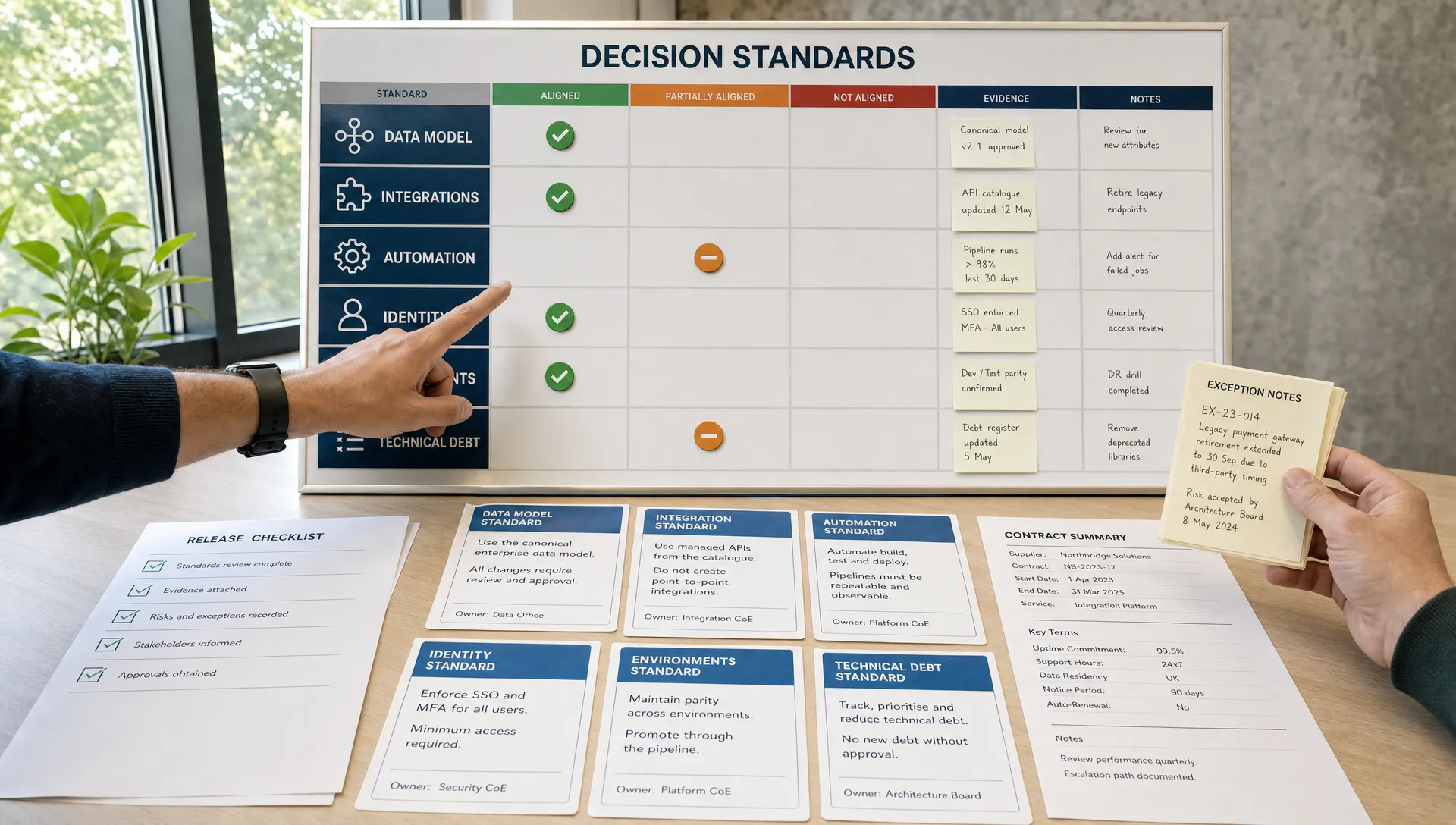
| Area | Governance question | Risk if ignored |
|---|---|---|
| Data model | Who can create new objects, fields and record types? | Reporting fragmentation and duplicate process logic |
| Integrations | Which systems can write to Salesforce and under what rules? | Data conflicts, brittle APIs and security gaps |
| Automation | When should teams use Flow, Apex or external workflow tools? | Hidden logic, poor performance and hard-to-debug processes |
| Identity and access | How are roles, profiles, permission sets and privileged users reviewed? | Excess access and audit exposure |
| Environments | How are sandboxes, testing and deployment paths controlled? | Release instability and production defects |
| Technical debt | How is unused configuration identified and removed? | Rising change cost and slower delivery |
Architecture standards should be firm enough to prevent avoidable mess, but not so theoretical that delivery teams work around them. The strongest models combine a clear standard with a fast route for exceptions. If every exception takes weeks, the exception process becomes the real architecture.
Treat change control as a business discipline
Salesforce change is often framed as technical release management. That is only half the issue. Every Salesforce change also reflects a business decision: a process is being altered, data is being captured differently, a team is being asked to work in a new way or a report is being given more authority.
For that reason, change control should include business impact, not just deployment risk.
A sensible Salesforce change model distinguishes between:
- Small administrative changes that can move quickly with light approval
- Process changes that need product owner sign-off and user communication
- Data model or integration changes that need architecture review
- Commercially relevant changes that may affect licence demand, support needs or contract scope
- Regulated or sensitive changes that need security, legal or compliance input
This avoids two bad extremes. One is chaos, where every team makes changes locally and the estate becomes inconsistent. The other is bureaucracy, where even minor changes need a committee. Neither serves the business.
The aim is proportionate control. The bigger the impact, the more visible the decision.
Make support part of governance, not an afterthought
Support models shape governance more than many leaders expect. If the organisation relies entirely on a small internal admin team, governance may become reactive because that team is buried in tickets. If it outsources too much to a system integrator, internal ownership may weaken. If every business unit has its own Salesforce resource, standards may drift.
There is no single correct model. Large organisations often need a blend: an internal platform owner, business product owners, specialist admin and developer capability, architecture oversight, external expertise where it is genuinely needed and clear escalation paths for incidents or major design choices.
The key is to decide what must remain owned internally. In most enterprises, that includes the roadmap, commercial priorities, data boundaries, architecture principles and vendor strategy. Delivery can be supported externally. Accountability should not be outsourced by accident.
SaaSed's comparison of SFDC support models for enterprise teams is useful if your current model has grown organically and no longer fits the size of the estate.
Bring AI and consumption into the same governance frame
Salesforce is no longer only a seat-based conversation. AI capabilities, automation and consumption-based services can change the risk profile of the estate. Governance has to adapt.
This does not mean every AI feature needs a board paper. It does mean leaders should avoid treating new capabilities as harmless add-ons. Before adoption, teams should understand the data being used, the permission model, the expected consumption pattern, the operational owner and the commercial exposure if usage scales faster than expected.
The same principle applies to any consumption or usage-sensitive model. Forecasting should sit with the business, IT and finance together. If only one group owns the estimate, it will usually miss something: adoption behaviour, technical constraints or commercial consequence.
Use metrics that expose value and friction
Governance becomes vague when it has no measures. The right metrics should show whether Salesforce is supporting the business, becoming harder to manage or drifting commercially.
A compact scorecard is usually better than a large dashboard that no one reads.
| Metric | What it reveals | Review cadence |
|---|---|---|
| Active usage by licence type | Whether paid access matches real behaviour | Monthly or quarterly |
| Adoption by critical process | Whether teams are using Salesforce for the work that justified the spend | Quarterly |
| Open technical debt items | Whether configuration complexity is being managed | Quarterly |
| Integration failures or manual workarounds | Whether architecture is supporting operations | Monthly |
| Release success and rollback rate | Whether change control is mature enough | Monthly |
| Shelfware value estimate | Whether licences or products are materially underused | Quarterly |
| Renewal readiness status | Whether the organisation is commercially prepared | From 12 months pre-renewal |
The scorecard should be shared across finance, IT, procurement and relevant business owners. Salesforce governance weakens when each function keeps its own partial truth.
Set a renewal governance calendar
A Salesforce renewal should not be treated as a procurement event that begins when the quote arrives. By that point, leverage is often reduced.
For enterprise agreements, renewal governance should begin 9 to 12 months before the renewal date, sometimes earlier for complex estates. The work is straightforward, but it takes time: validate usage, identify shelfware, test future demand, review contract terms, challenge bundles, align stakeholders and decide what the organisation is prepared to trade.
A practical renewal calendar looks like this:
| Timing | Governance activity |
|---|---|
| 12 months before renewal | Confirm contract dates, owners, renewal mechanics and decision timeline |
| 9 months before renewal | Run usage, SKU and shelfware review across the estate |
| 6 months before renewal | Align business demand, roadmap priorities and retirement opportunities |
| 4 months before renewal | Build negotiation position, fallback options and approval path |
| 2 months before renewal | Pressure-test final proposal against usage, terms and future demand |
| Post-renewal | Record concessions, obligations, assumptions and next review date |
The post-renewal step is often missed. It matters because the next renewal starts the day the current one is signed. If concessions, assumptions and commitments are not recorded, they are hard to defend later.
Common governance mistakes to avoid
The most expensive Salesforce governance failures are usually ordinary. They rarely arrive as dramatic incidents. They build quietly through weak ownership, over-permissive buying and unchecked complexity.
| Mistake | What it looks like | Better discipline |
|---|---|---|
| Governing only through IT tickets | The platform team fulfils requests without challenging business value | Use product ownership and prioritisation forums |
| Reviewing licences only at renewal | Shelfware is discovered when time is short | Review usage quarterly |
| Letting bundles hide decisions | Products are accepted because the discount looks attractive | Evaluate each SKU against adoption and roadmap evidence |
| Treating all clouds the same | One governance model is applied to Sales, Service, Marketing and platform capabilities | Govern by product role, data sensitivity and user population |
| Ignoring retirement | New functionality is added but old tools and fields remain | Make decommissioning part of every business case |
| Outsourcing accountability | External partners make design choices without enough internal ownership | Keep architecture, roadmap and commercial decisions inside the enterprise |
None of these mistakes means Salesforce is the wrong platform. They mean the operating model has not caught up with the scale of the estate.
A simple governance model that works
For most enterprise teams, Salesforce governance does not need to become a large bureaucracy. A lean model with clear forums is enough.
A workable structure includes three rhythms.
First, a monthly platform forum led by the Salesforce platform owner, with IT, business product owners and architecture present. This forum prioritises change, reviews technical debt, resolves design questions and tracks adoption issues.
Second, a quarterly commercial review led by procurement or IT commercial management, with finance and the platform owner involved. This review covers licence usage, shelfware, new demand, contract risks and renewal preparation.
Third, an executive steering point, usually quarterly or tied to major investment decisions. This group should not debate field names or sprint tickets. It should decide scope, funding, risk appetite and trade-offs between business units.
That is enough structure for most organisations. The discipline lies in keeping the forums connected. Architecture choices affect cost. Commercial choices affect support. Business priorities affect data quality. Salesforce governance works when those links are visible.
Frequently Asked Questions
Who should own Salesforce governance in an enterprise? Salesforce governance should usually be shared. A platform owner should run the operating model, but finance, procurement, IT architecture, security and business product owners all need defined decision rights. The CFO or CIO may sponsor the model, depending on how Salesforce is used and funded.
How often should Salesforce licences be reviewed? Enterprise organisations should review Salesforce licence usage at least quarterly, with a deeper review 9 to 12 months before renewal. Waiting until the renewal quote arrives usually leaves too little time to challenge shelfware, bundles or future demand assumptions.
Is Salesforce governance mainly an IT responsibility? No. IT plays a central role, especially in architecture, security and release management, but Salesforce governance also covers commercial control, business process ownership, adoption and contractual risk. Treating it as only an IT issue is one reason estates become expensive and hard to change.
What is the biggest governance risk with Salesforce enterprise software? The biggest risk is fragmented decision-making. If business teams request, IT configures, procurement renews and finance approves spend without a shared view of usage and value, the organisation loses control of both cost and complexity.
When should renewal preparation begin? For a material Salesforce estate, start 9 to 12 months before renewal. Complex multi-cloud estates, SELA-style agreements or major transformation programmes may need an even longer runway because usage validation and stakeholder alignment take time.
Govern the estate before the renewal governs you
Salesforce can be a strong enterprise platform, but it needs adult supervision: clear ownership, visible trade-offs, commercial discipline and architecture choices that can survive growth.
The practical test is simple. If your leadership team can explain what you own, what you use, what you no longer need, what must change and what you will challenge at renewal, governance is doing its job. If those answers are scattered across teams, spreadsheets and assumptions, the next renewal will be harder than it needs to be.
SaaSed helps organisations review Salesforce contracts, SKUs, usage and renewal readiness before commercial pressure builds. If you want a clear external view of where leverage, waste or risk may be hiding, book a complimentary Salesforce audit conversation.
Want this kind of intel on your renewal?
Don’t head into your next software negotiation alone
Contact Us