SFDC Support Models Compared for Enterprise Teams
Most enterprises do not need one SFDC support answer. They need a model that separates platform resilience, backlog delivery, user help, commercial evidence and renewal leverage before costs harden.
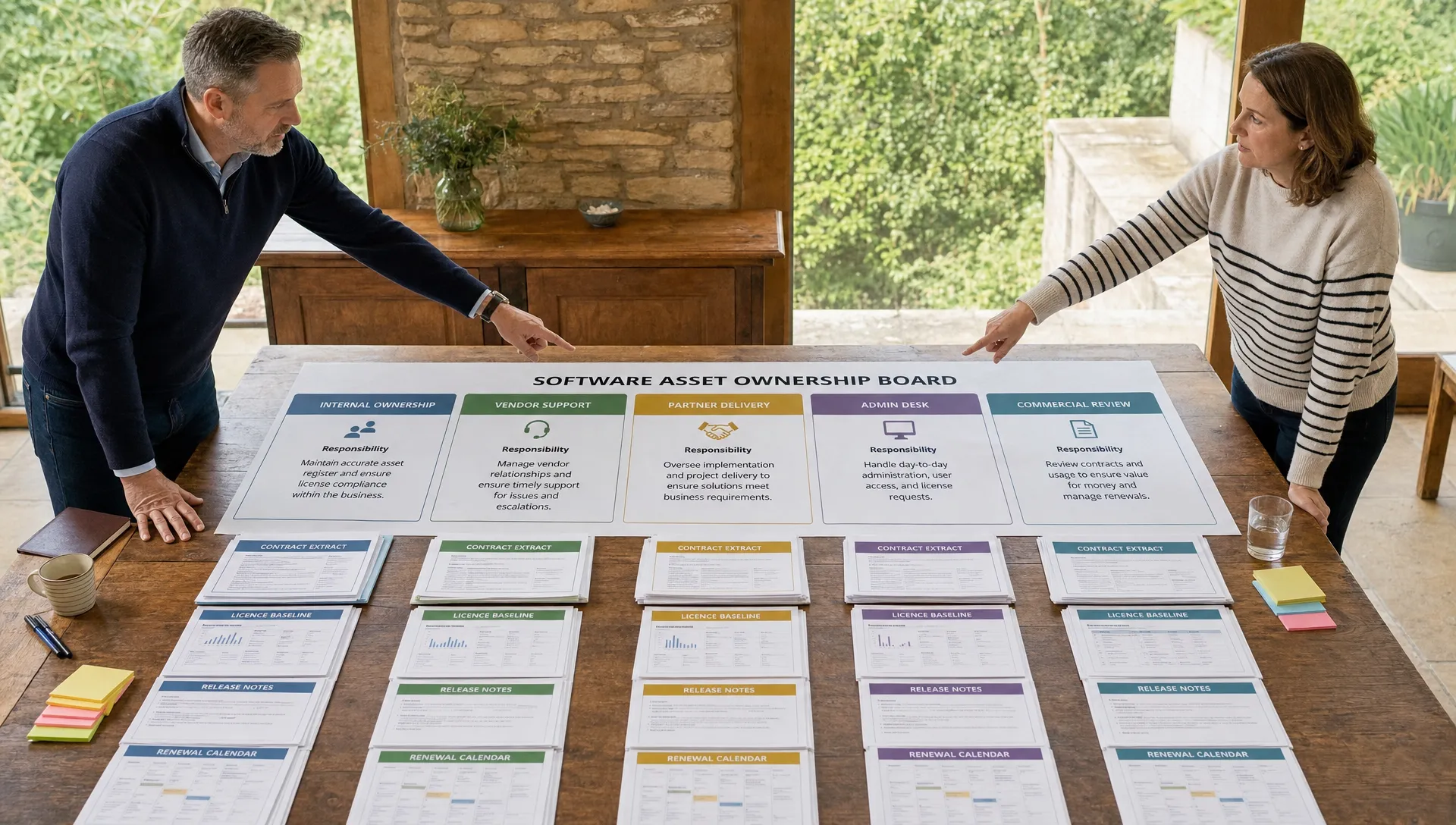
SFDC support is often treated as a service desk decision. For enterprise teams, that is too narrow.
The right support model affects uptime, delivery speed, adoption, architecture quality and renewal leverage. It also affects how much evidence you have when Salesforce asks for a broader commitment, a multi-year term or additional SKUs.
Most large organisations need more than one form of Salesforce support. The question is not whether to use Salesforce, an internal team, a partner or a commercial adviser. The question is which responsibilities should sit where, and how those responsibilities should change before renewal.
What enterprise teams usually mean by SFDC support
SFDC support can mean at least five different things inside the same organisation.
It can mean break-fix help when users cannot log in, automations fail or integrations stop behaving. It can mean admin work, such as permission changes, report requests, user management and minor configuration. It can mean development capacity for backlog items. It can mean architectural governance across Sales Cloud, Service Cloud, Marketing Cloud, Data Cloud, CPQ or custom integrations. It can also mean commercial support, where someone turns usage, contract terms and roadmap reality into a stronger negotiating position.
Those are not interchangeable tasks. A team that is excellent at triaging incidents may not be the right team to challenge SKU sprawl. A strong implementation partner may not be set up to produce renewal evidence. A Salesforce plan may help with platform issues, but it will not automatically tell you whether you should keep paying for licences that the business has stopped using.
That distinction matters because enterprise Salesforce estates tend to become layered over time. New clouds are added. Acquisitions bring different orgs. Admin workarounds become permanent. Reporting requests multiply. Licences sit with people who have changed role or left. By the time renewal is close, the support conversation has quietly become a commercial conversation.
The main SFDC support models compared
There is no universal best model. Each has a sensible place. Problems start when one model is asked to do work it was never designed to do.
| SFDC support model | Best suited for | Weak spot | Commercial implication |
|---|---|---|---|
| Internal centre of excellence | Strategic ownership, governance and business context | Can become overloaded with tickets and admin | Strongest if it keeps clean usage and value evidence |
| Salesforce Success Plan | Vendor-side product support and access to Salesforce resources | Does not replace internal ownership or independent commercial review | Useful, but should be reviewed against actual need and entitlement |
| System integrator or managed services partner | Configuration, development, backlog delivery and specialist skills | May optimise for delivery volume rather than estate simplification | Scope and incentives need tight control |
| Admin support or offshore desk | Routine user support, low-risk changes and queue management | Limited strategic or architectural authority | Can reduce cost if governance is strong elsewhere |
| Independent commercial and procurement support | Renewal readiness, SKU review, negotiation strategy and leverage | Not a substitute for operational platform support | Helps convert support evidence into commercial outcomes |
| Hybrid model | Complex enterprise estates with multiple clouds and stakeholders | Requires clear ownership and decision rights | Often the most resilient when renewal risk is material |
Model 1: Internal Salesforce centre of excellence
An internal centre of excellence is usually the strongest anchor for enterprise SFDC support. It understands the business, the political reality, the reporting needs and the compromises made during previous deployments.
The best internal teams do not just close tickets. They own standards. They decide what can be configured locally and what needs central design. They maintain the operating model for releases, environments, data quality, permissions and integrations. They also challenge business requests when another field, workflow or licence will add cost without much value.
The risk is capacity. Internal teams are easily dragged into day-to-day noise. Once that happens, architecture, adoption and commercial evidence suffer. Support becomes reactive, and reactive teams rarely enter a renewal with a clean view of what is used, what is valuable and what can be removed.
For CFOs and CIOs, the question is whether the internal team has enough time to govern the estate, not just maintain it. If every capable person is buried in minor requests, the organisation may be paying a hidden tax in poor renewal leverage.
Model 2: Salesforce Success Plans
Salesforce offers different levels of vendor support through its own Success Plans. These can be relevant for enterprise teams that need access to Salesforce resources, product guidance and support routes. The exact entitlements, response targets and inclusions depend on the plan and contract, so buyers should always check the current Salesforce position directly through Salesforce Success Plans before making assumptions.
The value of this model is proximity to the vendor. If the issue relates to product behaviour, platform limits or official guidance, Salesforce support can be important. It can also be helpful when internal teams need a route into Salesforce expertise rather than relying only on partner interpretation.
The limitation is independence. Salesforce support is not designed to act as your commercial counterweight. It will not normally tell you that your estate is over-licensed, that a bundle is misaligned with adoption or that the next renewal proposal should be challenged based on inactive users, duplicate capability or low-value add-ons.
This does not make Salesforce support unhelpful. It means its role should be defined accurately. Use it for the things only the vendor can do. Do not mistake it for a complete support strategy.
Model 3: System integrator or managed services partner
A system integrator or managed services partner can be valuable when the estate needs sustained technical capacity. This might include configuration, development, release management, integration support, Marketing Cloud work, CPQ changes or specialist cloud expertise.
The model works best when scope is explicit. Is the partner expected to run the backlog, support users, improve architecture, document the estate, reduce licence waste or prepare renewal evidence? Those are different jobs. If the scope says support but the business expects transformation, disappointment is almost guaranteed.
Partners also need commercial guardrails. A partner paid for delivery hours has a natural incentive to keep delivering. That is not wrong, but it is not the same as reducing complexity. Enterprise teams should ask how the partner will simplify the estate, retire redundant components and improve admin efficiency, not just how fast they can build.
If you are comparing partner options, SaaSed has a useful companion piece on how to choose the right partner for Salesforce support. The key point for this article is simple: partner capability is only one part of the decision. Incentive design matters just as much.
Model 4: Admin support or offshore service desk
For some organisations, a lean admin or offshore service desk is a sensible layer of SFDC support. It can handle password issues, basic access changes, list view help, simple reports, user questions and low-risk configuration requests.
This model can reduce the load on senior internal staff. It can also make user support more consistent if requests are well categorised and the knowledge base is maintained.
The risk is escalation quality. Salesforce estates are full of small changes that look harmless but accumulate into fragility. A field added without a data model view, a permission change made without role context or a workflow adjusted without downstream testing can create slow damage.
This model needs clear boundaries. Routine work can sit with a service desk. Design decisions, security changes, data model changes, integration work and commercially meaningful licence questions should not.
Model 5: Independent commercial and procurement support
Commercial support is often left too late. By the time procurement enters the room, the business may already have accepted the roadmap, the account team may have framed the renewal and the internal team may be too busy to produce clean usage evidence.
Independent commercial support sits in a different lane from technical support. It looks at the contract, the SKU mix, adoption evidence, shelfware, renewal timing, co-terming, discount structure, expansion history and commercial risks. It asks whether the support model is producing the evidence needed to negotiate well.
For enterprise buyers, this is where support and procurement meet. A support desk may know that a group of users rarely logs in. An admin may know a feature was never fully adopted. A business owner may know a cloud was bought for a project that lost sponsorship. Unless someone turns those fragments into a renewal case, they do not create leverage.
This is one reason to build the support strategy before renewal rather than during it. SaaSed has covered the timing and evidence side in more detail in how to build a support strategy before Salesforce renewal.
Model 6: Hybrid support for large Salesforce estates
Most enterprise teams end up needing a hybrid model. That is not a compromise. It is often the most disciplined structure.
A sensible hybrid model might keep product ownership and architecture inside the business, use Salesforce support for vendor-specific issues, rely on a partner for defined delivery capacity, route routine admin to a lower-cost desk and bring in independent commercial support ahead of renewal.
The important part is not the number of parties. It is the clarity of decision rights. Someone must own the estate. Someone must decide whether change requests are worth doing. Someone must maintain the evidence base. Someone must say no when a new SKU solves a problem that better governance would have solved for less.
Without that clarity, hybrid support becomes a queue of suppliers. With it, the model can be both resilient and commercially sharp.
The boundary problem: Salesforce rarely sits alone
Enterprise SFDC support has become harder because Salesforce increasingly touches adjacent platforms. Marketing teams may rely on Salesforce journeys, but the content supply chain may sit in a DAM, PIM, creative workflow tool or AI production layer. Service teams may depend on telephony, knowledge systems and data platforms. Sales teams may rely on enrichment, quoting, finance systems and partner portals.
This means support ownership has to follow the business process, not just the application boundary. If a campaign fails because content approvals were delayed upstream, Salesforce may only be the visible symptom. If a service agent sees incomplete customer history, the problem may sit in integration, identity, data governance or process design.
The same issue is now appearing in AI-led operating models. For example, a marketing organisation running AI-assisted creative and campaign tooling may need Salesforce support to understand where campaign orchestration, approvals, assets and compliance controls sit outside Salesforce but still affect Salesforce outcomes.
Support models that ignore these dependencies misclassify incidents. They also make renewal discussions weaker because the organisation cannot separate Salesforce value from the value of surrounding systems.
How to choose the right model
Before comparing suppliers or support tiers, enterprise teams should answer a few plain questions.
- What must never fail, and who owns those processes end to end?
- Which Salesforce clouds and SKUs are business-critical, and which are merely present?
- What work is strategic enough to keep internal?
- What work is repetitive enough to standardise or outsource?
- Which teams can produce reliable usage and adoption evidence before renewal?
- Where do incentives conflict with cost reduction or simplification?
The answers usually reveal the model. A heavily customised, multi-cloud estate with CPQ, Service Cloud, integrations and strict release windows needs more than a light admin desk. A stable Sales Cloud deployment with limited change volume may not need an expensive managed services layer. A company approaching a large renewal may need commercial support even if operational support is running well.
The timing also matters. If renewal is more than twelve months away, the focus should be on evidence, governance and clean operating rhythm. If renewal is six months away, the priority shifts to SKU review, usage analysis and commercial options. If renewal is already in flight, the support model still matters, but the room for structural change is smaller.
What each stakeholder should look for
Different leaders will naturally judge SFDC support through different lenses. That is healthy, provided the organisation reconciles those views before signing anything.
| Stakeholder | Primary concern | What to test in the support model |
|---|---|---|
| CFO | Cost control, renewal exposure and measurable value | Can the model identify waste and defend the renewal position with evidence? |
| CIO | Resilience, architecture, security and delivery quality | Are decision rights clear enough to prevent unmanaged complexity? |
| IT lead | Queue health, release discipline and user satisfaction | Does the model reduce noise without losing technical control? |
| Procurement leader | Leverage, timing, contract options and supplier accountability | Does support create usable data before negotiation starts? |
| Business owner | Adoption, speed and fit for process | Are requests prioritised by value rather than volume? |
A good model will not satisfy every wish. It will force the right trade offs into the open. Cheap support with weak governance can become expensive later. Premium support without usage discipline can feel safe while waste grows quietly. A strong partner with unclear scope can become the default answer to every problem.
Red flags in enterprise SFDC support models
Some warning signs appear early if you know where to look.
A support provider cannot explain how it will reduce demand over time. The internal team cannot produce a reliable list of active users by licence type. Business owners keep asking for new functionality while existing features remain underused. Salesforce renewal planning begins before support evidence has been gathered. No one can say who owns integration failures across platforms. Partner reports focus on ticket closure but not root cause reduction.
None of these means the Salesforce estate is failing. They mean the support model is not giving leadership the information it needs.
If your support reporting only answers what happened last month, it is incomplete. Enterprise support should also answer what is becoming more complex, what can be simplified, what the business no longer uses and what should be challenged commercially.
A practical target model
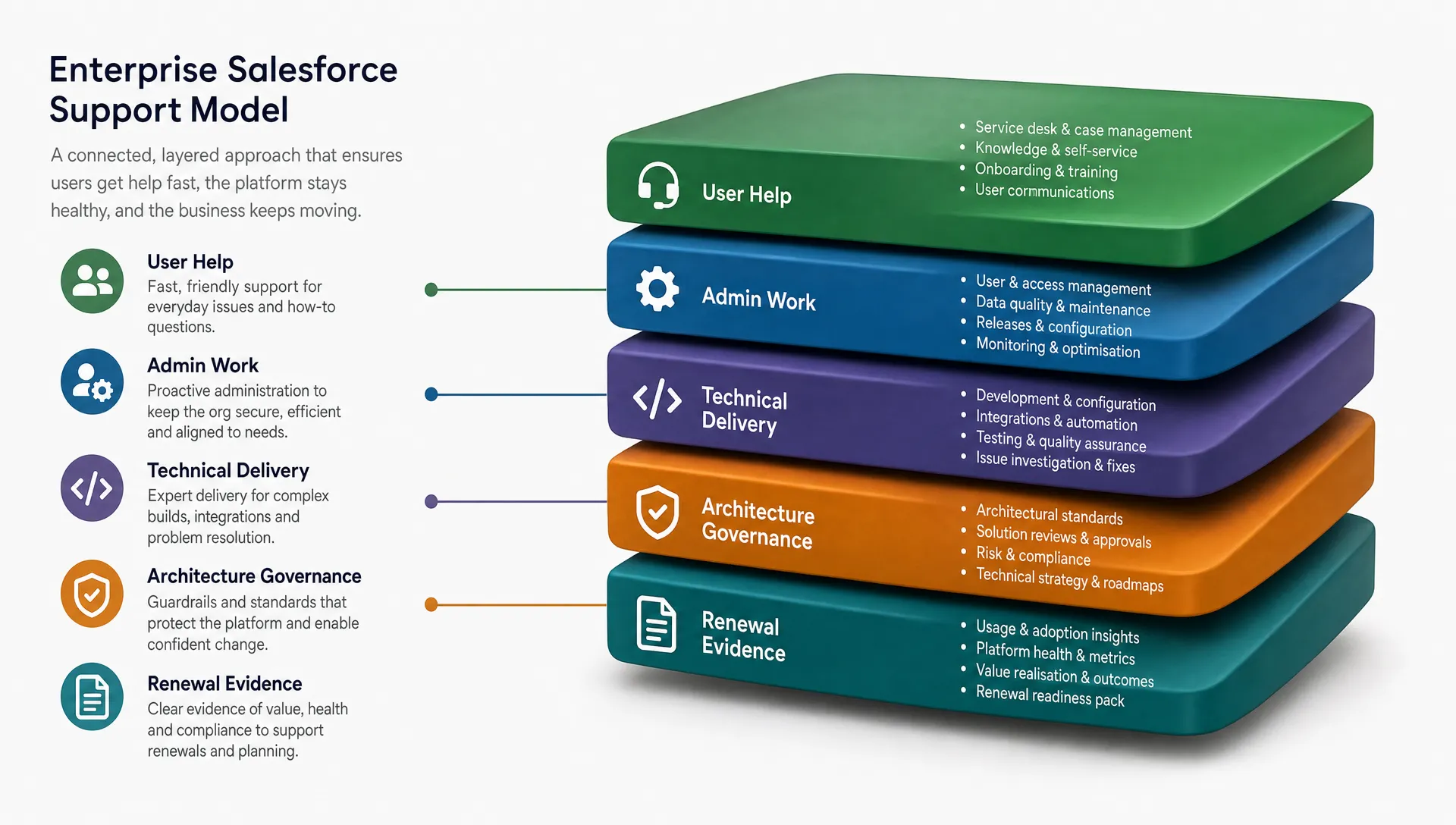
For many enterprise teams, a strong SFDC support model has five layers.
First, internal ownership for product direction, architecture and prioritisation. Second, vendor support for Salesforce-specific product issues and entitlements. Third, a partner or managed service for defined technical delivery. Fourth, a user and admin support layer for repeatable work. Fifth, commercial support before renewal to test whether the estate and contract still match reality.
This is not about adding more suppliers. In some cases, it means fewer. The point is to stop pretending that one team can do every kind of support equally well.
The best models are boring in the right way. Issues have owners. Changes have standards. Licence decisions have evidence. Renewals do not depend on anecdotes. That level of discipline is rarely glamorous, but it is usually where the savings and risk reduction come from.
Frequently Asked Questions
What is SFDC support? SFDC support is the operating model used to maintain, improve and govern Salesforce. It can include user help, admin work, technical delivery, vendor support, architecture oversight and renewal evidence.
Is Salesforce Success Plan support enough for an enterprise team? It can be an important layer, especially for vendor-specific product issues, but it should not be treated as the whole support model. Enterprise teams still need internal ownership, governance and independent commercial review.
When should procurement get involved in SFDC support decisions? Procurement should be involved well before renewal, ideally when the support model is being defined. Support activity produces the usage and value evidence that shapes renewal leverage.
Should we outsource Salesforce support? Outsourcing can work well for routine admin, delivery capacity or specialist skills. Strategic ownership, architecture decisions and commercial judgement should remain clearly controlled by the organisation.
How does SFDC support affect renewal cost? Support determines whether the organisation can prove what is used, what is valuable and what can be reduced. Without that evidence, renewal negotiations tend to rely on vendor framing and internal opinion.
Before you choose, make the support model visible
The cleanest SFDC support model is the one your leadership team can explain without a diagram. Who owns the estate? Who handles routine work? Who challenges complexity? Who gathers renewal evidence? Who has permission to say no?
If those answers are unclear, the next renewal will expose the gaps.
SaaSed helps enterprise teams review Salesforce contracts, SKUs, usage and renewal readiness before commercial decisions harden. If you want a second pair of eyes on your support model and renewal position, you can book a complimentary Salesforce audit conversation.
Want this kind of intel on your renewal?
Don’t head into your next software negotiation alone
Contact Us