How to Choose the Right Partner for Salesforce Support
Choosing a Salesforce support partner is not just an IT decision. This guide shows how CFOs, CIOs and procurement teams can assess fit, control scope and avoid renewal surprises.

Choosing a partner for Salesforce support is not a small operational decision. It affects admin speed, user experience, roadmap discipline, data quality, integration reliability and, very often, your next renewal negotiation.
For CFOs, CIOs, IT leads and procurement teams, the question is rarely, "Can this partner configure Salesforce?" Many can. The better question is, "Will this partner help us run Salesforce in a way that is technically sound, commercially sensible and honest about what we actually need?"
A good Salesforce support partner should reduce noise. They should help your team make clearer decisions, not create a dependency that is hard to inspect. This guide gives you a practical way to choose one.
Start by defining what "Salesforce support" means for you
Salesforce support can mean very different things depending on the organisation. One company may need administrator cover for day-to-day changes. Another may need managed releases, integration monitoring, security reviews, architecture guidance or help reducing a backlog built up over years.
Before speaking to partners, write down the support problem in plain terms. Do not start with a package name or a retainer model. Start with the work.
Common support needs include:
- User administration, permissions and access control
- Configuration changes, flows, reports and dashboards
- Integration support and incident handling
- Data quality management and duplicate clean-up
- Release planning and sandbox governance
- Support for Sales Cloud, Service Cloud, Marketing Cloud or other Salesforce products
- Technical debt reduction after a rushed implementation
- Advice on licence use, SKU fit and renewal planning
This early definition matters because partners tend to sell around their delivery model. If you are not clear on your needs, you can easily buy more support than you require, or the wrong kind of support altogether.
It is similar to buying any specialist operational service. A manufacturer sourcing custom cardboard packaging would not begin with a generic supplier list. It would first define sizes, materials, print requirements, volume, handling constraints and sustainability needs. Salesforce support deserves the same discipline. Define the job before you choose the supplier.
Know the type of partner you are actually looking for
There are several kinds of Salesforce partner, and the label alone does not tell you enough. A large implementation partner may be excellent for a global transformation but too expensive or too slow for weekly support. A small specialist may be brilliant in one Salesforce cloud but weak on integrations or governance.
Salesforce's own consulting partner marketplace can be a useful starting point for finding certified firms, but it should not replace your own selection process. Certification, customer logos and sector pages are signals. They are not proof of fit.
Most organisations are choosing between four broad support models.
| Support model | Best suited for | Watch carefully for |
|---|---|---|
| Freelancer or independent consultant | Targeted admin help, small backlog items, tactical fixes | Availability risk, limited cover during leave, narrow skill range |
| Boutique Salesforce partner | Specialist support, faster access, close working relationship | Capacity constraints, dependency on a few senior people |
| Large consulting partner | Multi-cloud programmes, complex integrations, global governance | Higher cost base, slower mobilisation, more layered delivery |
| Managed service provider | Ongoing ticket handling, release support, defined service levels | Rigid scope, variable seniority, weak commercial challenge |
None of these models is inherently better. The right choice depends on your Salesforce estate, risk profile, internal capability and renewal calendar.
Separate technical ability from commercial judgement
A partner may be technically strong and still give poor commercial advice. That distinction matters.
Many Salesforce support partners are rewarded for delivery hours, project scope or additional implementation work. That does not make them bad partners. It does mean their incentives may not always align with licence reduction, simplification or saying, "You do not need to buy that yet."
Commercial judgement shows up in small behaviours. Does the partner ask what you already own before suggesting new products? Do they challenge unused licences? Do they understand which changes could increase edition, add-on or storage requirements? Can they explain the licence impact of a request before the work is approved?
A support partner should help you avoid accidental spend. For example, a seemingly simple request for more automation, external access, AI capability or data storage may have contract implications. The best partners flag this early, in language a CFO or procurement lead can understand.
If your organisation is close to renewal, this becomes even more important. Support activity can shape the evidence you take into negotiation. If your ticket backlog, usage data and future roadmap are unclear, renewal talks become harder than they need to be. SaaSed has covered this in more detail in its guide to building a support strategy before Salesforce renewal.
Ask how they control scope, not just how they deliver work
Salesforce support can quietly expand. A few admin tickets become a backlog. A backlog becomes a mini programme. A mini programme becomes a commercial dependency.
Good partners welcome scope control. They will define what is included, what sits outside the agreement and how work is prioritised. They will not treat every request as equally urgent. They will help your internal owner separate genuine business need from noise.
When assessing a Salesforce support partner, ask how they handle:
- Intake of new requests
- Priority setting between departments
- Estimation and approval before work begins
- Documentation after changes are made
- Release windows and testing responsibilities
- Escalation when requests have security, architecture or cost implications
The answer should be practical. If the partner talks only about responsiveness, be careful. Fast support is useful, but uncontrolled responsiveness can create messy systems and higher cost.
Test their understanding of your Salesforce estate
A credible partner should want to understand your current Salesforce setup before proposing a support model. If they move too quickly to a monthly retainer or package, slow the process down.
You do not need them to complete a full audit before proposal stage, but they should ask for enough detail to avoid guessing.
Useful discovery questions include:
- Which Salesforce products and editions are currently in use?
- How many users are active, inactive or lightly active?
- Which teams rely on Salesforce daily?
- Which integrations are business critical?
- What recent changes caused issues?
- What work is handled internally today?
- What is the timing of the next renewal?
- Which licences or add-ons are under review?
If a partner does not ask about contract structure, licence mix or renewal timing, they may still be a good technical vendor. But they are unlikely to protect the commercial side of your Salesforce estate.
Use a scorecard that reflects real risk
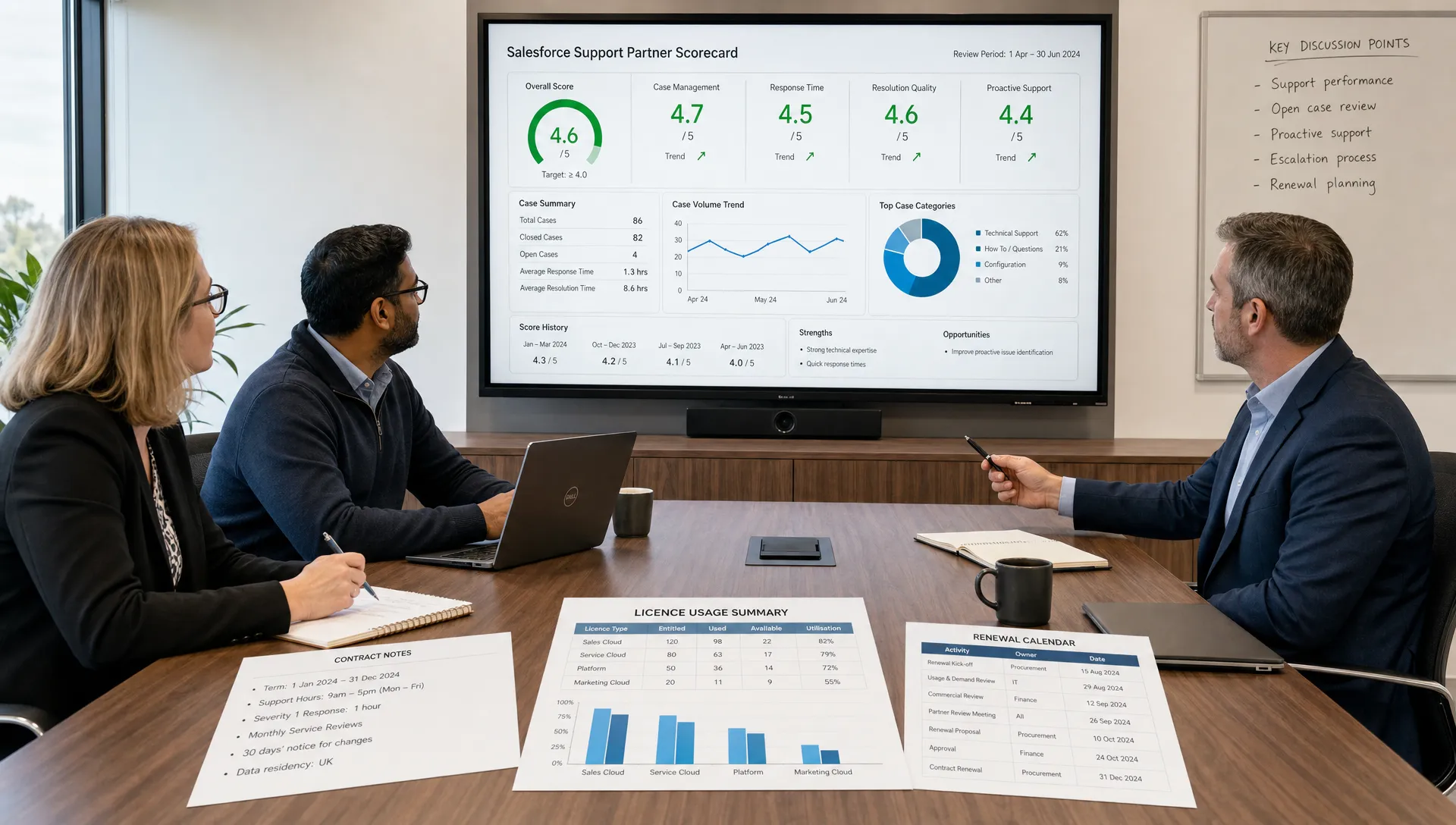
Partner selection often becomes too subjective. One partner has a polished deck. Another has better chemistry. A third offers a lower day rate. These inputs matter, but they should not dominate the decision.
A simple scorecard can help your team compare partners without pretending the process is more scientific than it is.
| Criterion | Why it matters | What good looks like |
|---|---|---|
| Salesforce technical capability | Prevents poor configuration and fragile fixes | Relevant certifications, named senior people, examples of similar support work |
| Commercial awareness | Reduces licence waste and renewal surprises | Asks about SKUs, usage, contract terms and renewal dates |
| Scope discipline | Prevents support from becoming uncontrolled spend | Clear intake, prioritisation, estimates and approval rules |
| Knowledge transfer | Reduces long-term dependency | Documents changes and explains decisions clearly |
| Senior access | Ensures complex issues get proper attention | Named escalation route and visible involvement from experienced consultants |
| Cultural fit | Makes support easier to manage | Direct communication, low drama, honest trade-offs |
| Independence of advice | Helps separate delivery from buying pressure | Will challenge unnecessary work or product expansion |
You can weight these criteria differently. A heavily regulated business may give more weight to governance and security. A fast-growing sales organisation may care more about release speed and practical admin cover. A CFO approaching a major renewal may weight commercial awareness far higher than usual.
Check whether they can say no
This is one of the simplest tests of a Salesforce support partner.
Ask them to describe a time when they advised a client not to build something, not to buy something or not to proceed with a requested change. Listen carefully to the answer.
Strong partners are not negative, but they are willing to be inconvenient when needed. They will tell you when a request adds avoidable complexity. They will point out when a workaround is cheaper and safer than a build. They will explain when an internal process should change before Salesforce is changed.
This matters because Salesforce often becomes the place where organisational mess is automated. A partner that fulfils every request without challenge may feel helpful in the short term, but it can leave you with a more expensive system to support.
Look at how they discuss licences and shelfware
Support partners see how Salesforce is actually used. That gives them valuable insight into licence fit. If they ignore that insight, you lose an opportunity.
A capable partner should be able to help you identify patterns such as:
- Users with licences that exceed their actual needs
- Teams that rarely log in but remain fully licensed
- Add-ons bought for projects that never fully launched
- Features configured once but no longer used
- Permission sets that suggest poor role design
- Support tickets that point to training issues rather than system defects
This is where technical support and procurement should talk to each other. Usage evidence is not just an IT metric. It is renewal leverage. It can also help you avoid blunt cost-cutting that damages operational performance.
If licence mix is already a concern, it is worth reviewing how your organisation can right-size its Salesforce user licence mix before the partner relationship becomes another source of untested assumptions.
Understand their delivery team, not just the sales team
The people who sell the work are often not the people who deliver it. This is normal, but you need to know who will actually support your organisation.
Ask for named roles, not vague bench strength. You should know who handles daily tickets, who reviews architecture, who manages escalation and who owns service quality. If senior expertise is promised, ask how often it will appear in practice.
A good partner will be comfortable explaining the team shape. They will also be honest about what they cannot cover. That honesty is a positive sign. Salesforce estates can involve CRM, data, integrations, identity, marketing, analytics and AI. No single consultant is excellent at all of it.
Be wary of proposals that imply unlimited expertise under one neat monthly fee. Support agreements need enough clarity to make trade-offs visible.
Review the contract with the same care as the proposal
The support contract is where good intentions either become manageable or vague. Procurement should review it closely, but IT and business owners should be involved too.
Pay attention to:
- Minimum term and exit rights
- Notice period and renewal mechanics
- Day rate or retainer structure
- Unused hours and roll-over rules
- Service levels and response definitions
- Out-of-scope charges
- Intellectual property and documentation ownership
- Security, data access and confidentiality terms
- Named personnel and substitution rights
The goal is not to create a hostile contract. The goal is to avoid ambiguity. Ambiguity usually favours the party with more control over delivery.
This is also where organisations should consider the wider Salesforce ecosystem. Support partners, implementation partners, AppExchange apps and advisory services can overlap in ways that make total cost harder to see. SaaSed has written about these moving parts in its article on Salesforce ecosystem costs and partner models.
Run a practical pilot if the risk is material
If Salesforce is business critical, consider a short pilot before signing a long support agreement. The pilot does not need to be elaborate. It should test the things that matter.
Give the partner a small but representative set of work. Include one admin request, one backlog item, one ambiguous business requirement and one question with possible licence impact. Watch how they respond.
You are looking for evidence of working style. Do they ask sensible questions? Do they document assumptions? Do they explain options clearly? Do they flag risks without making everything sound frightening? Do they help you decide, or simply wait for instructions?
A pilot will not reveal everything, but it often reveals enough.
Red flags when choosing a Salesforce support partner
Most poor partner choices are not obvious at the start. The warning signs are usually subtle.
Be cautious if a partner:
- Proposes a support model before understanding your estate
- Focuses only on tickets, not outcomes or risk
- Avoids discussing licence impact
- Cannot explain who will actually do the work
- Treats documentation as optional
- Pushes new Salesforce products before reviewing current usage
- Gives vague answers on scope boundaries
- Has no view on renewal timing or commercial implications
One red flag is not always a reason to walk away. It may simply need clarification. But if several appear together, the relationship is likely to be hard to manage.
What the right partner should leave you with
The best Salesforce support partner does more than keep the system running. They leave your organisation with a cleaner operating model.
That means fewer mystery changes, better documentation, clearer prioritisation, stronger internal ownership and fewer renewal surprises. It also means your IT, finance and procurement teams can have a more grounded conversation about Salesforce spend.
This is the real measure of support quality. Not how busy the partner is. Not how many tickets they close. Not how many certifications appear on the proposal. The measure is whether your organisation gains control.
Frequently Asked Questions
What is the difference between a Salesforce implementation partner and a Salesforce support partner? An implementation partner usually helps design and deploy new Salesforce capability. A support partner helps maintain, improve and govern the system after go-live. Some firms do both, but the skills and commercial model are not always the same.
Should a Salesforce support partner help with licence optimisation? They should at least understand licence impact and highlight obvious waste or mismatch. Deep commercial analysis may require separate procurement or contract expertise, but a support partner should not ignore usage patterns that affect spend.
How early should we choose a support partner before renewal? Ideally, review support needs at least six to nine months before a major Salesforce renewal. That gives you time to gather usage evidence, reduce avoidable waste and avoid rushed decisions during negotiation.
Is the cheapest Salesforce support partner usually a risk? Not always. A focused independent consultant may be excellent value. The risk is choosing on rate alone without checking availability, seniority, documentation, scope control and commercial awareness.
Can one partner handle all Salesforce support needs? Sometimes, but not always. Larger estates may need a mix of admin support, architecture input, integration expertise and commercial review. The important point is to know which responsibilities sit where.
Choose support that strengthens your position
The right partner for Salesforce support should make your estate easier to understand, easier to govern and easier to defend commercially. They should help your teams see what is being used, what is creating risk and what does not need to be bought again.
If you are reviewing support before a renewal, SaaSed can help you look at the contract, licence mix, usage signals and negotiation position before decisions harden. For a practical first conversation, use the contact page for a complimentary Salesforce audit conversation.
Want this kind of intel on your renewal?
Don’t head into your next software negotiation alone
Contact Us