Navigating the Salesforce Ecosystem: Advisory, Implementation Partners, and Hidden Costs
Salesforce cost does not stop at the licence line. Learn how to govern partners, AppExchange add-ons and SOWs before hidden ecosystem costs harden into renewal leverage and budget drift for next year.

Executive Overview: Beyond the Salesforce Licence
Buying Salesforce software is only one part of the commercial equation. The larger question is what sits around it: implementation partners, AppExchange ISVs, advisory firms, managed service providers, integration tools, data work, change requests, training, and post-go-live support.
This is where a Salesforce ecosystem strategy matters. Not as a slide deck, but as a way to control total cost of ownership before cost becomes embedded in the operating model.
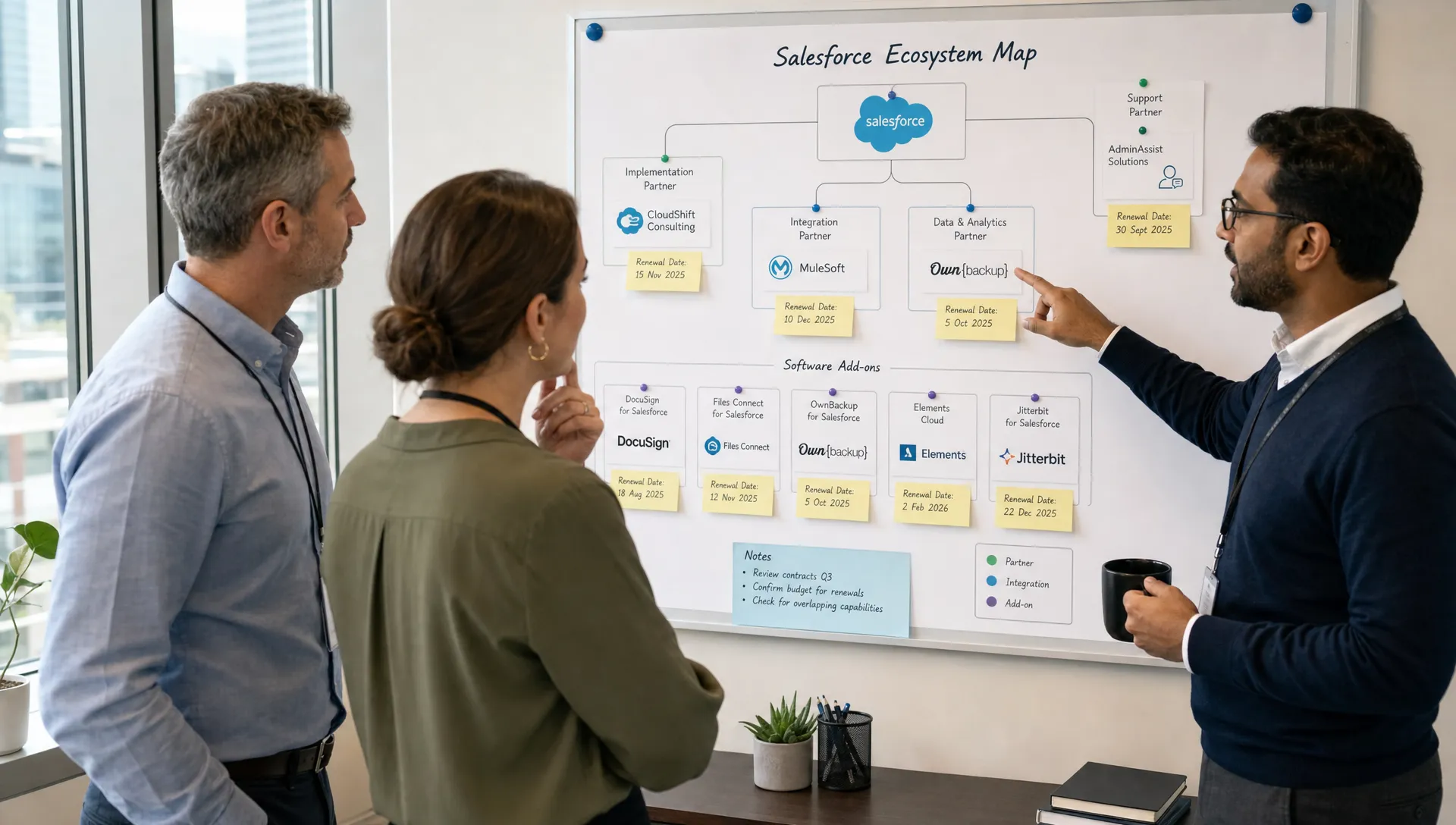
The pattern is familiar. A business signs the core Salesforce contract, then discovers that the real spend arrives in layers. A global system integrator is needed for architecture. A regional partner is added for local delivery. A few AppExchange products fill gaps. A managed service partner takes over backlog and releases. Six months later, the Salesforce estate is no longer just a CRM platform. It is a commercial ecosystem with its own gravity.
That is not inherently bad. Salesforce can carry real operational value when the scope is clear and the ownership is disciplined. The risk is opacity. Complexity is a tax on the unknown. If they cannot convince you, they may confuse you.
For a useful overview of how the ecosystem is structured, Salesforce Ben's video guide on the Salesforce ecosystem is a good starting point. The procurement question is different, though. Once you understand the players, you need to understand who has influence, who carries incentives, and where cost can drift.
Breaking Down the Salesforce Ecosystem Layers
The Salesforce ecosystem is broad by design. That breadth is part of its strength. It is also where commercial discipline tends to thin out.
Implementation Partners and System Integrators
Implementation partners translate Salesforce products into working business processes. At enterprise scale, they often shape architecture, data models, integrations, governance, migration plans, and release methods.
There are two broad categories to watch.
Global system integrators, often called GSIs, bring scale, global coverage, and experience with complex estates. They can be useful when the programme spans many countries, business units, clouds, and legacy systems. Their commercial risk is that large delivery structures can become hard to challenge. Senior people may sell the work, while delivery is handled by a wider bench at blended rates.
Regional partners can be closer to the business, more flexible, and easier to hold to account day to day. Their risk is capacity. If the partner has a small pool of specialists, the client can become dependent on named individuals. When those individuals move, the programme can slow down or knowledge can leak away.
The core Salesforce implementation partners risk is not simply price. It is dependency. Once a partner owns architecture choices, technical debt, documentation quality, and backlog interpretation, they may also shape the next phase of spend.
AppExchange ISVs and Subscription Stack Bloat
The official Salesforce AppExchange marketplace is a major part of the platform’s appeal. It gives organisations access to specialist applications for quoting, document generation, e-signature, analytics, customer service, industry workflows, data quality, and more.
The commercial issue is that AppExchange products are often bought to solve urgent delivery gaps. One team needs a feature. A partner recommends a familiar tool. A department adds seats. The cost looks small compared with the main Salesforce contract, so it escapes scrutiny.
Over time, Salesforce AppExchange licensing can create four forms of bloat:
- Duplicate capability, where multiple tools solve similar workflow problems.
- Low adoption, where licences are assigned but not used in the intended process.
- Hidden dependency, where a small tool becomes critical to a core customer journey.
- Renewal misalignment, where ISV renewal dates sit outside the main Salesforce negotiation calendar.
The cost is not only subscription spend. Every add-on can carry implementation, integration, security review, data processing, admin, support, and exit costs. In regulated environments, the same scrutiny should apply to adjacent systems that touch customer, operational or compliance data, including AI tools used by risk and compliance teams.
Advisory and Managed Services
Advisory firms and managed service partners often enter after the initial build. They help with optimisation, release management, technical debt, training, backlog grooming, and enhancement work.
Used well, they keep Salesforce from becoming stale. Used loosely, they become a standing cost centre with weak commercial boundaries.
Managed services are especially sensitive because the work is continuous. A monthly retainer can feel tidy, but the buyer should still know what is included, what counts as extra work, what service levels matter, and which activities are genuinely reducing cost or risk.
This is where independent commercial governance matters. The same partner should not be the only voice defining the problem, recommending the software, implementing the solution, and pricing the next phase.
Partner Cost and Risk Matrix
The table below gives a procurement lens on the main ecosystem layers. It is deliberately simple. The point is not to over-model the market, but to give CFOs, CIOs, IT leads, and procurement teams a shared way to challenge cost.
| Ecosystem Layer | Primary Role | Hidden Commercial Risk | Procurement Governance Rule |
|---|---|---|---|
| Global system integrators | Large-scale implementation, architecture, multi-country delivery | Expensive blended teams, delivery opacity, change request growth | Require named role mix, acceptance criteria, milestone evidence, and change control thresholds |
| Regional implementation partners | Local delivery, configuration, process adaptation, user proximity | Dependency on a small expert pool, uneven documentation, limited scale | Insist on knowledge transfer, documentation standards, and contingency planning for key roles |
| AppExchange ISVs | Specialist functionality and third-party extensions | Subscription stack bloat, duplicate tools, misaligned renewals, hard-to-exit workflows | Maintain an ISV register with owner, usage, renewal date, data access, and exit plan |
| Advisory firms | Strategy, assessment, roadmap, operating model design | Advice that leads directly into paid delivery or extra software | Separate advisory scope from implementation scope and require evidence for SKU recommendations |
| Managed service providers | Ongoing support, releases, backlog, optimisation | Retainers with weak output tracking, recurring enhancement dependency | Link service fees to defined work types, service levels, backlog reduction, and knowledge transfer |
Managing Partner Dependencies and SOW Negotiations
A Statement of Work is where commercial ambiguity either gets removed or gets priced in later. Most Salesforce consulting partners cost issues do not start with a bad rate card. They start with loose scope, unclear acceptance, and partner-controlled assumptions.
Step 1: Define “done” before delivery begins
A strong SOW should not only describe activities. It should define outcomes and acceptance criteria.
For example, “configure Service Cloud” is too loose. A better SOW states which processes are in scope, which user groups are included, what integrations are required, which reports are expected, what data must migrate, who signs off testing, and what documentation must be handed over.
Procurement should also insist on practical boundaries. What is excluded? What assumptions could affect price? Which client-side dependencies could trigger delay? Which deliverables are fixed, and which are advisory only?
If “done” is not defined, the change request process becomes the real contract.
Step 2: Split discovery from build
Large Salesforce programmes often suffer because buyers approve a major build before the design is stable. The partner then discovers complexity mid-flight and the budget moves.
A better structure is to contract discovery separately. Let the partner assess process, data, integrations, technical debt, user groups, reporting needs, and security requirements. The output should be a blueprint that can be challenged before the larger build is committed.
This does not mean slowing everything down. It means avoiding false certainty. Paying for a disciplined discovery phase is usually cheaper than funding uncontrolled change requests during build.
For teams buying Salesforce across multiple clouds, the same principle applies to product scope. As covered in SaaSed’s view on Salesforce multi-cloud buying decisions, the buyer needs to distinguish core platform need from optional SKUs that are easier to sell than to adopt.
Step 3: Challenge software recommendations at source
Partners may recommend additional Salesforce products or ISV tools for good reasons. They may also recommend them because the tool is familiar, easier to implement, commercially aligned, or part of a preferred delivery pattern.
That does not make the recommendation wrong. It means it needs evidence.
Before approving any new SKU or AppExchange product, ask for a written case covering the capability gap, process owner, expected users, adoption plan, overlap with existing entitlements, integration impact, reporting need, renewal date, and exit route.
If the business cannot name the owner, usage model, and success measure, the licence is not ready to buy.
This is particularly important before renewal windows. Once a product is embedded into a partner roadmap, it can become politically hard to remove. SaaSed has written separately about how Salesforce complexity affects renewal leverage, and partner-led scope is one of the quieter ways that complexity grows.
Procurement Decision Checklist for Ecosystem Governance
Salesforce ecosystem governance is not about saying no to every partner, app, or advisory recommendation. It is about making sure each layer earns its place.
| Governance Rule | What to Ask | Evidence to Request |
|---|---|---|
| Audit partner billings against the SOW | Are invoiced activities tied to approved deliverables and named roles? | Timesheets, milestone acceptance, role mix, change request log |
| Maintain an AppExchange and ISV register | Who owns each tool, who uses it, and when does it renew? | Licence count, usage data, contract terms, renewal dates, data access notes |
| Track change requests by root cause | Did the change come from new business need, missed discovery, weak design, or partner assumption? | CR history, approval trail, budget impact, delivery impact |
| Price long-term maintenance before go-live | What will it cost to support, enhance, secure, and exit the solution? | Managed service proposal, internal FTE estimate, documentation pack, exit plan |
A few practical disciplines make the biggest difference.
First, keep a single commercial view of the Salesforce estate. That view should include Salesforce licences, AppExchange subscriptions, partner SOWs, managed service retainers, renewal dates, and major dependencies.
Second, force recommendations into comparable terms. A partner recommendation for another SKU should be compared with configuration, process change, existing entitlement, deferral, and non-Salesforce alternatives. Not every gap needs a new subscription.
Third, bring procurement into ecosystem decisions early. If procurement only appears after the technical decision is made, leverage has already narrowed.
Fourth, make internal ownership visible. Salesforce may be a platform, but every workflow, integration, report, and add-on needs a business owner. Without ownership, spend survives even when value fades.
The Quiet Cost: Commercial Drift
The most expensive Salesforce estates are not always the ones with the highest ambition. They are often the ones where each decision looked reasonable in isolation.
One partner was added because the first partner lacked capacity. One AppExchange tool was bought because a release deadline was tight. One managed service retainer was approved because internal admin capacity was thin. One advisory review became a roadmap, then a delivery phase, then a new licence recommendation.
None of these moves is automatically wrong. The issue is cumulative effect.
A sound Salesforce ecosystem strategy gives the leadership team a way to ask calm, commercial questions before the estate hardens:
- Which partners are shaping demand, not just fulfilling it?
- Which add-ons are now critical, and which are merely convenient?
- Which SOWs are tied to measurable outcomes?
- Which renewals should be negotiated together rather than separately?
The goal is not to weaken delivery partners. Good partners make complex programmes work. The goal is to avoid becoming commercially dependent on an ecosystem that no one has fully costed.
SaaSed helps enterprise teams pressure-test Salesforce renewals, SKU decisions and commercial risk before the negotiation narrows. If a grounded second view would be useful, you can book a complimentary Salesforce audit conversation with our team.
Want this kind of intel on your renewal?
Don't head into your next software negotiation alone.
Contact Us
Want this kind of intel on your renewal?
Don’t head into your next software negotiation alone
Contact Us