Salesforce Multi-Cloud Strategy: Core Infrastructure vs. Unnecessary SKUs
Salesforce multi-cloud buying can be sensible, or quietly expensive. This guide helps CFOs, CIOs and procurement leaders separate core infrastructure from unnecessary SKUs before renewal pressure narrows the options.

For many enterprise teams, Salesforce starts as a clear operating system for revenue or service. Then the estate grows. A cloud is added for marketing, another for commerce, a data layer appears, an AI layer follows, and an industry package is proposed as the missing piece.
That growth may be justified. It may also be a neat way to turn one renewal into a much larger commitment before the business has proved it can absorb the software.
Executive Overview: The Multi-Cloud Expansion Reality
A sensible Salesforce multi-cloud strategy is not about buying more Salesforce. It is about knowing which parts of Salesforce are core infrastructure, which are optional growth engines, and which are simply unnecessary SKUs dressed up as transformation.
Salesforce expands account value by connecting specialised Clouds around the customer record. The story is attractive: sales, service, marketing, commerce, data, AI and industry workflows all joined in one ecosystem. In the right business, that can reduce fragmentation and give leaders a cleaner operating model.
The commercial problem is that Salesforce’s product portfolio is broad enough to make almost any expansion sound logical. If the internal team is under pressure, and the account team can package the proposal with a headline discount, the decision can move from “do we need this?” to “can we afford to miss this bundle?”
That is where overbuying starts.
Complexity is a tax on the unknown. If the organisation does not have usage evidence, adoption ownership, integration cost estimates and a clear business case per Cloud, the bundle becomes hard to challenge. And if they cannot convince you, they will confuse you.
The core procurement dilemma is simple: distinguish essential infrastructure from Salesforce unnecessary SKUs before the commercial clock starts running.
Salesforce Clouds Explained: Core Infrastructure vs. Enterprise Fit
The phrase “Salesforce clouds explained” often becomes a product catalogue. That is not useful for CFOs, CIOs or procurement leaders. The better question is: which Clouds carry the operating model, and which require a specific business case?
Sales Cloud vs. Service Cloud: the operational backbone
Sales Cloud and Service Cloud are usually the centre of gravity.
Sales Cloud is often justified when pipeline management, account ownership, forecasting, opportunity controls and revenue workflows need standardisation across teams or regions. It becomes core when the business uses it as the commercial system of record, not just as a manager reporting tool.
Service Cloud earns its place when case handling, support channels, entitlements, field service handoffs or customer service governance are material to the business. It becomes core when service performance, customer retention and agent productivity depend on it.
The risk is not that these Clouds are weak. The risk is buying too many user types, editions and add-ons without mapping them to real job roles. A full-access licence for a light-touch user is not a strategy. It is leakage.
Marketing Cloud vs. Commerce Cloud: growth and transactional engines
Marketing Cloud is not just an email platform. At enterprise scale it can support customer journeys, segmentation, campaign orchestration, consent, analytics and multi-channel engagement. It is valuable when marketing complexity is real: many brands, many markets, high-volume customer communication, strict compliance, and the internal capability to operate the platform well.
It is overkill when the business mainly needs simple campaign execution and does not have the team, data quality or content operating model to use the platform properly. For a deeper view, see our complete analysis of Salesforce Marketing Cloud capabilities and enterprise fit.
Commerce Cloud is different. It needs transaction volume, digital trading ownership and clear integration into fulfilment, pricing, product catalogue and customer service. It may be strategic for retail, consumer goods, manufacturing distribution, B2B portals or branded direct-to-consumer models. It is rarely a casual add-on.
Data Cloud and Agentforce: the new consumption layers
Data Cloud and Agentforce change the commercial shape of a Salesforce estate because they move the buyer closer to consumption-based economics.
Data Cloud can be valuable when the enterprise needs to unify customer data across systems, activate segments, power personalisation or support AI use cases. But the commercial exposure sits in data volumes, data harmonisation, storage, activation and downstream usage. The technical idea may be clean. The invoice may not be.
Salesforce’s own Data Cloud developer documentation is useful because it shows how broad the platform architecture can become. Procurement should read that breadth commercially: every data source, identity rule, activation path and usage pattern can create cost consequences.
Agentforce and the wider AI layer raise similar questions. They may support service automation, sales assistance, employee support or workflow automation. But they should not be treated as a harmless feature toggle. They need governance around consumption, outcomes, escalation, data access and renewal exposure. We covered the executive questions in more detail in Salesforce Agentforce: what enterprise leaders actually need to know.
Industry Clouds: vertical overlays, not automatic necessities
Financial Services Cloud, Health Cloud and other Industry Cloud offerings can be strong when the business genuinely needs industry-specific data models, workflows, compliance patterns and packaged processes.
But vertical language can also hide duplication. If an existing Sales Cloud or Service Cloud deployment already supports most workflows, an Industry Cloud may add cost without enough operational lift. The buyer should ask whether the vertical Cloud replaces custom work, removes complexity, improves adoption, or simply adds another SKU family to govern.
Enterprise Selection Matrix
Use this matrix as a first filter. It is not a substitute for a usage audit, but it helps separate core infrastructure from optional expansion.
| Salesforce Cloud Module | Ideal Business Profile / Scale | When It Is Overkill | Main Licensing Model |
|---|---|---|---|
| Sales Cloud | Multi-team revenue organisation needing pipeline control, forecasting and account governance | Small sales team with simple CRM needs or poor process discipline | Per named user, usually edition-based |
| Service Cloud | High-volume support, multi-channel service, entitlements or service operations complexity | Low case volume or support handled well in lighter tools | Per named user, with add-ons for channels and capabilities |
| Marketing Cloud | Enterprise marketing teams with complex journeys, consent needs and customer segmentation | Basic email campaigns, weak data maturity or no marketing operations ownership | Contacts, messages, editions and capability bundles vary by product |
| Commerce Cloud | Digital commerce at meaningful transaction scale with catalogue, pricing and fulfilment complexity | Low-volume web sales or simple brochure-style ecommerce | Revenue, order, GMV or product-specific commercial models can apply |
| Data Cloud | Cross-system customer data unification, activation and AI readiness at scale | Limited source systems, unclear use cases or unmanaged data quality | Consumption, data, storage and activation-related capacity models |
| Agentforce / AI Layers | Defined automation use cases with measurable business outcomes and governance | Experimental AI appetite without process redesign or usage controls | Consumption or credit-based elements, often with platform prerequisites |
| Industry Clouds | Regulated or specialised sectors needing vertical data models and workflows | Existing core Clouds already cover the operating model | Named users or packages layered onto core Cloud foundations |
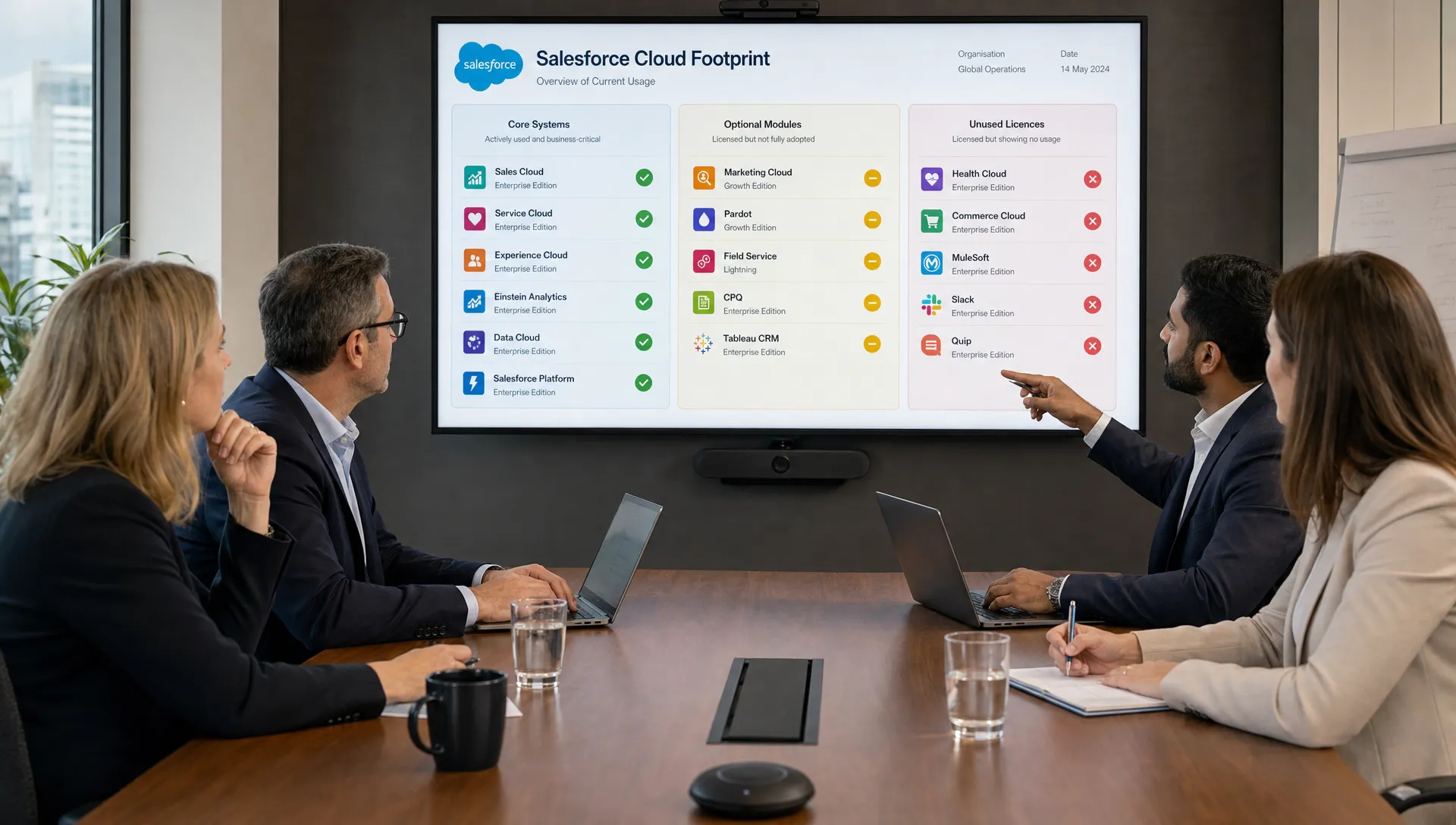
The table should also be read alongside business change. A company opening in a new region, for example, may need new commercial systems, new local service coverage and new workspace decisions at the same time. Keep those decisions separate. If Malta is part of an expansion plan, compare office space options there as a real estate decision, rather than letting a geographic growth story justify every proposed software SKU.
The Commercial Risks of Multi-Cloud Bundling
Multi-cloud bundling is not inherently bad. It can create better pricing, simpler contracting and cleaner vendor governance. The issue is the trade-off.
Salesforce account teams often use cross-cloud discounts to encourage broader commitment. The buyer is shown a larger package, a better blended discount, and a deadline that makes the bundle feel like the rational choice. In some cases, this moves into a Salesforce Enterprise Licence Agreement style structure, where the customer commits to a broader estate over several years.
That can work if the enterprise has a strong adoption plan and clear internal ownership. It can be expensive if the bundle includes aspirational usage that never becomes operational reality.
The main risks are practical:
- Discount dependency, where future renewals are anchored to a large bundle rather than clean unit economics.
- Shelfware, where licences or Cloud capacity sit unused because teams were not ready to deploy.
- Integration cost, where each new Cloud requires data work, middleware, admin capacity and implementation support.
- Consumption exposure, especially across Data Cloud, AI and automation layers.
- Renewal floor pressure, where unused products remain in the baseline because removing them threatens the commercial structure.
The commercial trap is not always the first-year cost. It is the loss of manoeuvrability. Once a Cloud is bundled, implemented partially, connected to a few workflows and folded into a multi-year agreement, removing it becomes harder than buying it.
For a specific view on how bundled enterprise agreements can reduce pricing transparency, SaaSed’s guide to Salesforce SELA bundling traps and decoupled pricing is worth reading before renewal planning begins.
Procurement Decision Framework: How to Right-Size Your Cloud Footprint
A good Salesforce product portfolio enterprise fit review should happen before the account team frames the renewal. Once the proposal is on the table, the negotiation has already narrowed.
Step 1: Build a licence-to-role map
Start with users, not products. Map every Salesforce licence, permission set, add-on and Cloud entitlement to named business roles. Identify who needs full functionality, who needs limited access, and who has not logged in or used meaningful features.
This reveals an uncomfortable truth in many estates: licence design often reflects past buying moments rather than current work.
Step 2: Separate adoption from entitlement
Owning a Cloud is not the same as using it. For each major Cloud, ask what workflows are live, what teams use them, what volume moves through them, and what business decisions depend on them.
If Marketing Cloud is contracted but campaign operations still happen elsewhere, that is not adoption. If Data Cloud is licensed but only a narrow proof of concept is live, treat the gap as commercial risk.
Step 3: Price the hidden implementation burden
Every added Cloud carries work outside the Salesforce order form. Integration, data cleansing, security review, reporting design, admin support, training and change management all have cost.
Procurement should require a simple deployment cost view before approving expansion. If the implementation burden is unknown, the business case is incomplete.
Step 4: Demand decoupled commercial visibility
Ask for pricing by Cloud, SKU, licence type, add-on and consumption component. Do not rely only on a blended discount. Blended pricing can make a weak SKU look affordable because a strong SKU is carrying the value.
The question is not “what is the discount?” The better question is “what would we still buy if every line had to justify itself?”
A practical review can be captured in a short leadership table:
| Decision Area | Evidence Needed Before Expansion | Red Flag |
|---|---|---|
| Business fit | Named owner, live workflow, measurable outcome | “Strategic platform” with no specific process |
| Usage | Login, transaction, campaign, case or consumption data | Entitlement exists, activity does not |
| Cost | Unit pricing, add-ons, implementation and support effort | Only a blended package price is available |
| Renewal risk | Exit options, ramp terms, consumption controls | Multi-year commitment before adoption proof |
Frequently Asked Questions
What is a Salesforce multi-cloud strategy? A Salesforce multi-cloud strategy is the deliberate selection and governance of multiple Salesforce Clouds across sales, service, marketing, commerce, data, AI and industry workflows. The key word is deliberate. Buying several Clouds in one bundle is not a strategy unless each Cloud has a clear role, owner and adoption path.
Which Salesforce Clouds are usually core infrastructure? Sales Cloud and Service Cloud are most often the core operational backbone, especially where revenue and customer service processes depend on Salesforce every day. Marketing Cloud, Commerce Cloud, Data Cloud, Agentforce and Industry Clouds can be valuable, but they usually need a more specific business case.
How do unnecessary Salesforce SKUs appear in enterprise contracts? They often enter through bundles, renewal concessions, pilots that become permanent, or future-state assumptions. The SKU may have been logical at the time, but without adoption governance it becomes shelfware.
Should enterprises avoid multi-cloud Salesforce deals? No. Multi-cloud deals can be commercially sensible when the business has clear deployment plans and evidence of need. The risk is committing to a broad estate before usage, data readiness, integration effort and renewal flexibility are understood.
SaaSed helps enterprise teams pressure-test Salesforce renewals, SKU decisions and commercial risk before the negotiation narrows. If a grounded second view would be useful, you can book a complimentary Salesforce audit conversation with our team.
Want this kind of intel on your renewal?
Don't head into your next software negotiation alone.
Contact Us
Want this kind of intel on your renewal?
Don’t head into your next software negotiation alone
Contact Us