Salesforce SELA – Avoiding Bundling Traps and Securing Decoupled Pricing
A Salesforce SELA can simplify buying, but bundled pricing often hides the cost of each cloud. This guide shows how to insist on line-item pricing, renewal exit rights and guardrails before commitment.

At first glance, a Salesforce SELA is easy to like. One enterprise agreement, fewer purchasing events, a wider entitlement pool and a larger discount story can all sound sensible, especially when the Salesforce estate is already broad.
The friction begins when the commercial structure becomes harder to inspect than the technology it is meant to support. Complexity is a tax on the unknown. If they can’t convince you, they’ll confuse you. To effectively unbundle products during contract review, explore how our Salesforce SELA advisory protects your decoupled pricing.
Why is a Salesforce SELA both attractive and dangerous?
A Salesforce SELA is a multi-year enterprise licence structure that wraps multiple Salesforce products into a broader commercial commitment. It can simplify buying, but bundled pricing must be audited because it can move visibility, flexibility and renewal leverage away from the customer.
For organisations with $1M-$10M in annual Salesforce spend, the SELA is rarely a simple discount mechanism. It is a commercial architecture. It decides which products are visible, which costs can be challenged, which commitments become fixed, and which parts of the estate can be reduced later.
The buyer sees simplified access. Salesforce sees a larger committed spend, a clearer growth path and a stronger renewal anchor. Both can be true. The job of procurement is not to reject the SELA by default, but to make sure the structure does not silently transfer all commercial risk to the customer.
If your team is still aligning on the basics, SaaSed’s plain-English guide to what a Salesforce SELA actually is is a useful starting point. This article goes deeper into the harder problem: Salesforce SELA bundling traps, renewal floors and how to secure decoupled pricing before the order form is signed.
What is the SELA bundle trap?
The SELA bundle trap is the practice of placing separate Salesforce products into one commercial envelope with one blended price. The buyer receives an attractive headline discount, but loses the ability to see, benchmark, reduce or remove the cost of each component later.
Procurement practitioners such as Fredrik Filipsson have helped put a useful frame around this problem. The SELA can look like enterprise simplification, but the real risk sits inside the bundle mechanics.
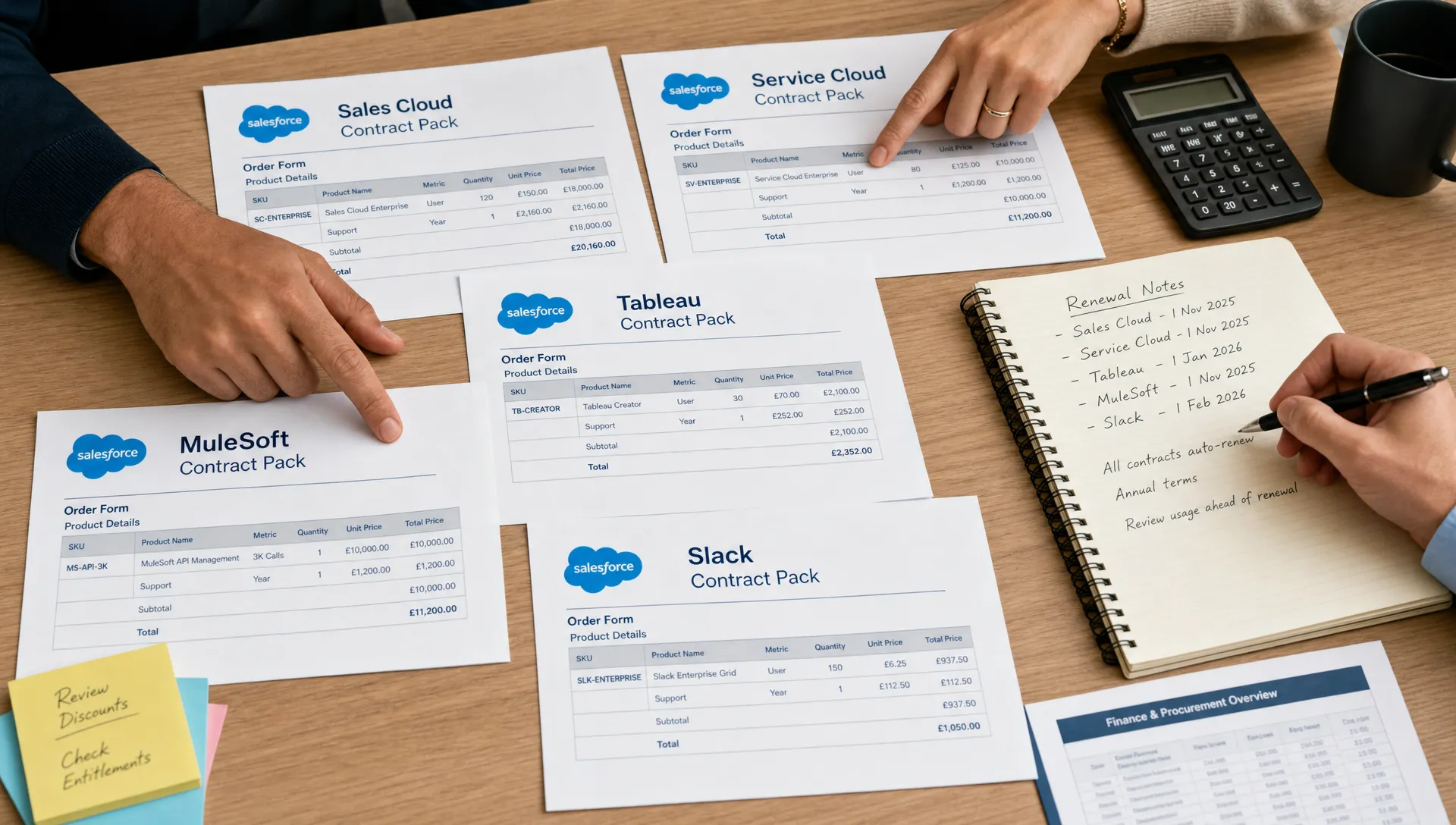
Sales Cloud, Service Cloud, MuleSoft, Tableau, Slack and other products may be presented as one portfolio commitment. That portfolio may carry a strong-looking discount. But these are not interchangeable products. They have different user groups, adoption curves, business owners, implementation costs, support needs and value cases.
When they are compressed into one price, the buyer loses several forms of control.
- Single envelope: Distinct clouds and acquired products are merged into one commercial number, making individual economics hard to isolate.
- Blended value: Strong adoption in one product can hide weak adoption in another, because the total contract value looks acceptable at portfolio level.
- Benchmarking blind spot: Procurement cannot compare the net rate of Sales Cloud, Service Cloud, MuleSoft, Tableau or Slack against market evidence if no standalone rates exist.
- Future hostage: An underused product becomes difficult to remove because Salesforce can argue that the original discount depended on the entire bundle.
- Approval camouflage: Internal stakeholders approve the aggregate deal without seeing which products are carrying the cost.
Bundling is not automatically bad. A well-designed bundle can reduce friction and support a genuine platform strategy. The trap begins when the bundle price is impossible to reverse-engineer, and when that opacity survives into the next renewal.
At contract level, the order form matters. Salesforce’s public legal framework makes clear that master terms and order forms work together, which is why the commercial detail preserved in the signed order form is so important. The relevant source material is available in Salesforce’s published legal agreements.
Why does one bundled price reduce negotiation leverage?
One bundled price reduces leverage because every future negotiation starts from the facts preserved in the signed contract. If the contract only preserves the bundle, the customer has to argue from opinion rather than evidence.
A CFO can challenge a line item. A CIO can defend or reject a product based on adoption and dependency. Procurement can benchmark a SKU. But if the estate is wrapped into one blended annual figure, the discussion becomes soft: overall value, strategic partnership, platform vision, transformation roadmap.
Those themes may matter. They should not replace inspectable economics.
What hidden restrictions turn enterprise access into a renewal floor?
Enterprise access in a SELA usually means broader rights inside a defined commercial commitment, not unlimited economic freedom. Usage floors, minimum growth assumptions and rigid ramp schedules can convert promised flexibility into a non-reducible renewal baseline.
The word unlimited deserves careful handling. In many enterprise software negotiations, unlimited access is used as a comfort phrase. It reduces anxiety about future demand. It also makes it easier to accept a larger upfront commitment.
The commercial reality is usually more constrained.
- Usage floors: The agreement may include minimum quantities, minimum spend, minimum product families or minimum platform commitments that cannot be reduced during the term.
- Growth commitments: The deal may assume headcount growth, geographic expansion or digital transformation before the business has proved the demand.
- Rigid ramps: Year two and year three spend can rise on a calendar schedule, even if deployment or adoption lags behind the plan.
- Renewal anchors: The final year’s ramped spend can become the assumed starting point for the next multi-year renewal.
- Shelfware migration: Underused products survive because removing them threatens the economics of the wider bundle.
- Forecast substitution: The vendor forecast becomes a substitute for verified internal demand.
This is where a SELA can become expensive without looking broken. No single clause may appear alarming in isolation. The risk emerges from the combination: bundled pricing, ramped commitments, non-reduction language and weak product-level exit rights.
For a deeper view of how these structures affect the next buying cycle, SaaSed’s guide on how Salesforce SELA pricing models affect renewal costs walks through the mechanics in more detail.
How does the final-year ramp become the next deal’s starting line?
The highest contracted year is often treated as the cleanest evidence of your accepted run rate. Once that number exists, the next renewal conversation may begin with the assumption that maintaining it is the minimum acceptable outcome.
Consider an illustrative SELA that ramps from $4.2M to $5.0M to $6.0M over three years. Sales Cloud and Service Cloud may be broadly adopted, but Tableau usage may lag, Slack may overlap with another collaboration tool, and MuleSoft may only be deployed in a subset of the original roadmap.
If the contract does not preserve product-level pricing and renewal reduction rights, the buyer may still find the next negotiation anchored around $6.0M. The vendor can argue that the discount, approvals and enterprise access were granted on the full portfolio. The customer then has to work backwards from a number it can no longer easily deconstruct.
The point is not that every SELA contains an explicit final-year floor clause. The point is behavioural and commercial. A ramped final year hardens expectations, changes internal budgeting, and gives the vendor a convenient baseline for the next ask.
Ramps often embed growth assumptions, including new geographies, new channels or new operating units. If part of the Salesforce business case depends on entering additional markets, validate that demand before it becomes a CRM quantity commitment.
How do you secure decoupled, line-item pricing?
Decoupled pricing means every product inside the SELA has its own SKU, quantity, metric, standalone net rate and renewal treatment. It lets the customer preserve enterprise discounts while retaining the right to reduce or remove underused product lines at renewal.
Before signing any SELA framework, procurement should make one rule plain: no invisible economics.
This does not mean rejecting volume discounts. It means separating the discount from the fog. The buyer can accept a portfolio agreement while still requiring product-level transparency.
- Product identity: Every product in the bundle should be named clearly, including edition, add-ons and any acquired cloud products.
- SKU-level mapping: Each product should have an assigned SKU or equivalent line-item identifier that can be tracked through the term.
- Standalone commercial rate: Each line should show its standalone net unit price, not only its contribution to a blended portfolio number.
- Metric clarity: The agreement should specify whether the product is priced by user, org, transaction, credit, capacity, message, consumption unit or another metric.
- Year-by-year ramp: Each product should show the quantity and cost by contract year, not just the total SELA annual value.
- Discount logic: The contract should clarify which discounts apply to which product lines and whether those discounts survive partial renewal.
- Renewal treatment: Each line should state whether it can be renewed, reduced, removed or replaced at the next renewal.
- Reduction rights: The buyer should preserve the right to drop underused products without punitive repricing of the retained core estate.
What should line-item transparency look like in the order form?
Line-item transparency should make the bundle reconstructable without Salesforce’s help. A finance or procurement reviewer should be able to answer what each product costs today and what it will cost at renewal.
The clean test is simple: if the person who signed the deal leaves the company, can the next team understand the economics without relying on vendor explanation?
A good SELA order form should show more than total contract value. It should show the commercial anatomy of the deal. That includes core clouds, adjacent products, add-ons, platform capacity, usage-based elements, contracted quantities, net rates and renewal rules.
If Salesforce says a component cannot be individually priced because the discount is strategic, treat that as a negotiation point, not a fact of nature. Internal approval policy is not the same as contractual impossibility.
What contract language protects unbundling at renewal?
Unbundling language should state that the customer may renew, reduce or remove individual product lines without losing agreed discounts on retained products. Without that language, a line-item price can still be cosmetic.
Useful language will vary by jurisdiction, contract type and legal review, but the commercial principle is consistent. The customer needs an explicit right to renew a subset of the estate.
A buyer might pursue wording along these lines, subject to counsel review:
At renewal, customer may renew any subset of products listed in this order form. Any decision not to renew a product line shall not remove or reduce the agreed discount applicable to product lines that customer elects to renew, provided the renewed products meet the applicable volume thresholds stated in this order form.
That final qualification matters. Salesforce may reasonably protect discount thresholds. The buyer should equally protect against all-or-nothing discounting, where one underused product becomes the price of keeping the rest of the estate commercially viable.
What does a good SELA commercial architecture separate?
A defensible SELA separates four things that vendors often prefer to merge: entitlement, consumption, price and renewal rights. If those layers remain separate, the business can govern adoption without surrendering commercial options.
The architecture should be simple enough for finance to audit, precise enough for legal to enforce and practical enough for IT to manage.
- Entitlement: What the organisation is allowed to use under the SELA.
- Consumption: What the organisation actually uses, by product, team, region and business process.
- Price: What each component costs on a standalone net basis.
- Renewal rights: What the organisation may keep, reduce, remove or renegotiate later.
The CIO owns technical dependency. The CFO owns economic exposure. Procurement owns the translation between those two realities and the contract. When the SELA is bundled too tightly, all three roles lose visibility at the same time.
Salesforce SELA commercial risk matrix
A SELA risk matrix translates attractive commercial promises into the specific traps they can hide. It also gives procurement a clean set of guardrails to negotiate before the order form is signed.
| Commercial Promise | Hidden SELA Trap | Procurement Counter-Measure / Guardrail |
|---|---|---|
| Unit Pricing | One blended annual price masks SKU economics and prevents product-level benchmarking. | Require SKU-level line items, standalone net rates, metrics, quantities and year-by-year pricing for every product. |
| Enterprise Access | Broad access is presented as flexibility, but contractual floors and minimum commitments limit reduction rights. | Define access scope, adoption assumptions, usage metrics and reduction rights before signature. |
| Multi-Year Certainty | Ramped spend creates a final-year anchor that becomes the starting point for the next renewal. | Set renewal baseline language, cap uplift assumptions and preserve the right to reduce products that were not adopted. |
| Product Bundling | Core clouds and adjacent products are merged, making it difficult to drop underused items without losing portfolio discounts. | Separate product families, assign standalone rates and include an unbundle clause that protects discounts on retained products. |
How should CFOs, CIOs and procurement leads run the SELA negotiation?
The SELA negotiation should be run as a commercial architecture exercise, not as a discount chase. Each leader should test a different risk: the CFO tests the financial floor, the CIO tests product dependency, and procurement tests the contractual exit path.
A large headline discount can be a weak outcome if the baseline is inflated, the ramp is unrealistic or the renewal rights are poor. The better question is not, how much discount did we get? It is, what did we commit to, what can we prove we need, and what can we change later?
- CFO view: Test whether the SELA creates a future spend floor that the business would not accept if each product were priced separately.
- CIO view: Test whether every product in the bundle has a real implementation path, accountable owner and dependency on the Salesforce stack.
- Procurement view: Test whether the order form gives enough line-item evidence to benchmark, challenge and renew selectively.
- Legal view: Test whether renewal rights, reduction rights, product definitions and discount preservation are written clearly enough to enforce.
- Business owner view: Test whether the value case is based on funded demand, not vendor-led aspiration.
The practical leverage work starts well before Salesforce presents the renewal shape. SaaSed’s guide to Salesforce negotiation tactics that improve leverage covers the preparation discipline in more detail.
What evidence should be ready before Salesforce sees the renewal strategy?
Salesforce should not be the first party to tell you what you use. Your internal evidence pack should already show entitlement, consumption, shelfware, growth demand and credible alternatives by product.
Build the evidence before the commercial conversation starts.
- Contract baseline: Current order forms, amendments, renewal dates, auto-renewal terms, uplift language and product commitments.
- Usage audit: Actual consumption by product, region, department and user group, with inactive and low-use populations separated.
- Shelfware analysis: Products or quantities paid for but not adopted, with reasons and remediation options.
- Roadmap test: A clear view of which Salesforce products are required for funded projects, not merely possible future initiatives.
- Leverage map: Alternatives, deferral options, consolidation options and products that can credibly be removed.
- Decision calendar: Internal deadlines that leave enough time for executive alignment, not just vendor paperwork.
The evidence pack does not need to be theatrical. It needs to be clean. Salesforce negotiations often become difficult because the buyer waits too long, then tries to negotiate from memory, hope and last year’s deck.
What red flags should pause a SELA signature?
A SELA should pause when the commercial model depends on trust instead of inspectable economics. The more the vendor asks you to accept blended value, the more explicit your contract needs to be.
Red flags do not always mean walk away. They mean slow down, isolate the issue and require written clarity.
- No component pricing: Salesforce will not provide standalone product rates inside the SELA.
- All-or-nothing discounting: The discount is positioned as dependent on renewing the full bundle, including products with weak adoption.
- Non-reducible renewal base: The agreement does not clearly allow reductions at renewal, or treats the final ramp year as the assumed renewal floor.
- Ramps without adoption gates: Spend increases are fixed by date rather than tied to implementation, usage or business readiness.
- Undefined enterprise access: The phrase enterprise access is used without precise product, metric, geography or user scope.
- Forced adjacent clouds: Secondary products are inserted to reach a volume threshold, even when ownership and adoption are unclear.
- No unbundle clause: The contract lacks language allowing product lines to be dropped while preserving discounts on the retained core stack.
The cleanest time to fix these issues is before signature. After signature, the argument changes. You are no longer designing the commercial architecture. You are asking to modify it.
Frequently Asked Questions
These are the practical questions buyers usually ask once a SELA moves from concept to order form. The answers below focus on commercial control rather than legal theory.
What is a Salesforce SELA bundle trap? A SELA bundle trap occurs when multiple Salesforce products are combined into one blended commercial commitment without transparent product-level pricing. The buyer may get a strong headline discount but lose the ability to benchmark, reduce or remove individual products later.
Can Salesforce provide decoupled pricing inside a SELA? Buyers can and should ask for decoupled pricing. The negotiation point is whether each product has a visible SKU, metric, quantity, standalone net rate and renewal treatment inside the wider enterprise agreement.
Does decoupled pricing mean losing volume discounts? Not necessarily. The objective is to preserve legitimate volume discounts while preventing all-or-nothing pricing that penalises the customer for dropping underused products at renewal.
Is enterprise access the same as unlimited use? No. Enterprise access usually sits within defined contractual rights, products, metrics and commitments. It should be reviewed for floors, caps, true-up exposure, product scope and renewal implications.
When should unbundling rights be negotiated? Unbundling rights should be negotiated before the SELA is signed. Once the bundle is embedded in the order form, the buyer’s leverage is usually lower and the renewal anchor is harder to move.
What if the SELA is already signed? Start by reconstructing the estate from order forms, invoices, usage data and stakeholder interviews. Even if the current term is fixed, a disciplined product-level audit can create leverage for the next renewal and identify shelfware before it becomes the baseline again.
How should you calibrate the SELA before renewal?
Calibrating a SELA means proving which products deserve renewal, which need reduction and which should be removed before the commercial anchor hardens. Volume discount thresholds should inform pricing, but they should never become behavioural anchors that force the business into bad economics.
A well-built SELA can work. It can reduce procurement friction, support a platform strategy and create commercial predictability. But it only works when the buyer keeps product economics visible and renewal rights intact.
The disciplined position is simple: accept scale where it creates value, reject opacity where it removes control.
SaaSed helps organisations review Salesforce contracts, SKUs, usage, shelfware and renewal exposure before negotiation pressure builds. If your next renewal is within the next 12-18 months, we can support a line-item contract benchmark and an independent SELA negotiation audit. To start with a quiet second opinion, book a complimentary Salesforce audit conversation.
Want this kind of intel on your renewal?
Don’t head into your next software negotiation alone
Contact Us