Salesforce SELA Changes & Negotiation Tactics for 2026
Salesforce SELA renewals in 2026 demand sharper scrutiny of uplifts, bundles and shelfware. This guide gives CFOs, CIOs and procurement leaders a practical negotiation lens before the commercial structure hardens.

- Executive Summary (TL;DR): Salesforce SELA economics are becoming less forgiving in 2026. Where a 3% to 5% annual uplift is embedded, a $5m ACV can carry roughly $455k to $763k in extra 3-year cost before any net-new scope.
- The risk is less the SELA label and more the commercial architecture. Ramped commitments, bundled products, renewal baseline resets and cross-cloud dependencies can dilute control faster than most dashboards reveal.
- The best negotiation move is to make the unknown visible. A Salesforce commercial structure audit, usage evidence and product-level pricing are the practical route to reduce Salesforce SELA overspend without cutting useful capability.
The 2026 Salesforce SELA Landscape
A Salesforce SELA can still be the right instrument for a large enterprise. It can simplify a sprawling estate, create commercial certainty and support a multi-year transformation. The mistake is assuming that simplicity on the invoice means simplicity in the economics.
In 2026, the direction is clear: Salesforce SELA structures are doing more commercial work inside fewer contract lines. More value is being packed into bundles. More growth is being assumed in advance. More risk is being moved into baselines, ramps, uplift clauses and renewal mechanics.
Complexity is a tax on the unknown. If they can't convince you, they'll confuse you. That is not a criticism of Salesforce as a vendor. It is a description of enterprise software economics. The buyer’s job is not to dislike the structure. The buyer’s job is to make the structure legible. This is where mastering tactical preparation becomes essential for any upcoming Salesforce SELA negotiation.
Hidden auto-escalation clauses are doing more work
Hidden auto-escalation clauses, typically 3% to 5% annual increases in the structures we review, deserve separate scrutiny. They may appear as annual uplifts, ramped year-two and year-three pricing, renewal increase language, or minimum growth commitments dressed as transformation capacity.
On a $5m ACV, a 3% annual uplift adds roughly $455k over a flat 3-year term. At 5%, the same mechanism adds roughly $763k. That spend arrives before additional products, support changes, acquisitions, headcount growth or new projects.
The negotiation point is not simply to remove uplift. Sometimes you will accept it. But you should never accept it without a compensating concession: price protection, reduction rights, product substitution, service credits, a longer discount lock, or a tighter definition of what is included in the renewal baseline.
Shelfware traps are moving upstream
The classic view of shelfware is too narrow: unused licences sitting in a report. In a SELA, shelfware often starts before the licence is provisioned. It starts when an adoption assumption becomes a financial commitment.
The traps are familiar once you look for them. Products are bundled because the headline discount improves. Future headcount is bought in advance. Premium editions are committed because the roadmap might need them. Cloud capacity is pooled so broadly that no business owner remains accountable for consumption.
This is why Salesforce shelfware optimization has to begin before the renewal, not after it. If you wait until year two to discover non-adoption, the commercial structure has already hardened.
Product complexity bundling is the new negotiation fog
Bundling is not inherently bad. Undocumented economics are bad.
When core clouds, Slack, Tableau, MuleSoft, Data Cloud, AI capabilities, industry products or support entitlements are wrapped into one commercial proposal, the discount percentage becomes less useful. A 40% discount on an unclear bundle tells you very little. Which products carry the value? Which are subsidising the others? Which ones reset the baseline? Which can be removed later without repricing the estate?
Where AppExchange dependencies form part of the estate, map them separately using the official Salesforce AppExchange. ISV spend can be strategically important, but it can also hide duplicate capability or integration lock-in that weakens your renewal position.
The sharper question is not, ‘What discount did we get?’ It is, ‘What flexibility did we give away to get it?’
Standard Enterprise Agreement vs Salesforce SELA Structure
The table below is not a judgement that one structure is better. It is a decision lens. For a wider view of how this fits with other Salesforce commercial models, including AELA, see SaaSed’s guide to Salesforce commercial structures.
| Commercial dimension | Standard Enterprise Agreement | Salesforce SELA Structure | Procurement implication |
|---|---|---|---|
| Typical commitment shape | Often product-by-product, with clearer unit counts and edition pricing | Often broader multi-product commitment with enterprise-level spend logic | SELA may simplify governance, but can make product-level value harder to test |
| Leverage | Higher where products are separable and renewal is contested line by line | Higher upfront if Salesforce wants strategic consolidation, lower later if scope is locked | Leverage must be used before the bundle is accepted, not after signature |
| Lock-in | Usually tied to specific products, quantities and terms | Can be tied to committed spend, broad entitlements, ramps and baseline resets | Lock-in risk is often structural rather than legal |
| Flexibility | More room to reduce, swap or challenge individual products at renewal | Flexibility depends on negotiated reduction rights, substitution rights and product carve-outs | Flexibility must be written into the order form and commercial model |
| Cost visibility | Clearer SKU-level economics, though still imperfect | Blended pricing can obscure which products create or destroy value | Demand product-level reference pricing before comparing options |
| Renewal risk | Renewal pressure is easier to isolate by SKU | Renewal pressure can affect the whole estate if the SELA becomes the new baseline | Model the renewal after the SELA, not just the first term |
Core Negotiation Tactics for CFOs: Salesforce renewal negotiation strategy
A serious Salesforce renewal negotiation strategy starts with one premise: the vendor’s proposal is not the baseline. Your actual estate is the baseline.
That sounds obvious. In practice, many renewal teams let the first Salesforce proposal frame the entire conversation. Once that happens, the negotiation becomes a debate over discount percentage, not a review of commercial fit.
“The biggest mistake we see CFOs make during a SELA negotiation is treating the discount percentage as the scoreboard. The real scoreboard is the cost of optionality you give away to get that discount.”
Start with a Salesforce commercial structure audit, not a discount target
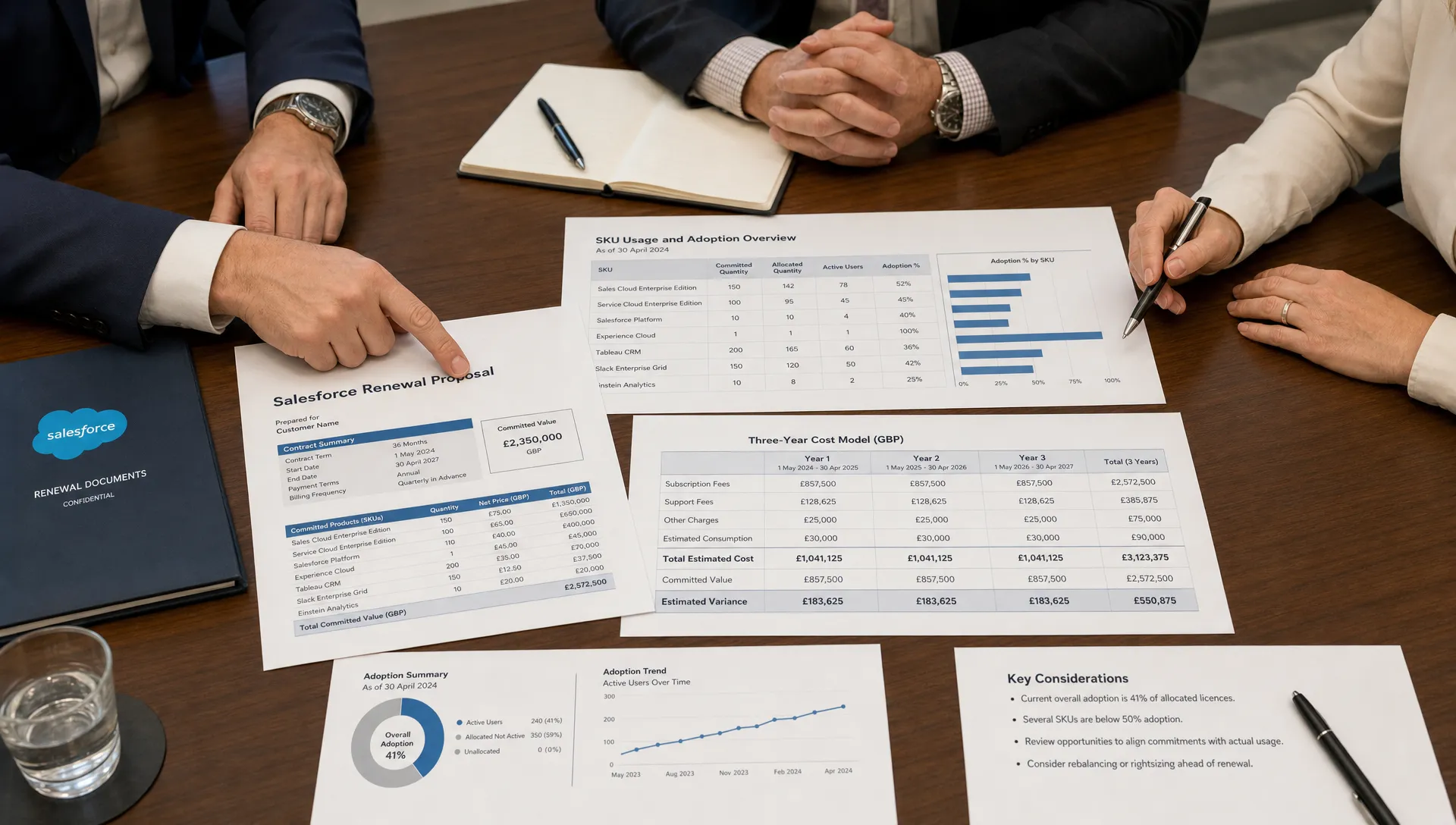
A Salesforce commercial structure audit should be completed before commercial discussions become detailed. It is not the same as a usage report. It is a commercial reconstruction of how your estate actually works.
At minimum, the audit should reconcile:
- Full order form lineage, including amendments, co-terming events and prior concessions
- SKU-level entitlements, editions, add-ons, support levels and contractual restrictions
- Actual usage by product, role, business unit and geography
- Business owner mapping for each material product family
- Renewal mechanics, uplift language, auto-renewal dates and notice windows
- Product dependencies, including integrations, AppExchange packages and adjacent SaaS overlap
- Future roadmap assumptions, separated into funded, approved, speculative and aspirational demand
The output should be a one-page renewal control sheet that finance, IT and procurement can all defend. If a product has no owner, no adoption evidence and no funded roadmap, it should not sit quietly inside a strategic bundle.
Review the contractual mechanics against Salesforce’s legal agreements and terms library, but do not confuse legal completeness with commercial quality. A contract can be perfectly valid and still be a poor buying instrument.
Negotiate the baseline before negotiating the discount
The renewal baseline is where future overspend often hides. If year-three SELA spend becomes the starting point for the next renewal, you may be accepting a compounding cost path without noticing it.
Before discussing discount, ask three questions. What is the true renewal baseline? Which products are included in that baseline? What happens if adoption is lower than forecast?
The answer should be documented in the pricing schedule, not left to account-team interpretation. If a promotional product, pilot SKU or future-use entitlement is included, state whether it renews automatically, at what price and under what conditions it can be removed.
Price the bundle as if you might unbundle it
A bundled SELA proposal should still carry product-level economics. This does not mean you intend to buy everything separately. It means you need to understand the internal cross-subsidy.
Ask for product-level reference pricing, discount baselines, committed quantities, edition assumptions and renewal treatment. If the response is that the bundle only works as a whole, treat that as a risk signal, not as a reason to stop asking.
If bundling is the centre of the proposal, SaaSed has written separately about securing decoupled pricing in a Salesforce SELA. The principle is simple: you can accept a strategic bundle without accepting commercial opacity.
Make the walk-sideways option credible
The best buyers rarely rely on a dramatic walk-away threat. It is usually not credible for a deeply embedded Salesforce estate. What is credible is a walk-sideways option: a narrower SELA, a standard agreement on core products, delayed adoption of speculative products, or a phased structure that keeps strategic direction intact while reducing overcommitment.
This matters because Salesforce renewal pressure often builds around time. If the only approved path is the vendor’s proposed SELA, procurement has little room to move. If the CFO, CIO and business owners have agreed a credible alternative, the tone changes.
For more on the mechanics of creating leverage before renewal, see SaaSed’s guide to Salesforce negotiation tactics that improve leverage.
Use the calendar as a control mechanism
For a $1m to $10m Salesforce ACV, 180 to 240 days before renewal is not early. It is sensible. The larger the estate, the longer it takes to build usage evidence, align business owners, test alternatives and secure internal agreement on red lines.
Late negotiations reward complexity. Early preparation reduces it.
How to reduce Salesforce SELA overspend without damaging the roadmap
To reduce Salesforce SELA overspend, do not start by cutting. Start by classifying.
Some spend is productive. Some is insurance. Some is political. Some is simply unknown. The CFO’s role is to stop those categories blending into one renewal number.
Protect the products with real adoption
There will usually be parts of the Salesforce estate that are central to revenue, service operations, integration or executive reporting. Do not weaken those casually. A poor negotiation is not one that pays for value. A poor negotiation is one that pays for value and waste as if they were the same thing.
Where adoption is strong, use it. High-value products can justify multi-year certainty if the economics are clean. But clean means product-level clarity, price protection and a renewal path that does not punish success with an unexplained baseline reset.
Convert uncertain demand into options
Future demand should not automatically become committed spend. If a business unit expects to adopt a product in 18 months, negotiate option rights, pre-agreed pricing, phased activation or conditional expansion. Do not pay today for an adoption plan that has no funded owner.
This is especially important where AI, data and automation products are being introduced into the estate. The strategic direction may be right, while the committed quantity is wrong.
Keep risk and compliance in the same conversation as price
A SELA that pulls in data, integration or AI workloads should be reviewed for operational risk as well as commercial value. Use Salesforce Trust to validate service status, security information and trust commitments as part of the wider risk assessment.
This does not replace legal review. It gives the CIO and risk teams a shared evidence base when deciding whether a broader commitment is operationally sensible.
Decide which flexibility is worth paying for
Flexibility has a price. The question is whether you know what that price is.
If Salesforce offers a stronger discount for a broader commitment, model the cost of lost optionality. What is the cost if adoption is 20% lower than forecast? What if a business unit is divested? What if an acquired company runs a different CRM estate? What if a product is replaced by an adjacent platform?
A SELA is not just a purchase. It is a set of assumptions about your next three to five years. Those assumptions need owners.
Salesforce shelfware optimization: make waste visible before it renews
Salesforce shelfware optimization is not a policing exercise. It is a governance exercise.
The aim is not to embarrass business units for poor adoption. The aim is to stop quiet waste from becoming contractual truth. In large estates, shelfware tends to sit in three places: dormant licences, premium editions used like basic editions, and overlapping products solving the same business problem.
A disciplined review asks four questions before renewal sign-off:
- Which licences or entitlements have materially low usage over the last two quarters?
- Which premium features are paid for but not used in the workflow?
- Which products duplicate capability already paid for elsewhere?
- Which future-use products have a funded adoption plan, named owner and implementation date?
If the answer is unclear, the product should not be treated as proven demand. It may still belong in the roadmap, but it should be negotiated as an option, not a fixed commitment.
For teams still testing whether the SELA form itself is suitable, SaaSed’s Enterprise Salesforce SELA procurement and cost optimisation advisory sets out the decision criteria in more depth.
A practical 2026 SELA renewal control checklist
Before entering detailed Salesforce SELA negotiations, make sure the buying team can answer these points without relying on the account team’s interpretation:
- What is the true current ACV by product family, net of one-off credits and prior concessions?
- Which clauses create 3% to 5% annual uplift, ramped pricing or renewal baseline resets?
- Which products are essential, under-adopted, speculative or duplicative?
- What is the 3-year and 5-year cost under flat, 3% and 5% uplift scenarios?
- Which products can be removed, reduced, swapped or delayed without repricing the entire estate?
- Which business owners have signed off future adoption assumptions?
- What is the credible alternative if the proposed SELA is commercially too rigid?
- Which approval body owns the final trade-off between price, flexibility and risk?
If those answers are not ready, the negotiation is not ready. The vendor may still be ready. That is a different matter.
Frequently Asked Questions
What is changing in Salesforce SELA agreements in 2026? The main shift is not a single public template change. It is the increasing use of broader bundles, multi-year ramps, uplift language, baseline resets and product complexity inside strategic agreements. Buyers need to test the commercial architecture, not just the headline discount.
How early should we start a Salesforce SELA renewal process? For a mid-to-large enterprise with $1m to $10m in Salesforce ACV, 180 to 240 days before renewal is a sensible planning window. Complex estates need time for usage analysis, stakeholder alignment, legal review and alternative modelling.
How do we reduce Salesforce SELA overspend without weakening important programmes? Separate proven demand from speculative demand. Protect products with clear adoption and business value, then negotiate options, phased activation or removal rights for products that are not yet justified by usage or funded roadmap.
What should a Salesforce commercial structure audit include? It should include order forms, amendments, SKU-level entitlements, usage data, support levels, renewal clauses, uplift mechanics, product dependencies, business ownership and future roadmap assumptions. The goal is to reconstruct the economics before accepting a new structure.
Is a Salesforce SELA always worse than a standard enterprise agreement? No. A Salesforce SELA can be useful where there is genuine enterprise-wide adoption, clear governance and strong product-level transparency. It becomes risky when bundled pricing hides value, shelfware is carried forward, or flexibility is traded away without being priced.
Closing Thought: Make the Commercial Structure Legible
A Salesforce SELA renewal should not feel like a fog bank. If the structure is good, it can survive scrutiny. If it cannot survive scrutiny, the discount is not the point.
If you are approaching a Salesforce SELA renewal and want to eliminate overspend with precision, visit our contact page for a complimentary Salesforce audit conversation and to book a direct, confidential strategic session with Anders to audit your commercial structure.
Want this kind of intel on your renewal?
Don’t head into your next software negotiation alone
Contact Us