Salesforce Negotiation Tactics That Improve Leverage
Salesforce leverage is rarely won in the final pricing call. This guide shows CFOs, CIOs and procurement leaders how to build a cleaner fact base, control renewal timing and trade concessions with discipline.

Salesforce renewals are often treated as pricing events. In practice, the price is usually the last visible part of a much longer negotiation.
The organisations that improve their position tend to do less theatre, not more. They arrive with clean usage data, a clear view of contractual risk, aligned decision-makers, and a credible set of choices. That is what creates leverage.
For CFOs, CIOs, IT leads and procurement teams, the aim is not to “beat” Salesforce in a negotiation. It is to avoid buying under pressure, paying for avoidable waste, or accepting terms that make the next renewal harder.
What leverage really means in a Salesforce negotiation
Leverage is not a louder request for a discount. It is the supplier’s belief that you have credible options, disciplined governance, and enough time to act.
The negotiation concept behind this is familiar: your BATNA, or best alternative to a negotiated agreement. The Harvard Program on Negotiation’s explanation of BATNA is a useful reminder that power comes from having a workable alternative, not from posturing.
In a Salesforce context, leverage usually comes from four sources:
- Clean evidence on what is used, unused, needed and duplicated.
- Contractual clarity on renewal dates, uplifts, notice periods, co-termination and committed spend.
- Internal alignment between finance, IT, business owners, legal and procurement.
- Credible alternatives, including right-sizing, deferring expansion, changing term length, or moving selected workloads elsewhere.
A weak buyer enters the discussion asking, “What can you do on price?” A stronger buyer enters with a defined position: “Here is what we use, here is what we no longer need, here is what we can commit to, and here are the conditions under which we will expand.”
That difference changes the conversation.
Start before Salesforce sets the rhythm
The easiest way to lose leverage is to start when the renewal quote arrives.
By then, the account team may already have shaped the internal narrative: growth plan, product roadmap, executive sponsor, preferred term, uplift and expansion package. If your side is still collecting usage data, debating business ownership, or trying to find the signed order form, you are late.
A better window is usually six to nine months before a material renewal, and longer for complex estates, SELA-style structures, global agreements, or renewals tied to transformation programmes. The goal is not to negotiate for nine months. The goal is to remove panic from the final month.
Your early work should answer three questions:
- What are we contractually obliged to do?
- What are we actually using and valuing?
- What are we prepared to change if the commercial outcome is poor?
That last question matters. If the answer is “nothing”, Salesforce will often sense it. If the answer is specific, credible and backed by executive agreement, your position improves.
Build the fact base before asking for better pricing
Many companies ask for a reduction before they have earned the argument. That puts procurement in a weak position because the supplier can steer the discussion back to list prices, product value, benchmark claims or bundle logic.
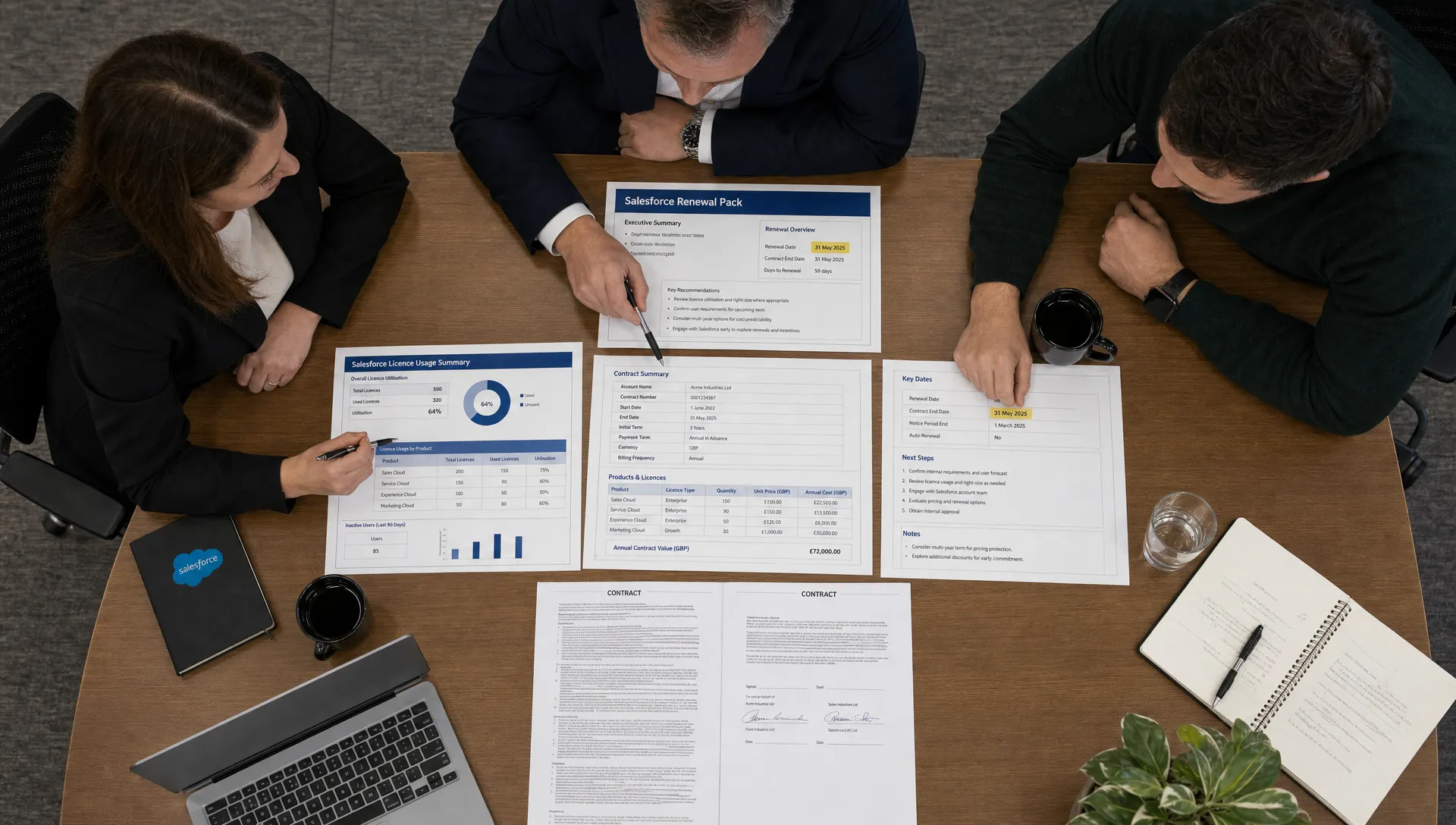
A stronger approach is to build the fact base first. This means reviewing order forms, amendments, renewal language, SKU mix, usage data, assigned licences, inactive users, duplicate functionality and planned demand.
It also means checking the legal and commercial documents that govern the relationship. Salesforce publishes a range of standard legal materials through its Salesforce legal agreements page, but your negotiated order forms and amendments are often where the commercial detail sits. Do not rely on the latest quote alone.
If you want a deeper view on this point, SaaSed has written separately about why much of the value in Salesforce is already in your contract. The short version is simple: before asking for new concessions, understand what you have already paid for and what rights you already hold.
| Fact to establish | Why it improves leverage | Common finding |
|---|---|---|
| Licence assignment and login activity | Shows where spend is not tied to adoption | Inactive users, over-provisioned roles, duplicated licences |
| SKU-level entitlements | Reveals value already contracted but unused | Features bought through bundles but not adopted |
| Renewal and notice dates | Prevents time pressure being used against you | Missed notice windows or late internal approvals |
| Uplift and price protection language | Frames what is contractual versus negotiable | Automatic increases treated as unavoidable |
| Business-critical workloads | Separates genuine dependency from habit | Some use cases are essential, others are convenience spend |
The point is not to produce a beautiful audit pack. The point is to know where your money is going before anyone asks you to commit more of it.
Separate genuine demand from encouraged demand
Salesforce is good at connecting product conversations to commercial moments. That is not a criticism. It is how enterprise software selling works.
The risk for buyers is that renewals become blended with expansions, new clouds, add-ons, AI capabilities, premium support, integration products or additional environments. Once everything is bundled into one commercial event, it becomes harder to see which parts are necessary and which parts are optional.
A useful negotiation tactic is to separate the three categories before the supplier does it for you:
- Must-renew services that support live, critical business processes.
- Useful services where adoption, value or timing is still uncertain.
- Optional or exploratory services that should not be tied to the core renewal unless the commercial terms justify it.
This separation gives you room to trade. You may be willing to discuss expansion, but not at the cost of locking in shelfware. You may be willing to consider a longer term, but only if it comes with price protection and flexibility. You may be willing to consolidate products, but not if the bundle hides future uplift risk.
This is where CFO and CIO alignment becomes important. Finance may see avoidable spend. IT may see platform dependency. Business owners may see delivery risk. Procurement’s job is to make those views visible early, not force them into agreement during the final call.
Make right-sizing credible, not theatrical
Right-sizing is one of the most useful Salesforce negotiation tactics, but only when it is credible.
A vague threat to reduce licences rarely carries much weight. A specific right-sizing plan does. For example, there is a meaningful difference between saying “we need a better price or we will cut seats” and saying “we have identified 420 assigned licences with no meaningful activity over the last 120 days, and we have agreed internally that these will not be renewed unless there is a documented business owner.”
Credible right-sizing requires evidence, ownership and timing. It should be discussed internally before it is used externally. If sales, service or marketing teams are surprised by proposed reductions during the negotiation, the supplier may not need to push back. Your own stakeholders will do it for them.
Alternatives do not always mean replacing Salesforce as a whole. They can include retiring unused modules, pausing expansion, moving a narrow workflow to another tool, reducing sandbox or support commitments, or improving data migration readiness for future optionality. For smaller entities and business units evaluating CRM movements, data quality and migration discipline matter long before a switch is made.
The practical lesson is straightforward: the more credible your ability to change, the less you need to threaten change.
Use term length as a trade, not a concession
Salesforce renewals often involve pressure around term length. Longer terms can be useful, especially where the platform is stable, the roadmap is clear, and the commercial protection is strong. They can also lock in waste, limit future flexibility and make the next negotiation more difficult.
The key is to treat term length as something you sell, not something you give away.
If Salesforce wants a longer commitment, ask what you receive in return. That may include stronger price holds, lower uplift exposure, flexibility to reduce or swap certain licences, clearer ramp terms, or protection against future packaging changes. The right answer depends on your estate and risk appetite.
This is where contract language matters. Renewal term mechanics can quietly shift leverage if they create automatic extensions, limit termination windows, or reset pricing unfavourably. SaaSed’s guide on how to use the renewal term without losing ground covers this in more detail.
A simple rule helps: never evaluate term length only through the first-year price. Look at the total commitment, the exit points, the uplift path and the operational flexibility.
Negotiate protections, not just discounts
Discounts get attention because they are easy to compare. Protections often matter more because they shape the cost of the next two or three years.
A lower headline price can still be poor value if it comes with rigid minimums, aggressive uplift language, limited reduction rights, unclear true-up terms, or bundled products that are difficult to unwind. Conversely, a slightly less dramatic discount may be commercially stronger if it gives you pricing stability and room to adjust.
Useful negotiation areas often include:
- Uplift caps or fixed pricing for renewal periods.
- The right to reduce unused quantities at renewal.
- Flexibility to swap agreed products or licence types where business needs change.
- Clear treatment of add-ons, co-termination and mid-term purchases.
- Defined ramps that match adoption plans rather than sales targets.
- Visibility on usage limits, overages, storage and consumption-based exposure.
Some of these points may be negotiable. Some may not. The discipline is to ask for protections that reflect your actual risk, not a generic wish list.
Contract clauses can also create cost increases that are hard to see during a pricing discussion. If you are reviewing your next agreement, SaaSed’s article on SaaS contract clauses that drive up Salesforce costs is a useful checklist.
Control the internal sequence
Supplier leverage often increases when the buyer’s internal sequence is messy.
A common pattern looks like this: the business wants new capability, IT wants continuity, finance wants savings, procurement wants time, legal sees issues late, and executives only become involved once escalation is already happening. Salesforce then has multiple entry points and can tailor different messages to different stakeholders.
A stronger sequence is quieter and more disciplined.
First, agree your internal baseline. What must renew? What can reduce? What is undecided? What is out of scope? Then agree who can speak commercially, who owns technical validation, who approves exceptions, and who handles executive contact.
This does not mean shutting Salesforce out. It means avoiding accidental commitments. A friendly product discussion can become a commercial signal. A roadmap workshop can imply budget. An executive meeting can narrow options before procurement has seen the detail.
Good stakeholder control is not defensive. It simply keeps the negotiation honest.
Know what you are willing to trade
Every negotiation involves trades. The mistake is making them late, emotionally, or without knowing their value.
Before the commercial discussion becomes active, build a short list of what you can trade and what you cannot. This helps procurement avoid giving away valuable concessions for weak returns.
| Possible buyer concession | Why Salesforce may value it | What to ask for in return |
|---|---|---|
| Longer contract term | Revenue certainty | Stronger price protection, flexibility, or improved unit economics |
| Earlier signature | Forecast certainty | Better commercial terms, not just pressure relief |
| Product consolidation | Larger committed footprint | Removal of unused SKUs, clearer bundle rights, lower future uplift risk |
| Expansion commitment | Account growth | Adoption-based ramp, implementation timing, or price holds |
| Executive reference or case study | Market credibility | Only consider if value is substantial and internally approved |
The table is not a script. It is a reminder that buyer commitments have value. Treat them that way.
Avoid tactics that weaken your own position
Some negotiation behaviours feel strong but reduce leverage.
The first is asking for an arbitrary percentage reduction without evidence. It invites an equally arbitrary response and keeps the discussion anchored on discount theatre.
The second is letting the supplier define urgency. Quarter-end, year-end and internal Salesforce timelines may matter commercially, but they should not replace your own governance.
The third is mixing every possible request into one negotiation. If the ask list is too broad, the important points get diluted. Focus on the few items that materially change cost, flexibility or risk.
The fourth is escalating too early. Executive involvement can help, but only when the facts are clear and the desired outcome is specific. An early escalation without a clean position often creates noise rather than leverage.
The fifth is treating the renewal as procurement’s problem alone. Salesforce is usually too embedded for that. The best outcomes come when finance, IT and business owners share the same evidence and understand the trade-offs.
A practical leverage checklist before renewal talks
Before you enter the main Salesforce negotiation, you should be able to answer these questions without guessing:
- Which order forms, amendments and terms govern the renewal?
- What is the current annual commitment and what changes at renewal?
- Which licences are assigned, active, inactive or duplicated?
- Which products are business-critical and which are optional?
- What expansion is genuinely approved versus still exploratory?
- What reductions are internally agreed and operationally safe?
- What term length would you accept, and only in exchange for what?
- What contractual protections matter most for the next renewal?
- Who is authorised to discuss commercial position with Salesforce?
- What is your credible alternative if the proposal does not work?
If these answers are unclear, negotiation should wait. Not forever, but long enough to avoid negotiating from fog.
Frequently Asked Questions
When should we start preparing for a Salesforce negotiation? For a material renewal, start six to nine months before the renewal date. Complex estates, global contracts or SELA-style arrangements may need more time, especially if usage data is fragmented or business ownership is unclear.
What creates the most leverage in a Salesforce renewal? The strongest leverage usually comes from clean usage evidence, contractual clarity, internal alignment and credible alternatives. A discount request without those elements is much easier for a supplier to resist.
Should we threaten to move away from Salesforce? Only if the alternative is real. Empty threats weaken trust and can expose internal misalignment. A credible plan to right-size, defer expansion or move selected workloads is usually more useful than a dramatic replacement claim.
Is a longer Salesforce term always bad for buyers? No. A longer term can be sensible if the platform is stable and the commercial protections are strong. The risk is accepting a longer commitment without price holds, flexibility or a clear view of future demand.
What should procurement focus on besides price? Procurement should look at uplift language, minimum commitments, reduction rights, co-termination, add-on treatment, ramps, usage limits and renewal mechanics. These terms often determine the real cost of the agreement.
A calmer way to improve your position
Salesforce negotiation is not about clever lines in the final meeting. It is about doing the unglamorous work early: reading the contract, testing usage, aligning stakeholders and deciding what you are genuinely prepared to trade.
If your renewal is approaching and you want a second view on the commercial risks, SaaSed can help you assess the contract, SKU mix and negotiation position before formal talks begin. You can book a complimentary Salesforce audit conversation with the team and decide from there whether outside support would be useful.
Want this kind of intel on your renewal?
Don’t head into your next software negotiation alone
Contact Us