
Salesforce SELA Changes & Negotiation Tactics for 2026
Salesforce SELA renewals in 2026 demand sharper scrutiny of uplifts, bundles and shelfware. This guide gives CFOs, CIOs and procurement leaders a practical negotiation lens before the commercial structure hardens.
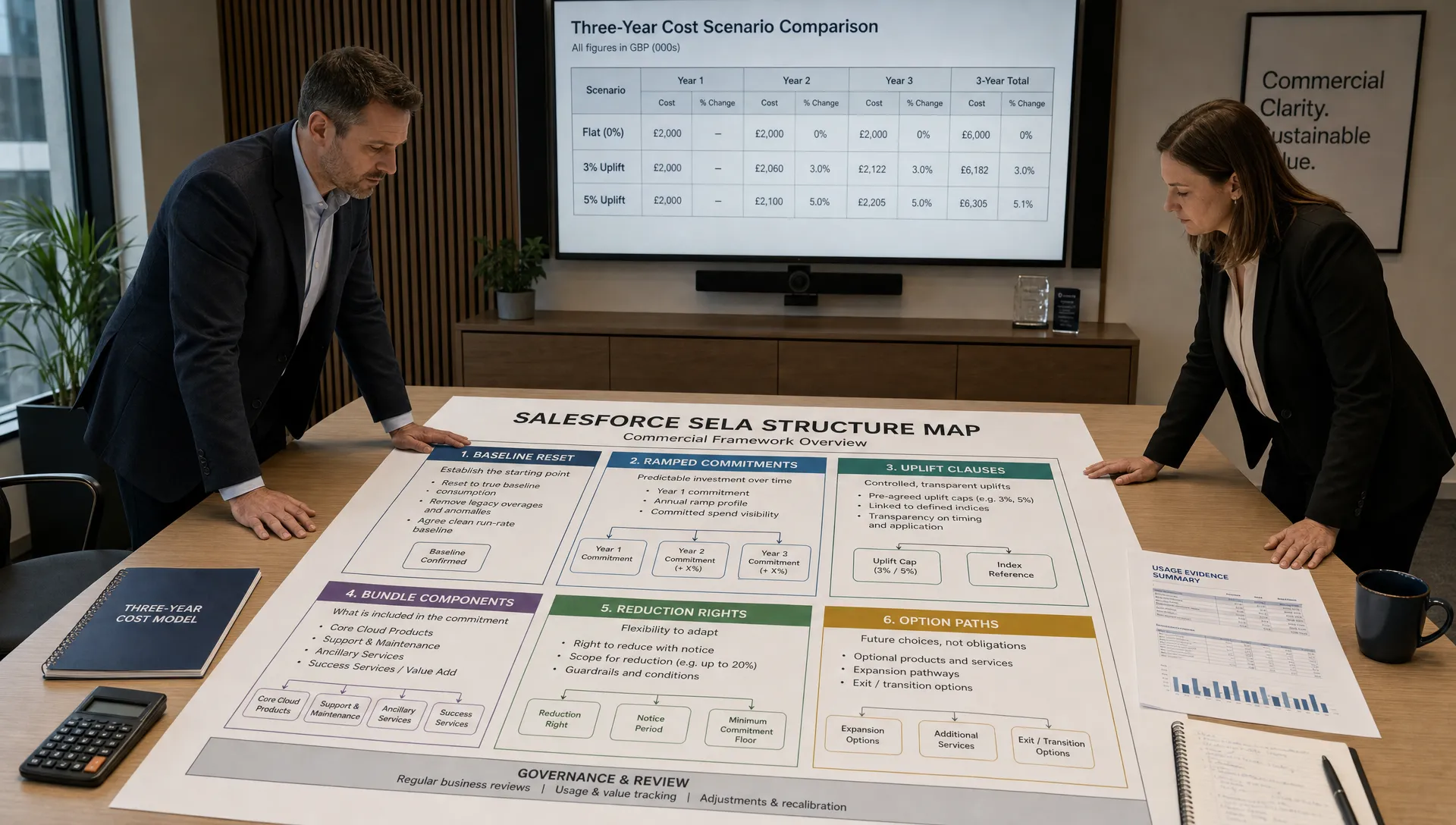
How to reduce Salesforce SELA overspend without damaging the roadmap
To reduce Salesforce SELA overspend, do not start by cutting. Start by classifying.
Some spend is productive. Some is insurance. Some is political. Some is simply unknown. The CFO’s role is to stop those categories blending into one renewal number.
Protect the products with real adoption
There will usually be parts of the Salesforce estate that are central to revenue, service operations, integration or executive reporting. Do not weaken those casually. A poor negotiation is not one that pays for value. A poor negotiation is one that pays for value and waste as if they were the same thing.
Where adoption is strong, use it. High-value products can justify multi-year certainty if the economics are clean. But clean means product-level clarity, price protection and a renewal path that does not punish success with an unexplained baseline reset.
Convert uncertain demand into options
Future demand should not automatically become committed spend. If a business unit expects to adopt a product in 18 months, negotiate option rights, pre-agreed pricing, phased activation or conditional expansion. Do not pay today for an adoption plan that has no funded owner.
This is especially important where AI, data and automation products are being introduced into the estate. The strategic direction may be right, while the committed quantity is wrong.
Keep risk and compliance in the same conversation as price
A SELA that pulls in data, integration or AI workloads should be reviewed for operational risk as well as commercial value. Use Salesforce Trust to validate service status, security information and trust commitments as part of the wider risk assessment.
This does not replace legal review. It gives the CIO and risk teams a shared evidence base when deciding whether a broader commitment is operationally sensible.
Decide which flexibility is worth paying for
Flexibility has a price. The question is whether you know what that price is.
If Salesforce offers a stronger discount for a broader commitment, model the cost of lost optionality. What is the cost if adoption is 20% lower than forecast? What if a business unit is divested? What if an acquired company runs a different CRM estate? What if a product is replaced by an adjacent platform?
A SELA is not just a purchase. It is a set of assumptions about your next three to five years. Those assumptions need owners.
Salesforce shelfware optimization: make waste visible before it renews
Salesforce shelfware optimization is not a policing exercise. It is a governance exercise.
The aim is not to embarrass business units for poor adoption. The aim is to stop quiet waste from becoming contractual truth. In large estates, shelfware tends to sit in three places: dormant licences, premium editions used like basic editions, and overlapping products solving the same business problem.
A disciplined review asks four questions before renewal sign-off:
- Which licences or entitlements have materially low usage over the last two quarters?
- Which premium features are paid for but not used in the workflow?
- Which products duplicate capability already paid for elsewhere?
- Which future-use products have a funded adoption plan, named owner and implementation date?
If the answer is unclear, the product should not be treated as proven demand. It may still belong in the roadmap, but it should be negotiated as an option, not a fixed commitment.
For teams still testing whether the SELA form itself is suitable, SaaSed’s Enterprise Salesforce SELA procurement and cost optimisation advisory sets out the decision criteria in more depth.
A practical 2026 SELA renewal control checklist
Before entering detailed Salesforce SELA negotiations, make sure the buying team can answer these points without relying on the account team’s interpretation:
- What is the true current ACV by product family, net of one-off credits and prior concessions?
- Which clauses create 3% to 5% annual uplift, ramped pricing or renewal baseline resets?
- Which products are essential, under-adopted, speculative or duplicative?
- What is the 3-year and 5-year cost under flat, 3% and 5% uplift scenarios?
- Which products can be removed, reduced, swapped or delayed without repricing the entire estate?
- Which business owners have signed off future adoption assumptions?
- What is the credible alternative if the proposed SELA is commercially too rigid?
- Which approval body owns the final trade-off between price, flexibility and risk?
If those answers are not ready, the negotiation is not ready. The vendor may still be ready. That is a different matter.
Frequently Asked Questions
What is changing in Salesforce SELA agreements in 2026? The main shift is not a single public template change. It is the increasing use of broader bundles, multi-year ramps, uplift language, baseline resets and product complexity inside strategic agreements. Buyers need to test the commercial architecture, not just the headline discount.
How early should we start a Salesforce SELA renewal process? For a mid-to-large enterprise with $1m to $10m in Salesforce ACV, 180 to 240 days before renewal is a sensible planning window. Complex estates need time for usage analysis, stakeholder alignment, legal review and alternative modelling.
How do we reduce Salesforce SELA overspend without weakening important programmes? Separate proven demand from speculative demand. Protect products with clear adoption and business value, then negotiate options, phased activation or removal rights for products that are not yet justified by usage or funded roadmap.
What should a Salesforce commercial structure audit include? It should include order forms, amendments, SKU-level entitlements, usage data, support levels, renewal clauses, uplift mechanics, product dependencies, business ownership and future roadmap assumptions. The goal is to reconstruct the economics before accepting a new structure.
Is a Salesforce SELA always worse than a standard enterprise agreement? No. A Salesforce SELA can be useful where there is genuine enterprise-wide adoption, clear governance and strong product-level transparency. It becomes risky when bundled pricing hides value, shelfware is carried forward, or flexibility is traded away without being priced.
Closing Thought: Make the Commercial Structure Legible
A Salesforce SELA renewal should not feel like a fog bank. If the structure is good, it can survive scrutiny. If it cannot survive scrutiny, the discount is not the point.
If you are approaching a Salesforce SELA renewal and want to eliminate overspend with precision, visit our contact page for a complimentary Salesforce audit conversation and to book a direct, confidential strategic session with Anders to audit your commercial structure.
Want this kind of intel on your renewal?
Don’t head into your next software negotiation alone
Talk to the team