Salesforce Commercial Structures: Standard Agreement vs. SELA vs. AELA
Salesforce agreement type is not a legal detail; it decides where cost and leverage sit. This guide compares Standard agreements, SELA and AELA so finance, IT and procurement can test the economics before renewal.

Salesforce procurement is complex by design. Complexity is a tax on the unknown: when a buyer cannot see unit economics, bundle logic, or renewal mechanics, the commercial discussion tilts away from them.
Standard Salesforce agreements buy named products and seats. SELA contracts buy broader enterprise access through a larger multi-year commitment. AELA, the newer 2026 model built around Agentforce and Data Cloud, shifts the argument from human users to autonomous AI agents and data dependency.
The right structure is not the one with the cleanest slide. It is the one that fits your 24-month roadmap, preserves pricing transparency, and leaves you with credible renewal leverage.
For any of these models, the executed order form and product terms matter more than commercial shorthand. Salesforce publishes its agreements and product terms, but your negotiated order form is where the economics usually live.
What Is a Standard Salesforce Subscription Agreement?
A Standard Salesforce Subscription Agreement is the conventional order-form model in which an organisation buys specific Salesforce products, editions and quantities for a fixed term. It is usually governed SKU by SKU and seat by seat, so flexibility depends on the exact products, quantities, co-termination rules and renewal language in the contract.
This is the familiar model for Sales Cloud, Service Cloud, Marketing Cloud, Tableau, MuleSoft, Slack and related products when they are purchased as discrete subscriptions. It gives the buyer clearer unit pricing, but less ability to move value across product lines once the term has started.
- Rigid SKU boundaries: A standard agreement normally ties commercial value to specific products and quantities. If you have 500 unused Sales Cloud seats, that value does not automatically convert into Service Cloud, Tableau, MuleSoft or Agentforce capacity unless your contract says it can.
- Retail overage penalties: If the business exceeds contracted user caps or needs urgent mid-term expansion, incremental licences may be quoted at weaker discounts, compressed co-term periods or current list pricing. The financial spike can feel like a penalty even when it is technically an add-on order.
- Seasonal needs advantage: For organisations with temporary worker spikes, graduate intakes, seasonal service peaks or regional rollouts that are not permanent, a standard agreement can be cheaper than a blanket SELA. Paying for a narrower set of known users can beat paying for broad enterprise access that sits idle for nine months of the year.
The standard model is not inherently weak. It is often the cleanest option when the Salesforce estate is stable, product ownership is disciplined and the business has enough procurement control to prevent unmanaged add-ons.
The weakness appears when teams treat the standard agreement as a filing exercise. Small expansions, co-termed add-ons and emergency purchases can create a messy renewal baseline. By the time finance sees the full picture, the account team may already be using last year’s fragmented purchases as proof of a higher future commitment.
When Does a Standard Agreement Work Best?
A Standard Salesforce Subscription Agreement works best when usage is measurable, product demand is specific and the organisation does not need broad cross-cloud flexibility. It favours buyers who can forecast seat demand with reasonable confidence and who value pricing transparency over broad bundled access.
For CFOs, the standard model is usually easier to govern because each SKU has a visible cost. For CIOs, it can be restrictive if teams need to shift value quickly between clouds. For procurement, it offers cleaner benchmarking, but only if every add-on is documented with the same discipline as the original order.
A good standard renewal pack should show active users, inactive users, assigned licences, feature usage, add-on history, price per SKU, renewal uplift clauses and any co-term compression. Without that evidence, the buyer is negotiating from memory while Salesforce is negotiating from telemetry, order history and pipeline intelligence.
What Is a Salesforce SELA Contract?
A Salesforce SELA is a customised, multi-year, enterprise-wide commercial agreement that trades higher committed spend for broader access across a defined Salesforce estate. It is not genuinely unlimited by default; the order form sets the products, floors, usage rights, growth assumptions and renewal baseline.
A SELA, often called a Salesforce Enterprise Licence Agreement, is usually discussed when the customer has a large annual contract value, multiple Salesforce clouds and a strategic expansion agenda. It can simplify internal access and reduce procurement friction, but it can also hide the true cost of each product inside a single blended commitment.
If you need the deeper mechanics, SaaSed has a separate primer on what a Salesforce SELA actually is. The important point here is simpler: a SELA is not just a bigger standard agreement. It changes the way risk is priced.
- The Bundle Trap: Salesforce can roll Sales Cloud, Service Cloud, Slack, Tableau, MuleSoft, Data Cloud or other products into one blended commercial package, making the total look tidy while hiding whether each component is fairly discounted. SaaSed's countermeasure: insist on line-item pricing, named SKU quantities, unit rates, discount levels and renewal rates before signature.
- Hidden Restrictions: SELA language may suggest broad access, while the order form still includes usage caps, minimum floors, excluded products, restricted clouds, deployment conditions or future spend commitments. SaaSed's countermeasure: define exactly what is included, what is excluded, which affiliates are covered and what happens if usage mix changes.
- The SELA Renewal Uplift: Some SELA structures create an automatic 7-10% baseline increase, or a similar economic effect through ramps, floors or committed growth assumptions. SaaSed's countermeasure: model the renewal baseline against actual utilisation, not against the theoretical maximum access Salesforce says you could have used.
The strongest SELA business case appears when three conditions are true. First, the organisation has a funded multi-cloud roadmap, not a wish list. Second, Salesforce will be a core platform across multiple divisions, not a point solution in one function. Third, internal governance is mature enough to allocate access, retire shelfware and prevent the SELA from becoming a warehouse for unused entitlements.
SELA pricing can look attractive in year one because the headline discount is larger than a standard agreement. The question is whether the committed floor, renewal uplift and unused bundle components erase that discount by year three. SaaSed’s article on how SELA pricing models affect renewal costs explores that renewal effect in more detail.
A SELA is not a mistake when it is built on data. It becomes expensive when the buyer signs for optionality without pricing the cost of unused optionality.
What Is Salesforce AELA?
A Salesforce AELA, or Agentic Enterprise License Agreement, is a 2026 enterprise licence model designed around Agentforce, Data Cloud and autonomous AI agent use rather than named human users. It replaces, for the covered AI scope, the per-seat metric with a flat unlimited-use fee, while leaving the real economics in definitions such as covered agents, data services, actions, environments and renewal uplift.
AELA is commercially significant because it changes the centre of gravity. Traditional Salesforce pricing asks how many people need access. AELA asks how much of the enterprise’s AI operating layer should sit inside Salesforce.
That is a different procurement problem.
- Integration Gravity: A flat fee for unlimited Salesforce agents can create an internal monopoly. Once teams perceive Salesforce agents as already paid for, procurement may struggle to justify alternative tools such as Microsoft Copilot, specialist workflow automation or vertical AI applications, even when those alternatives are better suited to a use case.
- Data Core Lock-in: AELA structures are commonly tied to Data Cloud because agents need governed data, identity, context and workflow access. The more agentic activity depends on Salesforce Data Cloud, the more switching costs move from software licence cost to architecture, data model, integration and operating process.
- Definition Drift: The word unlimited is only useful if the contract defines the limit of what is unlimited. Buyers need written definitions for covered agents, actions, conversations, data processing, API calls, sandboxes, logs, excluded workloads, premium services and future product packaging changes.
- Benchmark Loss: A flat enterprise AI fee can make year-one approval easier, but it can also remove the unit metrics that procurement needs later. If you cannot measure cost per agent, cost per workflow, cost per transaction or cost per business outcome, the next renewal becomes a debate about dependence rather than value.
AELA should not be evaluated as a cheaper way to buy AI. It should be evaluated as a platform commitment. The commercial risk is that the first AELA term becomes the anchor for a much larger AI renewal before the organisation has enough usage evidence to know what it is worth.
AI procurement also has a governance dimension. The European Commission overview of the EU AI Act is a useful reminder that AI systems are no longer just IT tools; they sit inside risk, compliance and operating control. Even adjacent markets, from content provenance to AI text detection, show how quickly AI categories can appear, fragment and mature. An AELA should not freeze your sourcing strategy before your AI governance model has caught up.
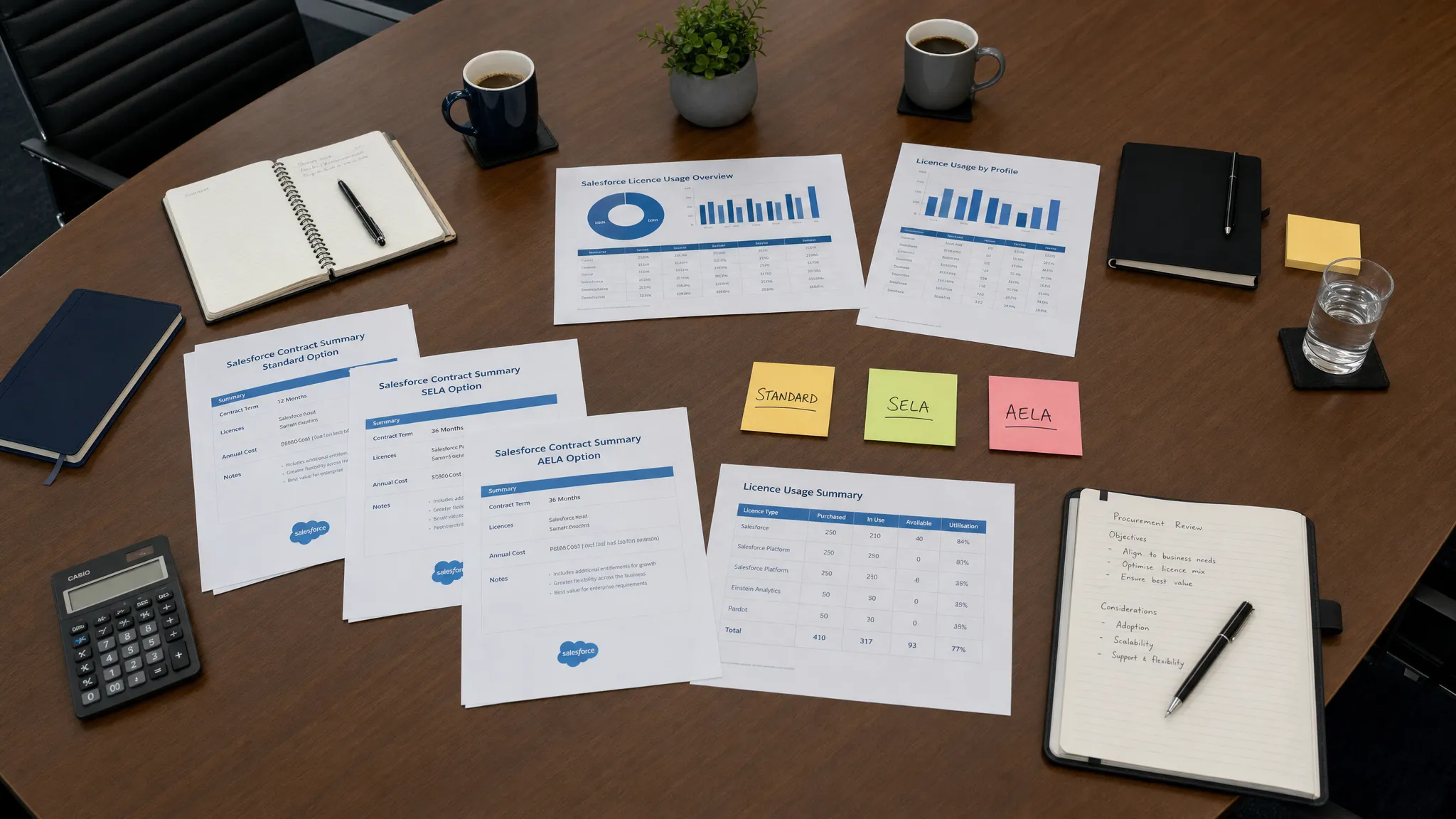
Standard Agreement vs SELA vs AELA: Head-to-Head Architectural Comparison
This table compares the three Salesforce commercial structures by pricing metric, enterprise fit, primary commercial trap and renewal complexity. The comparison is architectural, not legal advice; the signed order form, product terms and negotiated amendments decide the actual outcome.
| Contract Structure | Core Metric | Ideal Corporate Scale | Primary Commercial Trap | Renewal Negotiation Complexity |
|---|---|---|---|---|
| Standard Salesforce Subscription Agreement | Named users, product SKUs and contracted quantities | Departmental or multi-department estates with stable demand and clear product ownership | SKU rigidity, weak add-on pricing, fragmented co-term purchases and list-price expansion | Medium |
| Salesforce SELA | Enterprise commitment, bundled product scope and multi-year commercial floor | Large enterprises with multi-cloud Salesforce adoption and funded rollout plans | Opaque bundle economics, shelfware, hidden restrictions and renewal uplift on unused access | High |
| Salesforce AELA | Flat enterprise fee for defined AI agent and Data Cloud scope | AI-forward enterprises with a clear agentic roadmap, strong data governance and executive sponsorship | AI platform lock-in, undefined unlimited use, Data Cloud dependency and loss of unit benchmarks | Very high |
The table shows why these structures should not be compared only on first-year discount. A standard agreement may have a weaker headline discount but stronger control. A SELA may reduce friction while increasing renewal exposure. An AELA may solve AI adoption bottlenecks while creating a deep architectural dependency.
How Should CFOs, CIOs and Procurement Leads Compare the Three Models?
CFOs, CIOs and procurement leads should compare Salesforce commercial structures by modelling committed spend against actual usage, planned deployments and credible exit options over the next 24 months. The lowest headline price is often not the lowest total cost if it weakens transparency, reduces competitive tension or turns unused access into the next renewal baseline.
The practical test is not whether Salesforce can explain the structure. It is whether your team can independently prove the economics.
- Start with consumption facts: Pull assigned licences, active users, inactive users, permission sets, feature usage, login patterns, cloud-by-cloud adoption and regional deployment status. A price discussion without usage evidence is just a discount discussion.
- Separate roadmap from aspiration: A funded deployment with named owners, budget and dates can justify a broader commitment. A strategic idea without delivery capacity should not be priced as if it were guaranteed adoption.
- Model shelfware before flexibility: Broad access can be valuable, but only if the business can consume it. If 20-30% of the estate is inactive or underused, the first negotiation lever is often already inside the contract.
- Price the option value of flexibility: Standard agreements preserve product-level clarity. SELA and AELA structures may offer operational freedom, but the buyer should calculate what that freedom costs and what rights are lost in exchange.
- Protect future competition: A commercial structure should not quietly decide your architecture. Before signing a SELA or AELA, confirm where Salesforce is the deliberate platform choice and where you still want market options.
This is where many renewals go wrong. Buyers negotiate hard on discount but leave the structural terms untouched. The clauses that matter are often quiet: renewal uplift, minimum commitments, usage caps, audit rights, true-up language, add-on pricing, bundle definitions and product substitution rights. SaaSed’s guide to SaaS contract clauses that drive up Salesforce costs is a useful checklist before renewal discussions start.
What Data Should You Audit Before Choosing Standard, SELA or AELA?
A Salesforce commercial audit should connect contract entitlements, actual usage, product roadmap and renewal terms into one view. Without that evidence, the buyer cannot know whether a standard agreement, SELA or AELA is commercially rational.
| Audit Layer | Evidence to Collect | Why It Matters |
|---|---|---|
| Contract baseline | Current order forms, amendments, renewal dates, uplift clauses, add-on history and co-term rules | Shows the real commercial starting point and hidden renewal traps |
| SKU and licence usage | Assigned seats, active users, inactive users, permission sets and product-level utilisation | Identifies shelfware and unused products before Salesforce prices the renewal baseline |
| Business roadmap | Funded projects, regional rollouts, AI use cases, decommissioning plans and executive priorities | Separates genuine future demand from speculative expansion |
| Bundle economics | Line-item pricing, discount by SKU, included products, excluded products and substitution rights | Prevents blended pricing from hiding weak economics |
| Data and AI dependency | Data Cloud scope, agent use cases, integrations, governance requirements and competing AI tools | Tests whether AELA is an architecture decision, not just a procurement shortcut |
| Renewal leverage | Competitive alternatives, internal approval dates, cancellation rights and negotiation timeline | Determines whether procurement has time and evidence to negotiate properly |
A useful Salesforce case study rarely starts with the final saving. It starts with the evidence that made the saving possible: what was used, what was unused, what was needed next and what Salesforce assumed the customer would not challenge.
Practical Decision Rules for Standard, SELA and AELA
A practical Salesforce contract decision rule should match commercial structure to certainty. The more certain your usage and architecture are, the easier it is to justify a larger enterprise commitment; the less certain they are, the more valuable transparency and reversibility become.
Use a standard agreement when your demand is known, your product mix is stable and you need clean unit pricing. It is also often the better structure for seasonal or project-based demand where broad enterprise rights would create expensive shelfware.
Consider a SELA when Salesforce is already a broad enterprise platform, the rollout plan is funded and the organisation can consume the access within the term. Do not sign a SELA simply because the discount is larger or because it reduces short-term procurement effort.
Treat AELA carefully when AI strategy is still forming. AELA can be sensible where Agentforce and Data Cloud are deliberate architectural choices, with funded use cases and governance in place. It is risky when used as insurance against uncertainty, because the buyer may pay for broad AI optionality before knowing which agents will matter.
The hard question is simple: if this agreement became the baseline for your next renewal, would you be comfortable defending it to the board with usage data?
Frequently Asked Questions
Is a Salesforce SELA always cheaper than a standard agreement? No. A SELA can reduce unit costs on paper, but the total cost can be higher if the organisation pays for unused products, accepts opaque bundle pricing or agrees to a higher renewal baseline.
What does unlimited mean in a Salesforce AELA? Unlimited only means what the order form says it means. Buyers should define covered agents, workloads, data services, environments, integrations, exclusions and renewal treatment before relying on the term.
Can a standard Salesforce agreement be better for a large enterprise? Yes. Large enterprises with stable usage, seasonal peaks or a narrow Salesforce footprint may get better control from a standard agreement than from a broad SELA or AELA commitment.
How early should procurement prepare for a Salesforce renewal? For a $1M-$10M Salesforce annual contract value, procurement should ideally start several months before the renewal date. The work that matters is usage analysis, SKU review, internal alignment and negotiation strategy, not last-week discount chasing.
What is the first document to request before comparing Standard, SELA and AELA? Start with the full current contract pack: order forms, amendments, product terms referenced by the order forms, pricing exhibits, renewal clauses and add-on history. Then match that contract baseline against actual usage.
Strategic Calibration Before You Sign
The right Salesforce agreement only exists after a precise, data-backed audit of your actual 24-month roadmap. Standard, SELA and AELA are not good or bad in isolation. They are good or bad relative to usage, architecture, governance and renewal leverage.
If you are approaching a renewal, SaaSed can help with an independent contract benchmark, line-item pricing analysis, shelfware review and negotiation strategy before the commercial path is set. If useful, you can arrange a complimentary Salesforce audit conversation with SaaSed and pressure-test the structure before you sign.
Want this kind of intel on your renewal?
Don’t head into your next software negotiation alone
Contact Us