Salesforce Agentforce: What Enterprise Leaders Actually Need to Know
Agentforce can be useful, but only when the data, governance and commercial model are clear. This article gives CFOs, CIOs and procurement leaders a plain-English view of the value, cost risks and questions to ask before renewal.

Salesforce Agentforce: Innovation or Another Layer of Complexity?
Salesforce Agentforce is being positioned as the next step in CRM automation. For enterprise leaders, the useful question is not whether the technology is impressive. Some of it is.
The sharper question is simpler: will Salesforce Agentforce reduce operational friction, or will it add another commercial and technical layer to an already expensive estate?
Complexity is a tax on the unknown. If they cannot convince you, they may confuse you. Agentforce deserves a clear assessment before it becomes part of your next renewal conversation.
Executive Summary
• Agentforce is not just a chatbot. It is Salesforce’s move towards autonomous AI agents that can take actions across CRM workflows.
• The clearest early use cases sit in Sales and Service, where repeatable decisions, clean data and tight guardrails already exist.
• The hidden costs are often outside the licence line: Data Cloud, integration work, governance, usage-based pricing and internal process redesign.
• CFOs, CIOs and procurement teams should treat Agentforce as a commercial architecture decision, not a feature add-on.
What is Salesforce Agentforce, Really?
In plain English, Agentforce is Salesforce’s framework for building AI agents that can reason over business context and take approved actions inside Salesforce workflows. Salesforce’s own Agentforce materials describe it as a platform for deploying autonomous agents across functions such as sales, service, marketing and commerce.
The shift matters. A traditional chatbot answers questions from a script or knowledge base. A copilot helps a human user draft, summarise or find information. An agent can move a process forward within defined limits.
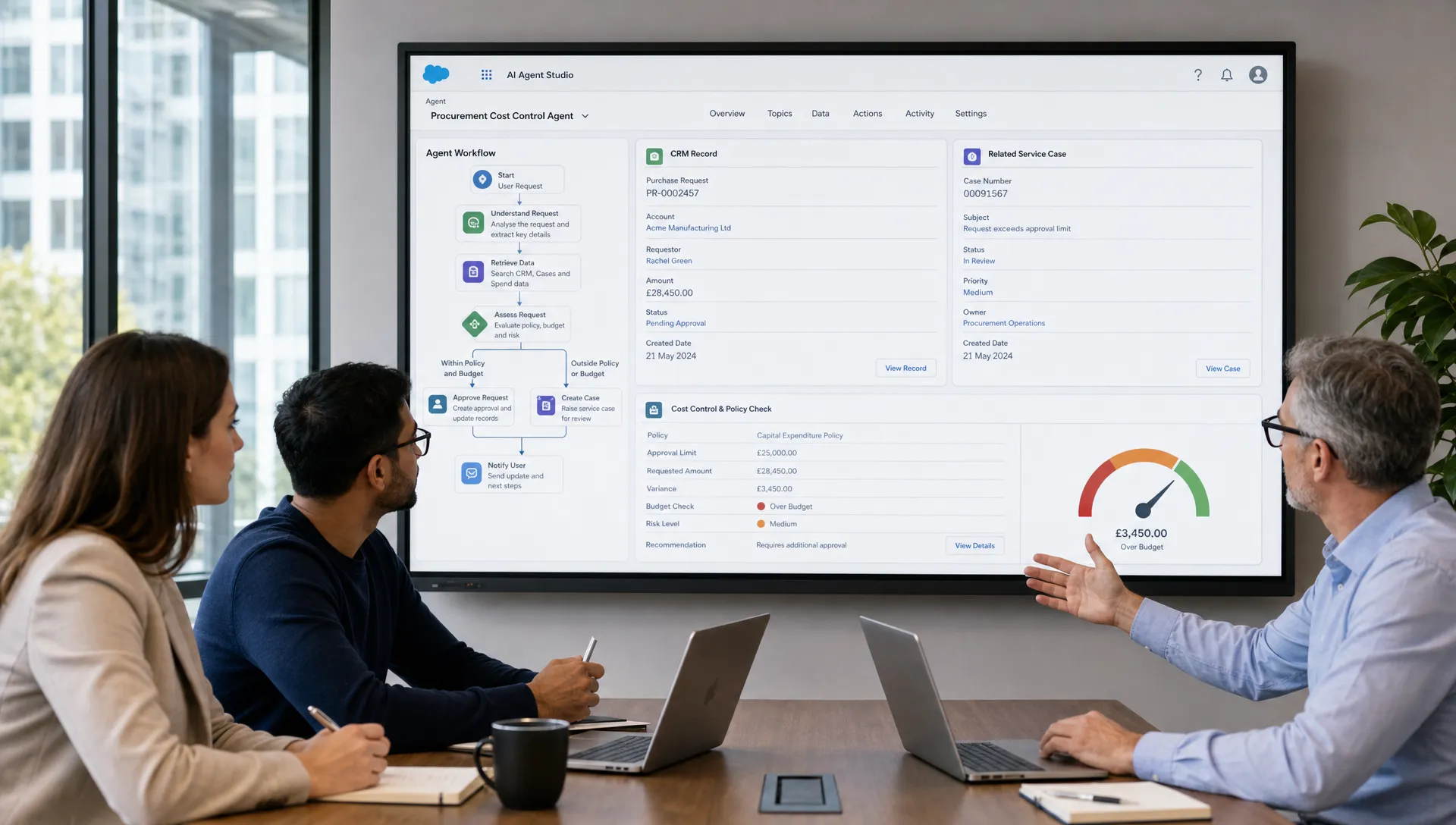
That could mean updating a record, triaging a case, prompting a customer, checking entitlement data, creating a follow-up task or routing work to the right team. It is not magic. It is an orchestration layer that depends heavily on data quality, permissions, workflow design and human oversight.
This is why the buyer conversation should stay grounded. Agentforce is most useful where your processes are already well understood. If the underlying CRM data is fragmented, the knowledge base is stale, or teams disagree on what “qualified” means, the agent will not solve that. It may simply automate the confusion.
For a wider view of how AI agents have evolved from basic chatbots into digital workers, SaaSed has covered the broader shift in AI agent trends.
How It Operates in Practice
Sales: qualification, prioritisation and follow-up
A sales agent might monitor inbound leads, review account history, assess buying signals, summarise context and suggest the next best action. In more mature environments, it may create tasks, draft outreach, enrich opportunity notes or route a lead to the correct owner.
The value is not replacing sales judgement. It is removing low-value manual work around follow-up, routing and CRM hygiene.
But this only works if the sales process is disciplined. If stages are inconsistently used, account hierarchies are poor, or pipeline data is politically managed, Agentforce will inherit those weaknesses. It can make a good process faster. It cannot make a weak process honest.
Service: case triage and guided resolution
In Service Cloud environments, an agent can read a case, check knowledge articles, review customer history, verify entitlements and propose a response. In controlled scenarios, it may complete an action such as resetting access, providing order status or escalating to a specialist queue.
The practical benefit is faster resolution for repeatable issues. It can reduce queue pressure and improve consistency where the answer is known, documented and safe to automate.
The risk sits in edge cases. Poor knowledge articles, unclear escalation paths and incomplete customer records can produce poor outcomes quickly. Service agents need strong guardrails, clear approval thresholds and a clean audit trail.
The Hidden Enterprise Costs & Data Readiness
For CFOs and CIOs, the Agentforce business case should include more than licence cost. The real number is the cost of making autonomous behaviour reliable enough for enterprise use.
Data readiness is usually the first constraint. Agentforce needs access to trusted enterprise data, whether through Salesforce Data Cloud, existing integrations or other governed data sources. That means identity resolution, permissions, data lineage, deduplication and clear rules for which systems are authoritative.
This is not unique to Salesforce. In regulated or operationally complex sectors, platforms only create value when the transaction layer and reconciliation logic are clean. A travel agency using an all-in-one payment platform, for example, benefits from unified payment management because the operating data is structured and controlled. The same principle applies to AI agents: bad data does not become good because an agent can read it.
Commercially, Agentforce also changes the renewal conversation. Buyers need to understand whether pricing is seat-based, usage-based, credit-based, bundled into a wider agreement, or tied to other Salesforce products. Small assumptions at pilot stage can become expensive at enterprise scale.
This is where Agentforce overlaps with the broader AELA discussion. If your Salesforce team is being guided towards enterprise-wide AI consumption models, it is worth understanding how Salesforce AELA changes the commercial dynamics before the renewal clock starts to bite.
Before committing, leadership should ask a few direct questions:
• Which business outcome will Agentforce improve, and what is the baseline today?
• Which data sources are required, and what must be cleaned or integrated first?
• What happens when usage grows faster than expected?
• Which actions can the agent take without human approval?
• How will failures, escalations and audit logs be reviewed?
These questions are not blockers. They are the minimum discipline required before adding autonomy to a critical system.
Traditional Chatbots vs. Einstein Copilot vs. Agentforce
| Traditional Chatbots | Einstein Copilot | Agentforce |
|---|---|---|
| Usually script-based or rules-based. | Assists users inside Salesforce. | Acts within defined workflows and guardrails. |
| Best for FAQs and simple routing. | Best for drafting, summarising and recommendations. | Best for repeatable operational tasks. |
| Limited context and limited action. | Uses CRM context to support human decisions. | Uses business context to move work forward. |
| Lower governance burden, lower capability. | Moderate governance burden. | Higher governance burden due to autonomy. |
| Cost risk is usually predictable. | Cost risk depends on packaging and adoption. | Cost risk may include usage, data, integration and renewal dependencies. |
Conclusion: Useful, If You Control the Shape of It
Salesforce Agentforce may become a valuable layer for enterprise teams with mature processes, clean data and clear operating controls. It is less attractive when bought as a broad promise before the organisation knows where autonomy should sit.
The risk is not AI itself. The risk is buying complexity before you have named the value, priced the dependencies and protected your renewal position.
If Agentforce is entering your Salesforce roadmap, start with the estate you already own: contracts, SKUs, shelfware, usage, data readiness and negotiation leverage. Much of the answer is already there.
SaaSed helps enterprise teams pressure-test Salesforce renewals, SKU decisions and commercial risk before the negotiation narrows. If a grounded second view would be useful, you can book a complimentary Salesforce audit conversation with our team.
Want this kind of intel on your renewal?
Don’t head into your next software negotiation alone
Contact Us