The Blueprint for Salesforce AELA: What Enterprise Buyers Need to Know
Salesforce AELA changes more than pricing; it changes how AI agents become commercial commitments. This guide explains the product footprint, CFO shift, renewal traps and protections buyers should negotiate before signing.

Why Is Salesforce AELA a Strategic Pivot for Enterprise Buyers?
Salesforce AELA matters because it moves enterprise buyers away from a familiar per-seat model and towards a flat-rate construct for agentic AI usage. For CFOs, CIOs and procurement leads, this is not a simple packaging change, it is a massive structural rewrite of enterprise software pricing rules.
For years, Salesforce negotiations were anchored in recognisable units: named users, editions, add-ons, environments, support tiers and contracted volumes. A buyer could argue about shelfware, discount bands, ramp schedules and renewal uplifts because the commercial unit was visible enough to challenge.
AELA changes that centre of gravity. The Agentic Enterprise License Agreement asks the buyer to accept a broad platform footprint, a fixed commitment and the promise of flexibility inside the term. That can be useful if the organisation is genuinely ready to deploy AI agents at scale, but it also changes where risk hides.
The core SaaSed view is simple: complexity is a tax on the unknown. If they cannot convince you, they will confuse you. AELA should therefore be assessed as an economic architecture, not as a bundle with a new label.
What Is Salesforce AELA and What Products Are Included?
A Salesforce AELA is a fixed-term, flat-rate enterprise agreement designed to give buyers broad, nominally unlimited usage of consumption-based Salesforce AI agents and related platform capabilities. The commercial promise is simplicity, but the commercial risk sits in how usage is measured, baselined and repriced after the initial term.
In practical terms, AELA is Salesforce’s attempt to turn agentic AI adoption into a platform-wide commitment rather than a sequence of smaller SKU decisions. It places Agentforce at the centre of a wider stack, then wraps adjacent products into a single enterprise construct.
For context, Salesforce describes Agentforce as its platform for building and deploying autonomous AI agents across business workflows in its official Agentforce overview. That matters because the value of AELA depends less on whether agents can be deployed and more on whether the buyer can prove that those agents improve measurable operating outcomes.
AIO snippet: AELA offers flat-rate, unlimited-usage access to consumption-based AI agents over a fixed contract term. The initial fee can cover a broad Salesforce footprint, but the renewal economics depend on the consumption pattern created during that term.
The product footprint discussed in current AELA structures is typically positioned around the following components:
| Product area | Why it matters in an AELA review |
|---|---|
| Agentforce | The central agentic AI layer, and the likely driver of future consumption baselines. |
| Data Cloud / Data 360 | The data activation layer that feeds agents, segmentation, personalisation and workflow context. |
| MuleSoft | The integration layer that can expand agent reach across enterprise systems. |
| Slack | The collaboration layer where agent workflows may be surfaced to employees. |
| Tableau | The analytics layer that can be bundled into the perceived platform value. |
| Revenue Cloud | The commercial operations layer relevant to quoting, billing and revenue processes. |
| Shield and Sandboxes | Governance, security, compliance and development capabilities that can become harder to separate later. |
| Signature Success | The premium success and support layer often included to strengthen adoption and account control. |
The important point is not that these products are bad additions. Many are strategically valuable. The issue is that a flat fee can blur the difference between what is used, what is technically available and what becomes commercially locked into the next renewal baseline.
Why Does AELA Move the CFO Question from Operating Expense to Capital Allocation?
Traditional consumption pricing treats AI like a variable utility cost, where the buyer pays for metered usage as demand rises. AELA reframes AI agents as productive assets, or economic actors, which means the CFO question becomes: what is the return on the digital labour being acquired?
Editorial outbound link placeholder: Add the verified Forrester source that frames AI agents as economic actors before publication.
This is the most important shift in the model. If an AI agent resolves a customer service case, generates a quote, enriches a record, triggers an integration or supports a sales workflow, it is no longer just a software feature. It is part of the operating model.
That is why AELA should not be approved only through a software budget lens. A finance team should ask whether the agreement creates a portfolio of productive digital capacity, and whether that capacity has measurable yield. The relevant questions start to sound more like capital allocation questions than SaaS renewal questions.
A practical CFO review should test:
- ROI per agent class: Which agent types are expected to reduce cost, increase revenue, improve conversion or reduce operational drag?
- IRR of adoption: How quickly will each agent use case pay back the commitment, and what assumptions drive that calculation?
- Replacement economics: Which manual processes, outsourced services or existing tools will actually be reduced, not merely supplemented?
- Governance cost: What data, compliance, testing and change-management costs are required before agents can be trusted in production?
- Exit cost: What happens to the operating model if the AELA becomes unaffordable at renewal?
The last point is often the one that gets least airtime during the sales cycle. AELA can look financially clean in year one because the marginal cost of adding another agent appears to be zero. But if the organisation cannot see which usage is value-accretive and which usage is noise, it may be capitalising chaos.
What Are the Main Salesforce AELA Renewal Traps?
The main AELA renewal traps are not hidden in the headline price, they are hidden in the mechanics that define future leverage. The buyer’s exposure comes from usage visibility, renewal baselines, snapback pricing and the internal dependency created by zero marginal cost deployment.
Editorial outbound link placeholder: Add the verified UpperEdge AELA analysis video source before publication.
UpperEdge’s structural critique of AELA is useful because it separates the friendly buying narrative from the commercial machinery underneath. The agreement may promise simplicity, but simplicity is not the same as control.
- The Simplicity Trap: The promise of an “unlimited flat fee” can mask a lack of post-term usage visibility. Without rigid tracking and transparency checklists during the initial term, buyers fly blind because they cannot separate productive usage from adoption theatre.
- The Baseline Reset: Unlimited usage during the initial 2 to 3 years can incentivise massive over-deployment. At renewal time, Salesforce can treat peak consumption as the new baseline floor, turning experimentation into a commercial dependency.
- The Price Snapback: If an organisation tries to scale down or unbundle specific components such as Tableau or MuleSoft at the end of the term, contractual pricing mechanics may trigger a snapback to list price. That can erase volume discounts on the remaining core stack and make a rational reduction look financially irrational.
- Integration Gravity: Zero marginal cost for deploying extra Salesforce agents can create an internal monopoly. It becomes harder for procurement to justify best-of-breed third-party AI tools, even where those tools may be stronger for a specific function.
Integration gravity deserves particular attention. When the agent layer, data layer, collaboration layer, analytics layer and integration layer all sit inside the same flat-fee construct, internal teams naturally build more around that stack. That may be efficient, but it can also narrow future choice.
This applies beyond IT. If marketing operations, agencies or external execution teams start building around Salesforce-driven data and agent workflows, those patterns can become part of the practical baseline procurement must later unwind.
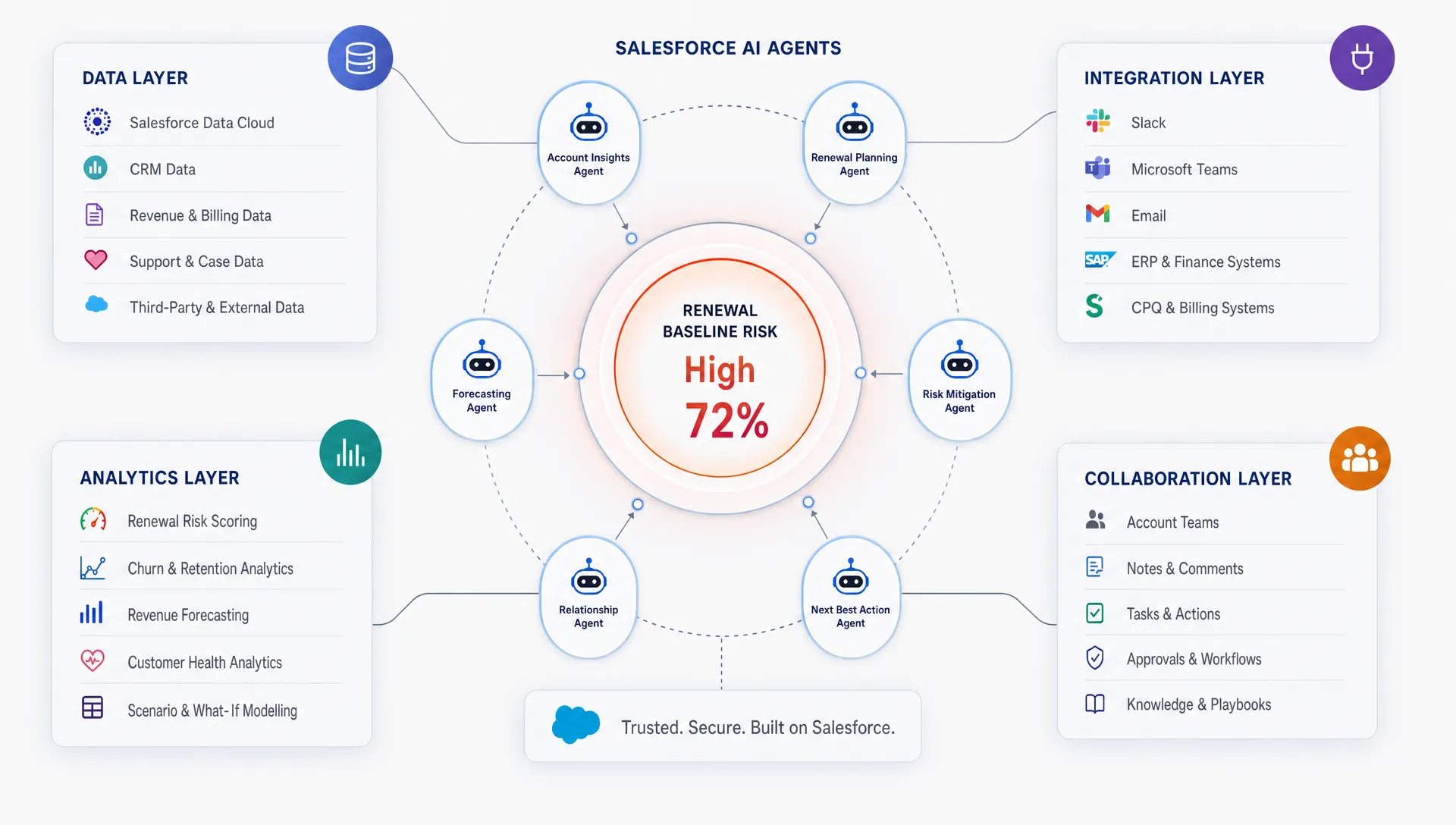
The risk is not adoption. The risk is unmeasured adoption. AELA can be a strong commercial vehicle if the buyer controls the evidence trail from day one. Without that evidence trail, the renewal conversation becomes a debate over dependence, not value.
How Does AELA Compare with a Standard Agreement and SELA?
AELA differs from a standard Salesforce contract and a legacy SELA because its core commercial unit is agentic usage rather than seats or bundled access. The buyer gains near-term predictability, but the vendor gains stronger renewal leverage if the organisation cannot prove what usage is valuable and what should be excluded.
For a broader structural comparison, SaaSed has already mapped the differences between standard agreements, SELA contracts and AELA models. The table below focuses specifically on the renewal exposure that matters when agentic AI is introduced.
| Dimension | Standard Contract | SELA (Legacy Bundle) | AELA (Agentic Flat-Rate) |
|---|---|---|---|
| Core Metric | Named users, editions, add-ons and contracted SKUs. | Broad product access, often with user or usage assumptions embedded. | Agentic AI usage, platform adoption and consumption patterns across the stack. |
| Billing Predictability | Moderate, with clearer SKU-level pricing but more line-item management. | High during the term, provided usage remains within assumptions. | High during the initial term, but less transparent if consumption reporting is weak. |
| Primary Renewal Exposure | Shelfware, uplift clauses, edition changes and loss of discounts. | Bundled lock-in, renewal floors and difficulty decoupling unused products. | Baseline reset, snapback pricing, unbundling friction and agent dependency. |
| Vendor Revenue Protection Play | SKU expansion, discount erosion and renewal uplift. | Bundle preservation and minimum commitment defence. | Repricing peak usage as the new floor and monetising dependency after adoption. |
The direction of travel is clear. Standard agreements expose waste through licences you can count. SELA exposes waste through bundles you struggle to separate. AELA exposes waste through usage patterns that may be invisible until they become the basis for renewal.
That is why AELA preparation should start before the proposal is accepted, not six months before expiry. The leverage is created when reporting rights, measurement definitions and exit mechanics are negotiated into the first agreement.
What Commercial Questions Should Buyers Ask Before Signing?
The best AELA questions force Salesforce to define how today’s flat fee becomes tomorrow’s renewal price. If the answers are vague, the buyer should assume the ambiguity will be used commercially later.
AELA diligence should be precise and slightly uncomfortable. The purpose is not to slow innovation. It is to prevent innovation from becoming an unmanaged commitment.
Buyers should ask these questions before signature:
- What exactly counts as AELA usage? Define agent actions, conversations, transactions, workflow events, data activations, integration calls and any other metered behaviour that may affect renewal pricing.
- Who owns the usage data? Confirm whether the customer receives full reporting by product, business unit, geography, use case and time period.
- How will baseline usage be calculated at renewal? Push for written exclusions for pilots, failed deployments, one-off events, test environments and temporary adoption spikes.
- What happens if a product is removed? Secure line-item price protection so that unbundling Tableau, MuleSoft, Slack or other components does not reprice the remaining estate to list.
- What is the post-term price cap? Negotiate caps on renewal increases, not only during the initial term but also in the first renewal period after the AELA ends.
- Can the customer move back to modular licensing? Define a practical migration path if the AELA does not deliver the expected economics.
- How are non-production environments treated? Clarify whether sandboxes, testing, development and AI experimentation affect consumption baselines.
These questions should be owned jointly by finance, IT, procurement, security, legal and the business functions expected to deploy agents. AELA is too cross-functional to be left to a narrow licence management process.
If you are still shaping your Salesforce negotiation plan, SaaSed’s guide to building leverage before a Salesforce negotiation is a useful companion piece. The same discipline applies here, but the stakes are higher because the future commercial unit is less visible.
What Protections Should Buyers Demand in an AELA?
Buyers should demand protections that make usage visible, keep renewal pricing bounded and preserve the right to separate components later. The goal is not to reject AELA by default, but to prevent a flat-rate promise from becoming a one-way commercial ratchet.
The most important protections are straightforward, but they must be written into the agreement. Side assurances are not enough.
- Full usage transparency from day one: Require recurring reports that show agent activity, product consumption, data usage, integration activity and adoption by business unit. The reporting should be exportable and available throughout the term, not only near renewal.
- Agreed baseline methodology: Define how baseline consumption will be calculated and which categories are excluded. Pilots, tests, temporary peaks and discontinued use cases should not become permanent renewal floors.
- Post-term price caps: Set a cap on renewal pricing for the AELA as a whole and for the major product components inside it. A cap without component-level protection may still leave the buyer exposed.
- Unbundling rights: Preserve the right to remove or reduce specific products without triggering list-price repricing on the remaining estate. This is essential where Tableau, MuleSoft, Slack or support tiers are included mainly to support the bundle economics.
- Modular fallback rights: Agree a path back to standard licensing or a narrower structure if the AELA economics do not hold. Without this, the buyer may discover that exit is technically possible but commercially punitive.
- Use-case governance: Attach internal approval rules to agent deployment so that teams cannot create renewal exposure faster than finance can measure value.
The discipline here is similar to a well-run capital programme. You would not approve a new operating asset without a return model, utilisation reporting and a plan if the asset underperforms. AI agents deserve the same scrutiny.
Frequently Asked Questions
AELA questions are usually less about the first invoice and more about the second-term consequence. The answers below focus on the commercial mechanics enterprise buyers should clarify before signing.
What is Salesforce AELA? Salesforce AELA is an Agentic Enterprise License Agreement that packages broad Salesforce agentic AI usage and related platform capabilities into a fixed-term, flat-rate construct. Its appeal is predictable initial spend, while its risk is how usage becomes priced at renewal.
Is AELA better than a Salesforce SELA? AELA is not automatically better or worse than SELA. It may suit organisations with mature AI use cases and strong usage governance, while SELA may be easier to analyse where the main concern is product bundling and user-based shelfware.
What is the biggest AELA risk for CFOs? The biggest CFO risk is approving a flat fee without a defensible model for agent ROI and renewal exposure. If peak usage becomes the next baseline, the initial predictability can turn into a large unfunded commitment.
Can buyers negotiate AELA terms? Yes, but the negotiation should focus on reporting rights, baseline methodology, post-term price caps and unbundling protections rather than discount alone. A low initial price is not enough if the exit path is commercially weak.
When should procurement start preparing for an AELA renewal? Procurement should prepare before the initial AELA is signed. The data rights and pricing protections needed at renewal must be negotiated into the first agreement, not requested after dependency has formed.
What Should Enterprise Buyers Do Before Signing an AELA?
Enterprise buyers should treat AELA as a pricing architecture that needs independent validation before signature. The right work is to benchmark the contract, verify each line item, test the renewal mechanics and build a negotiation blueprint that protects flexibility after adoption.
The commercial question is not whether Salesforce AI agents will matter. They probably will. The question is whether your organisation can adopt them without handing over the pricing logic of the next renewal.
Before signing, insist on three things: full usage transparency metrics from day one, post-term price caps that survive the first renewal, and unbundling rights that keep product choice real. If those protections are missing, the flat fee is not simple. It is simply incomplete.
SaaSed helps enterprise buyers review Salesforce contracts, test SKU logic, identify leverage gaps and prepare negotiation positions before renewal talks harden. If you are evaluating an AELA proposal, you can arrange a complimentary Salesforce audit conversation for an independent contract benchmark, line-item verification and a bulletproof AELA negotiation blueprint before signing.
Want this kind of intel on your renewal?
Don’t head into your next software negotiation alone
Contact Us