When Does Your Salesforce Renewal Actually Start?

Waiting for a renewal quote leaves little time to check what you actually need. Learn how to verify contract dates, build a licence baseline and organise Salesforce renewal preparation before commercial discussions begin.
When does a Salesforce renewal actually start?
Your Salesforce renewal should start 12 to 18 months before the contract end date, not when the quote arrives. Starting 8 to 12 months ahead is still a very good preparation window. Large bundled agreements need the earlier start.
The contract end date is a legal and commercial milestone. Your renewal start date is an internal decision: when you begin checking what you own, what you use and what you intend to buy again. Confusing those dates leaves procurement responding to a proposal before it has established its own position.
For large contracts, including bundled agreements such as a SELA, preparation means more than collecting licence totals. You need to understand the products inside the agreement, their quantities, their owners and their relationship to actual use. A single commercial package can conceal several distinct buying decisions.
When does Salesforce renewal start on your side?
Your internal renewal starts when procurement opens a review against the actual contract end date and assigns ownership of the evidence needed to make the buying decision.
That review should produce a usable baseline, not simply a calendar reminder. It must connect the contract to the deployed licences and connect those licences to business requirements. Otherwise, the existing order becomes the default answer to what you need next.
The useful distinction is between preparing and negotiating. You can begin preparation without requesting a quote or making a commercial commitment. Early work gives IT time to validate usage and Finance time to distinguish continuing requirements from proposed additions. Procurement then enters the conversation with a defined requirement rather than an inherited basket. So when does Salesforce renewal start? Earlier than the quote, and earlier than most teams plan for.
How do I find my renewal date?
Find your renewal date in the executed order form and any subsequent documents that amend its subscription term, then check them against the governing agreement. Do not rely solely on the original signature date, an account summary or a date supplied in a renewal email.
Salesforce's customer agreements page provides the contractual framework: customer terms are set by the Main Services Agreement and the order form, which specifies products, quantities and prices. Your own executed documents are the records you need to review.
Collect the original order, later additions and any amendments that changed the term. Record the start and end dates attached to each subscription rather than assuming that everything follows the same clock.
To determine when to begin your renewal, the first practical task is therefore to establish which end date you are working towards. A planning window calculated from an unverified date is not a reliable renewal plan.
Which documents should I reconcile before setting the clock?
Reconcile each executed order form with its amendments and the products currently provisioned, so the renewal calendar reflects the agreement you actually have.
A useful contract register connects each product or bundle to its quantity, term, document reference and internal owner. Where records disagree, mark the discrepancy and resolve it before treating either version as authoritative. Do not silently choose the date that gives you more preparation time.
Check notice requirements in your own order form and governing documents. Keep any notice obligation separate from the contract end date in your register. Preparing before expiry does not, by itself, establish that you have met a contractual requirement.
If an amendment is unclear, obtain clarification against the actual document. The objective is a verified calendar that procurement, IT and Finance can all use, not an informal recollection of the last negotiation. Once the dates are verified, you can answer one question properly: when does Salesforce renewal start for your own contracts?
Why does Salesforce's fiscal year matter to my price?
Salesforce's fiscal year matters because its final quarter is when deal pressure is highest, which can make timing commercially relevant. Salesforce's fiscal year ends on 31 January, as recorded in Salesforce's annual report (Form 10-K). That does not guarantee a discount or change your contractual obligations.
There are two clocks to distinguish: your contract calendar and Salesforce's financial calendar. The former determines the dates you must manage. The latter provides context for the commercial conversation. Neither replaces the other.
When deciding when to begin renewal preparation, the fiscal year is therefore a planning consideration, not the answer. You still begin with your end date and work backwards into the preparation window. Waiting for year-end pressure without building your evidence leaves you with urgency but little control over the requirement.
How should I use the fiscal calendar without letting it run my renewal?
Use the fiscal calendar to inform the timing of an already prepared commercial discussion, not to accelerate an untested buying decision.
If a proposal is presented as a year-end opportunity, compare it with your verified requirement. Check whether the offer changes the term, brings forward the renewal or adds products that your internal review has not approved. A timing argument does not resolve those questions.
The same discipline applies when your contract ends outside the final quarter. You still need a complete baseline and a clear position. Do not assume that a different fiscal window makes preparation less valuable or makes the quoted terms final.
For Finance, separate the attraction of the proposed price from the commitment being requested. A proposal can look favourable against the current quote while still changing the duration or composition of the purchase. Assess the whole agreement before assigning value to its timing. So when does Salesforce renewal start in relation to the fiscal year? Well before the year-end window, not because of it.
What happens if I start 3 months out instead of 12?
Starting 3 months before the contract end date is damage control, not a strategy. You cannot build leverage through time at that point. The remaining leverage is technical findings: a SKU audit, a licence baseline comparing assigned licences with actual use and identification of unused “ghost” licences.
Below 8 months, the leverage you have shrinks with every month that passes. That is the plain reason timing matters. It is not a claim that a particular outcome becomes impossible; it means you have less room to establish and validate your position before the decision is due.
For a late starter wondering when to begin, the answer is to begin the evidence review now. Do not spend the remaining preparation time treating the existing product names and quantities as settled facts.
Which technical findings should I prioritise when time is short?
Prioritise the SKU audit, the assigned-versus-used licence baseline and unused licences, because those findings can identify differences between the proposed purchase and the requirement you can substantiate.
A SKU audit checks whether the proposed item corresponds to the contracted product. SKU renaming can mask price increases, so a different name should prompt a comparison of the underlying entitlement and commercial treatment. A renamed item is not automatically equivalent to the old one.
The licence baseline separates licences assigned to users from licences actually in use. Assignment alone does not demonstrate a continuing requirement. Have the relevant owner validate what the usage evidence means rather than treating a login record as the entire answer.
Finally, identify unused or “ghost” licences and establish why they remain in the estate. Keep the findings factual and traceable. Technical evidence can support the discussion, but it does not guarantee a reduction, a revised quote or any other commercial outcome. When does Salesforce renewal start for a late starter? Today, with the evidence you can still gather.
What is an uplift cap, and when does it not protect me?
An uplift cap limits a specified price increase under the wording of your agreement; it does not necessarily limit the total renewal bill. Its protection can fail to cover products that are restructured, renamed or bundled, or an early renewal that resets the pricing baseline.
Start with the clause itself. Establish which products and price basis it covers, which event brings it into effect and whether the proposed renewal preserves those conditions. Do not substitute a remembered negotiation point for the wording in the executed agreement.
Understanding when to begin renewal preparation matters here because reviewing the cap belongs in preparation, before you treat a proposal as a like-for-like continuation. A cap is useful only if you can identify the baseline against which it operates.
What should I compare before relying on the cap?
Compare the protected contractual baseline with the proposed products, quantities, packaging and term before deciding that the cap controls the renewal.
A product rename may make the comparison harder without changing what you need. A bundle can combine previously separate items and obscure how the proposed price relates to the old order. An early renewal can introduce a new baseline that changes the relevance of the previous protection.
Those possibilities do not mean every rename defeats a cap. They mean you must check whether the clause still applies to the purchase being proposed. Separate an increase in the price of an existing entitlement from a change in what the agreement contains.
The contract renewal risks to catch early include precisely these gaps between the old baseline and the new proposal. Resolve them while you can still ask for a clear comparison. The question is not simply whether a cap exists, but whether it protects this renewal on these terms.
Who inside Salesforce actually approves my deal?
Deal desk generally decides discounts, especially on large deals; on smaller deals, the account executive may be able to make the decision. You should not assume that the person presenting a proposal has authority to approve every commercial change you request.
Keep the distinction practical. Your contact can discuss the requirement and present terms, but you need to know whether those terms are approved and whether a requested change needs deal desk approval. There is no need to speculate about an internal hierarchy you cannot verify.
This is another reason to decide when to begin renewal preparation before the quote arrives. You want the requirement and its supporting evidence established before asking for changes, rather than repeatedly revising the purchase while trying to understand what can be approved.
What should I establish about approval before treating a proposal as final?
Establish whether the proposed terms are approved, which requested changes remain unresolved and whether those changes require deal desk approval.
Ask those questions directly and keep the answers with the proposal. Distinguish a discussed possibility from an approved commercial position. If your contact cannot yet confirm a term, record it as unresolved rather than including it in the figure presented internally as settled.
Your contribution is a coherent buying requirement: the products needed, the quantities supported by the licence baseline and the contractual points requiring clarification. That makes the request specific. It does not entitle you to a particular discount or approval.
Avoid building the internal decision around an informal indication that a better price may be available. Finance needs to understand which terms are confirmed and which remain under discussion. Procurement should maintain that distinction until the executable documents match the position being considered.
What should I have ready before the first conversation?
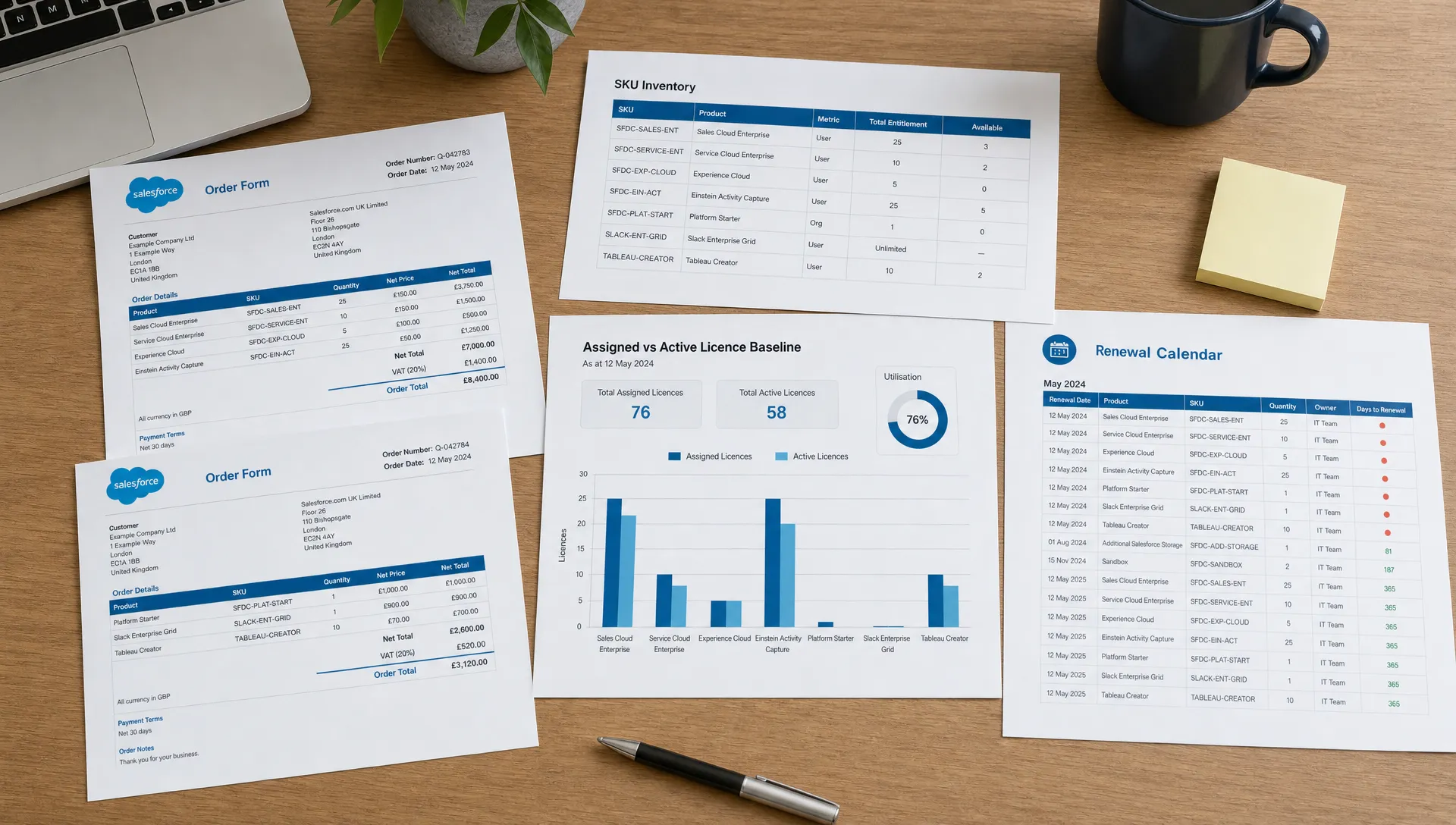
Before the first renewal conversation, have a SKU inventory, contracted quantities, assigned-versus-active usage, verified contract end dates and named internal owners. Procurement, IT and Finance should agree what that evidence supports before the existing order becomes the starting requirement for the discussion.
Keep the contractual and technical views together. The order form tells you what was purchased. The usage review tells you what is deployed and used. The internal owner explains whether that use represents a continuing requirement. None of those views is sufficient on its own.
Once the renewal preparation window is settled, this preparation becomes the substantive work. A date in the calendar creates no leverage unless the team uses the available time to establish a defensible baseline.
So when does Salesforce renewal start in practice? When this evidence exists, not when the quote lands.
What should the internal renewal pack contain?
The internal renewal pack should connect each purchased SKU to its quantity, usage evidence, contract end date and accountable owner, with discrepancies and proposed changes made explicit.
Use a working record that Procurement, IT and Finance can reconcile. Mark requirements as confirmed or unresolved rather than concealing uncertainty inside a single total. Keep proposed additions separate from the existing baseline so they do not quietly become part of the renewal assumption.
When the licence evidence suggests a mismatch, right-sizing the Salesforce user licence mix is a distinct task within preparation. The timing decision gives you room to do that work; it does not determine which entitlement a user needs.
Module 4, “The Enterprise Roadmap”, in the renewal crash course is relevant to organising this preparation; the crash course requires registration.
For Finance, summarise the continuing requirement, proposed additions and unresolved commercial assumptions separately. That gives the budget owner a figure with an explanation, rather than a quote whose composition has not been checked. Procurement remains responsible for ensuring that the commercial position matches the underlying evidence.
Can my own upsell trigger my renewal early?
Your own mid-term upsell can trigger an early renewal if the proposed agreement replaces or extends the existing commitment and resets its term and pricing baseline. An additional purchase does not automatically do this, so compare the proposed documents with the current order before signing.
A business request for more capacity can become a broader commercial proposal. The important question is whether you are buying an addition within the existing arrangement or agreeing to a new arrangement for the wider estate. Those are different decisions, even when they originate from the same requirement.
For renewal timing, this means the trigger may be your own purchase request rather than the approaching end date. Treat a proposal that changes the term or baseline as renewal work, not merely as an operational addition.
What should I check in a mid-term upsell proposal?
Check which existing commitments the proposal changes, whether it introduces a new end date and whether it replaces the pricing baseline used for future renewal discussions.
Read the proposed order alongside the current agreement. Identify what remains unchanged and what is being replaced, added or bundled. If the documents do not make that distinction clear, resolve it before evaluating the proposal as an incremental purchase.
Revisit any uplift protection against the proposed baseline. A favourable-looking addition can still change the basis on which the next renewal is calculated. Do not assume that protections attached to the existing arrangement transfer unchanged to a new one.
Keep the operational need separate from the broader commercial commitment. IT can validate the additional requirement while Procurement checks the proposed term and Finance assesses the commitment. Approval of the need for more licences is not, by itself, approval to renew the wider agreement early.
The 12-month renewal timeline: what to do when
So when does Salesforce renewal start? Use the phases below as a working plan.
Start preparation ideally 12 to 18 months before the contract end date, use the 8 to 12 month window to complete the internal evidence work and recognise that less time means less leverage. This timeline defines the renewal start through actions rather than the arrival of a quote.
| Phase | What to do | What should be clear afterwards |
|---|---|---|
| About 12 to 18 months out | Find every contract end date, audit the SKUs and build the licence baseline. This is the ideal start, especially for large bundled contracts such as a SELA. | Which agreements are approaching renewal and what the existing purchase contains. |
| About 8 to 12 months out | Run the structured internal audit and align Procurement, IT and Finance on usage, requirements and ownership. | Which requirements are supported by evidence and which questions remain unresolved. |
| Less than 8 months out | Resolve gaps in the contract and usage records and keep the buying requirement consistent. The leverage you have shrinks with every month that passes. | A usable baseline rather than an unchecked continuation of the old order. |
| About 3 months out | Treat the work as damage control. Focus on the SKU audit, assigned-versus-used licence baseline and unused “ghost” licences. | The technical findings you can substantiate without assuming a commercial outcome. |
| Signature | Reconcile the executable documents with the agreed products, quantities, prices, term and applicable protections. | A verified commitment and an accurate record for the next renewal. |
The sequence matters more than the label attached to a meeting. Preparation establishes the requirement, the commercial discussion tests the proposed terms and signature records the commitment. Do not let the arrival of a quote reverse that order.
Frequently asked questions
Is the renewal date the same for every product we own? Not necessarily; verify the dates against each order form and any amendments. Products purchased together or added later should not be assumed to share an end date. Keep a product-level contract register before deciding whether to manage them as one renewal.
Does Salesforce's fiscal year change my contract end date? No, the fiscal year does not itself change the end date in your agreement. It provides commercial context, not a replacement contract calendar. Any proposed change to your term needs to be assessed against the documents you are being asked to sign.
Who inside my company should own the renewal? Procurement should own the commercial renewal process, with IT validating requirements and Finance approving the financial commitment. For the internal question “when does Salesforce renewal start”, ownership means opening the review against a verified date and keeping the evidence aligned across those functions.
Can I reduce licences at renewal? Whether you can reduce licences depends on your contract, so check your order form and applicable terms before assuming a reduction is available. Establish the usage evidence separately: proving that a licence is unused does not, by itself, establish your contractual ability to remove it.
What should I do if I think my notice period has already passed? What you can do depends on your contract, so check your order form and governing documents before deciding that you have missed a requirement. Verify the relevant wording and dates, obtain clarification where needed and continue gathering the renewal evidence without assuming the commercial position is settled.
When does Salesforce renewal start for your own contracts? The assessment below helps you find out.
Use the 3-minute readiness assessment: Find your renewal window.
Want this kind of intel on your renewal?
Don’t head into your next software negotiation alone
Contact Us