What to Check Before You Procure a Software Contract
A software deal is rarely expensive because of the headline price alone. This guide gives CFOs, CIOs and procurement leaders a practical pre-signature checklist for demand, terms, renewal risk and leverage.

A software contract is easiest to improve before it exists. Once it is signed, every weak assumption becomes more expensive to correct: unused licences, awkward renewal dates, bundled products nobody owns and price protections that protect the supplier more than the customer.
That is why the work before signature matters. The goal is not to slow the purchase down. It is to make sure the agreement matches how the business will actually use the software, how budgets are governed and how much flexibility you will need later.
For CFOs, CIOs, IT leads and procurement leaders, the question is simple: before you procure a software contract, can you explain what you are buying, why now, what could change and where your leverage sits?
Start with the decision you are really making
A software contract is not just a route to access. It is a multi-year operating commitment. It can affect headcount planning, data architecture, security posture, customer operations and future sourcing choices.
The mistake is to treat the contract as the final administrative step after product selection. By then, most of the commercial shape has already hardened. Stakeholders have aligned around a preferred tool, users are waiting, implementation partners may be booked and the supplier knows the deal has internal momentum.
A better approach is to run commercial checks alongside product evaluation. Procurement should not arrive at the end with a red pen. Finance should not only approve budget. IT should not only confirm the technical fit. Each function needs to test the assumptions that will become contractual commitments.
The UK government’s Sourcing Playbook is written for public sector procurement, but one principle travels well into private software buying: early planning changes commercial outcomes. The earlier you define needs, risks and governance, the less likely you are to buy on the supplier’s timetable.
1. Check whether the business case still holds
Most software purchases begin with a sensible problem: improve sales execution, consolidate reporting, automate manual work, reduce risk or support growth. By the time the quote arrives, that original problem can be buried under demos, feature lists and stakeholder preferences.
Before approval, bring the business case back into plain language. What decision would this software improve? Which cost would it remove? Which risk would it reduce? Which team will be visibly worse off if the purchase does not happen?
A strong business case should answer five questions without resorting to optimistic adjectives:
- What is the measurable reason for buying this software now?
- Which teams will use it in the first year?
- Which existing tools, licences or processes will be retired?
- What internal work is required before value appears?
- Who owns adoption after the contract is signed?
If the only answer is that the platform is strategically important, you do not yet have enough to contract well. Strategic importance may justify investment, but it does not define licence volumes, renewal flexibility, support levels or exit options.
2. Confirm demand before it turns into committed licences
Demand forecasting is where many software contracts start to drift. The buying team asks stakeholders how many users they expect. Stakeholders add a buffer. The supplier prices a larger package attractively. The final number looks reasonable on the slide, but six months later finance is asking why adoption is lower than the paid entitlement.
Separate demand into real categories. Named users are not the same as occasional users. Core operational teams are not the same as future teams. Full licences are not the same as light access, read-only access or integration-only needs.
This is especially important if the purchase is linked to organisational change. A new region, shared service centre, acquisition or operating model can create genuine uncertainty. If a software purchase depends on a location decision, relocation plan or new workforce footprint, test those assumptions before they become fixed licence volumes.
Do not punish stakeholders for uncertainty. Capture it. A good contract can allow for ramping, phased deployment or narrower initial commitments. A poor contract converts uncertainty into shelfware.
3. Build the contract baseline before comparing offers
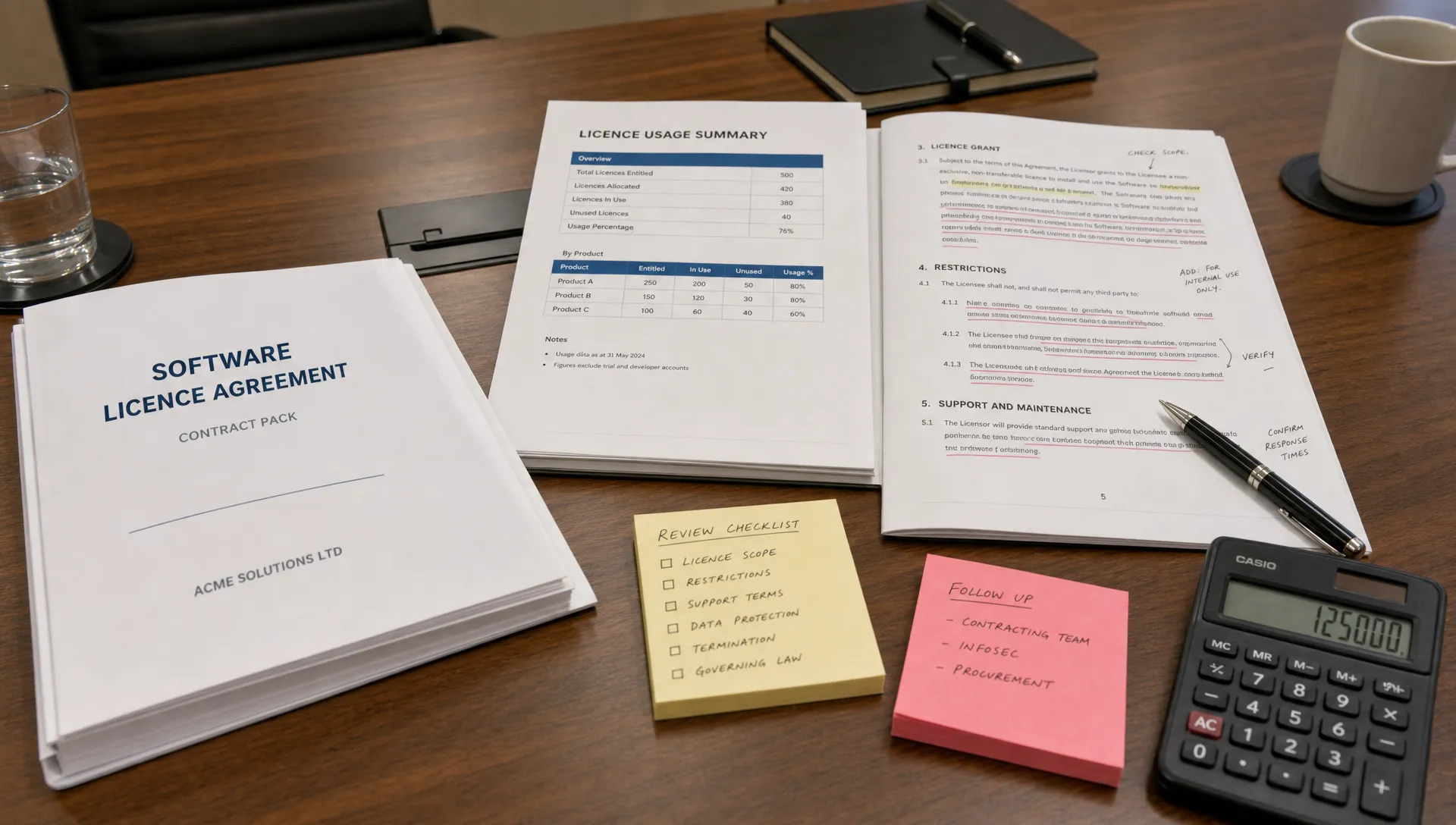
You cannot judge a software offer by the quote alone. The quote is only one layer. The real agreement is usually spread across an order form, master subscription agreement, data processing addendum, product terms, support policy, security documentation and sometimes partner statements of work.
For Salesforce agreements, for example, the legal and product framework can sit across several documents. Salesforce publishes its agreements and legal terms, but the commercial effect for your organisation depends on the specific order form, SKUs, amendments and negotiated terms you sign.
Before you compare options, collect the full baseline:
| Document or term | What to check | Why it matters |
|---|---|---|
| Order form | Products, quantities, start date, end date and billing terms | This is usually where the paid commitment lives |
| Master agreement | Liability, termination, renewal and audit provisions | These terms shape long-term risk |
| Product terms | Usage limits, feature restrictions and dependencies | Product names can hide important conditions |
| Data processing terms | Data location, subprocessors, security obligations and breach process | These terms affect compliance and operational risk |
| Support terms | Response levels, exclusions and escalation routes | Weak support terms can undermine critical systems |
| Statement of work | Implementation scope, responsibilities and assumptions | A licence deal can fail if delivery obligations are vague |
If the document set is incomplete, pause. Missing documents are not a paperwork nuisance. They make it harder to understand what the organisation is committing to. SaaSed has written separately on how to read a software contract before it costs you, which is a useful companion once the full pack is in hand.
4. Test the pricing model against likely change
Software pricing often looks clean in year one and less clean in years two and three. The headline discount is visible. The mechanics underneath are easier to miss.
Look beyond the net unit price. Check how the supplier handles future additions, reductions, product swaps, renewals, currency changes, inflationary uplifts and minimum commitments. If you expect growth, understand whether expansion will be priced at the same discount level. If you expect consolidation, understand whether you can reduce quantities or only add more.
Consumption pricing deserves particular care. It can be fair and efficient when usage is predictable, well measured and governed. It becomes difficult when business teams do not know which activities trigger cost or when technical usage grows outside procurement visibility.
Bundled pricing also needs pressure. A bundle can be good value if each component has an owner, adoption plan and measurable use case. It can be expensive theatre if weaker products are packaged with the one platform you actually need.
Ask the supplier to model realistic scenarios, not only the preferred case. What happens if adoption is 70 percent of forecast? What happens if one business unit joins late? What happens if a product module is delayed? A software contract should not assume perfect implementation.
5. Check usage rights, not just product names
Two products with similar names can carry different rights. Two licences for the same platform can support very different types of user. In SaaS, the SKU matters as much as the brand.
Usage rights can determine whether a contract is flexible or brittle. They affect which users may access the system, what data may be processed, which environments are included, whether APIs have limits, how sandboxes are licensed and whether AI or automation features carry additional restrictions.
This is where IT and procurement should work closely. Procurement can compare price and terms, but technical teams often know which rights are genuinely required. The risk is overbuying premium licences for users who do not need them or underbuying rights that later force an expensive upgrade.
6. Find renewal risk before the first term begins
Renewal risk is not a renewal problem. It is created at signature.
Auto-renewal clauses, notice periods, renewal uplift language, co-terming rules and restrictions on reducing quantities can decide how much leverage you have later. A contract that looks affordable today may become hard to reshape if the organisation cannot true down, remove unused modules or challenge future price increases.
Pay attention to co-terming. It can simplify administration, but it can also pull new purchases into an existing renewal cycle before they have been properly adopted. The business may then face a larger negotiation with less evidence than expected.
Also check whether any promotional pricing disappears at renewal. A first-term discount is not a saving if it merely sets up a steep increase later. Ask for the renewal price path in writing and make sure it is reflected in the contract, not just the sales conversation.
If renewal is already within sight for an existing platform, the review needs to begin well before the supplier’s quote lands. SaaSed’s article on why contract review should start months before renewal explains why late reviews tend to leave money and flexibility on the table.
7. Pressure-test implementation before accepting the commercial shape
A common procurement trap is paying for licences before the organisation can use them. The contract starts in January, the implementation starts in March, user training happens in June and serious adoption begins in September. On paper, the business bought a year. In practice, it bought a few months of productive use.
This does not mean every contract should start only after implementation. Sometimes early access is necessary for configuration, testing and migration. The point is to match the commercial structure to the deployment plan.
Check whether the agreement allows phased start dates, ramped quantities or delayed activation for certain modules. If the supplier will not offer flexibility, quantify the cost of the unused period and include it in the business case.
Implementation dependencies also matter. Who owns data cleansing? Who configures integrations? Which internal teams need to be available? Are partner costs approved? If these answers are vague, the licence contract may be moving faster than the organisation.
8. Review data, security and operational risk early
Security and legal review should not be a ceremonial gate at the end. If a tool will hold sensitive customer, employee or financial data, the risk review can affect the commercial position.
Data location, subprocessors, audit rights, access controls, encryption, breach notification, retention periods and deletion rights all matter. So does exit. Can you export the data in a usable format? Will the supplier assist? How long will data remain available after termination? What happens to integrations and historical records?
For critical systems, support terms deserve the same attention as price. A low price is not very helpful if response commitments are weak, exclusions are broad or escalation routes are unclear. CIOs and IT leads should decide which support obligations are necessary before procurement closes the deal.
Do not leave these points to redlines alone. Translate risk into commercial choices. If the supplier cannot meet a data requirement, does the business still want the tool? If stronger support is needed, is it included in the price or sold separately? If exit assistance is weak, what future cost should finance assume?
9. Make negotiation about evidence, not theatre
The best software negotiations are usually calm. They are built on evidence: actual demand, credible alternatives, contract risk, internal timing, budget constraints and a clear view of what the business can walk away from.
Last-minute pressure rarely helps the buyer. It tends to help the supplier, because internal urgency narrows options. If stakeholders have already promised the platform to the business, procurement is negotiating with one hand tied.
Leverage comes from preparation. It comes from knowing which SKUs are essential, which are optional, which dates matter, which terms are unacceptable and which commercial asks can be traded. It also comes from not confusing discount with value. A high discount on the wrong shape is still the wrong shape.
For Salesforce specifically, leverage often sits in the detail: SKU mix, adoption evidence, product overlap, renewal timing and the gap between the supplier’s preferred bundle and the customer’s real requirement. SaaSed covers this in more depth in how Salesforce procurement teams find hidden leverage.
A short pre-signature checklist
Before the contract goes for approval, the buying team should be able to answer these questions clearly:
- Is the business case still specific, current and owned by a named sponsor?
- Are licence quantities based on real user groups rather than padded forecasts?
- Have all contract documents been collected and reviewed together?
- Do pricing terms explain future additions, reductions, renewals and uplifts?
- Are product rights, usage limits and dependencies understood by IT?
- Does the implementation plan match the licence start dates and billing profile?
- Have data, security, support and exit terms been reviewed early enough to matter?
- Is the negotiation position based on evidence rather than supplier deadlines?
If any answer is weak, the issue should be surfaced before signature. Not every weakness is a reason to stop the deal. Some can be priced, negotiated or accepted knowingly. The danger is signing without seeing them.
Who should own which check?
Good software procurement is cross-functional, but shared ownership should not mean blurred ownership. Each leader should know what they are accountable for.
| Role | Primary responsibility before signature | Question to ask |
|---|---|---|
| CFO | Budget fit, cost trajectory and financial risk | What does this cost if adoption, growth or renewal pricing differs from plan? |
| CIO or IT lead | Technical fit, usage rights, implementation and support | Can we deploy, govern and support this software properly? |
| Procurement leader | Commercial structure, negotiation strategy and supplier commitments | Are we buying the right shape of contract, not just the right tool? |
| Legal or privacy lead | Liability, data protection, termination and compliance | Are the risks acceptable and clearly allocated? |
| Business sponsor | Adoption, outcomes and operational ownership | Who will make sure the promised value actually appears? |
This division keeps the conversation practical. It also prevents a familiar failure pattern: procurement negotiates price, IT handles implementation, finance tracks budget and nobody owns whether the contract still fits the business six months later.
Frequently Asked Questions
What should I check first before I procure a software contract? Start with the business case and demand assumptions. If the problem, user groups and adoption plan are unclear, the contract is likely to be too broad, too rigid or too expensive.
Is the cheapest software contract usually the best option? No. The better contract is the one that fits usage, risk and change. A low year-one price can become expensive if renewal uplifts, poor flexibility or unused licences are built into the terms.
How early should procurement be involved in a software purchase? Procurement should be involved during evaluation, not after the preferred supplier has been selected. Early involvement helps shape licence volumes, contract terms, negotiation strategy and renewal protection.
Which clauses create the most future cost? Renewal uplifts, auto-renewal provisions, minimum commitments, restrictions on reducing licences, weak price protection and unclear usage limits are common sources of future cost.
How is a Salesforce software contract different from a general SaaS contract? Salesforce agreements often involve multiple clouds, SKUs, amendments, product dependencies and renewal dynamics. General SaaS discipline helps, but Salesforce-specific commercial knowledge can reveal risks that a broad review may miss.
Before you sign, make the contract earn its place
A well-procured software contract should not rely on luck. It should reflect real demand, clear ownership, credible implementation plans and terms that will still make sense when the business changes.
The practical test is simple: if you had to explain the deal to the board one year from now, would the contract still look disciplined? If the answer is uncertain, slow down enough to check the assumptions before they become obligations.
If your next Salesforce agreement or renewal deserves a second pair of eyes, SaaSed offers a complimentary audit conversation focused on contract shape, SKU mix, usage and negotiation readiness. You can arrange that conversation here: book a complimentary Salesforce audit conversation.
Want this kind of intel on your renewal?
Don’t head into your next software negotiation alone
Contact Us