How Salesforce Procurement Teams Find Hidden Leverage
Hidden leverage in Salesforce procurement rarely appears in the first quote. It comes from better facts, earlier timing, cleaner demand and a calmer view of what the business really needs.

Salesforce leverage is often treated as something you either have or do not have. Big customer? Strong leverage. Small customer? Weak leverage. Renewal close? No leverage. Twelve months out? More leverage.
That view is too simple.
In Salesforce procurement, hidden leverage usually sits in the gaps between what the contract says, what the business actually uses, what Salesforce believes you will buy next, and how aligned your own stakeholders are. It is rarely one dramatic discovery. More often, it is a series of small commercial truths that change the tone of the renewal.
For CFOs, CIOs, IT leads and procurement leaders, the point is not to “beat” Salesforce. The point is to stop entering renewal talks with partial facts, soft demand signals and internal pressure that the supplier can read before the first pricing conversation begins.
What hidden leverage means in Salesforce procurement
Hidden leverage is commercial strength that already exists, but has not yet been turned into evidence.
It might be unused licences. It might be a product bundle where only one component is valuable. It might be a future roadmap that does not require the SKU mix currently being pushed. It might be a renewal term that exposes Salesforce to churn risk, if you are prepared early enough to act on it.
The common mistake is to define leverage as discount pressure. Discount matters, but it is only one outcome. Good Salesforce procurement teams look for leverage across five areas:
- Spend that is not tied to current business value.
- Contract terms that limit flexibility or create future risk.
- Roadmap assumptions that have not been tested with IT and business owners.
- Timing pressure that can be reduced by starting earlier.
- Supplier beliefs about your likely renewal behaviour.
The final point is often missed. Salesforce account teams build their own view of your organisation. They notice whether you start late, whether your executives are aligned, whether your admins can explain usage, and whether procurement has a credible alternative plan. Hidden leverage appears when that picture becomes less comfortable for the seller and more controlled for the buyer.
Start with the contract baseline, not the renewal quote
A renewal quote is Salesforce’s opening position. Your contract baseline is your opening position.
Before discussing price, procurement should build a clean view of the current commercial estate. That means more than collecting order forms. It means understanding the structure of what has been bought, when it renews, what is co-termed, which products are bundled, and where your rights are narrower than the business assumes.
A useful baseline should answer four simple questions.
| Baseline question | Why it matters |
|---|---|
| What are we contractually committed to today? | Prevents the team from negotiating against an incomplete view of obligations. |
| Which SKUs are business-critical, optional or unclear? | Separates value-bearing spend from inherited or speculative spend. |
| What commercial terms create renewal risk? | Highlights uplift clauses, auto-renewal language, ramp commitments and restrictive usage terms. |
| What flexibility do we actually have? | Shows whether reductions, swaps, phased changes or product exits are realistic. |
This is where many teams find their first leverage. Not because the contract contains a magic clause, but because it reveals choices the business had forgotten it had.
For example, a company may discover that a large part of its estate was added during a transformation project that has since changed scope. Another may find that several cloud products were purchased to secure a better headline discount, but only one is now deeply embedded. A third may realise that a renewal floor or uplift clause is much more important than the percentage discount being discussed.
If you want a broader checklist of early warning signs, SaaSed has covered related issues in its guide to Salesforce contract renewal risks to catch early.
Turn usage data into a commercial argument
Usage data is not leverage by itself. It becomes leverage when procurement, IT and business owners agree what it means.
Salesforce environments are complex. A low login count does not always mean a licence is waste. A lightly used integration product may still support a critical process. Equally, a highly discounted product may still be poor value if it was bought for a use case that never arrived.
The discipline is to classify usage into practical commercial categories. Keep it simple enough that finance, IT and procurement can use the same language.
| Usage category | Commercial interpretation | Possible action |
|---|---|---|
| Core and active | Strong business dependency | Protect continuity, negotiate fair forward pricing. |
| Active but over-specified | Users need capability, but not always at current edition or SKU level | Review edition mix, permissions and role design. |
| Low use with business reason | Usage is limited but justified | Keep, but document the reason before negotiation. |
| Low use without owner | Weak value evidence | Challenge renewal volume or bundle inclusion. |
| Unused or duplicated | No clear business case | Remove, reduce or trade for genuinely needed capability. |
The strongest position is not “we use less than we bought”. It is “we know exactly what we use, why we use it, what we no longer need, and what we are prepared to change”.
That last phrase matters. Suppliers can withstand vague complaints about shelfware. They react differently when a buyer has already mapped owners, usage, dependencies and removal options.
Look for leverage inside the SKU mix
Salesforce buying decisions often happen over several years, through multiple projects, stakeholders and commercial cycles. That history leaves traces in the SKU mix.
Procurement teams should look for three patterns.
First, inherited complexity. This happens when historic product decisions remain in place long after the original business case has faded. Nobody owns the waste, so it keeps renewing.
Second, bundled opacity. This happens when multiple products are priced together in a way that makes it hard to see the cost of each component. Bundles can be useful, but they can also weaken future negotiating control if you cannot separate what is essential from what is optional.
Third, edition drift. This happens when users sit on a higher edition or product tier than their actual work requires. Sometimes the higher tier is justified. Sometimes it is simply the result of standardisation that was never revisited.
The SKU review should not become a theoretical clean-up exercise. It should produce a negotiation-ready view of where you will defend spend, where you will challenge it, and where you need optionality.
Salesforce’s own published product and pricing information can help teams frame questions about editions and packaging, especially when comparing current entitlements with available product structures. The important point is not to treat Salesforce’s UK pricing pages as your negotiation benchmark. They are a reference point, not a substitute for your contract history, usage evidence and forward demand.
Test the roadmap before Salesforce tests it for you
Hidden leverage is not only found in the past. It is also found in the gap between your future roadmap and the supplier’s growth plan.
Salesforce account teams are trained to identify expansion paths. That is reasonable. Their job is to grow the account. Your job is to know which growth is real, which is premature, and which is mostly supplier-led.
Before renewal discussions, procurement should sit with IT and business owners and test the roadmap in plain terms:
- Which Salesforce capabilities are essential for the next 12 to 24 months?
- Which projects are funded, approved and staffed?
- Which ideas are still exploratory?
- Which existing tools overlap with proposed Salesforce products?
- Which purchases would create implementation work the organisation cannot absorb?
This is not a defensive exercise. Some expansion may be sensible. The risk is buying ahead of execution capacity, then paying for licences or clouds that sit half-used while the business catches up.
A good roadmap review gives procurement a calm answer when expansion is introduced into a renewal: “This is in scope, this is not funded, and this can be revisited later if the business case is approved.”
That sentence has leverage because it removes ambiguity.
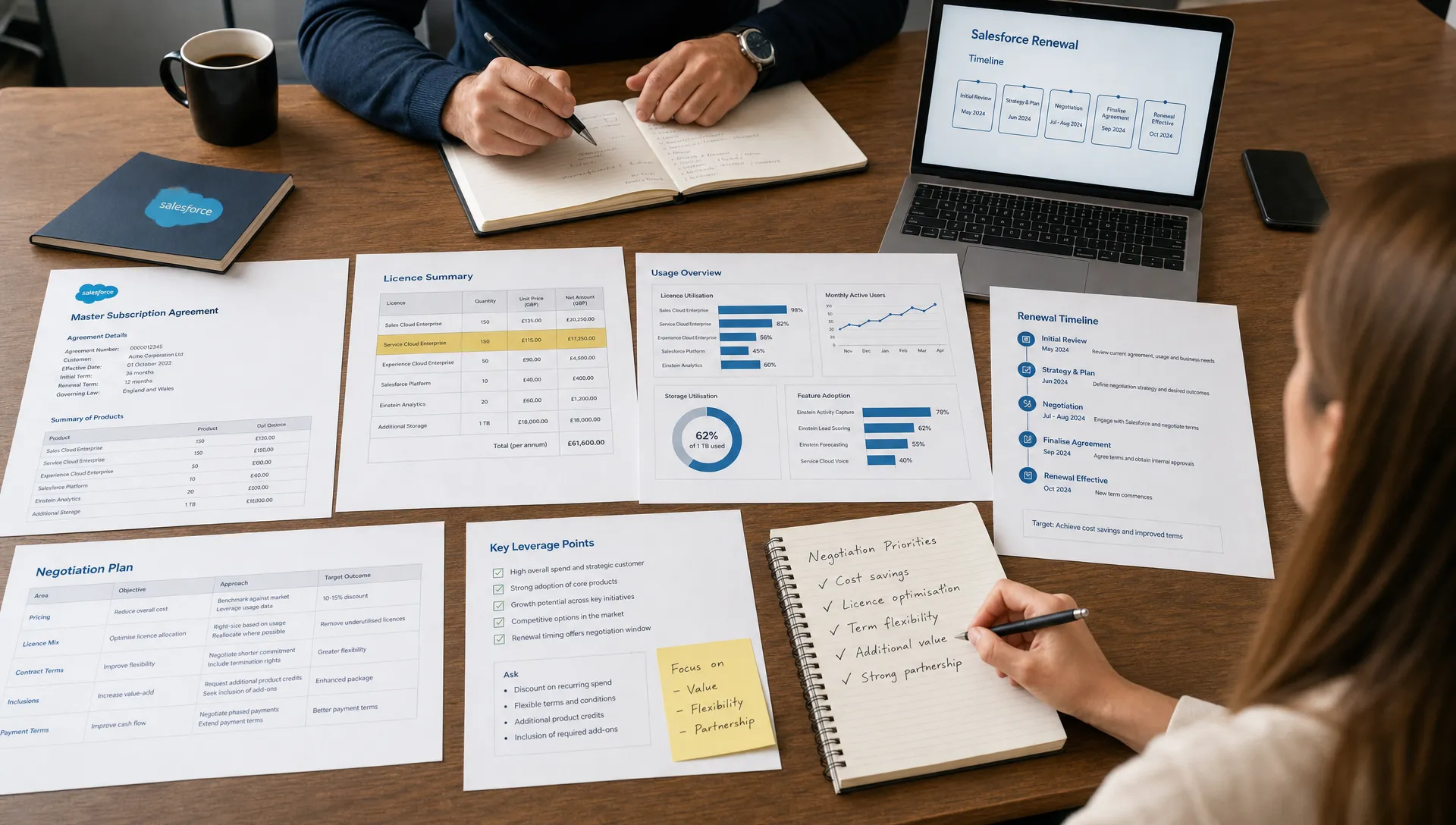
Separate supplier urgency from business urgency
One of the quiet skills in Salesforce procurement is knowing which deadlines are real.
Your business may have a genuine operational deadline. Salesforce may have a quarter-end, year-end or internal approval deadline. Those are not the same thing.
A late renewal compresses these pressures into one uncomfortable conversation. An early renewal process separates them. That gives procurement time to ask better questions, reject false urgency and use supplier timing constructively without letting it dictate the deal.
This does not mean playing games with the calendar. It means understanding it. If Salesforce needs internal approvals to support a commercial position, you need to know what evidence will help that approval. If the account team is pushing for a signed order before a certain date, you need to know what you would receive in exchange for moving quickly.
Harvard Business Review’s article on negotiating with powerful suppliers makes a useful point for enterprise software buyers: leverage improves when buyers reduce dependence, bring credible alternatives into view and change the supplier’s perception of the relationship. In Salesforce renewals, that perception is shaped long before legal redlines begin.
Build internal alignment before external negotiation
Salesforce knows when your organisation is divided.
If sales leadership wants more licences, IT wants fewer integrations to maintain, finance wants cost reduction and procurement is brought in late, the account team will usually find the path of least resistance. That path may not be malicious. It is simply how complex enterprise sales works.
Procurement teams find hidden leverage by aligning internal stakeholders before the supplier conversation becomes commercial. The alignment does not need to be perfect, but it must be clear.
At minimum, agree the following before negotiation:
- The renewal owner and decision process.
- The products and licences that are non-negotiable for business continuity.
- The areas where reduction, swap or delay is acceptable.
- The maximum acceptable increase, if any.
- The walk-away points that require executive review.
This is where a CFO and CIO partnership matters. Finance can challenge value. IT can explain risk. Procurement can control process and supplier engagement. Separately, each function has partial leverage. Together, they create a position Salesforce has to take seriously.
For a more tactical view of preparation and supplier engagement, see SaaSed’s article on Salesforce negotiation tactics that improve leverage.
Use outside expertise surgically, not as a substitute for ownership
There is a practical reason many teams miss hidden leverage: they are busy.
Salesforce renewals arrive alongside budget cycles, transformation work, security reviews and everyday operational demands. Internal teams often know there is waste or risk in the estate, but they do not have time to turn that knowledge into a negotiation file.
The answer is not to outsource accountability. The best results come when internal owners stay close to the facts, while specialist support accelerates the analysis and helps avoid known traps.
This pattern is common in other commercial functions too. Agencies, for example, bring in specialist execution capacity when they need senior expertise without hiring permanently. Salesforce procurement can apply a similar principle: bring in focused expertise for the moments where depth, pattern recognition and speed matter most, while keeping the decision-making inside the business.
Used well, external support should make your internal position clearer, not louder.
Watch for leverage that is easy to give away
Some leverage is found. Some is lost.
The most common ways to give away leverage are surprisingly mundane. A stakeholder tells Salesforce that the product is “mission-critical” before procurement has reviewed the numbers. A project sponsor shares future expansion plans without budget approval. The team asks for a discount before understanding what it is willing to remove. Legal starts redlining after the commercial position is already fixed.
None of these mistakes is dramatic. Together, they tell the supplier that the buyer is likely to renew with limited resistance.
Procurement should set a few simple rules early. Route commercial conversations through the agreed owner. Separate product discovery from buying intent. Make sure executives understand which comments create pressure later. Keep the account team informed enough to maintain trust, but not so informed that you lose room to move.
This is not about being secretive. It is about being disciplined.
A practical hidden leverage checklist
Before entering a Salesforce renewal negotiation, a procurement team should be able to answer these questions without guesswork.
| Area | Question to answer | Evidence needed |
|---|---|---|
| Contract | What are the binding terms, renewal dates and uplift risks? | Order forms, master agreement, amendments, renewal notices. |
| Usage | Which licences and products are active, underused or unused? | Login data, permission sets, feature usage, admin input, business owner validation. |
| Value | Which SKUs support critical processes? | Process maps, stakeholder confirmation, revenue or operational dependency. |
| Roadmap | What future demand is approved rather than aspirational? | Budget approval, project plans, executive sponsorship. |
| Flexibility | What can be reduced, delayed, swapped or renegotiated? | Dependency analysis, implementation constraints, alternative options. |
| Governance | Who can speak commercially to Salesforce? | Internal negotiation plan and stakeholder alignment. |
If the team cannot answer these questions, the first task is not negotiation. It is preparation.
Frequently Asked Questions
When should Salesforce procurement teams start looking for hidden leverage? Ideally 6 to 12 months before renewal, especially for larger estates or complex bundles. Smaller renewals may need less time, but late preparation almost always reduces options.
Is hidden leverage mainly about reducing licence count? No. Licence reduction can help, but leverage can also come from contract flexibility, SKU restructuring, better roadmap discipline, removal of risky terms and stronger internal alignment.
How do CFOs and CIOs avoid conflict during Salesforce procurement? They should agree the business-critical capabilities first, then separate value from waste. The CFO brings cost discipline, while the CIO validates operational risk and technical dependency.
Can Salesforce usage data be misleading? Yes. Low usage may be justified for some roles or processes, while high usage does not always prove the current SKU is the right one. Usage data needs business context before it becomes negotiation evidence.
What is the biggest mistake teams make in Salesforce renewals? Starting with the supplier’s quote instead of their own fact base. Once the quote frames the discussion, it is harder to reset the conversation around actual need, value and risk.
Closing thought: leverage is usually built before it is visible
The best Salesforce procurement teams do not wait for a better offer to appear. They build the conditions for one.
They know the contract. They understand usage. They test the roadmap. They align stakeholders. They control timing. Then they enter the negotiation with a position that is factual, calm and difficult to dismiss.
If you are approaching a Salesforce renewal and want a second view on where leverage may be hidden, SaaSed offers a complimentary Salesforce audit conversation. It is a practical way to pressure-test your contract, SKU mix and renewal readiness before the commercial conversation narrows your options.
Want this kind of intel on your renewal?
Don’t head into your next software negotiation alone
Contact Us