When a Salesforce Specialist Earns Their Seat at Renewal
A Salesforce renewal is rarely just a price discussion. A specialist earns their seat when they turn contract detail, usage evidence and timing into better decisions for finance, IT and procurement.
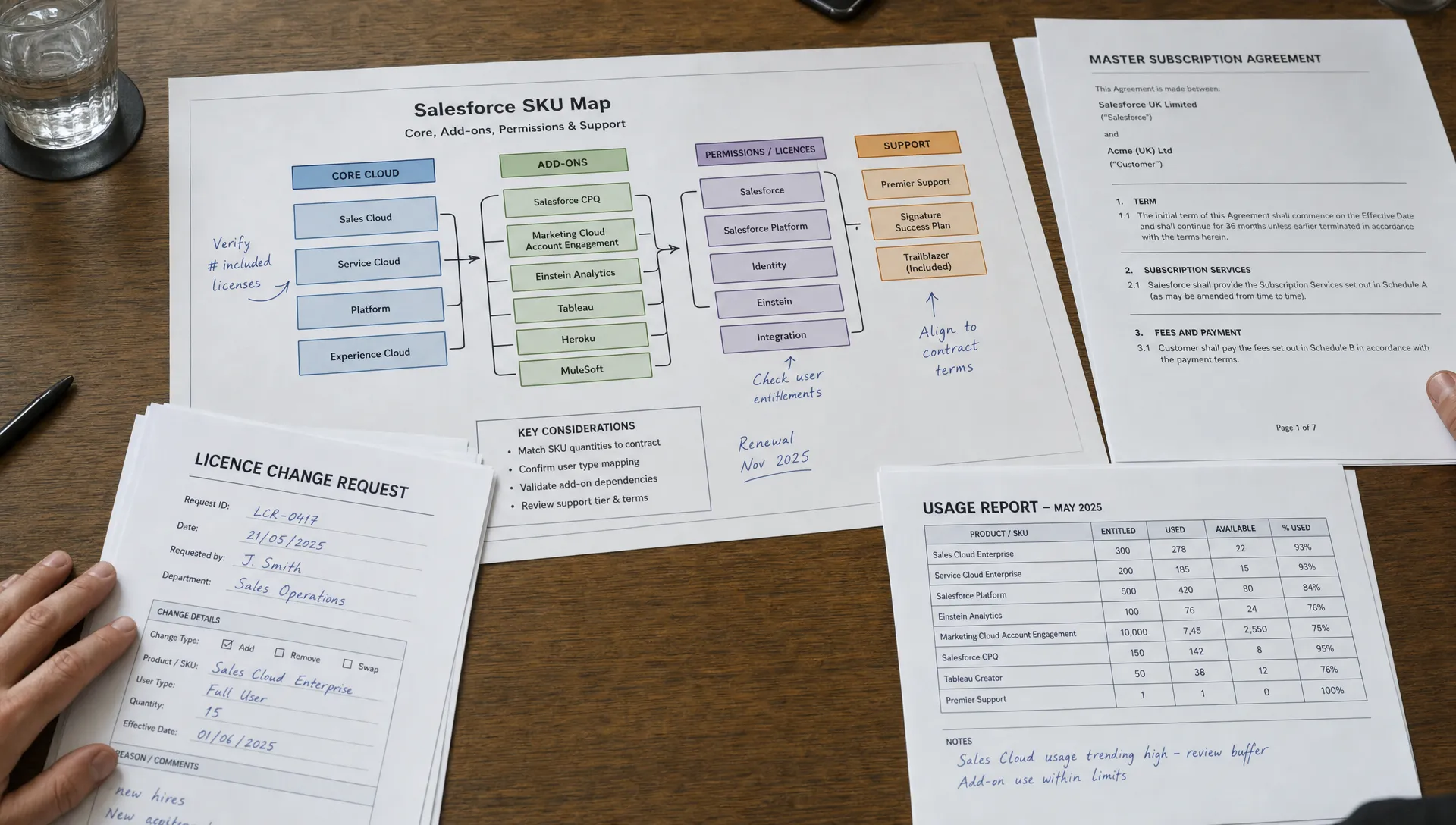
At renewal, a Salesforce specialist does not earn a seat because Salesforce is large, familiar or politically sensitive. They earn it when the renewal has enough commercial weight, product complexity and timing risk that a general SaaS process will miss leverage.
That distinction matters. Many teams already have smart people around the table: finance knows the budget, IT knows the platform, procurement knows the process and business leaders know what they need from the system. The problem is not lack of competence. It is that Salesforce renewals often combine technical sprawl, contract mechanics, product bundling and seller timing in ways that reward very specific experience.
A good Salesforce specialist narrows the gap between what the organisation thinks it is buying and what the agreement actually commits it to buy. That is when the seat is earned.
The seat is earned before the negotiation starts
By the time a renewal call turns commercial, much of the outcome is already shaped. The supplier has a view of the account, the growth story, the renewal date, historic discounting, product adoption and perceived urgency. Internally, the buyer often has fragments: usage data in one place, contract history in another, business sentiment across several teams and no single view of what can be reduced, challenged or traded.
A Salesforce specialist earns their place by making that picture coherent early enough to matter. Not by making noise in the negotiation, but by improving the quality of the decisions before anyone starts talking numbers.
That means separating three things that are often mixed together:
- What the business genuinely needs from Salesforce
- What the current contract says the business must pay for
- What Salesforce is likely to push for at renewal
When those three are treated as the same thing, renewals become expensive. When they are separated, finance and procurement can negotiate from evidence rather than unease.
The signals that a specialist should be involved
Not every Salesforce renewal needs outside support or a dedicated specialist. A small, stable estate with clean usage data and a straightforward contract may be perfectly manageable by an internal team. The case changes when the renewal carries structural risk.
| Signal | What it suggests | Why a Salesforce specialist helps |
|---|---|---|
| Multiple clouds or business units | Demand is distributed and hard to challenge | Builds a single view of entitlement, adoption and future need |
| Historic discounting or uplift language | The current price may not predict the next offer | Tests the commercial baseline before the supplier anchors the discussion |
| Shelfware concerns | Licences or add-ons may not match usage | Distinguishes real waste from temporarily low adoption |
| Bundled SKUs | Price and product value are difficult to isolate | Identifies where bundle value is real and where it masks poor fit |
| Approaching renewal date | Time pressure will shift leverage to the supplier | Rebuilds the sequence so decisions are made before deadlines bite |
| New products under consideration | Expansion may be mixed into renewal defence | Keeps renewal hygiene separate from genuine new investment |
These signals are not theoretical. They show up in ordinary review meetings: a licence report no one quite trusts, a product owner defending unused capacity because future plans are unclear, a quote that arrives late or a discount that only works if the buyer accepts extra products.
SaaSed has written separately about the main Salesforce contract renewal risks to catch early. The common thread is simple: risk becomes expensive when it is discovered after the renewal motion is already moving.
What a Salesforce specialist sees differently
A general procurement process can ask good questions about price, term, uplift and payment structure. A Salesforce specialist should go further. They should understand how commercial terms interact with product reality.
That includes the difference between assigned licences and active value, the commercial effect of permission set licences, the way clouds and add-ons are bundled, the cost of keeping legacy SKUs for convenience and the danger of accepting a clean looking quote that resets the baseline in the wrong way.
Salesforce publishes public Sales Cloud pricing, which is useful for orientation. But negotiated enterprise estates rarely live neatly inside public price pages. The real work is in the delta between list structure, existing entitlements, actual consumption, contractual protections and the supplier's renewal objective.
A specialist also understands the psychology of the renewal calendar. Salesforce account teams have their own deadlines and incentives. Buyers have internal approval cycles, budget freezes, transformation programmes and executive dependencies. The renewal outcome often turns on which timeline becomes dominant.
That does not mean playing games. It means refusing to let time pressure substitute for evidence.
Evidence is the currency of a serious renewal
A Salesforce specialist earns credibility when they produce evidence that finance, IT and procurement can all use. The evidence does not need to be elaborate, but it must be clean enough to support a decision.
Useful evidence normally includes:
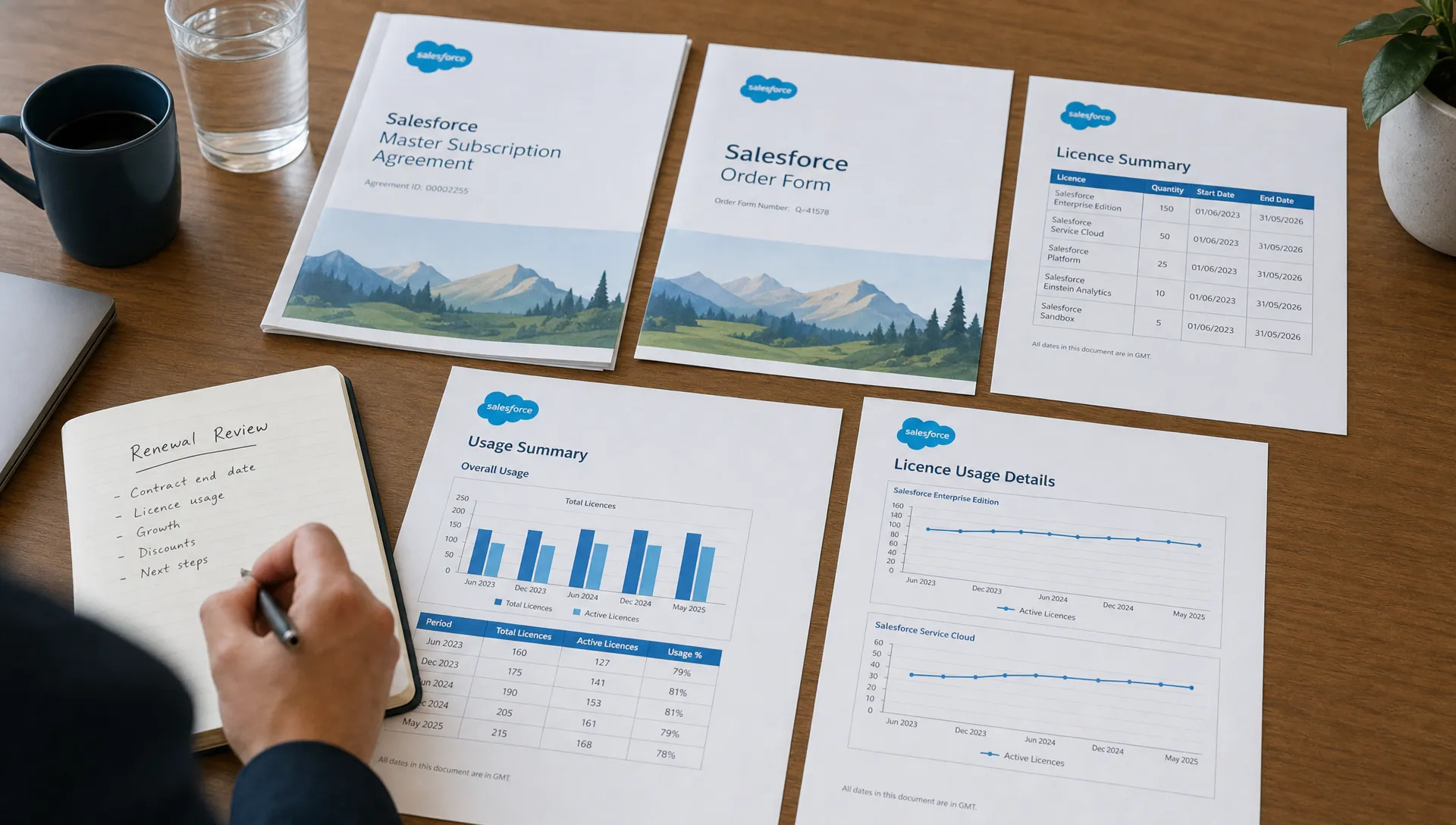
- A contract and order form baseline, including current term, renewal mechanics, price protections and notice dates
- A SKU map showing what is owned, who uses it and which business process it supports
- Usage and adoption analysis, with clear caveats where the data is incomplete
- A view of shelfware, underused products and licences held for future demand
- A demand forecast that separates confirmed need from aspiration
- A negotiation position that sets out what can be conceded, protected or removed
The point is not to create a large pack. The point is to stop senior people making decisions from partial memory. A renewal committee should not have to rely on whoever last spoke to the account team or whoever feels most strongly about a product.
This is where good analytics help. If your team is still debating which numbers to trust, it is worth looking at how Salesforce analytics can strengthen renewal decisions before the commercial conversation begins.
The best specialists make trade-offs visible
No credible specialist walks into a renewal promising that everything can be cut without consequence. Some licences are underused because a team has not been trained. Some are underused because the product was bought too early. Some are quiet because they support a critical but infrequent process. The commercial answer is different in each case.
The useful question is not simply whether a SKU is used. It is whether the business would buy it again, at the same quantity, under the same terms, if it were making the decision today.
That question changes the tone of the room. It invites finance to challenge waste without appearing hostile to the platform. It gives IT a way to defend genuine operational need without defending every line item. It gives procurement a clearer mandate than asking for a better discount.
Domain depth matters in procurement, not just in software
Specialism earns a seat when the buying decision depends on operational detail that generic process cannot see. That is not unique to Salesforce. A food production team assessing cleaning and contamination control, for example, would not treat all suppliers as interchangeable if yield, water use, labour and hygiene outcomes are part of the decision. The value of specialist cleaning and contamination-control providers lies in process knowledge as much as equipment.
The same principle applies to Salesforce renewals. Category process matters, but it is not enough when the commercial result depends on SKU mechanics, roadmap timing, platform adoption and supplier playbooks. A specialist earns their place by turning domain detail into better choices.
What the CFO, CIO and procurement lead should expect
A specialist should not take over the renewal. They should make the internal team stronger. The decision rights still sit with the organisation, not the adviser.
| Stakeholder | What they need at renewal | What the specialist should provide |
|---|---|---|
| CFO | Cost clarity, risk visibility and a defensible approval position | A clean financial baseline, waste analysis and options with commercial consequences |
| CIO | Platform continuity, product fit and realistic demand planning | A SKU and usage view that reflects operational reality, not just invoice history |
| Procurement lead | Negotiation leverage, supplier discipline and a controlled process | A sequence, evidence pack and negotiation position that avoids late surprises |
| Business owner | Confidence that critical capability will not be removed blindly | Clear separation between waste, low adoption and strategic need |
The specialist is most useful when they can sit between these groups without becoming political. If they only argue for cuts, IT will tune out. If they only defend the platform, finance will lose trust. If they only manage process, procurement will still be exposed to product detail they cannot validate.
The centre of gravity should be disciplined challenge.
Renewal timing is a leverage issue
A Salesforce specialist earns the seat earlier than many organisations expect. The obvious moment is when a quote arrives. The better moment is before the supplier has framed the renewal.
For larger or more complex estates, that can mean starting 9 to 12 months before expiry. For simpler renewals, 6 months may be enough. The exact timing matters less than whether the buyer has time to test usage, align demand, understand contract terms and decide what a good outcome looks like.
Late work becomes reactive. The team discovers that a notice date has passed, a key stakeholder is unavailable, a product owner has promised growth informally or a budget assumption was built on last year's price. None of these problems is impossible to manage, but each one narrows the room for manoeuvre.
If your renewal term is already shaping the conversation, the practical guide on how to use the renewal term without losing ground is a useful companion to this work.
When a specialist has not earned the seat
A healthy test is to ask what the specialist will change. If the answer is vague, wait.
A Salesforce specialist has not earned their seat if they cannot explain the evidence they need, the decisions they will support or the leverage they expect to create. They also should not be brought in merely to provide cover for a decision that has already been made. That wastes time and usually produces theatre rather than value.
The seat is earned when the renewal has unanswered questions such as:
- Are we paying for capacity we no longer need?
- Are we about to accept a new baseline that will be hard to unwind?
- Do we understand which products are essential and which are convenient?
- Can we separate genuine roadmap demand from supplier-led expansion?
- Do we have enough evidence to reject, reshape or accept the proposal?
If these questions are live and the numbers are material, specialist support is not a luxury. It is part of governing spend properly.
How to test a Salesforce specialist before giving them the room
The best test is practical. Ask them to review a small sample: an order form, a SKU list, a usage extract and the current renewal timeline. You are not looking for a magic answer. You are looking for the quality of their questions.
A strong specialist will usually ask about term structure, discount history, growth commitments, actual user behaviour, product ownership, downstream dependencies and decision timing. They will be careful where the data is thin. They will not pretend that every unused licence is removable or that every supplier proposal is unreasonable.
They should also be comfortable documenting assumptions. In a serious renewal, hidden assumptions are dangerous. If the business is holding licences for a rollout, say so. If a product is politically popular but lightly used, say so. If the team does not trust the usage data, say so and decide how to handle that uncertainty.
That level of clarity is often where the value lies. Better negotiation starts with better internal honesty.
Frequently Asked Questions
What does a Salesforce specialist do at renewal? A Salesforce specialist reviews the contract, SKU structure, usage evidence, renewal mechanics and negotiation position. Their role is to help finance, IT and procurement understand what should be renewed, reduced, challenged or protected.
When should we involve a Salesforce specialist? Involve one before the supplier frames the renewal, especially if the estate is large, multi-cloud, bundled or politically sensitive. For complex agreements, starting 9 to 12 months ahead gives the team more room to build evidence and align decisions.
Is a Salesforce specialist only useful for reducing cost? No. Cost reduction is only one outcome. Good specialist support can also protect important capabilities, avoid poor contract terms, improve demand planning and reduce the risk of buying products before the organisation is ready to use them.
Can internal procurement manage a Salesforce renewal without a specialist? Yes, particularly where the estate is simple, usage is clear and the contract is straightforward. A specialist becomes more valuable when SKU complexity, timing pressure, historic discounting or unclear adoption make the renewal harder to judge.
What should we prepare before speaking to a specialist? Gather current order forms, renewal terms, SKU lists, user counts, usage data, known business requirements and any supplier communication about the renewal. Even incomplete information is useful if gaps are made visible early.
A measured next step
A Salesforce specialist earns their seat when they improve the renewal decision, not when they make the process louder. The value is in sharper evidence, cleaner trade-offs and a calmer negotiation position before commercial pressure builds.
If your next renewal is starting to look complex, SaaSed can help you test the contract, usage and commercial baseline before you enter the renewal conversation. For a complimentary Salesforce audit conversation, contact SaaSed.
Want this kind of intel on your renewal?
Don’t head into your next software negotiation alone
Contact Us