How Salesforce Analytics Can Strengthen Renewal Decisions
Salesforce analytics can do more than report activity. Used well, it gives finance, IT and procurement a shared evidence base for renewal scope, risk and negotiation choices.

Salesforce renewals are rarely won or lost in the final negotiation meeting. They are usually shaped months earlier, when the business decides what evidence it trusts.
That is where Salesforce analytics can be useful. Not as a prettier dashboard. Not as another layer of reporting theatre. Useful analytics gives finance, IT and procurement a shared view of what is being used, what is not, what still matters, and where the next contract could quietly become more expensive than it needs to be.
The key is to point analytics at the renewal decision, not just at operational performance. A sales dashboard may tell you pipeline coverage. A service dashboard may tell you case volume. A renewal evidence pack needs to answer a different question: given how Salesforce is actually used, what should we renew, reduce, restructure or challenge?
The renewal question analytics must answer
Most organisations already have Salesforce reports. Many have CRM Analytics, Tableau, a data warehouse or finance-led reporting. The problem is not a lack of data. The problem is that renewal decisions often sit between systems.
Salesforce analytics should help answer five practical questions before renewal talks start:
| Renewal question | Useful analytics signal | Why it matters commercially |
|---|---|---|
| What have we bought? | Entitlements, SKUs, licence types, add-ons and contract quantities | Sets the baseline before any new proposal arrives |
| What is actually used? | Active users, feature use, objects touched, login patterns and workload by team | Highlights shelfware and weak demand evidence |
| What creates value? | Pipeline influence, case handling, campaign attribution, adoption by critical teams | Separates useful spend from convenient spend |
| What will we need next? | Hiring plans, territory changes, product roadmap, AI or data usage forecasts | Prevents false savings and weak future planning |
| What is risky in the contract? | Renewal dates, uplift clauses, minimum commitments, bundled products | Shows where commercial pressure may appear |
This is why analytics has to be joined to the contract. Usage data without contract context can be misleading. A low-use product may be contractually bundled. A high-use feature may sit inside a licence type that is broader than the team needs. A module may look inactive because adoption failed, or because the business no longer needs it.
A good renewal decision requires both sides of the picture.
Salesforce analytics is not the same as Salesforce value
This distinction is easy to miss.
High login rates do not always prove value. Low login rates do not always prove waste. A senior approver may log in rarely but be essential to a controlled process. A large group may log in daily but only use a narrow function that could be served differently.
Salesforce itself positions analytics as a way to explore data, spot patterns and support decisions, as described in Salesforce’s CRM Analytics overview. For renewal work, the important phrase is “support decisions”. Analytics should not replace judgement. It should make judgement harder to distort.
For CFOs, the question is whether spend maps to measurable business need. For CIOs, it is whether the platform remains technically and operationally justified. For procurement leaders, it is whether the organisation has enough evidence to resist a renewal path designed mainly around the vendor’s targets.
A simple comparison helps. A buyer for a specialist sports retailer would not decide next season’s stock by looking only at total footfall. They would look at sell-through, seasonality, product mix and returns. Salesforce renewals need the same discipline. Total logins tell you something, but not enough.
Build a renewal evidence pack, not just a dashboard
A dashboard can be useful. An evidence pack is stronger.
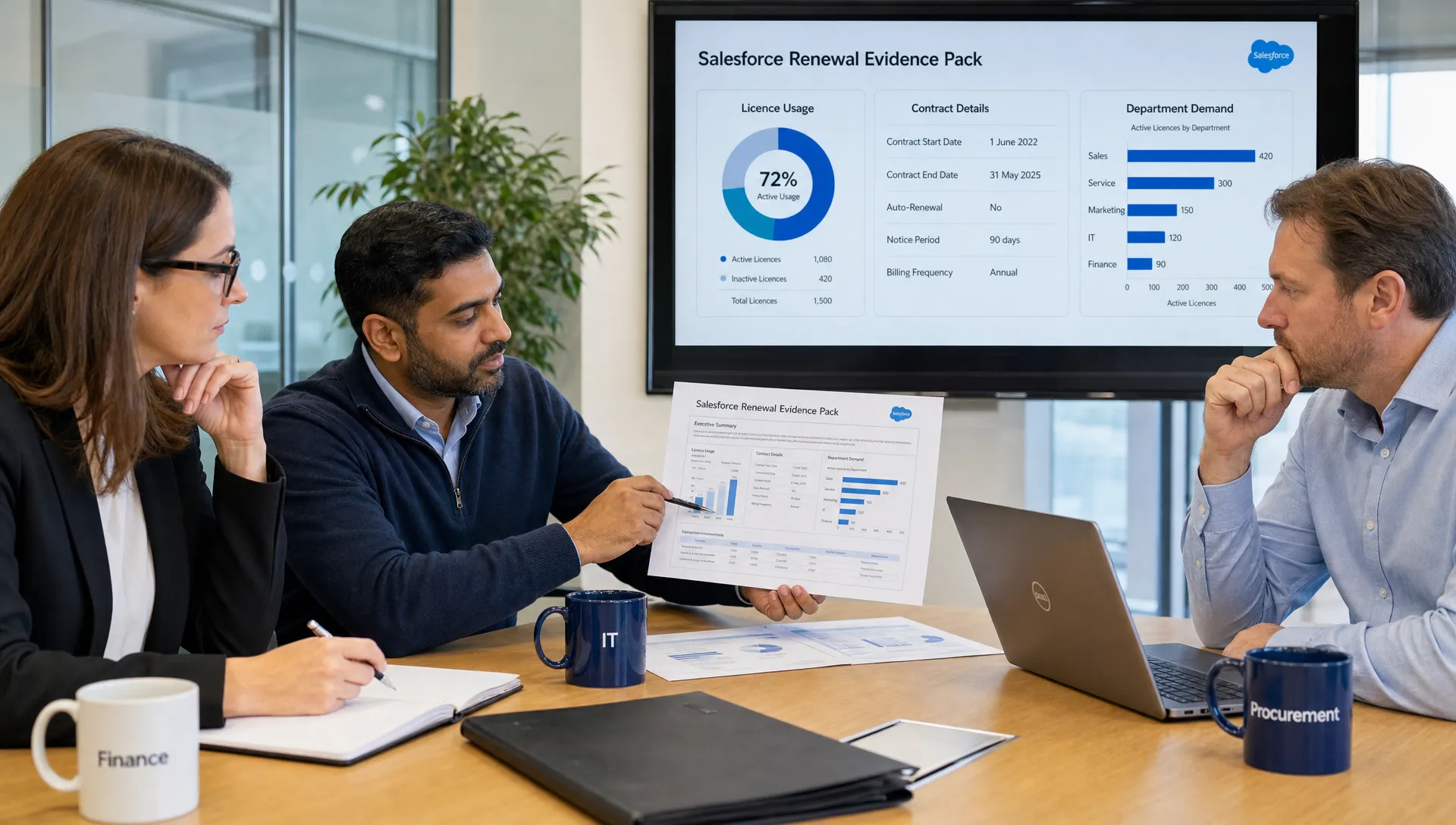
The difference is that a dashboard shows what happened. An evidence pack explains what the business should do next and why. It connects usage, cost, contract terms and future demand in one place.
A practical Salesforce renewal evidence pack usually includes:
- A contract baseline showing current products, quantities, terms, renewal dates, discount structure and known commercial obligations.
- A SKU and licence map showing which teams consume which products, including add-ons, sandboxes, storage, support and data-related products where relevant.
- A usage view showing active, inactive and lightly active users, ideally split by department, geography, role and licence type.
- A value view showing which Salesforce services support important business processes, such as revenue generation, service delivery, marketing operations or compliance.
- A demand view showing what the business expects to change during the next term, including headcount, process redesign, acquisitions, divestments, AI adoption or system consolidation.
This is close to the discipline needed in a strong SaaS renewal process, but Salesforce deserves particular care because the estate is often layered over many years. Licences, add-ons and product names change. Teams inherit old decisions. Nobody deliberately builds a messy estate, but it happens.
The evidence pack should be clear enough for a CFO to trust, detailed enough for IT to defend, and practical enough for procurement to use in negotiation.
Where Salesforce analytics changes the commercial conversation
Analytics strengthens renewal decisions by changing the conversation from preference to evidence.
Without evidence, renewal discussions often become a contest of opinions. Sales leaders want more flexibility. IT wants continuity. Finance wants a lower bill. Procurement wants negotiating room. Salesforce wants commitment, often with a broader commercial story attached.
With evidence, the internal discussion becomes more precise.
If 18 percent of a licence population has not logged in for 120 days, the question is not “who is to blame?” It is “do these users still need this licence type, and if not, what is the cleanest reduction path?”
If Service Cloud is heavily used by one region but lightly used elsewhere, the question is not “is Service Cloud valuable?” It is “where is it valuable, and should the renewal reflect that uneven adoption?”
If a newer product was bought with ambition but adoption never moved beyond a pilot, the question is not “was this a mistake?” It is “do we have a credible plan to use it during the next term, or are we renewing hope?”
These are calmer questions. They are also more commercially useful.
The red flags analytics should surface early
The earlier these signals appear, the better. Once the renewal quote is on the table and internal deadlines are tight, every finding becomes harder to act on.
| Analytics signal | Possible renewal risk | Sensible response |
|---|---|---|
| Large group of inactive assigned users | Shelfware hidden inside current quantities | Validate business need, then prepare reduction scenarios |
| Heavy use concentrated in a small number of teams | Over-wide deployment or poor licence fit | Review whether licence types match actual roles |
| Add-ons with little measurable activity | Bundled spend carried forward by habit | Check contractual dependencies before challenging renewal |
| Usage rising in consumption-linked products | Future cost exposure | Build forecasts and governance before committing |
| Low adoption in a strategic product | Renewal based on intent rather than evidence | Require an owner, plan and timeline before renewing at scale |
| Multiple teams using separate reporting logic | Weak internal alignment | Agree one version of the renewal fact base |
Some risks sit in the data. Others sit in the contract. The strongest view comes from reading both together. If you are already reviewing terms, this is also the moment to catch Salesforce contract renewal risks early, before they become negotiating constraints.
Do not average away the truth
Average usage can be dangerous in a Salesforce estate.
A single average across the whole organisation may hide strong adoption in one area and almost no use in another. It may also hide licence mismatch. Ten teams can all have “active” users, but they may use very different parts of the platform.
Segment the analysis before drawing conclusions. At a minimum, look at usage by business unit, role, geography, licence type and core process. If the data allows, go deeper into features and workflows.
For example, Sales Cloud value may sit in opportunity management, forecasting discipline or account planning. Service Cloud value may sit in case routing, knowledge use, agent productivity or customer visibility. Marketing Cloud value may sit in campaign execution and data quality, not simply the number of users with access.
This is why service-level assessment matters. If the organisation is trying to understand which Salesforce services are driving real value, the analytics should be designed around business processes, not just product names.
Clean data beats clever dashboards
The best renewal analytics is often unglamorous. It depends on basic data hygiene.
Start with named users. Remove leavers. Identify duplicates. Check whether users are assigned to the right departments. Map licence types to actual roles. Confirm whether integrations or shared accounts are skewing activity. Agree what counts as meaningful use.
This work is dull only until the negotiation starts. Then it becomes valuable.
If procurement enters a renewal discussion with weak data, the supplier can challenge the analysis easily. If IT cannot explain why a licence should be kept or removed, finance will struggle to approve a confident position. If business stakeholders disagree with the numbers, the renewal can drift back towards the status quo.
Clean data does not guarantee savings. It does something more important: it reduces avoidable uncertainty.
Use analytics to shape options, not just cuts
A common mistake is to treat analytics as a cost-cutting tool. It can support reductions, but that is only one use.
Sometimes the right decision is to renew broadly because the platform is working and demand is real. Sometimes the right decision is to reduce a product but protect investment in another. Sometimes the right decision is to negotiate flexibility rather than chase the lowest headline price.
Good Salesforce analytics helps create options such as:
- Renew current quantities where usage and business value are clear.
- Reduce or reallocate licences where demand has fallen or roles have changed.
- Restructure product mix where licence types no longer match actual use.
- Challenge add-ons that have no owner, no adoption plan or no measurable activity.
- Build staged commitments where future demand is plausible but not yet proven.
This is also where analytics improves negotiation behaviour. The strongest commercial position is not simply “we want a better price”. It is “this is the demand we can evidence, this is the demand we cannot yet justify, and this is the structure we are prepared to discuss”.
That is harder to dismiss.
Give each function a clear role
Salesforce renewal decisions are cross-functional by nature. Analytics works best when each function knows what it owns.
Finance should pressure-test the cost view, budget impact and value narrative. IT should validate platform dependency, technical constraints and realistic change paths. Business owners should explain whether usage reflects real process value or administrative habit. Procurement should turn the evidence into a commercial strategy and manage the negotiation rhythm.
No single team has the whole picture. That is not a weakness. It is the reason a shared evidence base matters.
A useful test is simple: if Salesforce sent the renewal proposal tomorrow, could finance, IT, procurement and the business explain the same position in different words? If not, the analytics work is not finished.
Frequently Asked Questions
What is Salesforce analytics in the context of renewals? It is the use of Salesforce usage, adoption, business outcome and contract-related data to decide what to renew, reduce, restructure or challenge before the next agreement is signed.
Is login data enough to support a Salesforce renewal decision? No. Login data is a starting point, but it does not prove value. Renewal decisions should also consider licence type, role, feature use, business process dependency, outcomes and future demand.
When should Salesforce renewal analytics begin? Ideally 6 to 12 months before renewal, earlier for large or complex estates. This gives enough time to clean data, align stakeholders and test commercial options before the supplier’s timeline narrows your choices.
Can analytics help if we are not trying to cut Salesforce spend? Yes. Analytics can justify continued investment, protect high-value products, improve licence fit and support a better contract structure. The point is not always to spend less. It is to spend with clearer intent.
Who should own the analytics work before renewal? Ownership should be shared. IT usually validates system data, finance tests cost and value, business owners confirm demand, and procurement turns the evidence into renewal strategy.
Turn Salesforce analytics into renewal leverage
Salesforce analytics is most useful when it is tied to a decision. Not “what does the dashboard show?” but “what should we renew, and on what terms?”
If your renewal is approaching, start with the basics: current contract, SKU map, usage evidence, stakeholder demand and known risks. The work does not need to be theatrical. It needs to be honest, specific and early enough to matter.
SaaSed helps organisations review Salesforce contracts, SKUs, usage and renewal risk before commercial discussions harden. If you would like a second view on your renewal position, book a complimentary Salesforce audit conversation.
Want this kind of intel on your renewal?
Don’t head into your next software negotiation alone
Contact Us