How to Control Agentforce Pricing Before You Sign
Agentforce shifts Salesforce cost from seats to usage, which changes how finance and IT should review a deal. This guide shows what to ask before signing so pricing, forecasts and credit rules do not become renewal surprises.

Insights 23 September 2026·SaaSed Team
How to Control Agentforce Pricing Before You Sign
Agentforce pricing is not just another Salesforce line item; it changes how cost appears, grows and escapes control. The safest moment to control it is before signature, when definitions, forecasts, protections and flexibility are still negotiable.
Traditional Salesforce licensing gave finance and IT something reasonably familiar: users, seats, editions and discounts. It was not always simple, but most teams could at least build a forecast around named users and renewal dates.
Agentforce changes the risk profile because the commercial unit can be usage, not just access. Flex Credits, per-action charges, per-conversation rates and outcome-based structures mean cost can rise with customer demand, automation design, data calls or agent behaviour.
That does not make Agentforce pricing bad. It does mean the deal needs a different type of review, one that tests the mechanics before procurement is left managing the bill.
How Agentforce Pricing Actually Works
Salesforce has been moving Agentforce towards several commercial models rather than one neat price list. The figures below reflect Salesforce-published examples and should be checked against Salesforce's current Agentforce pricing page before any decision, because rate cards and packaging change.
The main models are Consumption, Hybrid and Outcome. Consumption means you buy or draw down credits as work happens. Salesforce has published examples including $500 for 100,000 Flex Credits, $0.10 for a standard action and $2 per conversation. Hybrid combines a subscription or edition commitment with consumption on top, including packages such as Agentforce 1 Editions at $550/month. Outcome pricing links payment to a defined result, which sounds tidy until the contract has to define the result precisely.
For a deeper bill-level view of credits, tokens and related Salesforce usage, SaaSed's Agentforce cost breakdown goes further into the moving parts.
| Pricing Model | What It Means for Your Budget | The Question to Ask Salesforce |
|---|---|---|
| Consumption | Spend varies with actions, conversations, data usage and agent design. | Which events consume credits, at what rate and what happens above our commitment? |
| Hybrid | You carry a fixed subscription layer plus variable usage on top. | What is included in the edition and what draws down Flex Credits separately? |
| Outcome | Cost is tied to a defined result or completed interaction. | How is the outcome measured, audited, disputed and capped? |
Per-Seat vs. Consumption: What Changes for Your Renewal
Per-seat licensing gives buyers a clear negotiation object: number of users multiplied by SKU price, adjusted for discount and term. It still leaves room for waste, especially shelfware, but the waste is visible enough to challenge.
Agentforce pricing changes the renewal conversation because usage can scale between signatures. A renewal may no longer be about whether you have too many licences. It may be about whether the automation you deployed last year now consumes more credits than the budget ever expected.
| Area | Per-Seat Licensing | Agentforce Consumption Pricing |
|---|---|---|
| Predictability | Budget is linked mainly to named users and editions. | Budget depends on volumes, agent behaviour and chargeable events. |
| Forecasting | Teams forecast headcount, role changes and licence mix. | Teams must forecast conversations, actions, workflows and adoption rates. |
| Renewal leverage | Leverage comes from unused seats, competitive pressure and timing. | Leverage also depends on usage evidence, credit burn patterns and contractual protections. |
Four Questions to Ask Before You Sign
Controlling Agentforce pricing starts with asking for specificity. If the answer is still vague, the risk has not disappeared. It has just moved into the contract term.
1. What counts as a billable action?
Ask Salesforce to define the chargeable event in operational language. A standard action, a conversation, a data retrieval, a handoff and a generated response may look different to your service team, but they may all have commercial consequences depending on configuration.
Do not accept a definition that only repeats the product name. Ask for examples based on your intended use cases, including edge cases where an agent retries, escalates, calls another workflow or handles a long interaction.
2. Can Salesforce provide usage forecasts and examples first?
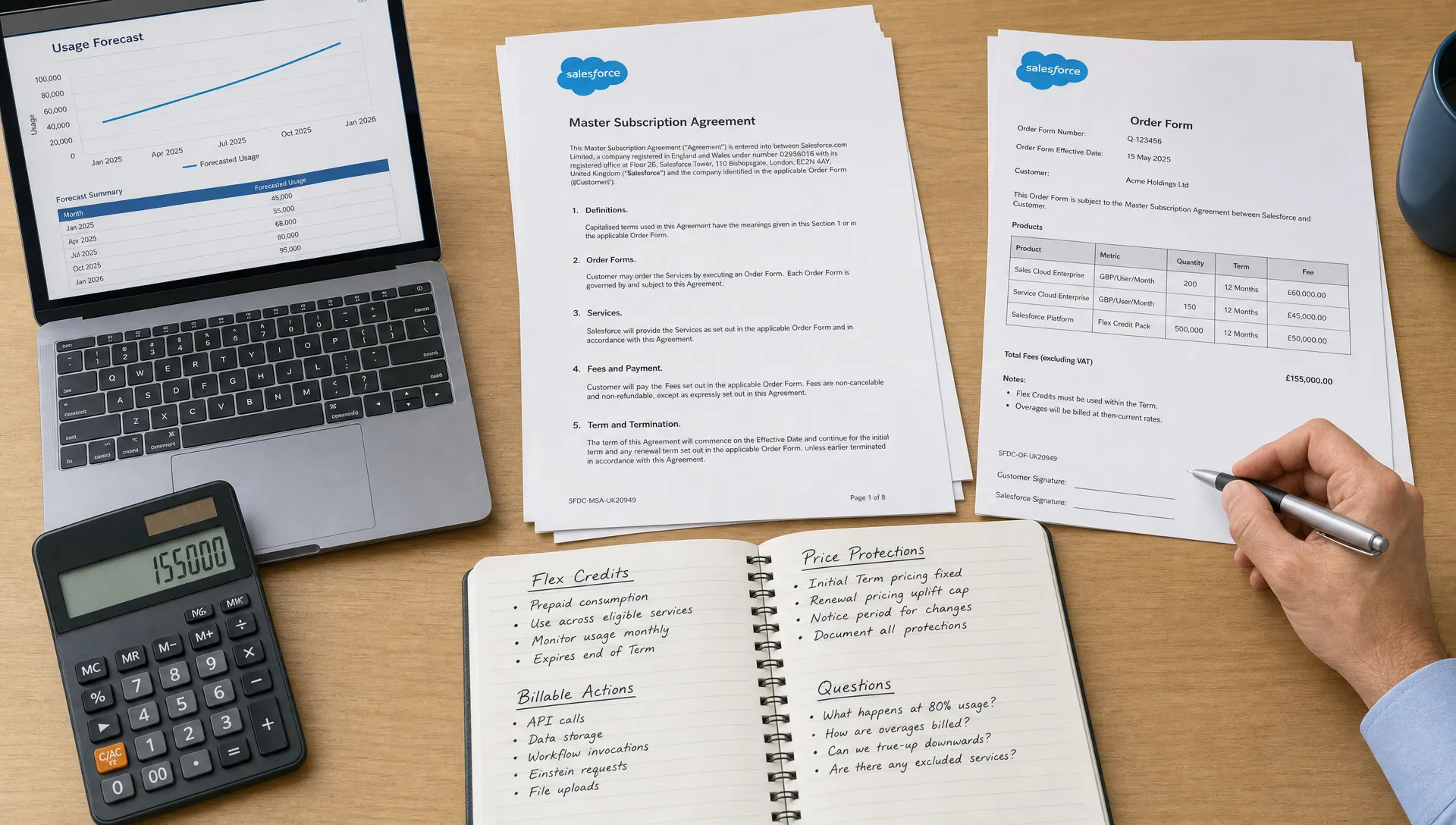
Before signing, ask Salesforce to model low, expected and high usage scenarios. The model should show the assumptions behind volumes, credit burn and overage exposure, not just a final annual number.
This is also where Salesforce Agentforce pricing should be tested against your actual process design. A support agent handling short FAQ-style interactions will not necessarily consume in the same way as an agent that searches records, updates cases, drafts responses and triggers follow-up workflows.
3. What price protections and tiered discounts are available?
A consumption model without price protection gives the supplier more upside than the buyer may realise. Ask for caps on rate increases, committed tier pricing and discounts that improve as volumes rise.
The negotiation should also cover what happens when you exceed forecast. If higher adoption is good for the business, the commercial model should not punish that success with uncontrolled unit cost. SaaSed's guidance on Salesforce negotiation tactics is relevant here because leverage usually comes from preparation, not from the final week of the deal.
4. Can we build in credit flexibility?
Flex Credits can help simplify purchasing, but they still need rules. Salesforce has described the concept in its own Flex Credits guidance, and buyers should still confirm the contract treatment.
Ask whether unused credits can roll over, whether they can be exchanged across eligible products and whether they expire at the end of the term. If credits are locked too narrowly, they can become another form of shelfware.
Common Mistakes Companies Make with Agentforce Deals
Most Agentforce pricing problems are not caused by one bad number. They come from signing before the commercial mechanics are plain enough for finance, IT and procurement to manage.
Signing without defined action examples
A rate card is not enough. You need examples that show what is billable in your environment, using your workflows and your intended agent behaviours. Without examples, each party may leave the negotiation with a different view of the same words.
Treating Flex Credits like a fixed cost
A credit commitment can feel like a budget line, but it is only fixed if usage stays inside the assumed range and the rules are clear. If adoption grows faster than expected, or if agent design consumes more than forecast, the economics change.
Skipping forecast validation
Forecasts produced late in the sales cycle are often shaped around getting the deal signed. That does not make them wrong, but they should be tested. Procurement should ask who built the forecast, which assumptions were used and what real usage data supports it.
Ignoring the renewal before the first term begins
The first Agentforce agreement sets the evidence base for the next one. If usage rights, reporting access and credit rules are weak, your renewal team may enter the next negotiation with less leverage than it should have.
Frequently Asked Questions
What are Agentforce Flex Credits? Flex Credits are a Salesforce commercial mechanism used to pay for certain AI and agentic usage across eligible products. In Agentforce, they can be consumed as agents perform actions or handle interactions, depending on the contracted model and current Salesforce rules. The key point is that credits are not the same as unlimited use.
Is Agentforce pricing negotiable? Yes, the commercial terms around Agentforce pricing are usually negotiable, especially before signature and before renewal pressure compresses the timeline. Buyers should focus on unit rates, usage tiers, price increase caps, reporting rights and overage treatment rather than only headline discount.
Can unused Flex Credits roll over? They may not roll over unless your agreement says they do. Rollover, expiry and exchange rights should be written into the contract rather than assumed from a sales conversation. If rollover is not available, ask what flexibility exists across eligible Salesforce products.
How is Agentforce different from traditional Salesforce licensing? Traditional Salesforce licensing is mainly based on access, users and editions. Agentforce can be based on usage, such as actions, conversations or outcomes, which means cost can move with operational volume. That makes forecasting and governance more important before signing.
Should we get outside help before signing an Agentforce deal? If the commitment is material, outside help can be useful before the terms are locked. A good review should test the forecast, compare the proposed structure with your renewal position and identify commercial risks that are easy to miss in a new pricing model.
A Calm Next Step Before You Commit
Eight out of ten companies already overpay for SaaS without realising it. Agentforce adds a newer kind of risk, where overspend may come less from unused seats and more from unclear usage rules, weak forecasts and terms that were never properly tested. If you are close to signing, take the time to review the commercial mechanics first and book a complimentary Salesforce audit conversation.
If your Agentforce proposal is close to signature, a second commercial view is usually worth the pause. Contact Us
Want this kind of intel on your renewal?
Don’t head into your next software negotiation alone
Contact Us