Salesforce Agentforce Cost Breakdown: How Flex Credits and Tokens Impact Your Bill

Agentforce changes Salesforce budgeting from fixed seats to consumption risk. This breakdown shows how Flex Credits, tokens, and Data Cloud usage can affect your bill before renewal talks begin.
Executive Overview
A Salesforce Agentforce cost breakdown should not start with list price. It should start with the commercial shift underneath it.
Salesforce is moving more of the customer estate from fixed, seat-based licensing into AI consumption models. Seats still matter. But the bill is increasingly shaped by what agents do, how often they act, how much data they touch, and how much model capacity they consume.
That is a different risk profile for CFOs, CIOs and Procurement leaders. A user licence is visible. Consumption is behavioural. It can move quietly, especially when automation is successful.
The friction comes from three layers sitting on top of each other:
- Base Salesforce licences, still contracted in familiar ways.
- Agentforce capacity, often packaged through credits or usage entitlements.
- Underlying token and data consumption, which can drive depletion faster than expected.
Complexity is a tax on the unknown. If the buyer cannot model usage before signature, the supplier has more room to shape the renewal later.
Salesforce publishes high-level commercial information on its official Agentforce pricing page, but enterprise contracts usually need a deeper read. The real question is not “what is the unit price?” It is “what behaviour burns the unit?”
Flex Credits vs. Token Consumption Mechanics
Think of the pricing stack in plain terms.
Base licences give named users access to Salesforce products. Flex Credits are a commercial bucket used to pay for AI-related usage, depending on what has been contracted. Tokens are the technical unit behind many AI model interactions, usually chunks of input and output text. Longer prompts, richer context, retrieval steps, tool calls and generated responses can all increase agentforce token consumption.
The trap is assuming these are separate worlds. They are connected. A business process starts as a user action, turns into an automated agent interaction, calls data, creates tokens, and consumes credits.
| Pricing Metric | How It Works | Financial Risk / Overage Potential |
|---|---|---|
| Base seat licences | Fixed user access for Salesforce clouds or editions. | Low volatility, but high waste if licences are unused or over-assigned. |
| Agentforce entitlements | Contracted right to run agents, conversations, actions or AI use cases. | Risk depends on how Salesforce defines the chargeable event in your order form. |
| Flex Credits | Pre-purchased consumption pool used against eligible AI usage. | Credits can deplete faster than forecast. Unused credits may expire or have limited rollover rights. |
| Token usage rates | AI model usage based on input, output and context volume. | High-context workflows can burn more consumption than simple pilots suggest. |
| Data Cloud credits | Consumption tied to data ingestion, harmonisation, queries or activation. | Agentforce use cases may create parallel Data Cloud spend, even when the AI SKU looks controlled. |
This is why salesforce flex credits pricing should be tested through scenarios, not averages. A simple support answer is not the same as an agent that retrieves customer history, checks entitlement, drafts a reply, updates a case and triggers a workflow.
For broader commercial context, see our comprehensive analysis on what enterprise leaders need to know about Agentforce.
The Hidden Overage Traps in Agentforce Contracts
1. Unallocated credit rollovers
Prepaid credits feel safe because the spend is known. That can be misleading.
If credits expire at year-end, unused consumption becomes breakage. If credits roll over only under narrow conditions, the buyer carries the planning risk. If overages are billed at a higher rate than the committed pool, a low pilot forecast can become expensive once adoption spreads.
The contract should answer three questions clearly: when credits expire, whether credits roll over, and what rate applies after depletion.
2. Unexpected automated conversation bursts
Humans pace usage. Agents do not.
A promotion, service incident, billing change, product outage or internal campaign can create a sudden spike in automated conversations. Each interaction may trigger several behind-the-scenes steps. One visible customer exchange can become multiple AI calls, data lookups and workflow actions.
That is where salesforce ai overage fees can appear. Not because the organisation behaved recklessly, but because the pricing model did not match operational reality.
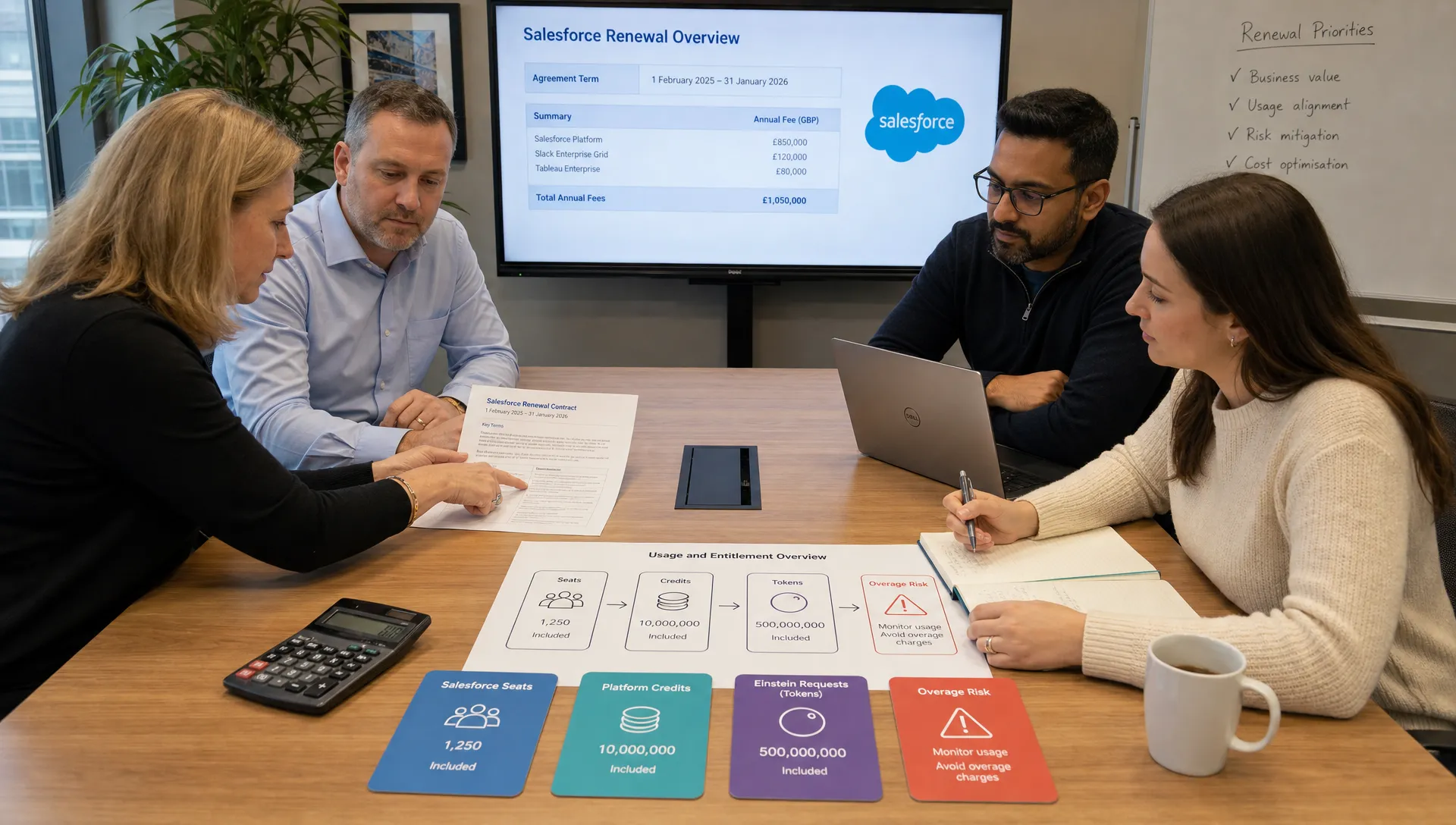
3. Compulsory Data Cloud credit usage
Agentforce is often positioned around intelligent action. Intelligent action usually needs data.
That can pull Data Cloud into the cost model, sometimes earlier than the buyer expected. If the agent needs unified customer profiles, event data, segmentation, retrieval or activation, the AI conversation cost is only part of the bill.
This matters because Data Cloud consumption can scale differently from user licences. A narrow agent use case may still require broad data movement. If that layer is not modelled, the Agentforce business case is incomplete. We cover this related risk in more depth in our guide to Salesforce Data360 and Data Cloud cost optimisation.
How to Pressure-Test the Bill Before Signature
Do not ask only for discounts. Ask for mechanics.
A disciplined review should map each proposed use case to the pricing event that triggers cost. It should also test low, expected and high adoption scenarios. The high case matters most, because successful AI adoption is exactly what can create budget pressure.
| Review Area | What To Ask Salesforce | Why It Matters |
|---|---|---|
| Chargeable event | What exactly counts as a billable conversation, action, request or credit drawdown? | Prevents later disputes over usage definitions. |
| Token assumptions | What prompt length, response length and context retrieval were used in the forecast? | Exposes whether the model reflects real workflows. |
| Overage terms | What happens when credits are exhausted? | Shows whether overage rates are controlled or punitive. |
| Rollover rights | Can unused credits move into the next term? | Reduces waste from conservative forecasting. |
| Data dependencies | Which Agentforce use cases require Data Cloud credits? | Avoids treating AI and data spend as separate decisions. |
The same discipline applies outside the Salesforce estate. Inside a large Salesforce estate, that discipline is even more important, because small modelling errors compound quickly.
FAQ
Are Flex Credits the same as tokens? No. Flex Credits are a commercial consumption pool. Tokens are a technical measure of AI model input and output. Your contract determines how token-heavy activity translates into credit consumption or charges.
Can Agentforce overages be avoided entirely? Not always, but they can be governed. The key is to define chargeable events, cap overage exposure where possible, and model usage based on real workflows rather than pilot averages.
Should Procurement treat Agentforce like another Salesforce add-on? No. Agentforce should be reviewed as a consumption model with operational dependencies. That means Finance, IT, Data and Procurement should agree the usage assumptions before the order form is signed.
Final View
The issue is not whether Agentforce can be useful. In many environments, it may be. The issue is whether the commercial model is clear enough to manage before adoption accelerates.
SaaSed helps enterprise teams pressure-test Salesforce renewals, SKU decisions and commercial risk before the negotiation narrows. If a grounded second view would be useful, you can book a complimentary Salesforce audit conversation with our team.
Want this kind of intel on your renewal?
Don't head into your next software negotiation alone.
Contact Us
Want this kind of intel on your renewal?
Don’t head into your next software negotiation alone
Contact Us