What to Check in a Vendor Contract Before Approval
Contract approval is not a rubber stamp. This guide gives CFOs, CIOs and procurement leaders a clear SaaS checklist for pricing, renewal risk, usage fit, data terms and exit rights before signing.

By the time a vendor contract reaches approval, most teams are tired of it. The business wants the tool, IT wants delivery to start, finance wants budget certainty and procurement may be under pressure to close before quarter end. That is exactly when weak terms slip through. Approval should not be a final nod to work already done. It should be the last disciplined check that the agreement still matches the commercial, operational and risk position you are prepared to own.
For CFOs, CIOs and procurement leaders, the issue is rarely one bad clause in isolation. The real risk sits in the gaps between the order form, product terms, renewal mechanics, usage assumptions and the internal business case. A deal can look acceptable in summary and still create avoidable cost two years later.
Why approval is the wrong time to skim
Approval often compresses everything into a short note: value, term, price, risk rating and a recommendation. That can be useful, but it is not enough. A vendor contract should be checked against the decisions your leadership team thinks it is making, not just against the documents supplied by the supplier.
The question is simple: if this agreement were challenged in 12 months, could you explain why the scope, price, renewal structure and risk position were reasonable at the point of approval?
That standard matters in SaaS because commitments are not static. User numbers change. Modules are delayed. Integrations take longer than expected. Teams restructure. A contract that assumes rapid adoption can turn into shelfware if the commercial terms do not flex with reality.
If you want a wider pre-signature view, SaaSed has also covered what to check before you procure a software contract. This article focuses on the approval gate itself: the moment when finance, IT, procurement and legal should agree that the final pack is fit to sign.
The vendor contract approval checklist
A good approval review is not about slowing down every deal. It is about separating acceptable risk from vague risk. The vendor contract should give you enough clarity to answer each of the checks below without relying on verbal assurances, side emails or optimistic adoption plans.
| Check area | What to verify before approval | Evidence to keep in the approval file |
|---|---|---|
| Document set | All documents are present and consistent | Order form, master agreement, product terms, data terms and any schedules |
| Scope | Products, quantities and licence metrics match the business case | SKU list, entitlement summary and internal demand forecast |
| Pricing | Unit rates, discounts, uplift rules and payment terms are clear | Pricing schedule and finance model |
| Renewal | Notice periods, auto-renewal rules and future price changes are understood | Renewal clause summary and key dates |
| Risk | Liability, data, security and termination terms are reviewed by the right owners | Legal and security sign-off notes |
| Exit | Data return, transition rights and post-termination obligations are workable | Exit plan assumptions and owner notes |
This table is not a substitute for legal review. It is a commercial control. Legal can advise on enforceability, but finance, IT and procurement must still decide whether the agreement makes sense for the organisation.
Check the full document set, not just the order form
The order form is usually the most visible document because it contains the products, quantities, term and price. It is not the whole deal. SaaS agreements often incorporate several documents by reference, including a master subscription agreement, product-specific terms, data processing terms, support policies and online terms that may change over time.
Before approving, confirm the full agreement hierarchy. If terms conflict, which document wins? If the order form says one thing and online product terms say another, the precedence clause decides which position survives.
This is especially important with Salesforce agreements, where order forms, product terms and referenced legal documents can sit across different pages and versions. The official Salesforce legal agreements page is a useful reference point when checking which documents apply to a current deal.
If a vendor contract relies on documents outside the signed pack, record the exact links, versions and access date. Do not approve a deal based only on a PDF quote if material obligations sit elsewhere.
Check scope, SKUs and licence metrics
Scope errors are expensive because they rarely look dramatic at approval. A few unnecessary SKUs, a licence metric that does not fit usage or an add-on bundled into a wider package can all seem minor. Across a multi-year agreement, they can become meaningful waste.
For Salesforce, check the named products, editions, add-ons, licence types, sandboxes and any consumption-based elements against the actual use case. The commercial question is not “could the business use this?” It is “will the business use this within the committed term, with owners, process change and budget already in place?”
Pay attention to licence metrics. Named users, platform users, storage, API usage, environments and feature entitlements behave differently. If the metric is misunderstood at approval, the team may later discover that the committed quantity does not match how the software is deployed.
A vendor contract should also state whether unused licences can be reduced, swapped, reassigned or only carried until renewal. If the answer is unclear, approval should be conditional on clarification.
Check the pricing mechanics, not only the headline discount
Discounts are useful, but they are not the same as savings. A large discount on an inflated or oversized baseline can still produce a poor outcome. Finance should review the committed spend, unit economics, payment timing and future price exposure in one model.
Start with the basics: total contract value, annual recurring cost, payment schedule, taxes, currency, invoicing entity and any late payment terms. Then test what happens if adoption is slower than planned or if the business needs fewer users after year one.
The next layer is price protection. Look for renewal uplift caps, limits on list price increases, ramp commitments, co-terming rules and any clause that allows the supplier to reset pricing after the initial term. A deal can be acceptable in year one and unattractive at renewal if future pricing has not been controlled.
For a deeper reading process, see SaaSed’s guide on how to read a software contract before it costs you. The same discipline applies here: read price terms as cash consequences, not legal wording.
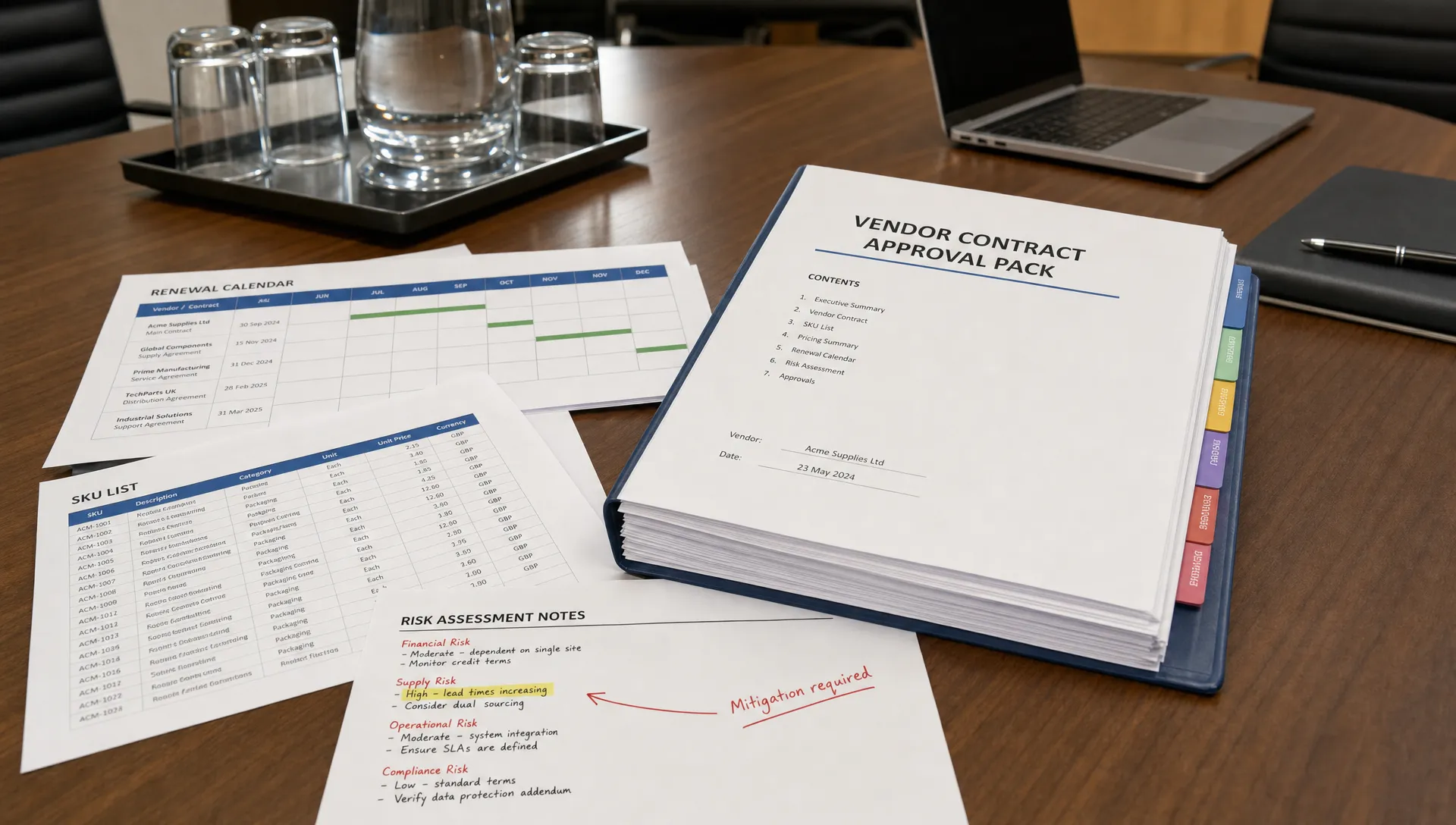
Check term, renewal and cancellation mechanics
Renewal terms deserve close attention because they define your next negotiation before it begins. Auto-renewal, long notice periods and unclear uplift language can remove leverage if nobody tracks them.
Before approval, document the start date, end date, notice deadline, renewal term, renewal pricing method and cancellation process. Do not rely on a calendar reminder created after signature. The approval file should already contain the key dates and accountable owner.
A vendor contract that renews automatically is not necessarily bad. The problem is automatic renewal without internal ownership. If the business case depends on a future review, usage audit or reforecast, the agreement should leave enough time to do that work properly.
This is where many Salesforce customers lose room to move. Renewal discussions are weaker when the supplier knows the customer has discovered scope, usage and budget issues too late. SaaSed has written separately about why contract review should start months before renewal, which is particularly relevant for large Salesforce estates.
Check usage rights, audits and compliance obligations
Approval should test whether the organisation can comply with the agreement in practice. SaaS contracts often include restrictions on use, transfer, access, benchmarking, third-party integrations, data extraction and credential sharing. Some are standard. Some need operational controls.
Ask IT and the system owner to confirm who will administer access, how licences will be assigned, how leavers will be removed and how usage will be monitored. If the contract includes audit rights or overuse charges, the business needs a way to spot issues before the supplier does.
For Salesforce, this matters because environments can grow organically. Teams add users, pilots become live processes and integrations expand. Without ownership, the estate can drift away from the approved commercial model.
The vendor contract should make clear what happens if usage exceeds entitlement. Is there a true-up? At what rate? From what date? Does excess use trigger a wider commercial reset? These answers belong in the approval note, not in a dispute after deployment.
Check liability, indemnity and service commitments
Legal teams will lead on liability and indemnity, but commercial leaders still need to understand the trade-offs. A low liability cap may be acceptable for a small non-critical tool. It may not be acceptable for a platform that supports revenue operations, customer service or regulated data workflows.
Review the liability cap, exclusions from the cap, indemnities, service commitments, support hours, maintenance windows and remedies for service failure. The point is not to demand perfect terms. It is to understand whether the agreed position matches the operational dependency.
Security and continuity also need practical review. If the supplier provides standard security documents, confirm that your security team has reviewed the relevant ones and that any exceptions are documented. If the tool will process personal data, the data processing agreement should be included in the approval pack.
A vendor contract should not be approved simply because legal risk is “market standard”. Market standard still has to be tolerable for your environment, your data and your dependency on the platform.
Check data, AI and change-control terms
SaaS agreements increasingly include terms covering analytics, AI features, product telemetry and data use. These terms can be scattered across product documentation, trust pages and online policies. They are easy to miss if approval focuses only on price.
Ask three practical questions. What data will the supplier process? For what purposes? Can those purposes change during the term without your consent? If the answer sits in linked documents, capture the relevant terms and ask legal, security and data protection owners to review them.
Change-control terms also matter. Suppliers may reserve rights to modify features, retire functionality, change support policies or update online terms. Some flexibility is normal in cloud software, but it should not undermine the business case you are approving.
For Salesforce estates, check whether any material product dependencies are assumed in the project plan. If approval depends on a specific capability, integration or support level, make sure the contractual documents support that assumption.
Check exit rights before you need them
Exit terms rarely receive enough attention because everyone is focused on starting. That is understandable, but poor exit terms can increase renewal pressure later. If data return, transition support or termination rights are weak, the organisation may have little practical choice but to renew.
Review what happens at expiry or termination. Can you export data in a usable format? How long is data retained? Are transition services available? Are there fees for assistance? What happens to integrations, sandboxes, archived data and user access?
A vendor contract should also be tested against plausible business changes. If the company divests a business unit, consolidates platforms, reduces headcount or changes operating model, can the agreement adapt? If not, the approval note should say so plainly.
This is not pessimism. It is stewardship. Good exit terms do not mean you expect the supplier relationship to fail. They mean you have protected future choice.
Red flags that should pause approval
Some issues do not mean the deal must stop, but they should slow approval until the owner accepts the risk in writing. The worst outcome is not a hard commercial decision. The worst outcome is an unspoken assumption that later becomes a cost.
Pause approval if you see any of the following:
- The final order form does not match the approved business case
- The supplier will not confirm the full document set or order of precedence
- Renewal uplift language is missing, vague or uncapped
- The notice period is long and no internal owner is assigned
- Licence quantities are based on aspiration rather than committed rollout plans
- Key data, security or AI terms sit in linked documents nobody has reviewed
- The agreement includes products that the business cannot explain how it will use
- Exit terms are unclear or depend on supplier discretion
None of these points automatically makes a deal bad. They do mean the approval pack is incomplete.
Build an approval note that can survive scrutiny
The approval note should be short enough to read and strong enough to defend. It should not repeat every clause. It should capture the commercial decision, the known risks and the controls that will stop those risks becoming surprises.
At minimum, include the recommended supplier, contract term, committed spend, scope, renewal position, main commercial risks, legal exceptions, data or security exceptions, implementation assumptions and named internal owners.
For larger Salesforce agreements, add a usage baseline and a renewal readiness plan. That creates a thread from approval to adoption to renewal, rather than treating each step as a separate event. SaaSed’s article on what a readiness audit should test before renewal is useful when building that evidence base early.
The approval note should also say what has not been checked. That may feel uncomfortable, but it is better than presenting an agreement as fully reviewed when material assumptions remain open.
Frequently Asked Questions
Who should review a vendor contract before approval? Finance should review cost, payment timing and budget exposure. IT should review scope, usage, security and operational fit. Procurement should review commercial terms, leverage and supplier commitments. Legal should review enforceability, liability, data protection and termination rights.
Is the order form enough to approve a SaaS deal? No. The order form is only part of the agreement. Approval should also consider the master terms, product terms, data processing terms, support policies, online documents and any schedules incorporated by reference.
What is the biggest contract risk before approval? The biggest risk is usually mismatch. The contract says one thing, the business case assumes another and the implementation plan depends on something else. That gap creates cost, delay and weak renewal leverage.
How early should contract approval work begin? For material SaaS or Salesforce agreements, approval checks should begin before final commercial negotiation. If the first proper review happens after the supplier has issued final paperwork, your ability to change the deal is already reduced.
Should approval be blocked if some risks remain? Not always. Some risks are acceptable if they are understood, priced and owned. Approval should be paused when risks are unclear, undocumented or inconsistent with the business case.
Final check before you approve
A contract approval gate is not there to make procurement feel tidy. It protects budget, delivery and future negotiating room. The work is straightforward: confirm the documents, test the scope, understand the pricing, control the renewal path, review the operational risks and keep a record of the decision.
For Salesforce agreements, that discipline matters even more because product scope, user demand and renewal leverage are tightly connected. A cleaner approval today gives you more options when the next renewal conversation begins.
If you are close to approving or renewing a Salesforce agreement and want a second set of eyes on the commercial position, SaaSed can help you review the contract, SKUs, usage and renewal risks before you commit. Start with a complimentary Salesforce audit conversation.
Want this kind of intel on your renewal?
Don’t head into your next software negotiation alone
Contact Us