How to Assess Salesforce Strategic Partnerships Before Signing
Salesforce strategic partnerships need more than trust and a discount. Use this practical assessment framework to test scope, incentives, usage evidence and contract risk before you sign.

A Salesforce partnership can look sensible in the room and still be expensive in the contract.
The risk is not that Salesforce or the partner is weak. The risk is that the word 'strategic' gets used before anyone has tested what it means. By the time the agreement lands with procurement, the business case may already be shaped, the scope may feel politically fixed and the renewal path may be harder to change.
For CFOs, CIOs, IT leads and procurement teams, the job is not to block partnership. It is to make sure the partnership has a commercial spine: clear outcomes, clear ownership, usable evidence and terms that still make sense when the first year is over.
This is a practical way to assess Salesforce strategic partnerships before signing.
Start by defining what strategic means
A strategic partnership is not the same as a large purchase. It should change how the organisation operates, not just add more licences, services or project meetings.
Before you accept the label, ask what makes the arrangement strategic. Is it tied to revenue operations, service transformation, data architecture, customer experience, compliance, M&A readiness or cost reduction? If the answer is vague, the commercial model will usually be vague too.
A useful test is dependency. If the partner fails, what stops working? If the answer is a minor backlog item, you may be buying support rather than entering a strategic relationship. If the answer is lead flow, case handling, pricing, sales forecasting or customer data quality, the diligence needs to be much sharper.
This is not unique to software. A logistics company choosing a specialist refrigerated vehicle supplier would look beyond the vehicle price and assess certification, service coverage, uptime risk and fit for its operating model. Salesforce deserves the same seriousness when it sits inside customer, revenue or service operations.
Map the partnership before you assess it
Most Salesforce strategic partnerships are not one contract with one party. They often involve Salesforce, an implementation partner, a managed service provider, AppExchange vendors, advisory support and internal teams. Each party may be credible on its own, but the whole arrangement can still create cost leakage if responsibilities overlap or incentives pull in different directions.
Before you judge the partnership, map who is responsible for what. SaaSed has written separately about the wider cost picture in the Salesforce ecosystem, including advisory, implementation partners and hidden costs, which is often where the real exposure sits.
A simple map should show the buying entity, contract owner, budget owner, technical owner, data owner, delivery partner, support partner, renewal owner and executive sponsor. If nobody can draw that cleanly, the partnership is not ready for signature.
| Area to map | What to confirm before signing | Why it matters |
|---|---|---|
| Licence estate | Products, editions, quantities, start dates and renewal dates | Prevents bundled spend from becoming invisible |
| Services scope | Delivery, support, advisory and change requests | Reduces overlap between partners and internal teams |
| Decision rights | Who can approve extra licences, apps or scope changes | Stops small choices becoming structural spend |
| Success measures | Business outcomes and operational metrics | Keeps the agreement tied to evidence rather than optimism |
| Exit route | Termination rights, knowledge transfer and data access | Protects leverage if the relationship underperforms |
This table is deliberately plain. Strategic partnerships fail commercially when the basics are treated as administrative detail.
Check the partner's credentials, then look past them
Certifications, case studies and marketplace listings are useful, but they are not diligence. They tell you a partner exists in the ecosystem. They do not tell you whether that partner is the right commercial fit for your estate.
Salesforce's own AppExchange consulting partner directory is a sensible starting point for shortlisting. Use it to understand categories, specialisms and market presence. Then move quickly to buyer-side questions.
Ask for relevant references, not generic success stories. If you are a mid-market group with a complex multi-cloud estate and patchy adoption, a glossy enterprise transformation case study may not help. If you are about to consolidate Service Cloud, Sales Cloud and CPQ, you need evidence that the partner has handled similar commercial and operational complexity.
Good references should answer three questions: what was originally promised, what changed during delivery and what the customer would do differently now. The third answer is often the most valuable.
Test the business case against usage evidence
Salesforce business cases can be persuasive because the strategic language is familiar: better data, faster sales cycles, stronger customer experience and more automation. Those may be valid outcomes, but they still need to be tested against current usage.
Before signing a strategic partnership, gather the evidence you already have. Current licence allocation, login activity, feature adoption, support tickets, integration load, duplicate tools, unused SKUs and regional usage patterns all matter. A partnership built on poor baseline data tends to produce the same problem at a higher price.
This is where procurement and IT should work together. Procurement can see the commercial pattern, but IT can see whether the estate is actually being used. Finance can test whether the proposed benefits are measurable. No single team has the full picture.
If you are approaching a renewal as part of the partnership, the work becomes even more important. We cover this angle in more detail in how Salesforce procurement teams find hidden leverage, particularly where usage evidence changes the negotiation position.
A useful pre-signature question is: what part of the proposed spend is solving a proven problem, and what part is buying optionality? Optionality is not wrong, but it should be priced and governed as optionality.
Look at incentives, not just capability
A partner can be skilled and still have incentives that do not fully match yours. This is not a character judgement. It is basic commercial hygiene.
Some partners are rewarded for delivery scope. Some are close to product expansion motions. Some may recommend additional clouds, apps or success services because those options are genuinely useful. Others may do so because the engagement model nudges them in that direction.
Your assessment should make those incentives visible. Ask direct questions: does the partner receive referral fees, resale margin or other commercial benefit from Salesforce or third-party vendors? Are they independent in their recommendations? Will they document where a lower-cost option, process change or licence reduction is the better answer?
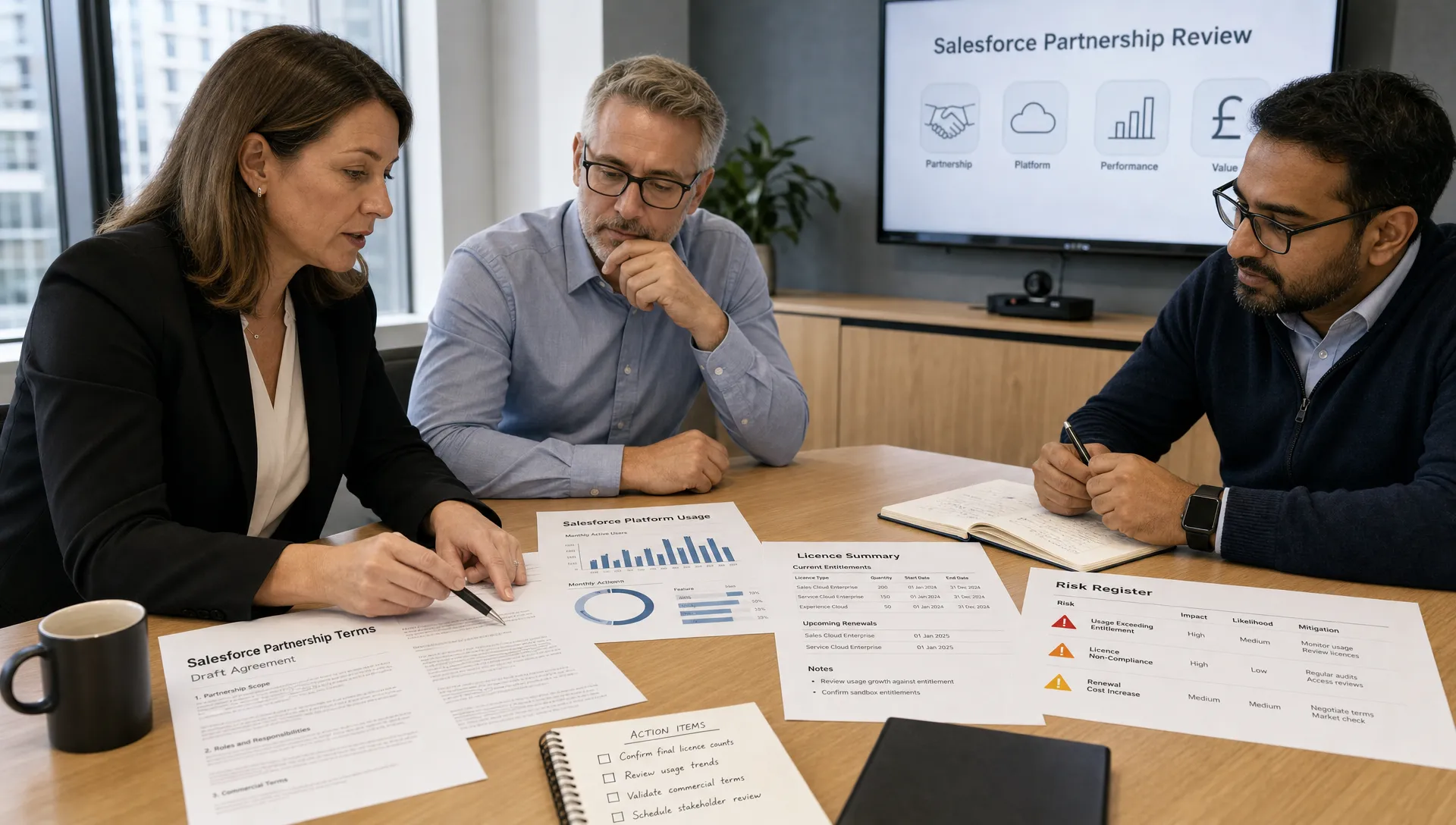
The best partners will not be offended by these questions. They will have clear answers. They will also understand that a CFO or CIO needs a clean basis for decision-making.
Review the agreement before the story hardens
Commercial review should not wait until the final draft. By then, stakeholders may feel committed to the partner and reluctant to reopen difficult points. The earlier you inspect the agreement, the less emotional the discussion becomes.
Focus on clauses that affect future leverage, not only year-one price. Renewal mechanics, uplift caps, auto-renewal language, minimum commitments, co-terming, product swaps, usage rights, audit rights, termination for convenience, data access and support obligations can all change the real cost of the partnership.
If the Salesforce element is part of a broader enterprise deal, be especially careful. Bundles can be convenient, but they can also make it harder to see which products are essential, which are underused and which are included mainly to support a discount narrative. The deeper the bundle, the more disciplined the review should be.
For a fuller list of clauses and agreement types worth slowing down for, see Salesforce agreements that deserve a harder review. The point is not to over-lawyer every document. It is to understand which terms will matter when the partnership is no longer new.
Build a pre-signature scorecard
A scorecard will not make the decision for you, but it does make disagreement clearer. That is useful. It stops one impressive workshop, one senior relationship or one aggressive discount from carrying too much weight.
Score the partnership across commercial, technical and operational criteria. Keep the scoring simple enough that leaders will use it, but specific enough that weak areas cannot hide behind broad confidence.
| Criterion | Strong answer | Weak answer |
|---|---|---|
| Business problem | Specific, measurable and owned by a leader | Broad transformation language with no baseline |
| Usage evidence | Current adoption and shelfware are understood | Licence need is estimated from headcount or ambition |
| Partner role | Responsibilities and limits are documented | Partner is expected to advise, deliver and govern itself |
| Commercial model | Pricing, renewals and change control are clear | First-year discount hides long-term exposure |
| Exit protection | Data, documentation and handover are covered | Dependency increases without a practical exit path |
| Governance | Decision rights and review cadence are defined | Issues will be handled informally as they arise |
The scorecard should include the people who will live with the decision, not only the people who negotiated it. That usually means finance, procurement, IT, security, data owners and business leadership.
Do not confuse discount with protection
A large discount can make a partnership feel commercially safe. It may not be.
The main question is not whether the discount looks attractive against list price. The better question is whether the organisation needs the products, can absorb the services and has enough flexibility if assumptions change.
A discounted SKU that nobody uses is still waste. A fixed commitment tied to an uncertain roll-out still carries risk. A price hold on products that are poorly matched to the roadmap may not be valuable. Strong buying teams separate price from fit.
This is also where timing matters. If you assess the partnership close to signature, Salesforce and the partner may have more control over the process. If you start earlier, you can test alternatives, clean up the estate and decide which parts of the proposal deserve commitment.
Watch for red flags before signing
Some warning signs are subtle. Others are blunt. Either way, they deserve attention before signature, not after the first difficult steering committee.
- The business case depends on benefits that no owner has agreed to measure.
- The partner cannot explain how recommendations affect licence demand.
- The contract gives flexibility to the vendor but not to the customer.
- The scope assumes internal capacity that does not exist.
- Discount discussions happen before SKU rationalisation.
- The agreement bundles products in a way that makes usage hard to track.
- Exit, handover and documentation are treated as end-of-project details.
None of these points automatically means the partnership is wrong. They mean the buyer needs more evidence or better terms before committing.
Set governance before the ink dries
Governance is often added after signing, when the first problems appear. That is late.
A strategic partnership should have a clear review rhythm from day one. That does not mean a bloated committee structure. It means agreeing how spend, adoption, delivery, support, risks and decisions will be reviewed.
At minimum, define who reviews licence usage, who approves scope changes, who owns business benefits, who tracks technical debt and who challenges new product recommendations. If the partner will play an advisory role, define how advice is documented and how conflicts of interest are disclosed.
The most useful governance meetings are not status theatre. They make decisions. They remove blockers. They keep the partnership commercially honest.
Frequently Asked Questions
What are Salesforce strategic partnerships? Salesforce strategic partnerships are commercial and operational relationships that go beyond a simple licence purchase or short project. They usually affect core processes, data, integrations, support models, budgets and future renewal choices.
When should we assess a Salesforce strategic partnership? Start before the proposal becomes the preferred plan. Ideally, assess the partnership before executive approval, commercial negotiation and contract drafting have all hardened. Early review gives procurement, IT and finance more room to shape the outcome.
What should procurement look for before signing? Procurement should look beyond the initial discount. Key areas include SKU fit, usage evidence, renewal terms, change control, commercial incentives, exit rights and whether the agreement preserves leverage over time.
How do we know if a Salesforce partner is genuinely independent? Ask how the partner is paid, whether they receive referral fees or resale margin and whether they will document recommendations that reduce spend or avoid extra products. Independence is easier to trust when it is visible in writing.
Should we use a scorecard to compare Salesforce partners? Yes, if the scorecard is practical. It should compare business fit, technical capability, commercial transparency, governance, references, incentives and exit protection. A scorecard is not perfect, but it reduces decision-making by anecdote.
Before You Sign, Get the Commercial Picture Straight
A good Salesforce strategic partnership should stand up to scrutiny. It should still make sense when the discount is ignored, the scope is tested, the usage data is reviewed and the renewal terms are read carefully.
If you are close to signing, or if the partnership is tied to a renewal, a short independent review can be enough to find the questions worth asking before leverage is lost. SaaSed helps organisations review contracts, SKUs, usage and negotiation readiness with a Salesforce-specific commercial lens.
For a calm second view, book a complimentary Salesforce audit conversation.
Want this kind of intel on your renewal?
Don’t head into your next software negotiation alone
Contact Us