Unlocking Leverage in Revenue Cloud Renewals: A Guide for Enterprise CFOs
Revenue Cloud renewals rarely fail because of one bad line item. The real risk is hidden in transaction bands, Billing assumptions, uplift clauses, and CPQ structures that no longer match how the business actually operates.

Executive Summary (TL;DR)
Takeaway 1: Revenue Cloud Renewals can hide material cost growth inside transaction-volume assumptions, tier bands, and amended order forms. The issue is rarely the headline discount. It is the commercial maths beneath it.
Takeaway 2: Tiered CPQ and Billing pricing can turn uncertain future usage into fixed spend. If billing lines also carry 3-5% annual uplifts, the compounding effect can be larger than the CFO sees in the first renewal quote.
Takeaway 3: Leverage comes from evidence, not pressure. A Salesforce CPQ contract audit that reconciles users, quote activity, invoice volumes, org history, and growth clauses gives procurement a defensible position before negotiations begin.
Revenue Cloud Renewals deserve a different level of scrutiny from a standard seat-based Salesforce renewal. CPQ and Billing sit close to revenue, finance operations, approvals, pricing logic, and invoicing. That makes them commercially sensitive, operationally sticky, and difficult to challenge once the renewal clock is running.
The product value may be real. Salesforce positions Revenue Cloud around quote-to-cash capabilities, including configuration, pricing, quoting, contracts, orders, and billing, as shown in Salesforce’s Revenue Cloud overview. The procurement problem is different: many enterprise contracts do not cleanly reflect how the platform is actually used.
That gap is where leakage lives.
Complexity is a tax on the unknown. If they cannot convince you, they will confuse you. In Revenue Cloud, confusion often appears as bands, inherited SKUs, bundled functionality, historical orgs, uplift clauses, and usage assumptions that nobody in finance would sign off on if presented in plain English.
The CPQ & Billing Leakage in Revenue Cloud Renewals
The most common overpayment pattern in Revenue Cloud is not a single bad line item. It is a chain of small assumptions that harden into spend.
A forecasted transaction volume becomes a contracted tier. A future Billing roadmap becomes a live subscription. A one-time multi-org deployment becomes a permanent commercial structure. A small annual uplift applies not only to visible user licences, but also to underlying Billing lines and transaction-based components.
For CFOs, the central question is simple: are you paying for actual usage, credible near-term demand, or the memory of an implementation plan that never fully happened?
Many enterprises miscalculate their real quote-to-cash volumes because the internal data is spread across Sales Ops, RevOps, Finance, IT, and regional Salesforce teams. The renewal quote may be based on a clean commercial narrative, while the usage reality is messy. Some users create complex quotes daily. Some approve once a quarter. Some were provisioned during a rollout and never became active. Some orgs still carry CPQ line items because an acquisition, region, or business unit was once negotiated separately.
The Billing side can be even harder to read. Enterprises often accept pricing based on projected invoice, order, amendment, or transaction activity without a rigorous reconciliation of what is production usage, what is testing, what is duplicate processing, and what is simply noise caused by poor process design. If the underlying assumptions are too high, the renewal starts from the wrong floor.
This is also where shelfware hides. CPQ can be bundled with Billing capability that sounded logical during the original transformation, but was never implemented at scale. The commercial bundle stays intact long after the operational case has weakened. That is why efforts to reduce Salesforce Billing fees should begin with evidence, not with a request for a better discount.
Salesforce’s own product documentation helps show why this requires care. The Salesforce CPQ documentation reflects the number of configuration, pricing, approval, and quote-management components that can sit behind what appears to be a simple SKU. That depth is useful for operators, but it also creates commercial ambiguity if the contract does not distinguish heavy use from light use.
A disciplined renewal review should test five points before accepting any CPQ or Billing baseline:
- Whether contracted users match active, value-creating users.
- Whether Billing volumes reflect live business activity rather than forecasted ambition.
- Whether historical CPQ line items are duplicated across orgs, regions, or legacy order forms.
- Whether annual uplifts apply to components that are already over-sized.
- Whether bundled functionality can be separated without damaging the operating model.
None of this is about underbuying. It is about refusing to let uncertainty become a paid commitment.
Contract Structure Comparison Table
| Metric | Standard Tiered CPQ Pricing | Optimized Usage-Based Revenue Cloud Structure |
|---|---|---|
| Volume Predictability | Often anchored to forecasted or historical bands that may not reflect current production usage. | Baselines are tied to verified activity, with growth bands linked to measurable thresholds. |
| Unused License Waste | Higher risk of paying the same rate for administrators, power users, occasional users, and inactive users. | User groups are separated by actual role, activity, and business value before quantities are committed. |
| Renewal Negotiating Leverage | Leverage weakens when the customer accepts the vendor’s tier logic as fixed. | Leverage improves when procurement can challenge tiers, uplifts, and bundled lines with clean evidence. |
The standard structure is not automatically wrong. It becomes expensive when the customer cannot prove what should change. Salesforce Revenue Cloud optimization starts when finance, IT, and procurement stop debating the discount and start debating the baseline.
Strategic Framework for Revenue Cloud Renewals
The strongest Revenue Cloud Renewals are not won by a late counter-offer. They are won by building a fact base early enough that the vendor knows the customer understands its own estate.
That means procurement cannot sit outside the operating detail. It needs the order forms, SKU history, provisioning records, usage reports, invoice counts, quote creation patterns, and implementation roadmap status. It also needs internal alignment on what must remain, what can change, and what is no longer defensible.
For broader preparation principles, SaaSed has written separately on Salesforce negotiation tactics that improve leverage. For Revenue Cloud specifically, the following three tactics matter most.
"The biggest mistake we see CFOs make during a Revenue Cloud renewal is treating transaction bands as fixed commitments rather than variable levers."
Run a Salesforce CPQ contract audit to right-size user types
A Salesforce CPQ contract audit should separate users by actual commercial function, not by the fact that they all sit somewhere near the quoting process.
In most large enterprises, CPQ usage is uneven. A small group may administer product rules, pricing logic, advanced approvals, quote templates, and complex amendments. A wider group may create or modify quotes regularly. A much larger group may only view, approve, or touch occasional standard quotes.
If all of those users are treated as commercially equivalent, the customer is likely overpaying. The audit should map named users against activity in the last 12 months, including quote creation, quote edits, approvals, administration changes, and deactivated users who still appear in the entitlement base.
The goal is not to invent licence categories that the contract does not support. The goal is to create a clear commercial argument: heavy CPQ administrators, regular quoting users, and occasional standard users do not create the same value or require the same commercial treatment. Once that distinction is documented, procurement can challenge a flat renewal quantity with more credibility.
This work also helps expose duplicated access. In multi-org environments, the same person may appear across different orgs or business units. During an implementation, temporary users may have been added and never removed. In acquisitions, legacy teams may retain access to CPQ structures that no longer support live revenue operations.
A CFO does not need to inspect every permission set. But finance does need confidence that every renewed user has a reason to exist.
Restructure growth clauses to reduce Salesforce Billing fees
The second tactic is to examine growth mechanics before discussing price.
Many renewal models apply automatic 3-5% escalations to the subscription base. That may sound modest in isolation. It is not modest when it applies to Billing lines that are already sized against inflated volume assumptions, or when future transaction bands become commitments before the business reaches them.
To reduce Salesforce Billing fees without creating operational risk, procurement should separate three things: the current production baseline, credible near-term growth, and speculative future demand. Those should not all be priced as if they are equally certain.
This is where contract language matters. If the renewal locks in uplifts across all Billing components, the customer may pay more even if transaction volume stays flat. If the order form treats growth bands as pre-committed, the customer loses the ability to tie spend to actual adoption. If the contract does not distinguish live production activity from test, migration, or duplicate transactions, the wrong numbers may shape the entire commercial structure.
Growth is not the problem. Unverified growth is.
SaaSed has covered related risk patterns in Salesforce contract renewal risks to catch early, including how uplift, minimum quantities, and bundled commitments can reduce flexibility before the renewal discussion has properly started.
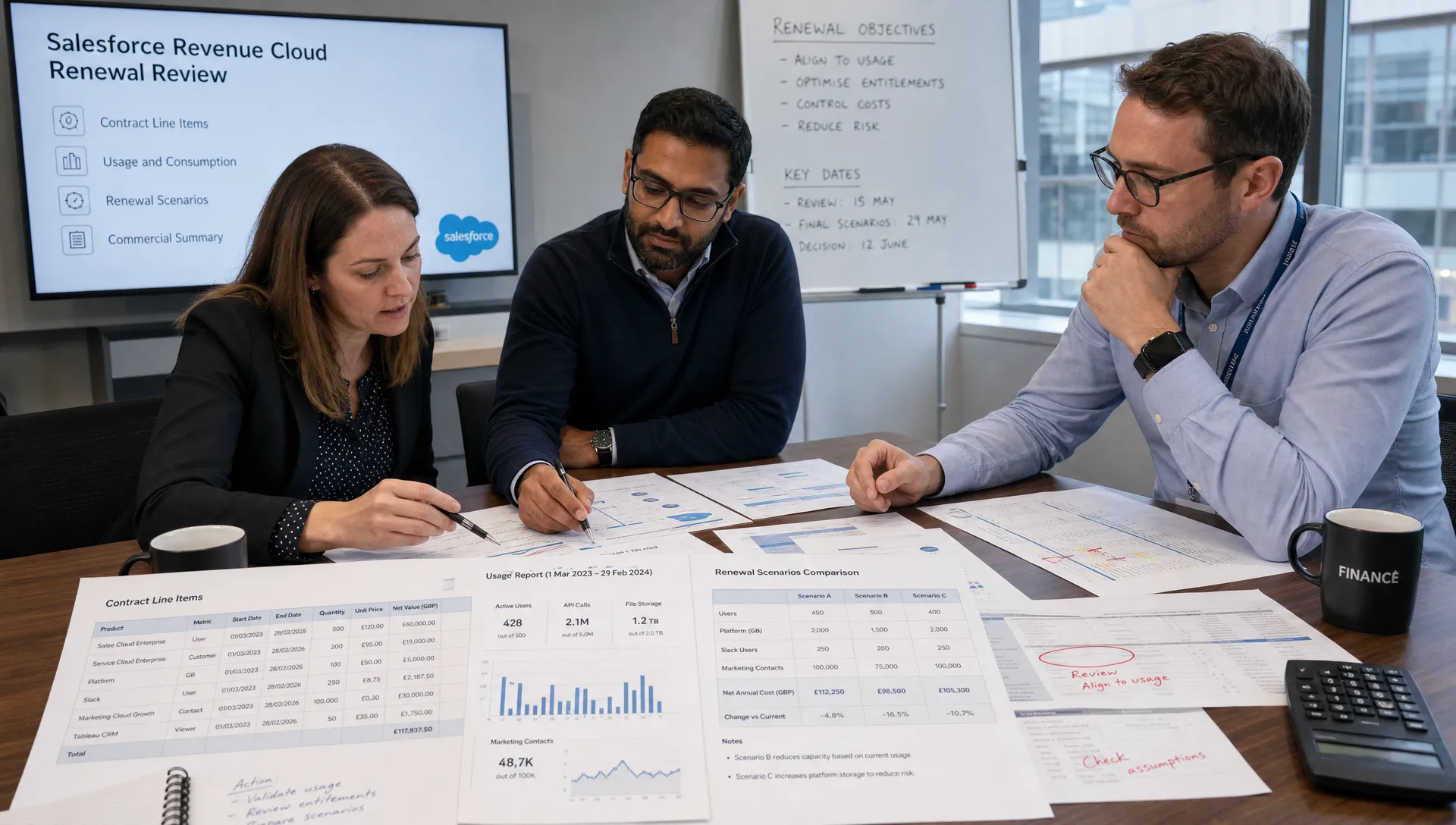
Consolidate historical multi-org CPQ line items into a single commercial structure
The third tactic is often missed because it is tedious. It is also one of the quickest ways to recover leverage.
Large Salesforce customers rarely arrive at renewal with one clean Revenue Cloud structure. They arrive with years of history: regional deployments, acquired businesses, phased CPQ rollouts, separate Billing pilots, amended order forms, co-term adjustments, and inconsistent discounting.
Each of those fragments may have made sense at the time. Together, they can create a weak commercial position. The customer may be paying different effective rates for similar CPQ capability. Some orgs may have old uplift terms. Some Billing components may sit in one order form while related CPQ functionality sits in another. The vendor then negotiates from a fragmented baseline, while the customer struggles to understand its own net position.
Consolidation does not mean forcing every business unit into the same technical design. It means creating one commercial view of the estate.
Procurement should build a renewal inventory that shows each Revenue Cloud line item, source order form, org, quantity, discount, uplift, term, and business owner. From there, the team can identify duplicates, outliers, unused lines, and opportunities to move toward a unified structure. This is especially important when global procurement is trying to negotiate on behalf of business units that historically bought Salesforce separately.
Commercial fragmentation favours the seller. A unified view gives the buyer a spine.
Where Salesforce Revenue Cloud optimization actually starts
Salesforce Revenue Cloud optimization is not a procurement slogan. It is a data exercise with financial consequences.
Before a renewal meeting, the CFO should expect a clean renewal pack that answers a few uncomfortable questions. What did we buy? What do we use? What did we intend to use but never implement? Which line items are tied to live revenue processes? Which are tied to historical decisions? Where are we exposed to automatic uplifts? Which volumes can we prove?
A practical renewal pack should include the following evidence.
| Evidence | Why it matters to the CFO | What to test |
|---|---|---|
| Contracted CPQ and Billing entitlements | Shows the paid baseline before the renewal quote reframes it | Are quantities, SKUs, and order forms still accurate? |
| Active CPQ user activity | Separates high-value users from occasional or inactive users | Who created, edited, approved, or administered quotes in the last 12 months? |
| Billing and transaction volumes | Tests whether tiers match real production behaviour | Are volumes live, duplicated, forecasted, or inflated by testing? |
| Multi-org and legacy line items | Reveals fragmented pricing and duplicated commitments | Can similar CPQ lines be consolidated into one commercial structure? |
| Uplift and growth clauses | Shows how cost compounds after signature | Do 3-5% escalations apply to over-sized or optional components? |
This pack should be prepared before the renewal quote lands. Once the vendor frames the negotiation around its preferred baseline, every correction becomes harder. Not impossible, but harder.
There is also a governance point here. Revenue Cloud sits at the intersection of sales, finance, and IT. If only Sales Ops owns the usage story, finance may miss the commercial risk. If only procurement owns the contract, IT may miss the operational constraints. If only finance owns the budget, the business may resist changes that were not tested with users.
The renewal team should agree on a small number of non-negotiables before entering vendor discussions. For example, no renewal based on unverified transaction bands. No automatic uplift on components that are already being challenged. No bundled Billing commitment justified by a roadmap unless the roadmap has budget, ownership, and dates.
If the seller cannot explain the pricing mechanics plainly, slow down. Clarity is not an unreasonable ask. It is the first condition of a fair commercial decision.
How CFOs should read the renewal quote
When the renewal quote arrives, read it less like a price proposal and more like a set of assumptions.
The first assumption is the baseline. Does the quote start from what you use, or from what you previously bought? In Revenue Cloud, those can be very different numbers.
The second assumption is growth. Are you being asked to pre-buy future transaction bands, future Billing use, or future CPQ expansion before the business has made those commitments internally?
The third assumption is flexibility. Are CPQ and Billing lines separable, or does the commercial structure force you to keep shelfware in order to protect discounts elsewhere?
The fourth assumption is time. A longer term may improve the displayed discount, but it can also lock in the wrong structure. If renewal term is being used as a trade-off, it is worth reviewing how term length affects control before agreeing. SaaSed’s guide on using the renewal term without losing ground covers that point in more depth.
A strong CFO review does not require hostility. It requires calm refusal to accept unexplained complexity.
Watch for these red flags:
- A discount that only holds if unused Billing functionality stays in the renewal.
- Transaction bands presented as immovable, even when usage evidence says otherwise.
- Annual uplifts applied to all underlying lines without regard to actual adoption.
- Multi-org CPQ history rolled forward without consolidation.
- A renewal timeline that pressures signature before finance has reconciled usage.
These are not technical details. They are financial controls.
Frequently Asked Questions
When should we start preparing for Revenue Cloud Renewals? For a large enterprise, six months is a sensible minimum. If you have multiple orgs, acquired entities, complex Billing lines, or more than one historical order form, nine to twelve months gives finance and procurement more room to build evidence before the vendor quote frames the discussion.
What is a Salesforce CPQ contract audit? A Salesforce CPQ contract audit compares contracted entitlements against real usage, user activity, org history, SKU structure, discounts, uplift clauses, and renewal assumptions. The output should show which CPQ and Billing lines are defensible, which are underused, and which need to be restructured before renewal.
Can we reduce Salesforce Billing fees without disrupting the revenue process? Often, yes, but only if the analysis is precise. The objective is not to cut working capability. It is to separate live production usage from over-sized bands, unused features, duplicate org structures, and speculative growth commitments.
What if Salesforce says our transaction bands are fixed? Treat that as a commercial position, not a law of physics. If your usage evidence shows that bands are misaligned with production activity, procurement has a basis to challenge the structure, ask for alternative bands, or separate current usage from future growth.
Should CPQ and Billing always be negotiated together? Not always. They may be operationally connected, but the commercial structure should still be tested. If Billing capability is underused while CPQ remains critical, the renewal should not automatically preserve both at the same scale.
Before You Sign
If you are approaching a Salesforce Revenue Cloud renewal and want to eliminate CPQ and Billing leakage with precision, visit our contact page to schedule a direct, confidential strategic session with Anders.
SaaSed can help audit your commercial structure before you sign anything, including the contract baseline, SKU structure, usage evidence, uplift exposure, and negotiation position. The aim is simple: a complimentary Salesforce audit conversation that gives you clarity before the renewal becomes a commitment.
Want this kind of intel on your renewal?
Don’t head into your next software negotiation alone
Contact Us