
Unlocking Leverage in Revenue Cloud Renewals: A Guide for Enterprise CFOs
Revenue Cloud renewals rarely fail because of one bad line item. The real risk is hidden in transaction bands, Billing assumptions, uplift clauses, and CPQ structures that no longer match how the business actually operates.
Where Salesforce Revenue Cloud optimization actually starts
Salesforce Revenue Cloud optimization is not a procurement slogan. It is a data exercise with financial consequences.
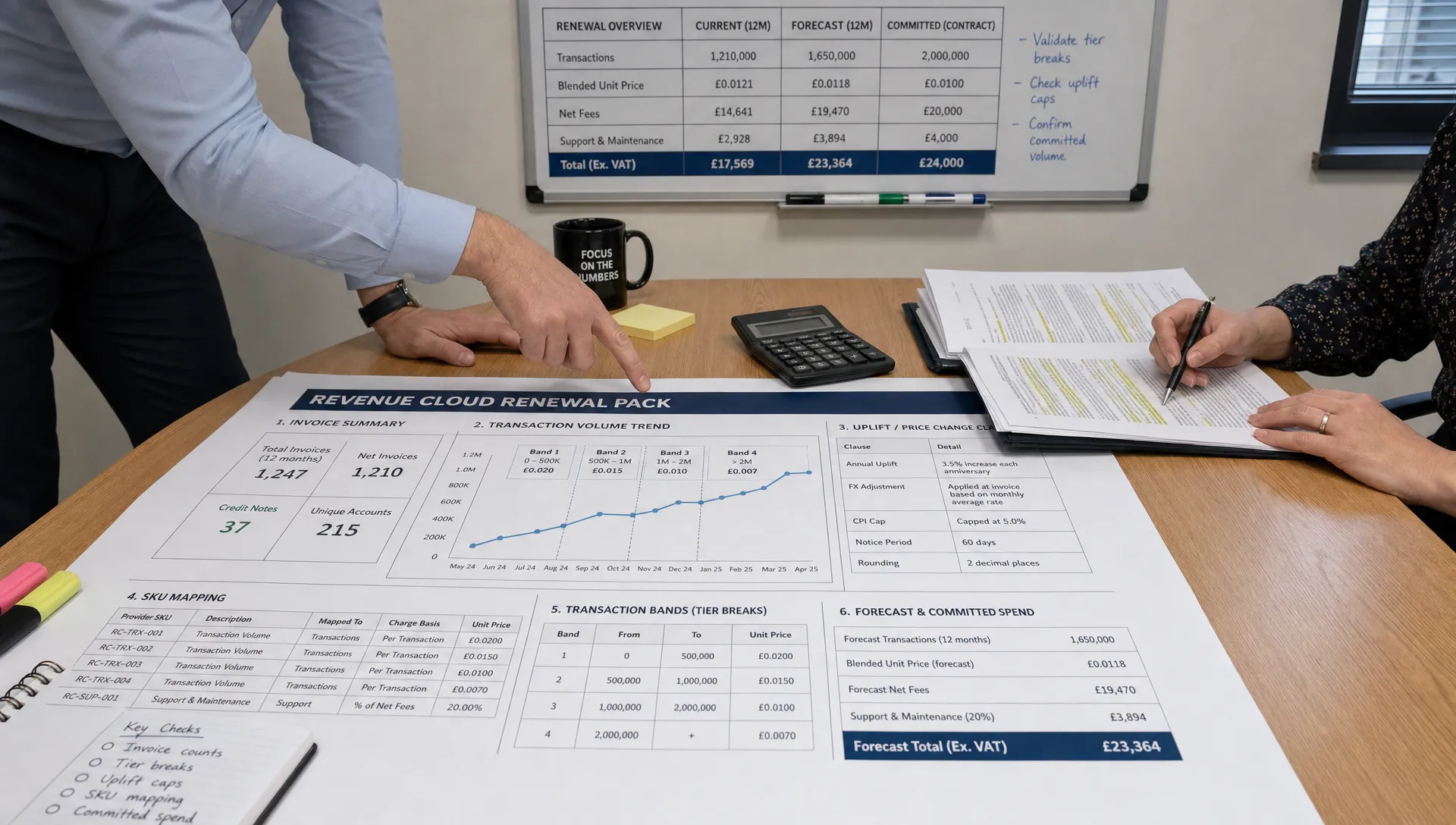
Before a renewal meeting, the CFO should expect a clean renewal pack that answers a few uncomfortable questions. What did we buy? What do we use? What did we intend to use but never implement? Which line items are tied to live revenue processes? Which are tied to historical decisions? Where are we exposed to automatic uplifts? Which volumes can we prove?
A practical renewal pack should include the following evidence.
| Evidence | Why it matters to the CFO | What to test |
|---|---|---|
| Contracted CPQ and Billing entitlements | Shows the paid baseline before the renewal quote reframes it | Are quantities, SKUs, and order forms still accurate? |
| Active CPQ user activity | Separates high-value users from occasional or inactive users | Who created, edited, approved, or administered quotes in the last 12 months? |
| Billing and transaction volumes | Tests whether tiers match real production behaviour | Are volumes live, duplicated, forecasted, or inflated by testing? |
| Multi-org and legacy line items | Reveals fragmented pricing and duplicated commitments | Can similar CPQ lines be consolidated into one commercial structure? |
| Uplift and growth clauses | Shows how cost compounds after signature | Do 3-5% escalations apply to over-sized or optional components? |
This pack should be prepared before the renewal quote lands. Once the vendor frames the negotiation around its preferred baseline, every correction becomes harder. Not impossible, but harder.
There is also a governance point here. Revenue Cloud sits at the intersection of sales, finance, and IT. If only Sales Ops owns the usage story, finance may miss the commercial risk. If only procurement owns the contract, IT may miss the operational constraints. If only finance owns the budget, the business may resist changes that were not tested with users.
The renewal team should agree on a small number of non-negotiables before entering vendor discussions. For example, no renewal based on unverified transaction bands. No automatic uplift on components that are already being challenged. No bundled Billing commitment justified by a roadmap unless the roadmap has budget, ownership, and dates.
If the seller cannot explain the pricing mechanics plainly, slow down. Clarity is not an unreasonable ask. It is the first condition of a fair commercial decision.
How CFOs should read the renewal quote
When the renewal quote arrives, read it less like a price proposal and more like a set of assumptions.
The first assumption is the baseline. Does the quote start from what you use, or from what you previously bought? In Revenue Cloud, those can be very different numbers.
The second assumption is growth. Are you being asked to pre-buy future transaction bands, future Billing use, or future CPQ expansion before the business has made those commitments internally?
The third assumption is flexibility. Are CPQ and Billing lines separable, or does the commercial structure force you to keep shelfware in order to protect discounts elsewhere?
The fourth assumption is time. A longer term may improve the displayed discount, but it can also lock in the wrong structure. If renewal term is being used as a trade-off, it is worth reviewing how term length affects control before agreeing. SaaSed’s guide on using the renewal term without losing ground covers that point in more depth.
A strong CFO review does not require hostility. It requires calm refusal to accept unexplained complexity.
Watch for these red flags:
- A discount that only holds if unused Billing functionality stays in the renewal.
- Transaction bands presented as immovable, even when usage evidence says otherwise.
- Annual uplifts applied to all underlying lines without regard to actual adoption.
- Multi-org CPQ history rolled forward without consolidation.
- A renewal timeline that pressures signature before finance has reconciled usage.
These are not technical details. They are financial controls.
Frequently Asked Questions
When should we start preparing for Revenue Cloud Renewals? For a large enterprise, six months is a sensible minimum. If you have multiple orgs, acquired entities, complex Billing lines, or more than one historical order form, nine to twelve months gives finance and procurement more room to build evidence before the vendor quote frames the discussion.
What is a Salesforce CPQ contract audit? A Salesforce CPQ contract audit compares contracted entitlements against real usage, user activity, org history, SKU structure, discounts, uplift clauses, and renewal assumptions. The output should show which CPQ and Billing lines are defensible, which are underused, and which need to be restructured before renewal.
Can we reduce Salesforce Billing fees without disrupting the revenue process? Often, yes, but only if the analysis is precise. The objective is not to cut working capability. It is to separate live production usage from over-sized bands, unused features, duplicate org structures, and speculative growth commitments.
What if Salesforce says our transaction bands are fixed? Treat that as a commercial position, not a law of physics. If your usage evidence shows that bands are misaligned with production activity, procurement has a basis to challenge the structure, ask for alternative bands, or separate current usage from future growth.
Should CPQ and Billing always be negotiated together? Not always. They may be operationally connected, but the commercial structure should still be tested. If Billing capability is underused while CPQ remains critical, the renewal should not automatically preserve both at the same scale.
Before You Sign
If you are approaching a Salesforce Revenue Cloud renewal and want to eliminate CPQ and Billing leakage with precision, visit our contact page to schedule a direct, confidential strategic session with Anders.
SaaSed can help audit your commercial structure before you sign anything, including the contract baseline, SKU structure, usage evidence, uplift exposure, and negotiation position. The aim is simple: a complimentary Salesforce audit conversation that gives you clarity before the renewal becomes a commitment.
Want this kind of intel on your renewal?
Don’t head into your next software negotiation alone
Talk to the team