Make Your Salesforce Renewal a Better Buying Decision
A Salesforce renewal is not just a deadline or discount discussion. With the right evidence, finance, IT and procurement can turn it into a cleaner buying decision.
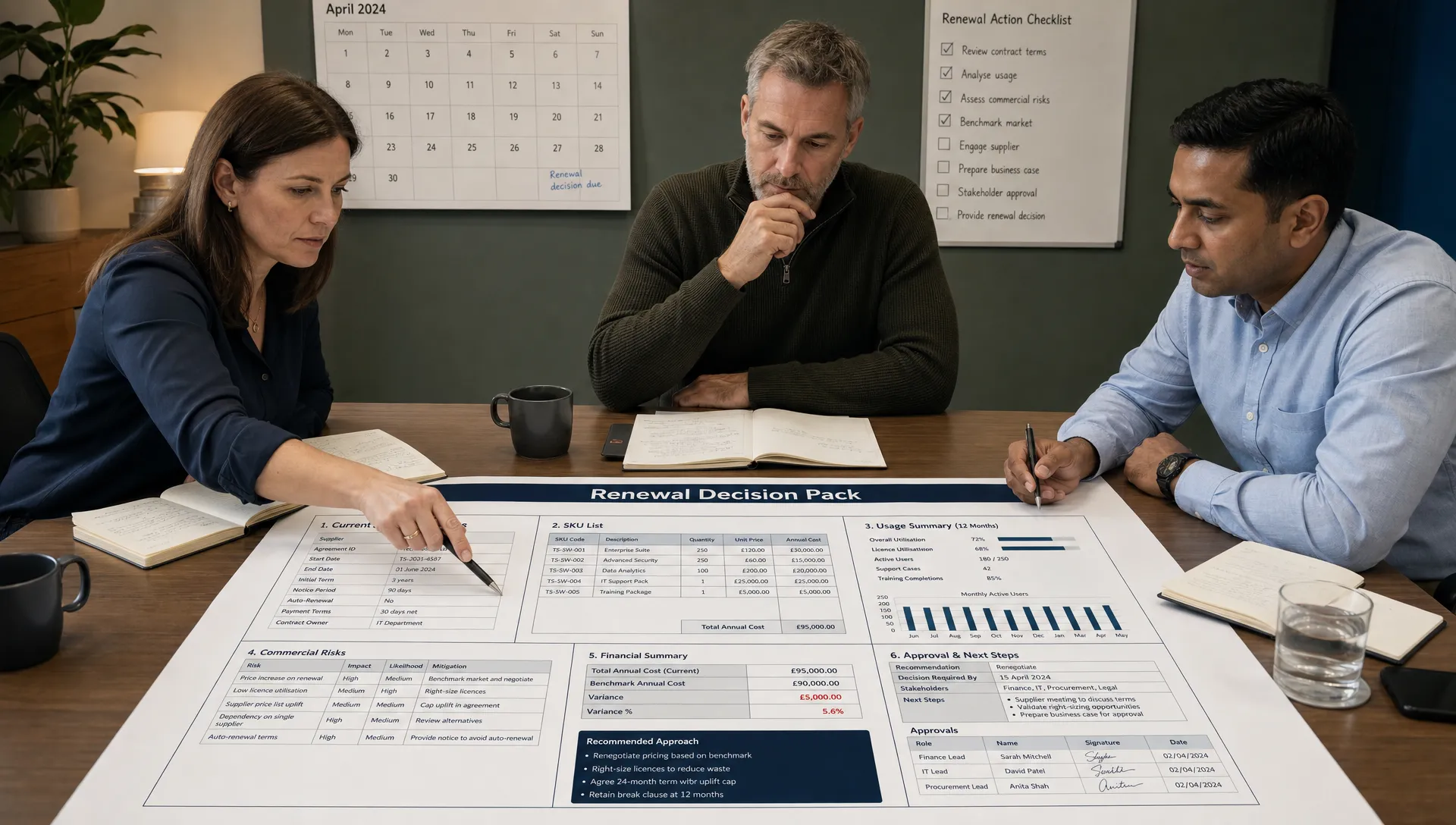
A Salesforce renewal can look like an administrative deadline. A date in the contract. A quote to approve. A familiar conversation with the account team.
That framing is too narrow.
For many organisations, Salesforce sits across revenue, service, marketing, data and reporting. The renewal is often one of the few moments when finance, IT and procurement can change the shape of the agreement without adding unnecessary disruption. Treated well, it becomes a buying decision. Treated late, it becomes a price discussion under time pressure.
A better buying decision does not simply mean paying less. It means knowing what you are renewing, what you should stop paying for, where growth is real and which commercial terms deserve attention before anyone starts negotiating.
Start by changing the question
The weak renewal question is simple: “Can we get a better discount?”
The better question is: “If we were buying this Salesforce estate today, what would we buy, on what terms and why?”
That change matters because discounts can distract from poor scope. A discounted shelfware position is still waste. A sharp unit price on the wrong SKU mix still leaves the business carrying cost it cannot defend. A renewal that bundles current need with speculative growth can make the number look tidy while hiding decisions that should be made separately.
For a CFO, the renewal should answer whether spend is tied to current and planned business value. For a CIO or IT lead, it should answer whether the products, editions and quantities match the operating reality. For procurement, it should answer whether the agreement creates enough flexibility and protection for the next term.
Those answers rarely appear in the final week before signature. They have to be built.
Build the baseline before you look at the quote
The seller’s quote is not the starting point. Your own baseline is.
Before reviewing any renewal proposal, build a clear picture of the estate you already own. That baseline should include the current contract, order forms, SKU list, quantities, editions, add-ons, support entitlements, renewal date, notice periods, price uplift language and any co-terming arrangements.
This sounds obvious, but many renewal teams discover too late that nobody has one complete view. Finance may hold the invoice history. IT may understand actual usage. Procurement may have the contract. Legal may know the risk. The business may have plans that have not yet been converted into approved demand.
Bring those pieces together early. It is far easier to challenge a proposal when your own numbers are clean.
Salesforce agreements and product terms can also change over time, so teams should not rely only on inherited assumptions. The official Salesforce legal agreements and product terms page is a useful reference point when checking current contractual language, although your signed order forms and master agreement will remain central to the review.
If you want a fuller view of the traps that tend to appear before signature, the SaaSed guide to Salesforce contract renewal risks to catch early covers the risk areas worth reviewing before the commercial conversation gets serious.
Turn the renewal opportunity into a buying file
If your team tracks a renewal opportunity in Salesforce, treat that record as the start of a buying file, not just a forecast line. The opportunity should not only show expected value and close date. It should point to the evidence behind the decision.
That evidence should answer a few plain questions. Which licences are contracted? Which are assigned? Which are active? Which teams rely on which products? Where are users provisioned but not using the platform? Where does the business have approved growth that will genuinely require more capacity?
A useful renewal file usually contains:
- Current contract and order form summary
- SKU list with quantities, editions and unit economics
- Assigned licence count and active usage view
- Known shelfware or low-use areas
- Approved business changes affecting future demand
- Open commercial risks, including uplifts, term length and renewal notice rules
- Internal decision owners from finance, IT, procurement, legal and the business
Do not overcomplicate this. The aim is not to create a perfect model. The aim is to stop the renewal from being decided by the loudest assumption in the room.
Salesforce analytics can help here when the right questions are asked. Usage data becomes useful when it is tied to decisions about scope, value and risk. SaaSed has written separately on how Salesforce analytics can strengthen renewal decisions, particularly where finance and IT need a shared evidence base.
Compare choices, not just prices
A renewal quote often narrows the discussion to one path: renew the estate, perhaps with some changes, then negotiate the discount. That is not enough.
A buying decision needs options. At minimum, compare three paths: renew as-is, renew with reshaped scope or separate the renewal from any proposed expansion. In some cases, you may also need to defer a decision on products where adoption is not yet proven.
| Decision area | Better buying question | Evidence to review | Risk if ignored |
|---|---|---|---|
| Licence volume | Do we still need this quantity? | Contracted, assigned and active user counts | Paying for inactive or unnecessary licences |
| SKU mix | Are we on the right products and editions? | Product usage, admin feedback and business need | Keeping higher-cost SKUs where lower scope would do |
| Expansion | Is new demand approved and timed? | Budget, headcount plans and project dates | Blending speculative growth into committed spend |
| Term length | How much flexibility do we need? | Business roadmap and platform dependency | Locking into commitments that outlast certainty |
| Price protection | What happens after this term? | Uplift clauses and renewal language | Winning today and losing ground next time |
| Contract structure | Are products grouped in a way we can manage? | Order forms, co-terming and cancellation limits | Reducing future negotiation options |
This table is simple by design. It gives the renewal team a way to talk about the decision without turning every meeting into a line-by-line contract review.
Separate growth from the core renewal
Salesforce renewals often arrive with a growth story attached. Some of that growth may be sound. A new service rollout, a planned sales team expansion or a data programme may all justify additional spend.
The problem is not growth. The problem is mixing unproven growth into the renewal too early.
When current usage, approved expansion and aspirational demand sit in one commercial package, it becomes harder to see what the business truly needs. It also weakens internal control. Finance may approve a blended number without understanding which part protects the existing estate and which part commits to future change.
Keep the core renewal clean. Then test each proposed addition on its own merits. Is there budget? Is there an owner? Is there a delivery date? Is the product needed now or only after another project lands? Has the business committed to adoption?
This is especially important where the renewal opportunity Salesforce teams see includes both run-rate spend and proposed growth. The commercial conversation may be easier when everything is bundled, but the buying decision is usually better when the components are separated.
For a deeper view on this point, SaaSed’s article on which Salesforce opportunities belong in your renewal plan explains how to distinguish evidence-backed demand from items that should sit outside the renewal.
Give each function a clear role
Salesforce renewals go wrong when every team assumes another team has checked the detail. A good renewal process gives each function a defined role without turning the work into a committee exercise.
| Function | What they should own | What they should not own alone |
|---|---|---|
| CFO or finance lead | Budget, value challenge and approval logic | Technical suitability or product fit |
| CIO or IT lead | Platform direction, architecture fit and operational risk | Final commercial position |
| Salesforce admin or platform owner | Usage reality, licence assignment and product feedback | Long-term contract commitments |
| Procurement | Negotiation plan, commercial structure and supplier process | Business case quality without input |
| Legal | Contract risk, notice rules and liability terms | Scope, adoption or value assessment |
| Business owners | Demand, adoption plans and benefit case | Commercial negotiation strategy |
This division keeps the conversation cleaner. It also prevents a common failure: procurement enters late with a savings target, IT defends the estate based on operational need, finance asks for evidence that does not yet exist and the business asks for expansion without owning adoption.

The earlier these roles are agreed, the less emotional the negotiation becomes. People do not have to defend positions. They can test evidence.
Watch the timing, not only the expiry date
The contract end date is not the real deadline. By the time a renewal is close to expiry, many choices have already narrowed.
Notice periods may limit your options. Internal approval cycles may slow decisions. Usage data may need cleansing before it is credible. Business owners may need time to confirm whether proposed growth is real. Legal may need to review terms that were last touched several years ago.
Large Salesforce estates need time because the hard work is not the negotiation meeting. It is the preparation before that meeting. Once the facts are assembled, the commercial conversation becomes more disciplined.
A practical renewal timeline should include enough room for contract review, usage audit, internal decision meetings, commercial strategy, proposal review and final approvals. If the first serious discussion happens only after the renewal quote lands, you are already working inside the seller’s rhythm rather than your own.
Do not let discount percentage become the story
Discounts matter. No serious procurement leader ignores price. But discount percentage is a poor measure of renewal quality on its own.
A higher discount on a bloated estate may cost more than a lower discount on a clean one. A good headline reduction may be offset by uplift terms, bundled products, minimum commitments or an inflexible term. A price hold may sound attractive until you realise the organisation is carrying licences it no longer needs.
The better measure is whether the agreement fits the business for the next term. That means asking whether the scope is defensible, the adoption plan is credible, the contract gives enough flexibility and the commercial terms are understood by the people who will live with them.
This is where a disciplined SKU review matters. Look beyond product names. Check edition levels, add-ons, support items and any packages that have accumulated over prior buying cycles. Salesforce estates often grow through projects, acquisitions, urgent requests and historic decisions that made sense at the time. The renewal is the moment to decide which of those choices still deserve funding.
Create a short decision memo before approval
For senior approval, avoid a long slide deck that buries the decision. A short memo is often better. It should state what you are renewing, what you are removing or reducing, what you are adding, which risks remain and what commercial position the team recommends.
The memo should be written in plain language. If the CFO, CIO, procurement lead and platform owner cannot all understand it, the decision is not yet clean enough.
A useful approval memo covers:
- Current annualised spend and proposed renewal spend
- Main changes in quantity, SKU mix and term
- Known unused or underused products
- Approved growth included in the renewal
- Growth deliberately excluded from the renewal
- Key contract risks and how they were handled
- Negotiation position and walk-away points
- Decision required and date required
The memo does not need to be perfect. It needs to be honest. It should make clear where the evidence is strong and where the organisation is making a judgement call.
What a better Salesforce renewal feels like
A better renewal is calmer. Not easier, necessarily, but calmer.
The team knows its current position. It has separated committed need from wishful growth. Finance can see the value logic. IT can explain the platform need without defending waste. Procurement has a negotiation plan based on evidence rather than pressure. Legal can focus on the terms that matter instead of discovering them late.
The seller may still push for a larger commitment, a longer term or a faster close. That is normal. The difference is that your team can respond from a prepared position.
A good Salesforce renewal does not try to turn procurement into a blocker. It turns the renewal into a controlled buying decision, with enough evidence to support the money being committed.
Frequently Asked Questions
When should we start preparing for a Salesforce renewal? Start early enough to review contracts, usage, SKU mix, business demand and approval requirements before the renewal quote becomes the centre of the discussion. For larger estates, this usually means months rather than weeks.
What is the biggest mistake companies make in Salesforce renewals? The most common mistake is treating the renewal as a pricing event instead of a buying decision. Price matters, but scope, usage, growth assumptions and contract terms often determine the real outcome.
Should Salesforce expansion be included in the renewal? Only when the demand is approved, timed and owned by the business. Speculative expansion should usually be separated so the core renewal remains clear and defensible.
How can finance and IT work better together during renewal planning? Finance should ask for value evidence and budget clarity, while IT should provide usage reality, platform direction and operational risk. The best results come when both teams work from the same contract and usage baseline.
Is a lower Salesforce renewal price always the best outcome? No. A lower price can still be poor value if the organisation renews unused licences, accepts weak terms or commits to products it is not ready to adopt. The better outcome is a clean scope at a defensible price, with terms the business understands.
Make the next renewal conversation more disciplined
Your Salesforce renewal deserves more than a late discount discussion. With the right baseline, usage evidence and internal agreement, it can become a better buying decision for finance, IT and procurement.
If you want a second pair of eyes before renewal talks begin, SaaSed can review your contract, SKUs, usage position and commercial risks with you. For a measured first step, book a complimentary Salesforce audit conversation.
Want this kind of intel on your renewal?
Don’t head into your next software negotiation alone
Contact Us