Which Salesforce Opportunities Belong in Your Renewal Plan
A renewal plan should not absorb every forecast, pilot or vendor idea. Use this guide to decide which Salesforce opportunities deserve budget, scrutiny and negotiating weight.
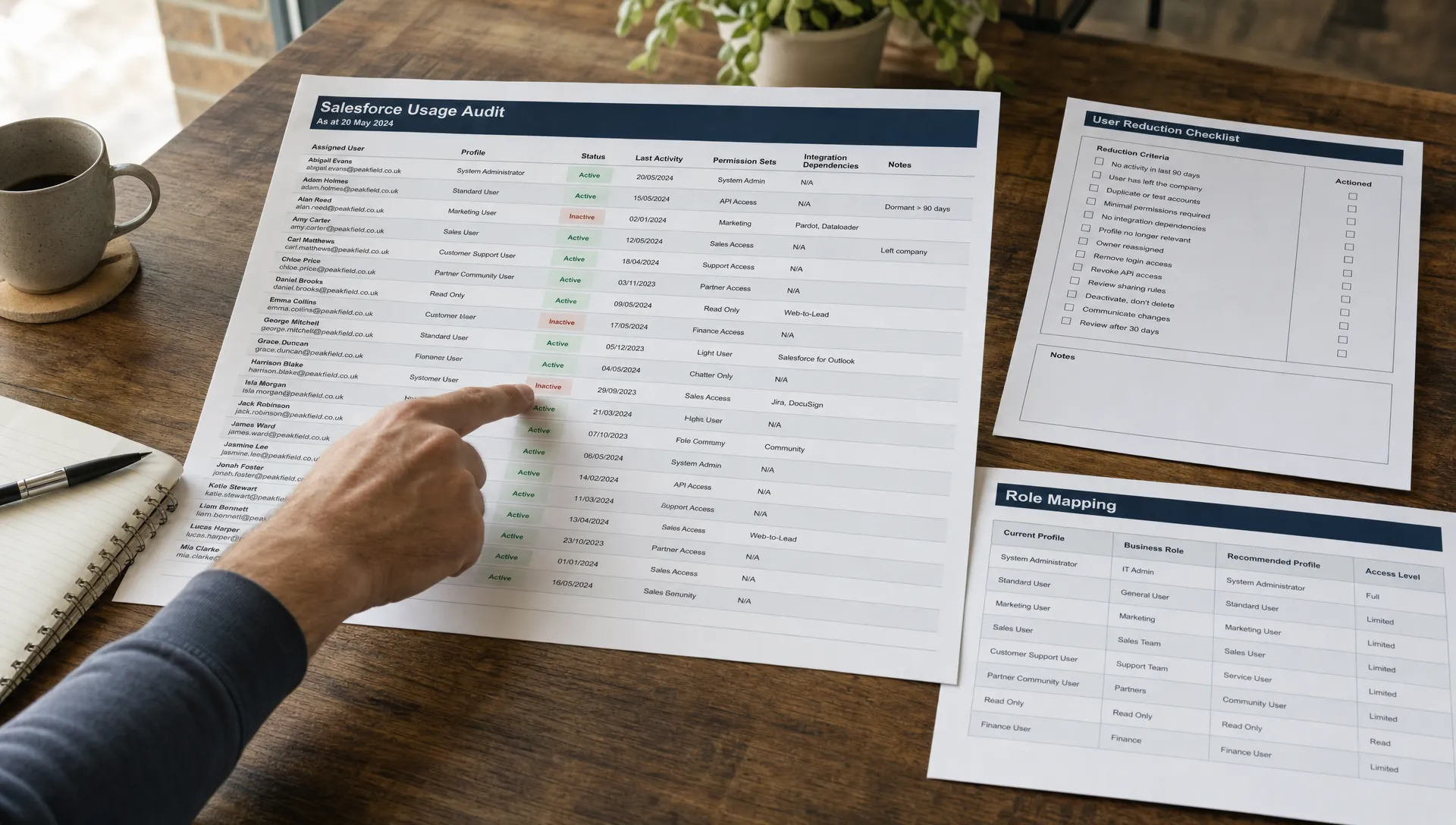
Your renewal plan is not a dumping ground for every Salesforce idea, forecast or product suggestion that appears before the contract date.
It is a commercial plan. It should say, with evidence, which Salesforce opportunities justify spend, which ones justify negotiation pressure and which ones should be kept outside the renewal until they become real.
That distinction matters because Salesforce renewal discussions often blur three different things: current usage, future demand and vendor-led expansion. Finance wants cost discipline. IT wants a stable platform. Sales and operations want room to grow. Procurement needs enough evidence to negotiate without blocking the business. A good renewal plan gives each group a shared view of what deserves budget and what does not.
Start by defining what you mean by Salesforce opportunities
In Salesforce language, Opportunities are records used to track potential deals and pending revenue. Salesforce explains this clearly in its official Opportunities guidance. Those records can be useful in renewal planning because they show where the business expects commercial activity to happen.
But in a renewal conversation, the phrase salesforce opportunities usually has a wider meaning. It can include revenue pipeline, planned team growth, unused licence recovery, product consolidation, support model changes, contract improvements and future platform initiatives.
The risk is treating all of these as equal. They are not.
A late-stage enterprise deal that will require 80 additional users next quarter belongs in a different category from an AI idea with no budget, owner or implementation date. A documented pool of inactive licences carries more weight than a manager's assumption that the team is too busy to lose access. Renewal plans work best when they separate these items before negotiation begins.
The renewal plan should include evidence, not ambition
Salesforce data can make a renewal plan sharper, but only if the data is interpreted carefully. Pipeline values are often inflated. Close dates move. Opportunity stages may mean different things across regions. Some users log in daily but do little meaningful work. Others use Salesforce less often but handle critical processes.
That is why the renewal plan should not simply ask, how much pipeline is in Salesforce? It should ask better questions:
- Which opportunities will be worked during the next contract term?
- Which teams, regions or roles will need access to support that work?
- Which current licences are not being used well enough to justify renewal?
- Which products are commercially useful, and which are present because they were bundled last time?
- Which future initiatives are funded, owned and scheduled?
If you need a cleaner fact base before those questions can be answered, Salesforce analytics can strengthen renewal decisions by giving finance, IT and procurement a common view of usage, pipeline and adoption.
Opportunities that usually belong in the renewal plan
Not every item needs the same level of detail, but the following categories usually deserve a place in the renewal plan if they are supported by evidence.
1. Revenue opportunities that create real platform demand
If Salesforce is the system where commercial teams manage pipeline, late-stage and high-confidence revenue opportunities can help explain future user, data and process demand. The key is not the headline pipeline value. It is the work required to pursue, close and serve that pipeline.
For example, a credible plan to enter a new region may require additional sales users, service coverage, reporting changes and integration work. That belongs in the renewal plan if there is an approved business case and a realistic timeline. A vague ambition to grow internationally does not.
Commercial model matters. A business built around local, transaction-heavy workflows, for example a flat-fee real estate brokerage, would test Salesforce demand against enquiry intake, regional coverage and listing operations. A subscription software firm would test it against pipeline generation, customer success coverage and renewals. The renewal plan should reflect how work is actually done, not how many opportunities happen to sit in the database.
2. Confirmed headcount and role changes
Salesforce renewals often go wrong when headcount plans are either ignored or accepted too loosely. Procurement is then left arguing about licence quantities without a clear picture of who will use what.
Include headcount changes when they are approved, funded and tied to specific Salesforce roles. A new sales development team may need a different licence profile from enterprise account executives. A service team may need access to different capabilities from field sales. Senior leaders may need reporting access rather than full operational access.
The useful question is not, how many people are joining? It is, what work will they perform in Salesforce, and which SKU genuinely supports that work?
3. Right-sizing opportunities backed by usage evidence
Some of the most valuable Salesforce opportunities are not growth opportunities. They are reduction and correction opportunities.
These include inactive users, users assigned to a higher tier than their role requires, duplicate products, low-adoption add-ons and licences held for teams that changed structure months ago. They should be in the renewal plan because they create a factual basis for reducing waste before commercial terms are discussed.
A usage audit should look beyond logins. It should consider feature use, record ownership, automation dependencies, integration needs and whether access is still required for compliance or reporting. Cutting blindly creates operational risk. Renewing blindly creates waste.
4. Product consolidation opportunities
Salesforce estates tend to expand over time. A product is added for one team, another platform is retained elsewhere, then a separate reporting tool remains because nobody wants to disturb it. By renewal time, finance may be paying for overlap without a clear owner.
Consolidation belongs in the renewal plan when there is a credible path to retire or reduce another tool. That requires more than saying Salesforce could do the job. The plan should identify the current tool, cost, users, process owner, migration effort and timing.
If the migration will not happen during the renewal term, it may still be worth tracking, but it should not be used to justify immediate Salesforce expansion.
5. Contract and term improvement opportunities
Some renewal opportunities sit in the contract rather than the product estate. Price protections, renewal notice periods, co-termination, ramp structures, swap rights, support terms and audit language can all affect future leverage.
These points are easy to miss if the renewal plan focuses only on licence counts. They are also where small wording differences can have a large commercial effect over several years. If your team has not yet mapped the weak points in the current agreement, it is worth reviewing the Salesforce contract renewal risks to catch early before the negotiation window narrows.
A simple test for deciding what belongs
A renewal opportunity should earn its place. The table below gives finance, IT and procurement a practical filter.
| Test | Include in the renewal plan when | Keep outside the plan when |
|---|---|---|
| Evidence | There is usage data, approved pipeline, funded headcount or a named business owner | The case relies mainly on opinion, aspiration or vendor suggestion |
| Timing | The need falls within the next contract term | The need is possible but not scheduled |
| Commercial impact | It affects licence count, SKU mix, discounting, term structure or support costs | It has no clear effect on the renewal decision |
| Operational dependency | Salesforce is required to deliver the work | Salesforce is only one possible route and no decision has been made |
| Ownership | A senior owner will defend the assumption internally | Nobody can explain who benefits or who will implement it |
| Reversibility | The business understands the risk of adding or removing access | The change could create hidden lock-in or service disruption |

Opportunities that should usually stay out
A disciplined renewal plan is as much about exclusion as inclusion. Leaving weak items out does not mean ignoring them. It means refusing to let them distort a major commercial decision.
Be cautious with:
- Early-stage pipeline that has low confidence or no agreed close date
- Transformation ideas without funding, architecture approval or delivery capacity
- Product add-ons introduced late in the renewal cycle without a business case
- Licence buffers created because teams are uncomfortable making allocation decisions
- Bundled items described as free but carrying future renewal, support or adoption cost
- Historic licence quantities that no longer match the operating model
The most common mistake is buying certainty where uncertainty still exists. A renewal can include flexibility without committing full spend upfront. That might mean phased quantities, clearer swap language, shorter commitment windows for uncertain products or documented review points. The right structure depends on the existing agreement, but the principle is simple: do not let uncertain demand become certain cost too early.
Turn each opportunity into a negotiation position
Once the right Salesforce opportunities are selected, they need to be translated into commercial positions. A renewal plan that says reduce shelfware is directionally useful. A plan that says remove 120 unused licences from these teams, retain 40 because of named reporting dependencies and request flexibility on 60 uncertain users is negotiable.
The same applies to growth. Saying sales expects expansion gives Salesforce the upper hand because the demand is loose. Saying approved headcount requires 35 additional users in Q3, with no commitment beyond that until regional hiring is confirmed, gives procurement a clearer position.
A strong renewal plan should connect each opportunity to one of four outcomes.
| Opportunity type | Renewal outcome | Evidence needed |
|---|---|---|
| Growth | Add capacity, but only where timing and role demand are clear | Approved headcount, pipeline plan, hiring timeline |
| Reduction | Remove or downgrade unused or mismatched licences | Usage data, role mapping, manager validation |
| Flexibility | Protect against uncertain demand | Forecast ranges, implementation dependencies, contract language |
| Risk control | Avoid terms that weaken future leverage | Current agreement review, renewal notice dates, price uplift exposure |
This is also where internal alignment matters. Finance may value reduction, IT may value stability and sales may value room to move. The renewal plan should not hide those tensions. It should put them on the table early enough to resolve them before the supplier conversation becomes live.
For teams preparing that conversation, Salesforce negotiation tactics that improve leverage can help turn the fact base into a cleaner negotiation strategy.
Do not let vendor timing set your opportunity list
The worst moment to decide which opportunities belong in the renewal plan is after the renewal proposal arrives. By then, the framing has often shifted towards the supplier's preferred package, timing and commercial trade-offs.
The better sequence is quieter and earlier. Build the current-state baseline first. Then test future demand. Then decide which growth, reduction, consolidation and contract opportunities are strong enough to influence the negotiation. Only then should you engage on commercial options.
This timing protects the business from two common traps. The first is overreacting to a high renewal quote and cutting without enough operational context. The second is accepting expansion logic because it arrives wrapped in a deadline.
Neither is good procurement. Both are avoidable.
Frequently Asked Questions
Should all Salesforce pipeline opportunities be included in a renewal plan? No. Include pipeline only when it creates credible Salesforce demand during the next contract term. Late-stage, owned and funded growth is relevant. Early-stage pipeline with weak close confidence should not drive licence commitments.
How far ahead should we assess Salesforce opportunities before renewal? For a strategic Salesforce estate, start several months before the commercial deadline. You need enough time to audit usage, validate headcount, review contract terms and align stakeholders before negotiation begins.
Can unused licences be treated as renewal opportunities? Yes. Unused, inactive or mismatched licences are often among the strongest opportunities because they are backed by data and can support right-sizing, downgrades or better allocation.
Who should decide which opportunities belong in the plan? Finance, IT, procurement and business owners should decide together. Procurement can structure the process, but business owners need to validate demand and IT needs to confirm operational dependencies.
What if future Salesforce demand is uncertain but likely? Do not ignore it, but avoid turning uncertainty into a fixed commitment too early. Consider flexibility in quantities, timing, SKU mix or contractual language rather than buying the full expected demand upfront.
Final thought: keep the plan narrow enough to negotiate
A good renewal plan is not the longest possible list of Salesforce opportunities. It is the shortest defensible list of opportunities that should change the commercial outcome.
Include what is evidenced. Challenge what is vague. Separate growth from waste, and separate future optionality from present commitment. That discipline gives CFOs, CIOs, IT leads and procurement teams a better chance of reaching a renewal that fits the business rather than the other way round.
If you would value a second set of eyes before renewal talks begin, SaaSed offers a complimentary Salesforce audit conversation to help review usage, SKUs, contract risks and negotiation readiness.
Want this kind of intel on your renewal?
Don’t head into your next software negotiation alone
Contact Us