How to Audit Every SaaS Licence Before Renewal
A SaaS licence audit should test usage, entitlement, contract terms and future demand before renewal pressure builds. This guide gives finance, IT and procurement teams a practical way to find waste without creating operational risk.

Renewal pressure has a habit of making weak data look acceptable. A vendor sends a quote, the business wants continuity, finance wants a cleaner number, and suddenly the licence audit becomes a rushed spreadsheet exercise.
That is where money leaks.
A proper SaaS licence audit is not just a count of seats. It is a check of entitlement, usage, value, contract limits and future demand, joined together before anyone starts negotiating. For CFOs, CIOs and procurement leaders, the aim is simple: enter renewal talks with evidence, not instinct.
This guide sets out a practical way to audit every SaaS licence before renewal, with Salesforce in mind where the stakes are often highest, but with a method that works across most material SaaS contracts.
What counts as a SaaS licence?
A SaaS licence is any paid right to use software, access a feature, consume a service or unlock a commercial entitlement. In simple tools, that may be one user seat. In larger platforms, it can be far less tidy.
In a Salesforce environment, for example, you may need to review named user licences, add-ons, permissioned products, bundled SKUs, storage, sandboxes, support entitlements and integrations. Some rights are obvious on the order form. Others sit inside packages, amendments or old deal structures that nobody has looked at for two renewals.
Salesforce itself notes in its official user licence documentation that a user licence determines which features a user can access. That matters commercially. If the licence defines the right to access, then the audit needs to test whether that right is still needed at the same level, by the same person, on the same commercial terms.
The question is not only, is the licence assigned? A better question is: what are we paying for, who can use it, who actually uses it, what business process depends on it, and what happens if we reduce, reassign or renegotiate it?
Start before the vendor controls the clock
The best time to audit a SaaS licence estate is before the renewal conversation becomes live. For strategic platforms, six months is not early. For smaller tools, 90 to 120 days may be enough if the data is clean and the contract is simple.
The danger is leaving the audit until after the vendor has issued a renewal quote. At that point, the commercial frame is already set. The quote becomes the anchor. Any reduction looks like a concession request rather than a data-led correction.
A stronger approach is to build the fact base first, then decide what the renewal should look like. If you want the wider operating rhythm around this, SaaSed has covered what a strong SaaS renewal process looks like, including the timing and internal alignment that protect leverage.
For the licence audit itself, start with one rule: do not rely on a single data source. Admin reports, invoices and contract documents all tell part of the truth. None of them tells the whole truth alone.
Build a complete licence baseline
Your first task is to create a baseline that shows what the organisation is contractually entitled to buy, what it is currently paying for, and what is actually deployed.
This sounds obvious. It rarely is.
Many organisations have order forms from different dates, mid-term amendments, co-termed add-ons, legacy discounts, bundled products and invoice lines that do not map cleanly to admin exports. If you only use the vendor portal, you may miss what the contract obliges you to keep. If you only use the contract, you may miss what the business has actually activated.
A practical baseline should bring these sources together:
| Evidence source | What it helps prove | Common issue found |
|---|---|---|
| Master agreement and order forms | Contracted products, quantities, renewal term and notice dates | Minimum quantities or auto-renewal language hidden in earlier documents |
| Invoices and purchase orders | What finance is actually paying | Charges that do not match current business ownership |
| Admin exports | Assigned users, roles, profiles and product access | Licences assigned to leavers, duplicates or inactive users |
| SSO or identity provider logs | Authentication and access patterns | Users who still have access but no meaningful activity |
| HR and contractor data | Employment status and department mapping | Former employees, changed roles or external users still consuming licences |
| Business owner input | Process dependency and future demand | Licences defended for aspirational projects rather than current need |
This is also where missed cost lines tend to surface. If you are reviewing Salesforce or another large platform, it is worth checking the broader pattern of SaaS software costs that get missed before renewal, especially where add-ons, bundles and support terms sit outside the obvious seat count.
The baseline is not glamorous work. It is, however, the difference between asking for a discount and showing why the renewal volume is wrong.
Match licences to real users and real need
Once the baseline is built, move from contract data to user-level evidence. Every assigned licence should be matched to a real person, team, role and business need.
A useful first pass is to classify each licence into one of these states:
- Active and correctly assigned
- Active but potentially over-tiered
- Assigned but inactive
- Assigned to a leaver or moved employee
- Assigned to a contractor or temporary user
- Unassigned but still paid for
- Used for service, integration or administration
- Unknown ownership
Be careful with service and integration accounts. They may look inactive in a standard login report, but they can be critical to operations. Do not remove them without technical validation. A clean audit is not a blunt deletion exercise.
For human users, look beyond whether someone logged in during the last 30 or 90 days. Login data is useful, but it can flatter a weak licence. A user may log in because a dashboard opens automatically, because SSO gives them access, or because a manager asked them to check something once. That is not the same as sustained need.
Ask sharper questions. What functions does this person use? Could they use a lower tier? Has their role changed? Does their team still own the process the licence supports? Is the licence needed every day, occasionally, seasonally or not at all?
This is where finance, IT and the business owner need to work together. Finance sees spend. IT sees access. The business owner sees whether the process still matters. Procurement can turn those views into a renewal position.
Measure usage by value, not just activity
Every SaaS category has its own meaningful usage signals. A seat-based CRM licence should not be audited in exactly the same way as an event platform, a security tool or a finance system.
The mistake is using one generic metric, usually login frequency, and treating it as truth. It is better to define a small set of usage signals that reflect the purpose of the tool.
| SaaS category | Better usage evidence | Renewal question to ask |
|---|---|---|
| CRM or sales platform | Records created or updated, pipeline activity, workflow use, reporting dependency | Does this user need this licence level to do their current role? |
| Customer support tool | Tickets handled, queues managed, knowledge base activity, escalation ownership | Are paid users aligned to actual support workload? |
| Collaboration or productivity tool | Content created, shared workspaces, recurring usage, guest access | Are we paying for creators, viewers or dormant accounts? |
| Security or infrastructure tool | Protected assets, monitored endpoints, alerts reviewed, integrations used | Is coverage aligned with current risk and estate size? |
| Event or ticketing software | Events created, ticket tiers used, sales phases managed, payout or guest-list activity | Is the paid plan aligned to event volume and operating model? |
For example, an events team using a specialist event ticketing platform should audit against event volume, ticketing complexity, sales control and settlement workflow, not only the number of staff with access. The same logic applies to Salesforce: measure the work the licence enables, not just the fact that the user can log in.
When you audit usage this way, the conversation changes. You are no longer saying, some people do not log in much. You are saying, these paid entitlements do not match the process we run today.
Give every licence a renewal decision
After the evidence is gathered, each licence needs a clear status. Avoid vague labels such as review later or business to confirm. They keep the problem alive until the renewal deadline forces a poor decision.
A simple decision model is usually enough:
| Decision | When it applies | What to do before renewal |
|---|---|---|
| Keep | Usage and business need are clear | Confirm quantity and protect pricing where possible |
| Downgrade | User needs access, but not the current tier | Check technical and contractual feasibility |
| Reassign | Licence is needed, but by a different user or team | Clean up ownership and update admin records |
| Remove | No current need and no validated future demand | Confirm notice rules and reduction rights |
| Hold for project | Demand is plausible but not yet live | Tie commitment to project approval, not optimism |
| Renegotiate | Product is needed, but terms or structure are wrong | Prepare evidence and alternative commercial asks |
The important point is that every paid item earns its place. Not every licence should be cut. Some are essential. Some are underused because a team lacks training. Some are dormant because a project has slipped, but the project is still real. The audit should separate waste from risk.
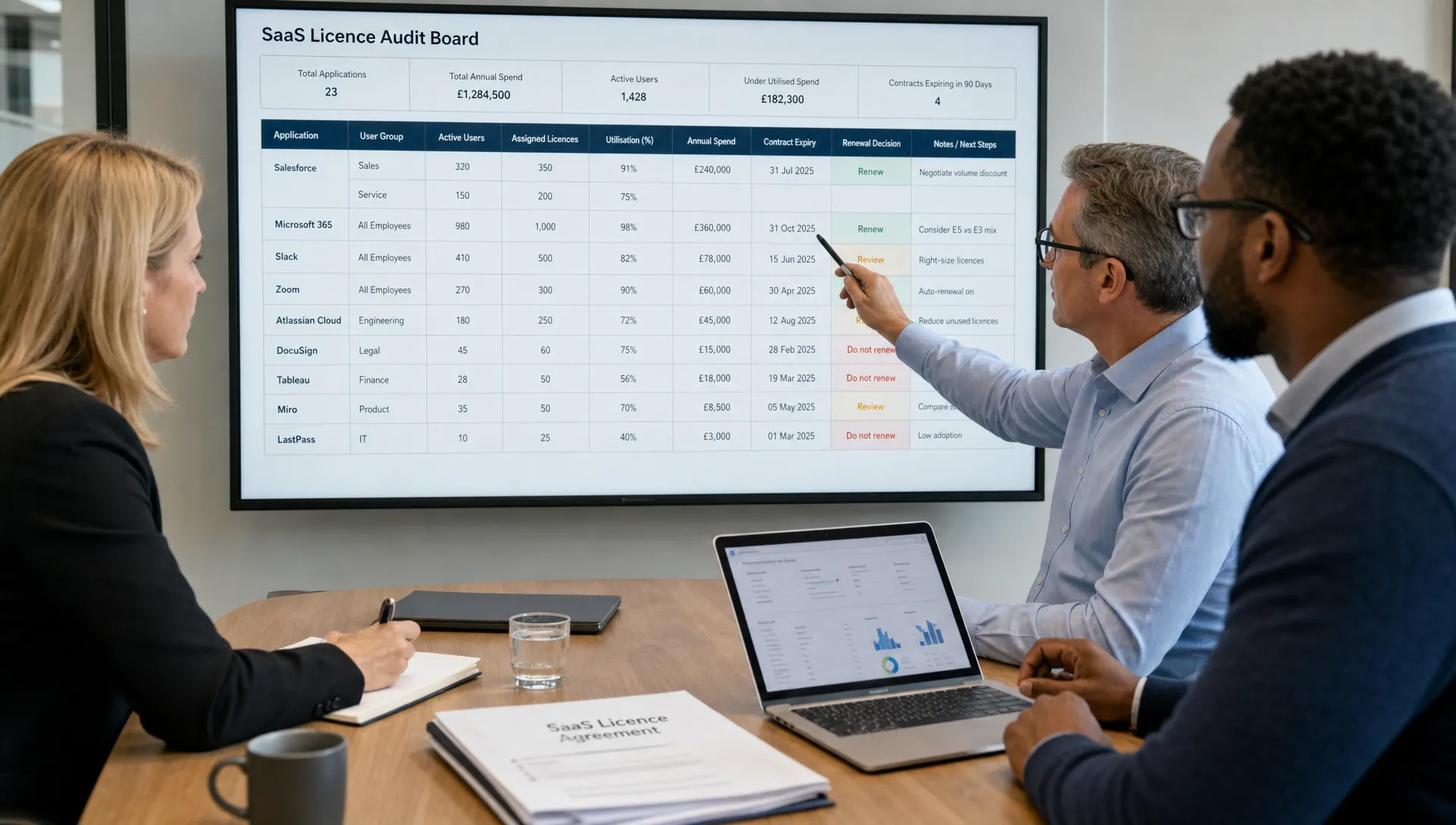
Reconcile licence decisions with the contract
This is where many audits lose value. The team identifies reductions, then discovers the contract does not allow them cleanly.
Before you assume a licence can be removed, check the commercial mechanics. Look for minimum quantities, product dependencies, renewal notice periods, co-terming rules, price uplift language, bundle restrictions and true-up obligations. A licence may be technically unused but commercially locked for another term unless you act early enough.
Salesforce contracts in particular can contain layered order forms and amendments. A SKU that looks removable in an admin export may be tied to a wider bundle, discount structure or minimum commitment. That does not mean you have no options. It means the negotiation needs to be shaped around the contract, not around a usage spreadsheet alone.
If the contract language is unclear, slow down before taking a position. SaaSed’s guide on how to read a software contract before it costs you is a useful companion here, especially for clauses that look harmless until the renewal date gets close.
The cleanest audit output is not just a list of cuts. It is a list of actions that are both operationally safe and contractually possible.
Validate future demand without buying hope
Future demand is where otherwise disciplined audits become soft.
A sales leader expects headcount growth. A service team plans a transformation project. A regional team says it may roll out a new process next year. These may all be legitimate. They are not all purchase commitments.
For every request to keep or increase licences, ask for evidence. Has the headcount been approved? Is the project funded? Is there an implementation plan? Who owns adoption? What happens if the timeline slips? Can the organisation add licences later rather than commit now?
This is not about blocking growth. It is about refusing to pay today for demand that has not passed the organisation’s own approval gates.
A good renewal position usually separates three numbers: current proven need, approved near-term demand and unapproved aspiration. Vendors will often want all three treated as one commitment. Buyers should not.
Turn the audit into a negotiation file
A SaaS licence audit only becomes valuable when it changes the renewal conversation. That means turning the work into a negotiation file that can be used by procurement, finance, IT and the business sponsor.
The file should be concise enough to use in live discussions, but detailed enough to withstand challenge. Include:
- Current contracted quantities, products and term dates
- Actual assigned, active and inactive usage by SKU
- Licence-level decisions, including keep, downgrade, remove and renegotiate
- Contract clauses that affect reduction rights or timing
- Future demand split between approved and unapproved need
- Commercial asks, fallback positions and internal walk-away points
- Risks that must not be created by cuts, such as integration failure or compliance gaps
This turns the renewal from a pricing discussion into a scope and value discussion. That is a stronger place to stand.
It also helps internal alignment. The CFO can see the financial case. The CIO can see the operational risk. Procurement can see the commercial levers. Business owners can see that the audit is not a cost-cutting raid, but a disciplined review of what the organisation actually needs.
Common mistakes to avoid
Most licence audits fail for ordinary reasons. The data arrives late. Ownership is unclear. The team trusts vendor exports too much. Someone treats last year’s quantities as the default answer.
Here are the traps worth catching early:
| Mistake | Why it costs money | Better approach |
|---|---|---|
| Starting after the renewal quote arrives | The vendor’s number becomes the anchor | Build your baseline before commercial talks begin |
| Counting assigned users only | Assigned does not mean needed or active | Match users to role, usage and process dependency |
| Treating all licences the same | Different SaaS tools create value in different ways | Define usage metrics by application category |
| Ignoring contract constraints | Identified savings may not be executable | Review notice periods, minimums and bundle rules early |
| Accepting vague future demand | Aspirational growth becomes fixed spend | Separate proven need from approved demand and hope |
| Cutting without technical review | Savings can create service or integration risk | Validate service accounts, integrations and admin users |
The best audits are firm, but not reckless. They remove waste without breaking the operating model.
A quick SaaS licence audit checklist
Before you enter renewal talks, you should be able to answer these questions with evidence:
- Do we have every order form, amendment, invoice and renewal notice date?
- Can we map every paid SKU to an owner, team and business process?
- Do assigned users match HR, contractor and identity records?
- Have we separated inactive users from service accounts and integrations?
- Have we tested usage by value metric, not just login frequency?
- Can each licence be marked keep, downgrade, reassign, remove or renegotiate?
- Do the contract terms allow the changes we want to make?
- Is future demand approved, funded and time-bound?
- Do finance, IT, procurement and the business owner agree on the renewal position?
If any answer is no, the audit is not finished. It may still be useful, but it is not yet strong enough to carry a serious renewal negotiation.
Frequently Asked Questions
How long should a SaaS licence audit take? For a small, clean contract, a few weeks may be enough. For Salesforce or another strategic platform with multiple SKUs, amendments and business owners, plan several months. The larger the renewal, the earlier you should start.
Is login activity enough to prove whether a licence is needed? No. Login activity is only one signal. A user may log in without using meaningful functionality, while an integration account may show limited human activity but still be critical. Always combine access data with role, process and technical context.
Who should own the SaaS licence audit? Procurement can coordinate it, but ownership should be shared. Finance owns spend discipline, IT owns access and technical risk, and business leaders own demand. A renewal decision made by only one group is usually weaker.
Should every unused licence be removed? Not automatically. Some unused licences are genuine waste. Others are tied to service accounts, delayed projects or contract terms that limit reduction. The audit should classify the reason before deciding the action.
What makes Salesforce licence audits harder than many other SaaS audits? Salesforce environments often involve multiple clouds, add-ons, bundles, permission structures, historical order forms and business-critical integrations. The commercial and technical picture can drift apart unless both are reviewed together.
Final thought: audit before you negotiate
A SaaS licence audit is not an admin tidy-up. It is the evidence base for a better renewal.
When every licence has an owner, a usage record, a business reason and a contract position, the renewal conversation becomes calmer and more precise. You may still decide to keep a large part of the estate. You may even invest more in some areas. But you will be doing it deliberately, not because last year’s quantity rolled forward unchecked.
If Salesforce is your largest or most complex SaaS renewal, SaaSed can help you pressure-test the contract, SKU mix and negotiation position before talks begin. To explore that quietly and practically, book a complimentary Salesforce audit conversation.
Want this kind of intel on your renewal?
Don’t head into your next software negotiation alone
Contact Us