Commercial Licensing Choices That Raise Renewal Risk
Renewal risk is often created long before the renewal date. This article shows CFOs, CIOs and procurement leaders which Salesforce licensing choices deserve a harder look before negotiation pressure builds.
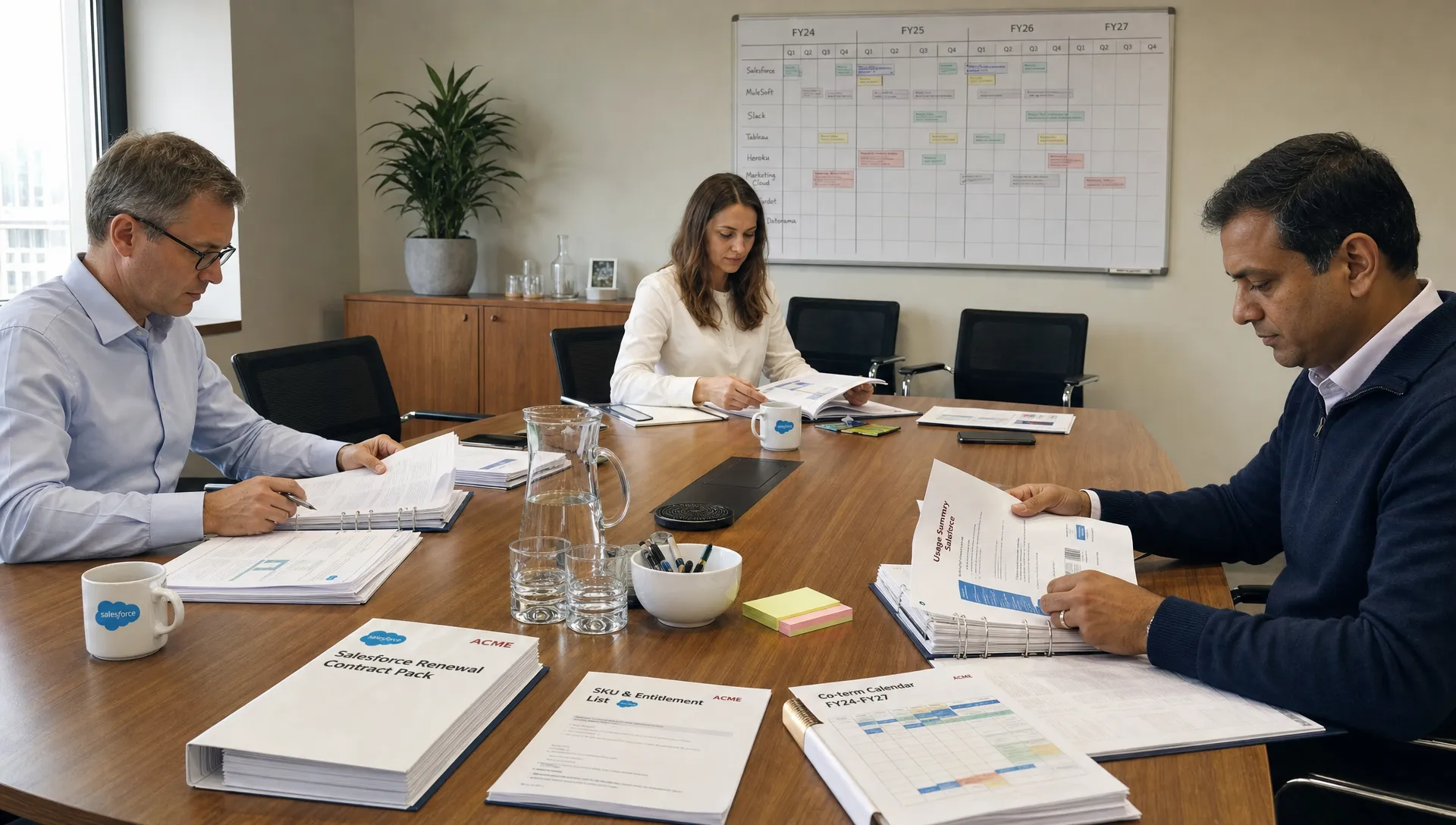
The most expensive Salesforce renewal problem is often not the final quote. It is the commercial licensing position the customer accepted 12, 24 or 36 months earlier, usually when the decision looked sensible. A bundle simplified approval. A co-term kept dates tidy. A larger commitment secured a discount. None of those choices is automatically wrong, but each can narrow your room to manoeuvre when renewal pressure arrives.
For CFOs, CIOs and procurement leaders, the useful question is not “Did we get a discount?” It is “What did we give up to get it?” Renewal risk often sits in the trade-offs that were not visible at approval stage.
Why commercial licensing choices raise renewal risk
Commercial licensing affects renewal risk because it defines your baseline before any negotiation starts. It determines what you own, what you can remove, what price protections apply, what usage rights are fixed and how future growth is priced.
Salesforce contracts are not just a list of products and quantities. They are a set of commercial commitments, usage permissions, renewal mechanics and amendment history. If those parts are not reviewed together, the renewal conversation can become too narrow, too late.
This is also why product complexity and contract complexity tend to compound each other. A customer may understand its business need but still struggle to see which SKUs are genuinely required, which are tied to a bundle and which are simply hard to unwind. SaaSed has covered that dynamic in more depth in its piece on why product complexity raises SaaS renewal risk.
Choice 1: Buying ahead of demand before demand is proven
Future demand is one of the easiest ways to justify a larger Salesforce commitment. A sales hiring plan, regional rollout or transformation programme can all support a bigger order. The risk is that commercial licensing then becomes based on intent rather than evidence.
This matters because renewal baselines often remember the full commitment, not the internal assumptions behind it. If headcount growth slows, if adoption takes longer or if a project is delayed, the unused licences can become an expensive starting point for the next term.
The sharper test is simple: has the demand already been funded, owned and scheduled? A vague forecast is not the same as an approved deployment plan. If the business case depends on growth, the contract should give the customer a route to adapt if that growth does not arrive.
Choice 2: Accepting bundles without a SKU-level exit route
Bundles can reduce friction at purchase stage. They can also blur what is being bought. A single commercial package may contain products with very different levels of adoption, business value and renewal importance.
The problem appears later, when finance asks what can be removed and IT has to answer at SKU level. If the original order does not make dependencies clear, the customer may discover that removing one underused component affects pricing, entitlements or access elsewhere.
This is one of the most common ways commercial licensing creates renewal risk: the agreement looks clean on the surface but limits practical flexibility underneath. The customer may have a strong usage argument, yet still lack a clean contractual route to act on it.
Before accepting a bundle, ask how each component would be treated at renewal. Can it be reduced separately? Does it affect discounting elsewhere? Is it priced only because it is part of a wider package? These are not legal afterthoughts. They decide whether shelfware can actually be removed.
Choice 3: Co-terming everything for convenience
Co-terming can be useful. It gives finance one budget cycle, procurement one negotiation window and IT one planning horizon. The risk is that neat dates can mask uneven leverage.
Not every product should be negotiated on the same footing. A core Sales Cloud estate with high adoption, a newly added product still in pilot and an add-on bought for a specific project may all carry different risk profiles. If everything lands on the same renewal date, the strongest items and weakest items can become commercially blended.
That blend can make commercial licensing harder to challenge. Salesforce may look at the account as a whole, while the customer needs to distinguish stable demand from uncertain demand. If the renewal plan does not separate those categories early, the business may end up defending every line item under the same time pressure.
Co-terming should be a deliberate negotiation choice, not an administrative reflex. The right question is whether combining dates improves leverage or simply makes the next renewal larger.
Choice 4: Trading flexibility for headline discount
A strong discount can still be an expensive deal if it comes with rigid minimums, aggressive ramps or limited reduction rights. This is not a criticism of discounting. It is a reminder that price is only one part of value.
Salesforce publishes product and edition information on its own UK editions and pricing pages, but enterprise customers know the signed order form is where the real commercial shape is set. The agreed quantities, term, ramp, uplift language and amendment structure matter as much as the visible unit price.
A common trap is treating a larger discount as proof of a better outcome. If that discount depends on buying more than the organisation can absorb, the customer has shifted cost from price into waste. If it depends on a long term without suitable review points, the customer has shifted cost into inflexibility.
Choice 5: Letting amendments reset the baseline quietly
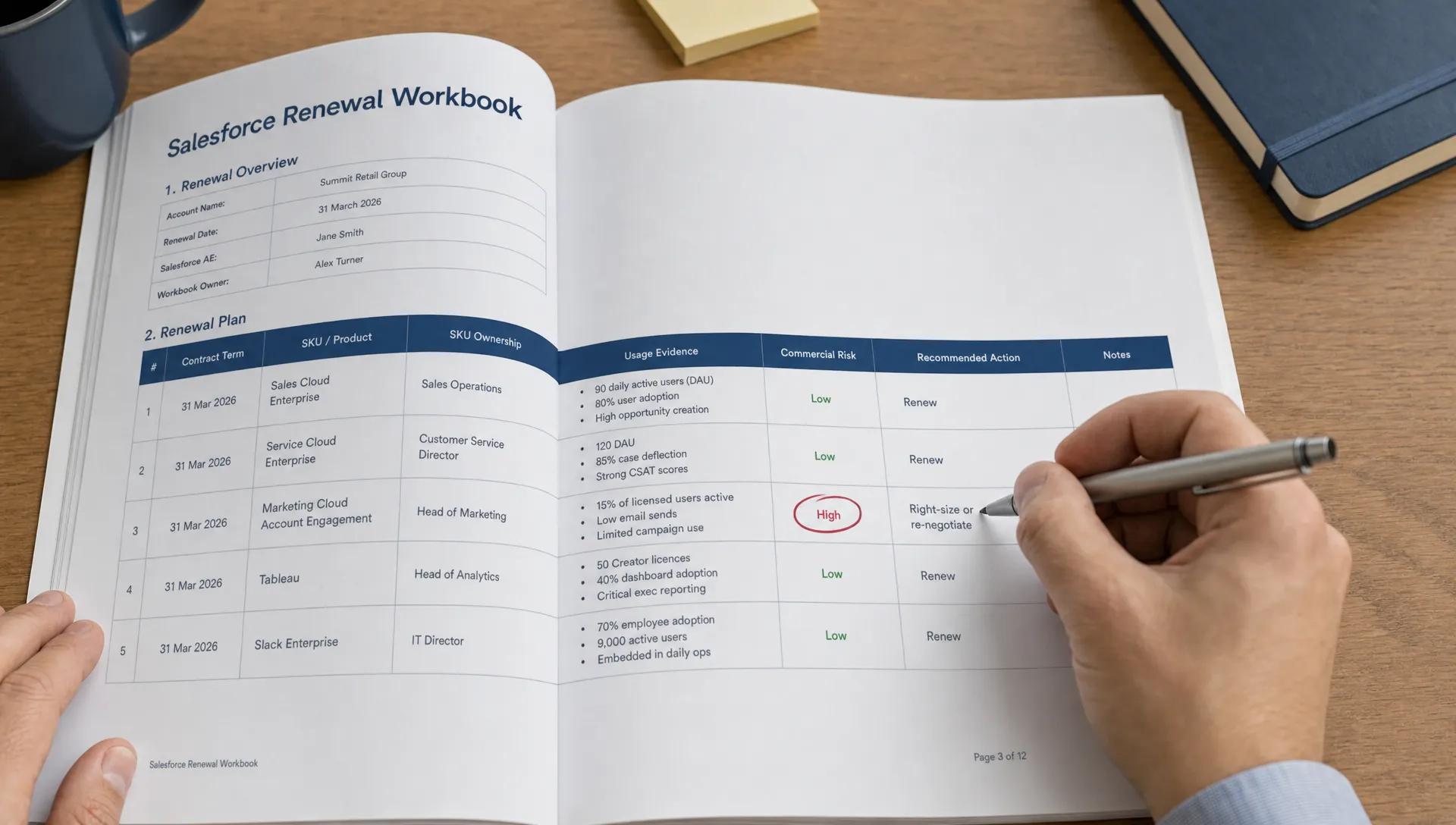
Many renewal problems are built through amendments, not the original agreement. A mid-term product add-on, extra licence purchase or co-term adjustment can seem small on its own. Over time, those changes can reshape the commercial baseline.
This is where commercial licensing needs a full contract history, not just the latest order form. Each amendment should be checked for its effect on renewal dates, pricing treatment, uplift provisions, minimum commitments and product dependencies.
The risk is not always hidden language. Sometimes it is scattered language. Finance may hold the original business case, IT may own the usage data, procurement may hold the order forms and legal may hold the master terms. Unless those records are joined up, the renewal team can miss how the current position was created.
If you suspect this is already happening, start with the practical risk areas in Salesforce contract renewal risks to catch early. The earlier the baseline is rebuilt, the less likely the renewal becomes a hurried reconciliation exercise.
Choice 6: Treating usage rights as a legal detail
Usage rights are often reviewed late because they look like legal language. That is understandable but risky. In a Salesforce estate, usage rights can affect who may access a product, how environments are used, what data can be processed and which functions are included.
The official Salesforce agreements and terms are the starting point, but customers also need to understand the signed documents that apply to their own estate. Order forms, product terms and negotiated provisions can all interact.
For commercial licensing, the danger is that usage rights are assumed rather than tested. A team may believe a licence supports a specific use case, only to find restrictions when adoption expands. Or the opposite can happen: the organisation may keep paying for higher entitlements when a narrower licence would support the actual use.
This is not about turning procurement into legal. It is about making sure the commercial review includes the rights that determine value.
A practical review before the renewal clock tightens
A useful renewal review does not start with supplier messaging. It starts with the customer’s own evidence. That means rebuilding the current position from contract documents, live usage, stakeholder demand and commercial obligations.
| Licensing choice | Renewal risk it can create | Evidence to check |
|---|---|---|
| Buying ahead of demand | Shelfware becomes part of the baseline | Approved hiring plans, deployment timelines and actual activation |
| Bundled products | Underused SKUs are hard to remove | SKU list, dependencies and discount conditions |
| Co-terming all products | Weak and strong leverage get blended | Product-level adoption, business ownership and renewal dates |
| Long terms or ramps | Future cost is locked before value is proven | Ramp schedule, minimum commitments and project milestones |
| Mid-term amendments | Baseline changes without full review | Amendment history, uplift terms and co-term effects |
| Unchecked usage rights | Wrong licence type or entitlement risk | Product terms, order forms and actual use cases |
The point is not to reject every complex structure. Sometimes a larger commitment is right. Sometimes a bundle is commercially sound. Sometimes a longer term protects the budget. The point is to understand the cost of those choices before the next renewal puts them under pressure.
A disciplined review also helps internal teams avoid circular debates. Finance can see the cost baseline. IT can explain what is used and what is planned. Procurement can identify negotiation options. Legal can focus on clauses that materially affect risk. If you need a broader structure, building a contract renewal strategy that survives scrutiny is a sensible next step.
How to decide whether a licensing choice is worth the risk
Every commercial trade-off should be tested against four questions. First, does the licence map to a funded business need? Second, can the organisation measure whether the need was met? Third, does the contract allow correction if demand changes? Fourth, does the discount compensate for the loss of flexibility?
Those questions keep commercial licensing grounded in evidence rather than optimism. They also create a cleaner internal approval trail. If the business chooses to accept risk, it does so knowingly and with a record of why the decision made sense.
This matters most when the next renewal conversation becomes difficult. A team with evidence can separate genuine requirements from historical commitments. A team without evidence is left negotiating from memory, and memory rarely beats a signed order form.
Frequently Asked Questions
What is the biggest licensing choice that raises Salesforce renewal risk? The most common issue is buying ahead of proven demand. It can be sensible when growth is funded and scheduled, but risky when the commitment is based on uncertain headcount, delayed projects or broad transformation assumptions.
Are Salesforce bundles always a problem? No. Bundles can be commercially useful when the components are needed and the exit route is understood. The risk comes when the customer cannot later separate underused products from core products without affecting pricing or entitlements.
When should a commercial licensing review start before renewal? Ideally, start 6 to 12 months before the renewal date, sooner for large or complex estates. That gives finance, IT, procurement and legal time to rebuild the baseline, verify usage and decide what should be challenged.
Should procurement lead the review or IT? Neither should work alone. IT understands adoption and architecture. Procurement understands negotiation mechanics. Finance owns budget pressure. Legal understands contract effect. The best renewal position comes from joining those views early.
Closing thought: renewal risk is built before renewal season
Commercial licensing decisions are rarely bad in isolation. They become risky when nobody tracks the trade-offs after signature. If your Salesforce renewal is approaching, the best use of time is to rebuild the evidence now: what you bought, what you use, what you need and what the contract allows you to change.
If it would help to have a second set of eyes on the baseline, SaaSed offers a complimentary Salesforce audit conversation. It is a practical way to pressure-test your renewal position before the formal negotiation starts.
Want this kind of intel on your renewal?
Don’t head into your next software negotiation alone
Contact Us