Build a Contract Renewal Strategy That Survives Scrutiny
A defensible Salesforce renewal is not built in the final fortnight. This guide shows CFOs, CIOs and procurement leaders how to ground renewal strategy in evidence, commercial discipline and internal alignment.
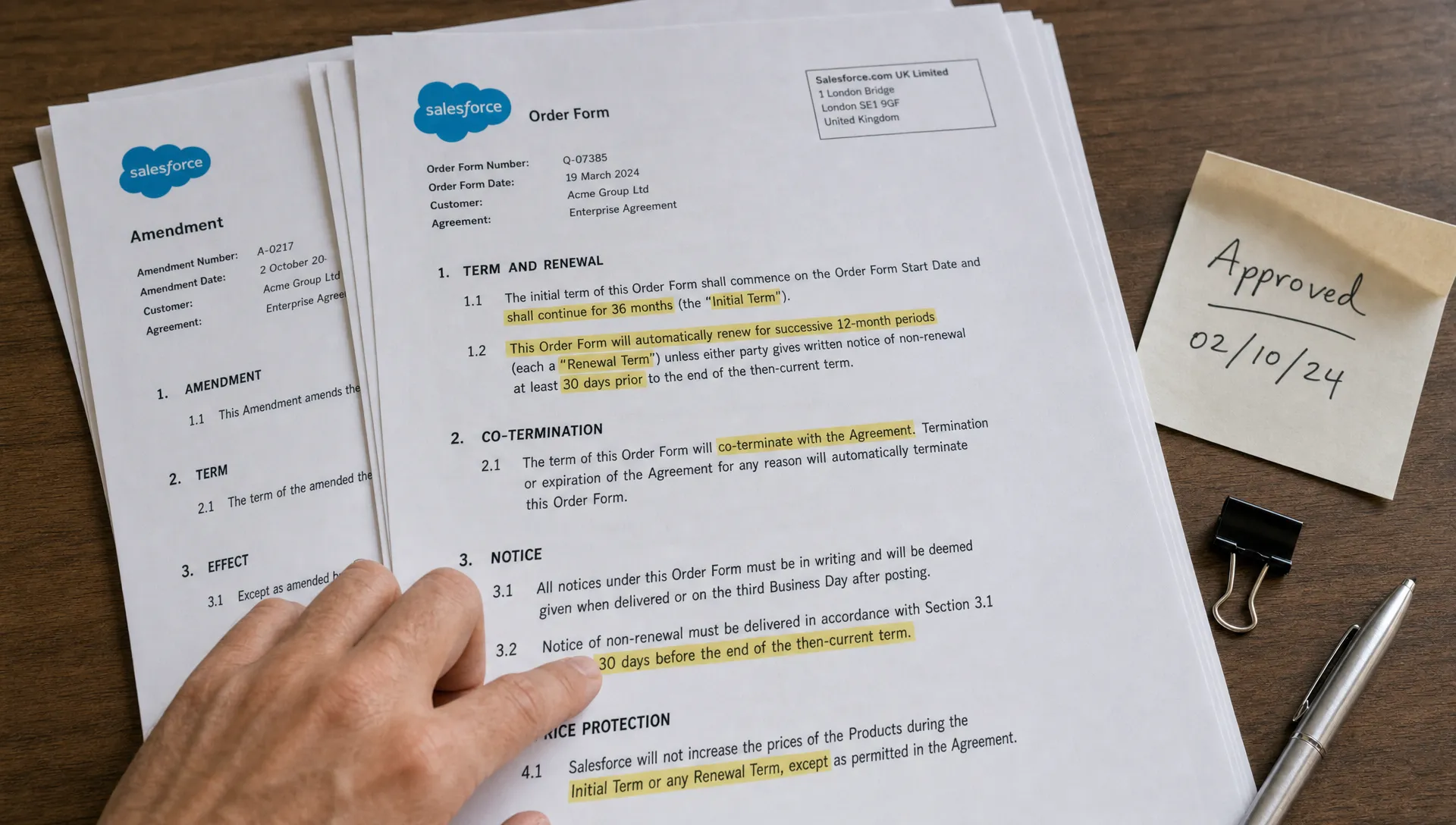
A contract renewal strategy is tested when someone outside the renewal team asks a simple question: why is this the right commitment?
For Salesforce, that question may come from the CFO, the CIO, procurement, legal, audit or a business unit that wants more capacity. The answer cannot be a supplier quote, a discount percentage or a hurried slide written two days before approval. It needs to be a clear commercial argument backed by evidence.
A strategy that survives scrutiny does three things well. It shows what the organisation truly needs. It explains what it does not need. It records the risks, trade-offs and assumptions behind the final position.
That sounds plain because it is. The hard part is doing it early enough, with enough discipline, before renewal pressure starts to shape the facts.
What scrutiny really means in a Salesforce renewal
Scrutiny is not hostility. In well-run organisations, it is a control. It protects cash, service continuity and decision quality.
The problem is that each stakeholder examines the renewal through a different lens. A CFO may care most about commitment, cash flow and budget variance. A CIO may care about continuity, architecture and whether the platform still supports the roadmap. Procurement will test leverage, process and commercial logic. Legal will look for exposure hidden in terms, dependencies and approvals.
A contract renewal strategy needs to withstand all of these views without changing shape depending on who is in the room.
| Stakeholder | Likely challenge | Evidence that helps |
|---|---|---|
| CFO | Why are we committing this level of spend? | Cost baseline, demand forecast, removal options, budget impact |
| CIO | Will the changes disrupt delivery or users? | Platform dependency map, adoption evidence, roadmap alignment |
| Procurement | Where is our leverage and what are our walk-away points? | Contract terms, timing, alternative scenarios, negotiation log |
| Legal | Are we accepting obligations we have not reviewed? | Order forms, amendments, renewal clauses, approval trail |
| Business owners | Will we still have what we need to operate? | Named requirements, usage by team, approved growth assumptions |
If one of those groups has to rely on opinion, the strategy is fragile. If they can challenge the plan and still trace the logic, the strategy is in much better shape.
Start with the renewal file, not the negotiation
Many renewal strategies begin too late because the team starts with the supplier conversation. That puts the organisation in reaction mode. The better starting point is the renewal file: the complete set of documents and data that define the current position.
For Salesforce, this usually includes the master agreement, order forms, amendments, support terms, price protections, renewal notice obligations, product schedules, co-termination details and any side letters or commercial commitments. It should also include the current SKU list, licence quantities, unit prices, discounts, contract dates and invoice history.
This is not admin for its own sake. It tells you what you are allowed to change, when you need to act and where supplier leverage may sit. If the file is incomplete, every later decision is weaker.
SaaSed has covered the timing issue in more detail in why contract review should start months before renewal. The practical point is simple: by the time renewal papers are circulating, the best opportunities to correct course may already have passed.
Your signed documents should always govern your own analysis. For reference, Salesforce also keeps its official agreements and legal terms available online, which can be useful when checking current standard terms against your executed paperwork.
A good renewal file is boring in the right way. Someone new to the project should be able to open it and understand what is active, what has changed, what renews automatically and what needs a decision.
Define the commercial question before collecting data
The weakest renewal strategies try to answer every question at once. They ask whether the renewal is affordable, whether licences are being used, whether the supplier will discount, whether the business wants more capacity and whether the contract terms are acceptable.
Those are all valid questions, but they need an organising question above them:
What Salesforce commitment can we justify for the next term, based on evidence we are prepared to defend?
That sentence changes the work. It stops the team from chasing a headline saving that may be operationally risky. It also stops the business from rolling forward every current SKU just because nobody has had time to challenge it.
From there, most renewal items fall into one of four commercial positions:
- Retain: the SKU or licence pool is clearly needed, used and aligned to the operating model.
- Reduce: the evidence shows waste, duplicate access or lower demand than the contracted quantity.
- Restructure: the need remains, but the current packaging, term or commercial structure is poor.
- Defer: future demand is plausible, but not approved or mature enough to include in the renewal commitment.
This is where discipline matters. Forecasts are useful, but only when they are labelled as forecasts. Approved hiring plans are different from expected hiring. A signed transformation plan is different from a workshop idea. Pipeline demand is different from budgeted demand.
A contract renewal strategy that survives scrutiny keeps those distinctions visible.
Build an evidence baseline people can challenge
Usage data is essential, but it is often misunderstood. A user who has not logged in recently may still be tied to an integration, a controlled process or a seasonal workflow. A user who logs in every day may be using only a small part of a higher-cost SKU. A department may be asking for more licences because allocation is messy rather than because demand is growing.
The aim is not to produce perfect data. The aim is to produce evidence that can be challenged without collapsing.
| Evidence area | Common mistake | Stronger approach |
|---|---|---|
| Licence assignment | Treating assigned licences as proof of need | Compare assignment, login, role and business owner confirmation |
| Usage | Using login data alone | Review meaningful activity, product-specific use and operational dependency |
| Shelfware | Counting unused items without checking constraints | Check whether quantities can be reduced and whether bundled terms restrict action |
| Growth demand | Accepting verbal forecasts | Tie demand to approved headcount, budgeted projects or signed operating plans |
| SKU fit | Assuming current editions still match need | Review whether users require the current functionality level |
| Business risk | Cutting what appears unused | Confirm whether the SKU supports reporting, automation, integrations or compliance processes |
This work is uncomfortable when ownership is unclear. Sales operations may understand usage, IT may understand configuration, finance may understand cost and procurement may understand terms. No single view is enough.
The baseline should therefore separate facts from interpretation. For example, “42 assigned licences show no login in 90 days” is a fact if the data is correct. “42 licences can be removed” is an interpretation that still needs validation.
That distinction protects the strategy when it is challenged.
Separate value, waste and risk
Cost reduction is not the same as value improvement. A renewal can be cheaper and still be a poor decision if it removes flexibility, locks in the wrong structure or creates disruption later. Equally, a renewal can preserve cost and still be wasteful if nobody has challenged shelfware or outdated assumptions.
A clean strategy classifies the estate in plain terms.
| Category | What it means | Renewal treatment |
|---|---|---|
| Clear value | Used, needed and commercially reasonable | Protect continuity, negotiate terms and price carefully |
| Visible waste | Unused or over-allocated with low removal risk | Reduce, reassign or remove where contractually possible |
| Unclear value | Some signals of use, but weak ownership or poor evidence | Investigate before committing for a full term |
| Future option | Potential need, not yet approved | Avoid locking into firm commitment too early |
| Commercial risk | Needed, but tied to weak terms, uplift exposure or inflexibility | Renegotiate structure, protections or renewal mechanics |
This classification is more useful than a generic savings target. It lets the CFO see which reductions are defensible. It lets the CIO see where risk has been considered. It gives procurement a better basis for negotiation than “we need a better price”.
It also avoids the common trap of treating every unused licence as immediate savings. In Salesforce renewals, the contractual right to reduce, the timing of the reduction and the commercial impact of changing quantities all matter.
Make stakeholder alignment practical, not theatrical
A renewal steering group is only useful if it improves decisions. Too often, internal alignment becomes a meeting series where people restate preferences without resolving trade-offs.
A stronger approach is to give each stakeholder a narrow responsibility. Finance owns budget impact and approval route. IT owns technical dependency and operational risk. Business owners validate demand. Procurement owns the commercial plan and negotiation process. Legal reviews terms, obligations and deviations.
This does not need heavy governance. It needs clarity. Each person should know which part of the strategy they are expected to sign off and what evidence they are relying on.
For Salesforce renewals, this is especially important because the platform often cuts across sales, service, marketing, analytics and operations. If one function overstates demand, the whole commercial position can tilt. If one function goes quiet until the final approval meeting, the team may have to choose between delay and a weak decision.
The internal support model deserves its own planning. SaaSed has written about how to build a support strategy before Salesforce renewal, including how to separate usage evidence from opinion and bring the right people into the process early.

Build negotiation leverage before the supplier conversation
Leverage is not created by asking harder in the final week. It is created by knowing what you can change, what you can delay, what you can remove and what you are prepared to accept.
By the time the supplier conversation becomes commercial, you should already know your preferred outcome, fallback position and non-negotiables. You should also know which concessions would look attractive but weaken the organisation later.
A practical timeline helps:
| Timing before renewal | Work to complete | What it protects |
|---|---|---|
| 6 months or more | Gather contract file, map renewal dates, identify decision owners | Time and internal control |
| 4 to 5 months | Audit usage, validate demand, classify SKUs | Evidence quality |
| 3 months | Build scenarios, agree negotiation range, review terms | Commercial leverage |
| 2 months | Run supplier discussions, test proposals, update risk view | Negotiation discipline |
| 1 month | Finalise decision record, approvals and execution plan | Governance and continuity |
The exact timing depends on contract size, complexity and internal approval cycles. Large Salesforce estates or broad enterprise agreements may need more time, especially where multiple clouds, bundled SKUs or support arrangements are involved.
The renewal term itself is a major lever. A longer term may improve commercial terms but reduce future flexibility. A shorter term may preserve optionality but leave price exposure unresolved. Neither is good or bad in isolation. The point is to make the term serve the strategy, not the other way round. For a deeper view, see how to use the renewal term without losing ground.
Prepare the decision record before the decision meeting
A strategy survives scrutiny when the decision record is written before everyone is tired of the renewal.
That record does not need to be long. It does need to be complete enough for a future reviewer to understand why the organisation committed. A good test is whether someone could reconstruct the decision six months later without asking the original team to explain it verbally.
Finance and operations leaders often see the same control principle across different managed-service environments. If your remit also covers real-estate assets, services such as property management in Jacksonville and St. Augustine show how detailed records and owner reporting support oversight in that domain. For Salesforce, keep the record focused on software: entitlement, usage, commercial terms, risk and approval.
The renewal decision record should usually cover:
- Current position: contract scope, spend, renewal date, products, quantities and key terms.
- Evidence reviewed: usage data, stakeholder input, business demand, budget and contract constraints.
- Options considered: renew as-is, reduce, restructure, extend, defer or challenge specific SKUs.
- Recommended position: the preferred commercial outcome and why it is defensible.
- Risks accepted: operational, contractual, financial and timing risks that remain after negotiation.
- Approval trail: who approved the plan, on what date and under which assumptions.
This record is also useful during negotiation. It keeps the internal team from being pulled into side discussions that sound attractive but do not support the agreed position.
Common weaknesses that fail scrutiny
Most weak renewal strategies fail for predictable reasons. The issue is rarely that the team lacks intelligence. It is usually that the work started too late, the evidence was too thin or the internal position was never made explicit.
| Weakness | Why it fails scrutiny | Better control |
|---|---|---|
| Final-month preparation | The team has little time to validate data or change course | Start with contract and usage review months in advance |
| Discount-led strategy | A discount can hide poor scope, waste or weak terms | Negotiate total commercial outcome, not percentage alone |
| Unclear ownership | Stakeholders challenge the result because they never owned the input | Assign decision rights early |
| Over-reliance on supplier data | The supplier view may not match internal use, budget or risk | Build an internal evidence baseline |
| Unapproved growth | Future demand is rolled into the renewal without financial control | Separate approved demand from speculative demand |
| Ignored renewal mechanics | Notice periods, uplifts or co-terming reduce room to move | Review renewal terms before commercial talks start |
These weaknesses are avoidable, but only if they are caught early. SaaSed has outlined related warning signs in Salesforce contract renewal risks to catch early, including weak baselines, misleading usage data and restrictive renewal terms.
What a scrutiny-ready contract renewal strategy contains
By the time the strategy reaches approval, it should not feel like a collection of slides. It should feel like a well-kept file with a clear recommendation.
A strong contract renewal strategy for Salesforce will usually contain these elements:
- A complete contract baseline with order forms, amendments, dates, terms and commercial obligations.
- A SKU and licence view that shows current quantities, cost, usage signals and business ownership.
- A demand forecast split between approved need, likely need and unapproved interest.
- A waste and risk assessment that distinguishes removable shelfware from operational dependency.
- A negotiation plan with target outcome, fallback position, trade-offs and escalation route.
- A renewal term view that explains why the proposed duration is commercially sensible.
- A decision record that captures evidence, options, recommendation, risks and approvals.
The point is not to create paperwork for its own sake. The point is to remove ambiguity before ambiguity becomes expensive.
When the strategy is clear, the negotiation is calmer. Procurement can push without improvising. Finance can approve without relying on optimism. IT can protect continuity without defending every historic choice. Business owners can ask for what they need while accepting that unproven demand should not automatically become contracted spend.
That is what scrutiny is supposed to produce: a better decision.
Frequently Asked Questions
How early should a Salesforce contract renewal strategy start? For a material Salesforce renewal, start at least six months before the renewal date. Complex estates, enterprise agreements, bundled SKUs or slow internal approvals may need more time. The aim is to complete contract review, usage analysis and stakeholder alignment before supplier pressure increases.
What makes a contract renewal strategy defensible? A defensible strategy connects the recommendation to evidence. It should show current contractual obligations, actual usage, validated business demand, commercial options, negotiation assumptions, risks and approvals. If the logic can be challenged and still holds, it is defensible.
Should we focus mainly on reducing Salesforce cost? Cost matters, but a narrow savings target can lead to poor decisions. The better aim is to improve the commercial outcome. That may mean reducing waste, restructuring SKUs, changing renewal terms, improving price protections or avoiding unnecessary future commitment.
Who should own the renewal strategy? Procurement often owns the commercial process, but the strategy needs input from finance, IT, legal and business owners. The cleanest model gives each function a specific area to validate rather than asking everyone to comment on everything.
What is the biggest mistake teams make before renewal? The biggest mistake is treating renewal as an event rather than a process. If the team waits for the supplier quote before reviewing contracts, usage and demand, it gives up time, leverage and internal control.
Build the file before you need to defend it
A contract renewal strategy does not need to be loud to be strong. It needs to be clear, evidenced and honest about trade-offs.
For Salesforce, that means knowing your contract position, validating usage, separating approved demand from aspiration and agreeing the negotiation position before the supplier conversation dominates the timetable.
If your next Salesforce renewal needs a sharper commercial view, SaaSed can help with contract and SKU review, usage audit, shelfware analysis and negotiation preparation. For a complimentary Salesforce audit conversation, get in touch before the renewal clock gets too tight.
Want this kind of intel on your renewal?
Don’t head into your next software negotiation alone
Contact Us