Why Product Complexity Raises SaaS Renewal Risk
Product complexity makes SaaS renewals harder to govern because the real decision is often buried in SKUs, bundles and usage gaps. This guide shows where the risk builds and how to regain control before the quote arrives.

Product complexity is one of the quietest sources of SaaS renewal risk. It rarely looks like a problem at the start. A new cloud solves a business need. An add-on fills a gap. A bundle improves the short-term commercial case. A pilot becomes a regional rollout. Two years later, the renewal is not a simple price discussion. It is a forensic exercise.
For CFOs, CIOs and procurement leaders, the issue is not that a SaaS estate has become large. Large can be justified. The risk is that the organisation can no longer explain, with confidence, what it owns, who uses it, what value it creates and which parts are negotiable.
That is where renewal risk rises. Complexity shifts the balance of information towards the vendor. It slows internal decision-making. It makes waste harder to spot. And, in platforms like Salesforce, it can turn a renewal from a commercial choice into a maze of SKUs, bundles, editions, usage metrics, contract terms and stakeholder dependencies.
What product complexity really means in a SaaS renewal
Product complexity is not just “we have too many licences”. It is the accumulation of commercial, technical and organisational layers that make a renewal hard to read.
In a Salesforce environment, this can include multiple clouds, different editions, named user licences, add-ons, sandbox entitlements, API limits, data products, support plans, regional deployments, legacy discounts, ramped quantities and bundled pricing. Each piece may have made sense when it was bought. The risk appears when nobody can see the full picture anymore.
Salesforce itself maintains extensive agreements and product terms, which is a useful reminder that enterprise SaaS is not one product under one simple set of rules. The contract is often a stack of order forms, product terms, usage definitions and commercial exceptions.
The danger is not complexity on paper. It is complexity without ownership.
When finance owns the budget, IT owns the platform, procurement owns the negotiation and business teams own adoption, renewal preparation can fragment quickly. Everyone sees part of the truth. Few people see the whole risk.
Where complexity turns into renewal risk
The renewal risk created by product complexity usually builds in five places.
1. The baseline becomes unreliable
A clean renewal starts with a clean baseline. What products are under contract? What quantities are committed? Which order forms are still active? What expires when? Which discounts are temporary? Which products are bundled, co-termed or dependent on other purchases?
In a simple agreement, this takes hours. In a complex estate, it can take weeks.
If the baseline is wrong, everything built on top of it is weak. Usage analysis becomes misleading. Negotiation targets are vague. Internal approvals are late. The vendor quote becomes the default version of reality.
This is why renewal teams should treat the contract baseline as a control document, not an admin task. If you are already close to renewal, it is worth comparing your position against the early warning signs covered in Salesforce contract renewal risks to catch early.
2. Shelfware hides inside bundles
Shelfware is easy to identify when unused licences sit in plain sight. It is harder when the unused element is part of a bundle, a suite, a strategic agreement or a blended commercial model.
A business may know it is using Sales Cloud heavily, but have less clarity on whether attached products are deployed, adopted or delivering measurable value. The bundle can make the total price look attractive while hiding the economics of individual components.
This matters because renewal negotiations depend on choice. If each product has a visible price, usage profile and business owner, you can decide what to keep, reduce, replace or renegotiate. If everything is blended, the negotiation becomes much harder.
The same logic applies in large Salesforce agreements, including SELA structures. Bundles can be useful, but only when the customer understands the trade-offs. The risks are explored in more detail in Salesforce SELA bundling traps and decoupled pricing.
3. Usage and value drift apart
Product complexity makes it easier for usage and value to drift apart.
A product may be technically assigned, but barely used. A licence may be active, but used for a narrow task that could be served by a lower-cost edition. A premium feature may be available, but not adopted. A regional team may still hold licences for a process that has since changed.
This is not a criticism of IT teams. It is normal in large organisations. People move. Projects pause. Processes change. Acquisitions happen. The issue is that SaaS contracts often do not adjust unless the customer forces the conversation before renewal.
Salesforce tools such as Salesforce Optimizer can help surface configuration and usage signals. They are useful inputs. They do not replace a commercial audit that connects usage, entitlement, business value and renewal leverage.
4. Internal decisions take too long
Complexity increases the number of people who need to be involved. Finance wants cost clarity. IT wants platform continuity. Security wants assurance. Legal wants risk control. Business owners want capability. Procurement wants leverage and timing.
None of that is wrong. The problem is sequencing.
If the first serious internal alignment happens after the vendor quote arrives, the organisation has already lost time. By then, the renewal date is close, switching options are theoretical and commercial pressure is easier for the vendor to manage.
A strong renewal process starts earlier because complex decisions need time. If you want a practical structure for that work, what a strong SaaS renewal process looks like sets out the main stages without turning the process into ceremony.
5. Vendor leverage becomes harder to see
In a complex product estate, leverage is rarely obvious. It may sit in unused quantities, overlapping products, poor adoption, future growth, regional rollout plans, support issues, competitive alternatives or the timing of the vendor’s quarter.
But leverage only exists if it is documented and usable.
A vague feeling that “we are not using everything” is not leverage. A clear analysis showing which SKUs are underused, which business units no longer need them, which contract terms limit flexibility and which renewal scenarios are credible, that changes the conversation.
| Complexity layer | What it obscures | Renewal risk |
|---|---|---|
| Multiple SKUs and editions | Which capabilities are actually needed | Renewing products at the wrong level |
| Bundled pricing | The real cost of each product | Weak ability to remove or resize components |
| Ramped quantities | Future commitments versus real demand | Paying for growth that did not happen |
| Fragmented ownership | Who can approve changes | Late decisions and reduced negotiation room |
| Add-ons and product dependencies | What can be removed safely | Fear-driven renewals with limited challenge |
| Legacy order forms | Current rights and obligations | Missed terms, uplifts or expiry constraints |
Why this matters more in Salesforce renewals
Salesforce is often not a narrow application. It can sit across sales, service, marketing, revenue operations, analytics, integration and customer data. That breadth is valuable when the platform is well governed. It also means renewal risk is rarely confined to one team.
A Salesforce renewal can include core licences, specialist clouds, platform licences, managed packages, support entitlements, sandbox needs, API consumption, data storage, automation, CPQ or Revenue Cloud components and negotiated commercial terms from previous cycles.
The commercial challenge is that these elements do not all behave the same way. Some are business-critical. Some are optional. Some are under-adopted. Some are technically embedded but commercially oversized. Some are valuable but badly contracted.
Treating them as one renewal line can lead to blunt decisions. Cutting too hard creates operational risk. Renewing everything creates cost risk. The better route is to separate the estate into what is essential, what is valuable but negotiable, what is uncertain and what should be challenged.
The finance risk: unclear cost attribution
For CFOs, product complexity creates a simple but serious problem: it becomes hard to explain where the money goes.
A large renewal may be approved because the platform is essential, but that does not mean every component is justified. Without cost attribution by product, function, region or business unit, finance has limited ability to challenge demand.
This leads to familiar questions:
- Which teams are driving the renewal increase?
- Which products are growing faster than adoption?
- Which licences are assigned but inactive?
- Which costs are tied to historic decisions rather than current need?
- Which future commitments are based on evidence rather than optimism?
Good renewal preparation gives finance a clearer view of controllable spend. It does not turn the CFO into a system administrator. It gives the CFO enough evidence to separate necessary platform cost from avoidable commercial drag.
The IT risk: dependency without commercial clarity
For CIOs and IT leads, the risk is different. Product complexity often reflects years of genuine business demand. Removing the wrong product can break a process, delay a programme or create support noise.
That is why renewal work cannot be a pure cost-cutting exercise. It needs a technical view of dependency.
The question is not only “is this product used?” It is “what would happen if we reduced, changed or removed it?” Some low-usage products may support a critical workflow. Some high-quantity products may be over-provisioned. Some licences may be assigned for convenience rather than need.
IT’s role is to make those distinctions visible. Procurement can then negotiate from fact, not guesswork.
The procurement risk: fewer clean options
Procurement teams are strongest when they can present credible options. Renew as-is. Reduce. Rebalance. Extend for a shorter term. Separate bundled products. Push back on uplift. Delay a planned expansion. Test alternatives.
Product complexity reduces those options if it is left too late.
By the time the quote arrives, the vendor will usually understand the account structure, usage signals, buying history and internal dependencies better than the customer’s negotiation team does. That is not a moral failing. It is the result of preparation.
Procurement can regain ground by building the commercial picture early, then using it to shape the renewal before the final proposal is framed.
A practical way to reduce complexity risk before renewal
The best response to product complexity is not to simplify everything overnight. That is rarely realistic. The better response is to make the complexity legible.
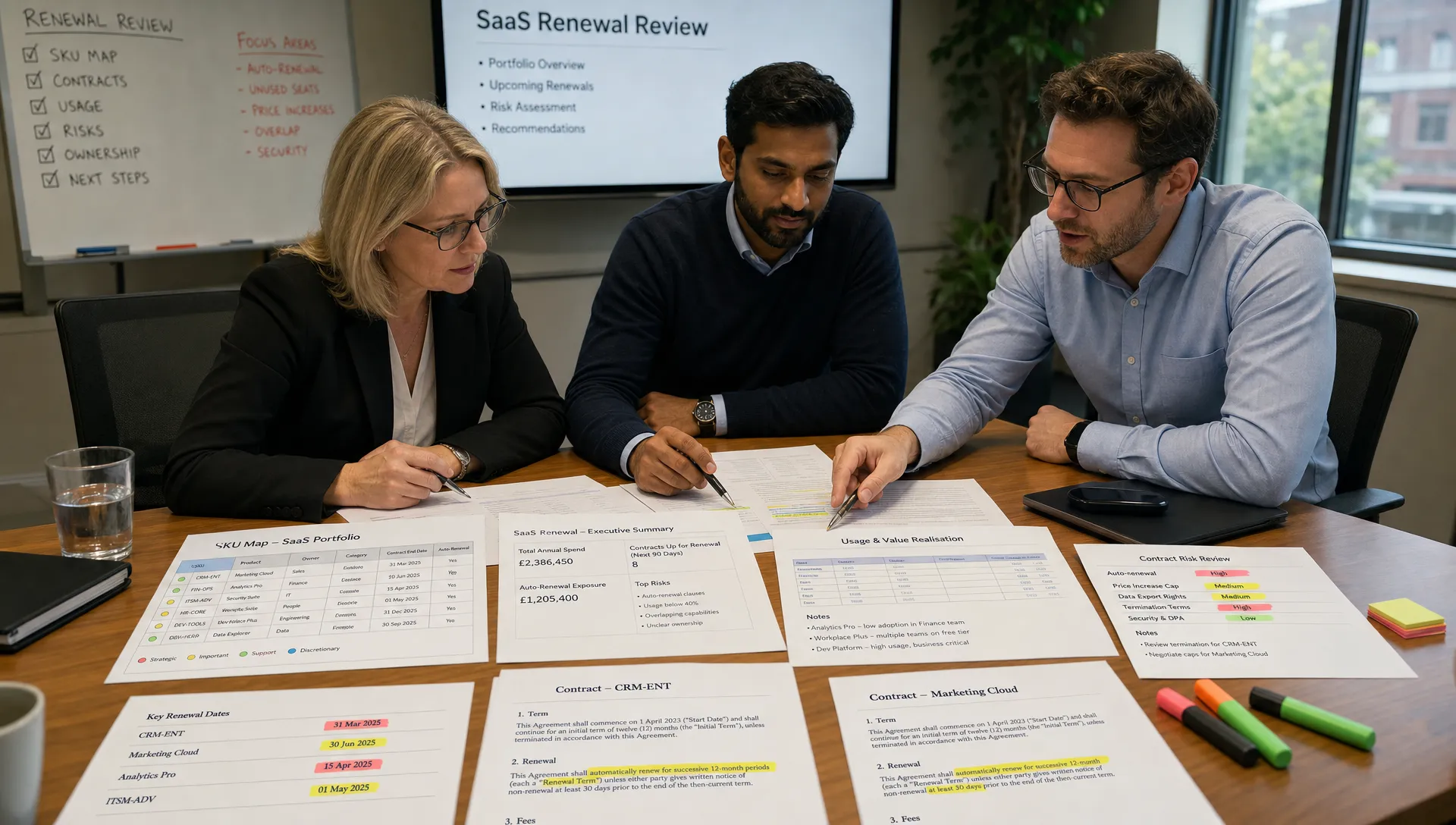
A disciplined renewal review should answer seven questions before negotiation begins:
- What exactly is under contract, by order form, SKU, quantity, term and price?
- Which products are deployed, partially deployed, unused or uncertain?
- Who owns each product from a business and technical perspective?
- What usage evidence supports each renewal quantity?
- Which products are bundled, co-dependent or priced in a way that limits flexibility?
- What commitments, uplifts, minimums or renewal terms reduce room to manoeuvre?
- What renewal scenarios are credible, including reduce, rebalance, extend, separate or remove?
This work does not need to become a months-long internal project. But it does need enough time for evidence, discussion and decisions. For complex Salesforce estates, starting six to nine months before renewal is often sensible. Longer may be needed where there are major bundles, global deployments or strategic agreement structures.
The signals that product complexity is already raising risk
Some renewal risks are visible well before the renewal date. The challenge is noticing them while there is still time to act.
| Signal | What it may mean | What to do next |
|---|---|---|
| Nobody can produce a clean SKU list | Contract baseline is fragmented | Rebuild the baseline from order forms and amendments |
| Business owners disagree on need | Product ownership is unclear | Assign owners before commercial talks begin |
| Usage reports conflict | Data sources are incomplete | Compare entitlement, assignment and active use |
| Bundles cannot be priced separately | Negotiation flexibility is limited | Model decoupled scenarios before accepting renewal logic |
| Renewal uplift is treated as inevitable | Leverage has not been tested | Review shelfware, adoption, term and alternative options |
| Decisions wait for the vendor quote | Internal process is reactive | Set a renewal timetable before pricing arrives |
These signals do not prove overpayment. They prove uncertainty. In a high-value SaaS renewal, uncertainty is enough to justify a closer review.
Frequently Asked Questions
Why does product complexity increase SaaS renewal risk? Product complexity increases renewal risk because it makes it harder to see what is owned, used, needed and negotiable. When the customer lacks a clear view, the vendor quote can become the default baseline.
Is product complexity always a bad thing? No. Complexity can reflect a mature platform supporting many teams and processes. The risk appears when that complexity is not governed, measured or connected to commercial decisions.
How early should a complex SaaS renewal review begin? For large Salesforce renewals, six to nine months before renewal is a sensible starting point. Complex bundles, global deployments or strategic agreements may need more time.
What should be reviewed first in a complex Salesforce renewal? Start with the contract baseline: order forms, SKUs, quantities, pricing, terms, renewal dates, discounts and dependencies. Without that baseline, usage and negotiation analysis will be unreliable.
Can usage data alone solve renewal risk? No. Usage data is essential, but it needs context. A good review connects usage to business value, technical dependency, contract terms and credible renewal options.
Conclusion: make the complexity visible before it prices itself in
Product complexity is not a failure. It is often the natural result of a platform that has grown with the business. But at renewal, unmanaged complexity has a cost. It hides waste, slows decisions and weakens negotiation leverage.
The answer is not to strip the estate back without care. The answer is to understand it well enough to renew deliberately.
If your Salesforce renewal is approaching and the product picture feels harder to read than it should, SaaSed can help with a focused review of contracts, SKUs, usage signals and commercial risk. For a practical first step, book a complimentary Salesforce audit conversation.
Want this kind of intel on your renewal?
Don’t head into your next software negotiation alone
Contact Us