When an Add On in Salesforce Becomes a Permanent Cost
A small mid-term add-on can become a full-year commitment without any increase in its unit price. Separate annualisation from uplift, test whether the business needs the entitlement and check what removal would actually require.
Persona: Salesforce Owner
Target query: Salesforce add-on cost renewal
Meta title: When an Add-On in Salesforce Becomes a Permanent Cost
What you add on Salesforce mid-term can look inexpensive because the first order covers only the months left on your contract. At renewal, the same entitlement may become a full-year commitment, with any applicable uplift calculated on top. Your job is to separate the shorter first term from the ongoing cost, then establish whether the business still needs what it bought. The first invoice alone cannot answer either question.
Why can the first add-on order understate the renewal commitment?
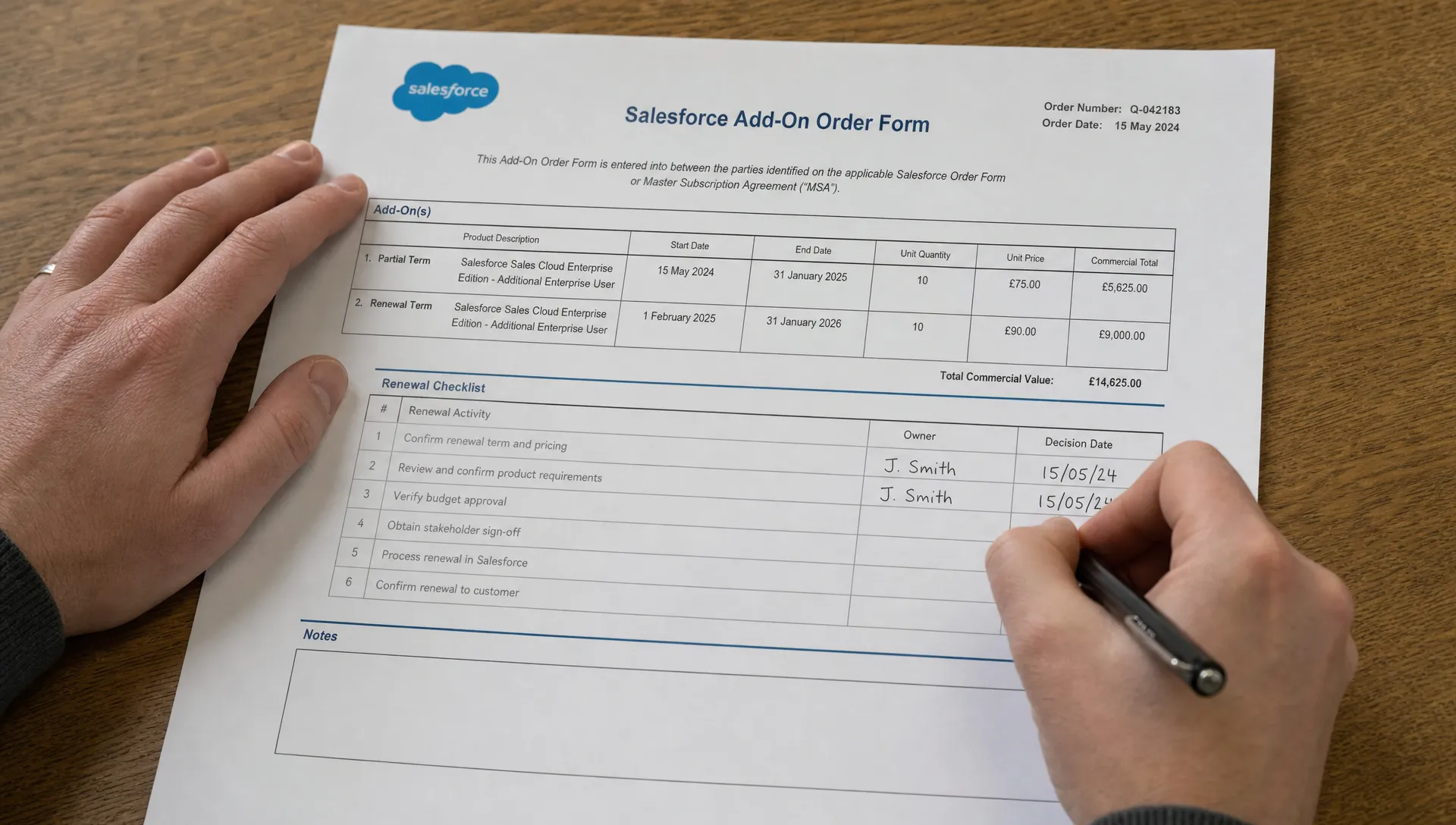
Co-terming aligns an additional subscription with the end date of an existing subscription. That can make the first order a partial-term purchase rather than a full year. If the add-on renews for twelve months, the renewal commitment increases even when its quantity and net unit rate stay unchanged.
Take an illustrative order starting on 1 November, co-termed with an existing subscription ending on 31 January. The initial purchase covers three months. A subsequent annual renewal covers twelve months, from 1 February to 31 January.
On a simple monthly charging basis, twelve months represents four times the initial three-month charge. That is annualisation, not a fourfold increase in the unit price. Actual billing and proration must follow the order form.
For a Salesforce add-on priced per user per month, the comparison is:
Annualised commitment = retained quantity × net monthly unit rate × 12.
Do not apply that formula to consumption-based or differently structured products without checking their charging basis.
The governing order form and subscription terms determine the commitment. Use Salesforce’s agreement library to locate the relevant standard documents, then check the version incorporated into your contract and any negotiated amendments. An invoice records a charge; it does not replace those terms.
When does what you add on Salesforce become essential?
An add-on becomes operationally embedded when removing it would interrupt a required process, not simply because licences have been assigned. Assignment proves that an entitlement has been allocated. It does not prove that someone uses the capability, that the usage matters or that no workable alternative exists.
Keep three separate records: what you bought, who has access and what business activity depends on it. Those records often answer different questions.
A permission set licence assignment may help identify entitled users, but it is not sufficient evidence of feature usage. Equally, low interactive usage does not establish that an add-on is unnecessary. A capability might support an integration, a periodic control or a process that runs infrequently but matters when it does.
Ask the operational owner to name the process, explain what fails without the entitlement and identify the evidence. General Salesforce login activity is not enough.
This distinction also matters when reviewing licensing decisions that create long-term waste. A purchase can have been justified at approval and still lack a defensible reason to renew today.
How does the add-on enter the renewal baseline?
A retained add-on can enter the renewal proposal as part of the annual recurring commitment. Any applicable uplift may then be calculated against its renewal rates or fees. The original partial-term invoice is no longer the useful comparison: you need the annualised amount before assessing the proposed increase.
Treat the renewal baseline as a reconciliation exercise, not an unquestionable total. Establish the retained quantities, net rates and charging periods line by line. Then separate each source of movement.
| Movement | What has changed? | Evidence to check |
|---|---|---|
| Annualisation | A partial term becomes a full renewal term | Subscription start and end dates |
| Quantity | More or fewer units are being renewed | Current and proposed quantities |
| Rate | The net price per unit changes | Contracted rates and proposed uplift |
| Product mapping | An existing SKU is replaced or repackaged | Written mapping between old and proposed lines |
A Salesforce add-on can therefore increase the renewal total without a unit-rate increase. Conversely, an unchanged total can conceal a rate increase if quantities fall elsewhere.
For your budget explanation, show the retained annualised commitment first, then quantity changes and rate changes separately. This is a practical starting point for understanding where Salesforce spend goes off track.
Being included in the proposal does not, by itself, make an add-on legally non-removable. That depends on the contract, applicable notice requirements and any linked commercial commitments.
What should you check before the next renewal?
Give every add-on an accountable owner, evidence of relevant usage and a documented retention or removal decision. Reconcile those findings against the order forms and renewal proposal. The aim is not to label everything used or unused, but to establish what you can stop buying and when.
Start with the exact order-form description or SKU. Record its quantity, charging basis, subscription dates, net rate and annualised commitment. Keep the original business reason beside the current one, particularly if the purchase supported a temporary project.
Next, identify an owner who can approve the operational consequence of removal. An administrator may manage access without having authority to decide whether the business can stop using the capability.
For each Salesforce add-on, request evidence suited to the product: feature activity where available, completed business transactions or documented dependencies. Record the observation period. A quiet month tells you little about a capability used for a quarterly process.
Finally, give the decision a status: retain, reduce, remove or investigate. An unresolved line needs a named decision owner and a deadline before the contractual action date. Otherwise, it can remain in the proposed baseline simply because nobody has completed the review.

What does a credible removal path need to contain?
A removal path needs both operational clearance and a contractual route. You must know what stops working, how any necessary replacement will be delivered and when the subscription can be reduced or ended. Removing access in the application does not, by itself, remove a payment obligation.
On the operational side, identify affected users, integrations, automations and any data-access requirements. Where relevant, test the proposed change in a suitable non-production environment before altering production access. Do not withdraw a capability merely to see who complains.
On the commercial side, check minimum quantities, linked discounts, bundle conditions and notice requirements. Ask whether removing one line changes the proposed rates on another. Require the relevant wording or a written commercial explanation rather than accepting that the whole package must stay untouched.
The contract clauses that shape Salesforce renewal commitments matter here because operational readiness and contractual flexibility are separate issues.
For a Salesforce add-on marked for removal, record the earliest effective date, required notice method and proof that the instruction was received. If removal cannot happen at the next renewal, document the reason and the next available action date.
Which three questions should you ask Salesforce about each add-on?
Ask for the full-term commitment, the contractual conditions for reduction and the effect of removal on other lines. Request answers against each specific SKU or order-form line, in writing. A general assurance about flexibility is not enough to support your renewal decision or your budget submission.
- What will this line commit us to for the whole renewal term? Ask for quantity, charging basis, net unit rate, subscription dates and total commitment. Require annualisation to be shown separately from uplift, quantity growth and any product substitution. This exposes whether the increase comes from time, volume or price.
- What allows or restricts us from reducing or removing it at renewal? Ask for the relevant contractual wording, notice deadline, notice method and any minimum commitment. Confirm whether the original add-on has its own terms or follows the existing subscription. Do not assume co-terming answers those questions.
- What else changes commercially if we remove this line? Ask whether other discounts, quantities or package terms change, and request a revised line-by-line proposal. This establishes the net saving rather than treating the add-on’s displayed charge as an amount you can necessarily remove in isolation.
What else should you know before approving renewal?
The final check is whether the evidence supports the commitment you are approving. A Salesforce add-on can be operationally useful without being needed at its current quantity, and a technically removable capability can still carry a contractual obligation. Keep those conclusions separate in the approval record.
Does co-terming mean the add-on must renew? Not by itself. Co-terming aligns subscription end dates. Renewal obligations, reduction rights and notice requirements come from the governing agreement and order forms, including any applicable amendments.
Does an uplift cap limit the whole renewal increase? Not necessarily. A cap on a defined rate increase may not limit annualisation, extra quantities or newly purchased products. Check exactly which rates or fees the clause covers before using it as a budget ceiling.
What number should go into the budget? Use the expected full-term commitment for the quantities you intend to retain, including applicable rate changes. Show unresolved removal decisions separately, with their financial effect and decision deadline. Do not carry forward the initial partial-term invoice as the annual budget.
Want this kind of intel on your renewal?
Don’t head into your next software negotiation alone
Contact Us