How Much Should I Pay for Salesforce?
A bigger discount does not fix a licence commitment you do not need. See how to calculate your effective price, test unused scope and prepare a defensible Salesforce renewal budget.

How Much Should I Be Paying for Salesforce?
If you are asking “how much should I pay for Salesforce”, there is no single correct price. The useful question is whether your net price per licence in use is justified by the access your people need and the commercial terms you can secure.
How much does Salesforce cost per user?
Salesforce publishes monthly per-user list prices, but those numbers are a starting point rather than your budget answer. The table below uses Salesforce’s EU Sales pricing page, shown in euros, with other currencies available. These are list prices, not what most enterprise buyers pay, and they can change.
| Edition | Published list price per user per month, billed annually |
|---|---|
| Starter Suite | €25 |
| Pro Suite | €100 |
| Core | €195 |
| Advanced | €395 |
| Max | €550 |
Core and Advanced replaced Enterprise and Unlimited in September 2026. Other Salesforce products have their own pricing, so do not apply these figures to every line on your order form or assume every SKU is charged per user.
As CFO, keep this table separate from your negotiated commitment. A published price tells you the starting position for a product, not whether the quantity, edition or contractual obligation is right for your organisation.
Your useful number is the price of the licences your business actually needs.
Is the list price what I should be paying?
No. The price you should pay starts with list price less a negotiated discount, shaped by deal size, term, timing, product and whether the transaction is new business or a renewal. Apply that commercial logic only to licences you actually use, rather than accepting the quoted quantity as fixed.
A larger discount on unnecessary licences does not make the commitment better. If you can remove unused seats at renewal under your contract, the reduced quantity may matter more than another concession on the same oversized baseline.
Ask for the net unit price, the committed quantity and the total commitment together. Then check whether the opening rate continues throughout the term and what terms apply to later additions.
What you should pay for Salesforce depends first on what you need to buy.
What decides the price I should be paying?
Your price reflects the commitment you offer and the approval Salesforce is willing to give. Volume, term, product mix and the difference between new business and renewal can all affect the proposal. Timing can help, but quarter-end or year-end never guarantees a discount.
Salesforce’s fiscal year ends on 31 January. Understanding why 31 January decides your price helps you judge the seller’s timetable without mistaking it for leverage you automatically possess. A deadline is useful only if your own approval process can meet it.
The account executive may present the number without having final authority to change it. Knowing who inside Salesforce approves your deal helps you distinguish a request that needs commercial approval from a concession your contact can already offer.
Your price follows the commitment and the approval process, not the calendar alone.
How do I work out what I am actually paying per user?
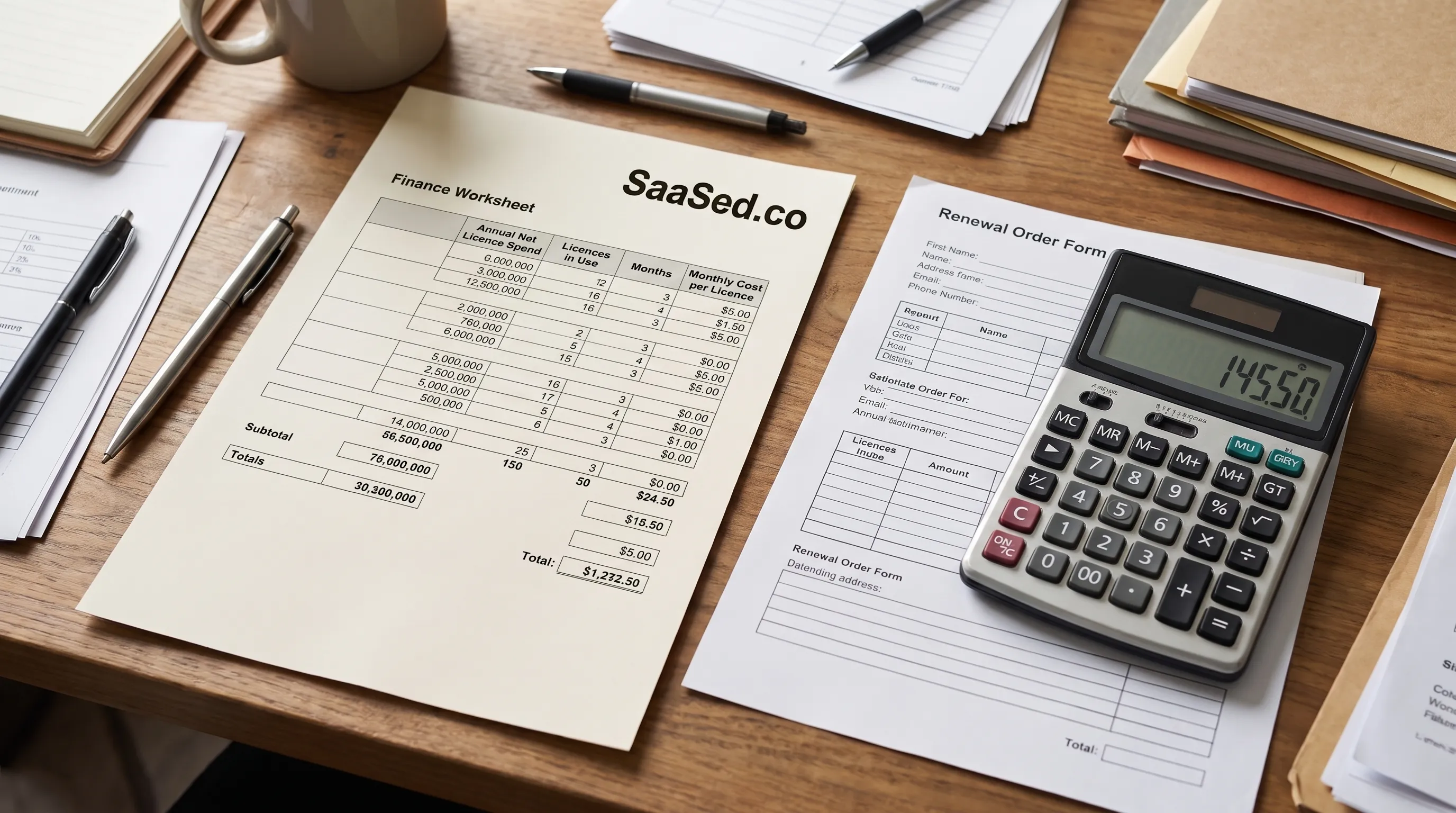
To answer “how much should I pay for Salesforce”, divide annual net licence spend by licences in use, then divide by 12. Calculate this for a comparable product or user group, not by pooling unrelated charges. This exposes the effect of paying for seats that contribute nothing.
The calculation is: annual net spend ÷ licences in use ÷ 12. For illustration, €120,000 a year for 100 purchased licences looks like €100 per user per month. If only 80 are in use, the effective monthly price is €125. These are illustrative figures, not a Salesforce pricing benchmark.
Define “in use” with the Salesforce owner. Login frequency is a signal, not proof of business value: some legitimate roles use Salesforce intermittently. Keep non-seat charges separate and measure usage over a period that captures the work those roles perform.
Your budget should show both the invoiced unit price and the effective price.
How do I know if I am overpaying?
You may be overpaying if committed scope exceeds useful access, even when the headline discount looks strong. Check seats assigned to people who rarely log in, premium licences given to users who need basic functionality and bundled products that have never been implemented. Each needs investigation, not an automatic cancellation.
In SaaSed’s conversations with buyers, about 8 in 10 companies we speak to are overpaying, more often in scope than in list price. That is SaaSed’s own observation, not a market statistic.
Review mid-term add-ons for duplicated functionality and lower discounts than the original deal. Dioro, our own Salesforce analytics tool, gives you a SKU audit and usage insight.
Decide what you should pay for Salesforce after testing the scope, not before.
How do I benchmark my Salesforce price?
Use list price as a reference ceiling for the same product, then compare effective price per licence in use across editions and successive renewals. Ask for independent benchmark data that matches your transaction. A lower quoted unit price is not a useful comparison if the scope or commitment is different.
A Salesforce pricing benchmark should compare currency, term, licence volume, included functionality and whether the deal is new business or renewal. Keep currencies consistent: do not compare a euro list price with a sterling net price without a stated exchange rate.
Ask what evidence supports any claimed comparable. Is the edition current? Does the rate include products you would otherwise buy separately? Does it require a volume or term you cannot justify? If the context is missing, the benchmark cannot tell you whether your own proposal is reasonable.
The answer to “how much should I pay for Salesforce” needs comparable scope and terms, not an unsupported discount range.
What should I do before my next renewal?
Start preparing 12 to 18 months before your contract ends, not when the renewal quote arrives. Confirm the date, rebuild the licence baseline and agree the number you can authorise. Salesforce’s renewal FAQ says the window for renewal changes opens 90 days before the contract end date.
Establish when your Salesforce renewal actually starts so your budget review begins ahead of the transaction window. If the date is unclear, our guide to how to find your Salesforce renewal date helps you check the paperwork.
Bring the Salesforce owner’s role-by-role requirements into your budget review. Ask procurement to separate the renewal baseline from proposed additions, then price each change explicitly. Agree internally which scope you can remove, which terms matter and who can authorise the final commitment.
Decide what you should pay for Salesforce before the renewal window starts dictating your decisions.
Frequently asked questions
These answers distinguish what you can negotiate from what your existing commitment may require.
Is Salesforce pricing negotiable? Yes. You can negotiate commercial terms, but no particular concession is guaranteed; the outcome depends on the deal and the contract.
Are Salesforce list prices what enterprise customers pay? No. They are published reference points, not proof of your net rate; what you pay depends on the deal and the contract.
Do I pay for Salesforce licences I do not use? Yes. Unused licences may remain payable if they are part of your committed quantity; whether you can reduce that quantity depends on the deal and the contract.
Can I reduce what I pay before my renewal? Yes. You can seek changes before renewal, but a mid-term reduction is not automatic; what Salesforce agrees to change depends on the deal and the contract.
SaaSed is a specialist Salesforce procurement and commercial advisory company. We work with enterprise buyers on Salesforce renewals, contract negotiation, licensing decisions, commercial strategy and cost optimisation — with the aim of improving commercial control and removing cost that serves no purpose. For an overview of how we support renewals, see Salesforce procurement advisory.
Check your timing with a 3-minute readiness assessment: Find your renewal window.
Want this kind of intel on your renewal?
Don’t head into your next software negotiation alone
Contact Us