Salesforce Fiscal Year: Why 31 January Decides Your Price
January pressure can create room for a better Salesforce agreement, but only if your side is ready. Separate the seller's deadline from your contract dates and prepare the evidence your finance decision needs.

The Salesforce fiscal year end is 31 January, a reporting deadline that can affect the offers available to you without changing your contract end date. For your budget, the useful question is whether you can use that deadline without accepting an unnecessary commitment or rushing an approval.
When does Salesforce's fiscal year end?
Salesforce's fiscal year ends on 31 January, and its final quarter covers November, December, and January. Salesforce's annual report (Form 10-K) confirms the year-end date. This is Salesforce's financial reporting calendar, not a universal renewal date for customers.
That distinction matters when an account team asks you to complete an agreement before January closes. The request may reflect its reporting timetable rather than anything required by your existing agreement. You need to establish which deadline belongs to whom before treating either as urgent.
Keep the seller's reporting deadline separate from your contractual obligations and internal approval timetable. They may overlap, but one does not establish the others.
For your budget, the Salesforce fiscal year end is therefore a commercial window to assess, not a contractual deadline to adopt. Its value depends on what you need to buy, what you can approve and how much time you have left.
Why does 31 January matter to the price I pay?
31 January matters because pressure to complete business before Salesforce's year-end can make discounts available that are not available at other times. That does not mean a particular discount is available to you, or that an offer made in January is necessarily better than one made earlier.
The account team may have a stronger reason to seek approval for a concession when a prepared buyer can reach an agreement before the reporting deadline. Your ability to make a credible decision matters here. An unresolved licence requirement or an unavailable approver can prevent you from using that opportunity.
As CFO, assess the whole commitment rather than the discount alone. A lower quoted rate does not establish better value if the proposal also adds products, increases quantities or extends your obligations beyond what the business needs.
The Salesforce fiscal year end can change the seller's willingness to negotiate, but it cannot tell you whether the agreement is sound. Compare the proposed scope, term and total committed spend against your approved requirement before judging the offer.
Does the fiscal year change my contract end date?
No, Salesforce's fiscal year does not change your contract end date; that date comes from your order forms. The dates can coincide, but usually do not. Check the signed documents and applicable terms for the end date, any notice deadline and the provisions governing renewal.
An account team's request for a January signature is not evidence that your current agreement expires then. Nor does a proposed early renewal simply bring the same purchase forward without consequences. It can reset the term, so the proposed start and end dates need explicit review.
Ask how the new agreement would interact with the remaining commitment under the existing one. Establish what changes when you sign, what changes when the new term starts and which obligations remain. Do not assume those events happen together.
This is why contract review should start months before renewal: finance needs an accurate contractual timeline before assessing a commercial proposal. Treat the Salesforce fiscal year end as a separate date on that timeline, not a substitute for the dates in your agreement.
What changes on the Salesforce side as the year-end gets close?
Sales teams are working against their targets and deal desk is under pressure as Salesforce's year-end approaches. Requests for commercial exceptions can become more urgent, and discounts can be available. Neither the account team's urgency nor its willingness to seek approval guarantees that an offer will be approved.
Deal desk is part of the internal process for reviewing commercial exceptions. An account team discussing a possible concession is not the same as having an approved proposal ready for your signature. Keep that distinction clear in your own approval papers.
Ask which elements of the proposal are approved, which remain subject to review and whether any stated expiry applies to the written offer. A verbal indication should not become the basis of your budget decision.
The Salesforce fiscal year end also creates a practical availability problem. Your finance, legal and procurement reviewers may not be free when revised documents arrive. Agree review dates and cover before the final weeks, rather than assuming internal approvals can be compressed because the seller wants a signature.
Should I time my renewal to land before 31 January?
You should use a pre-31 January window only when it supports the right agreement and your business is ready to decide. Do not move a renewal simply to meet Salesforce's reporting deadline. An early renewal can reset the term, and any benefit must be assessed alongside the resulting commitment.
Start with the contract end date and work backwards. The ideal preparation window is 12 to 18 months before that date, especially for a large agreement such as a SELA that bundles many products. That gives you time to establish requirements and examine the agreement before discussing an early signature.
Starting 8 to 12 months ahead is a very good window. Below 8 months, leverage shrinks with every month as the time available to resolve scope, contractual questions and approvals reduces.
Understanding when your Salesforce renewal actually starts helps you judge whether January is a usable opportunity or merely a deadline appearing late in the process.
The Salesforce fiscal year end should be an option within your plan, not the plan itself. If an early proposal changes the term, compare the remaining existing commitment with the proposed new commitment before authorising it. A decision not to accelerate can be the correct financial decision.
What should I have ready before the year-end window opens?
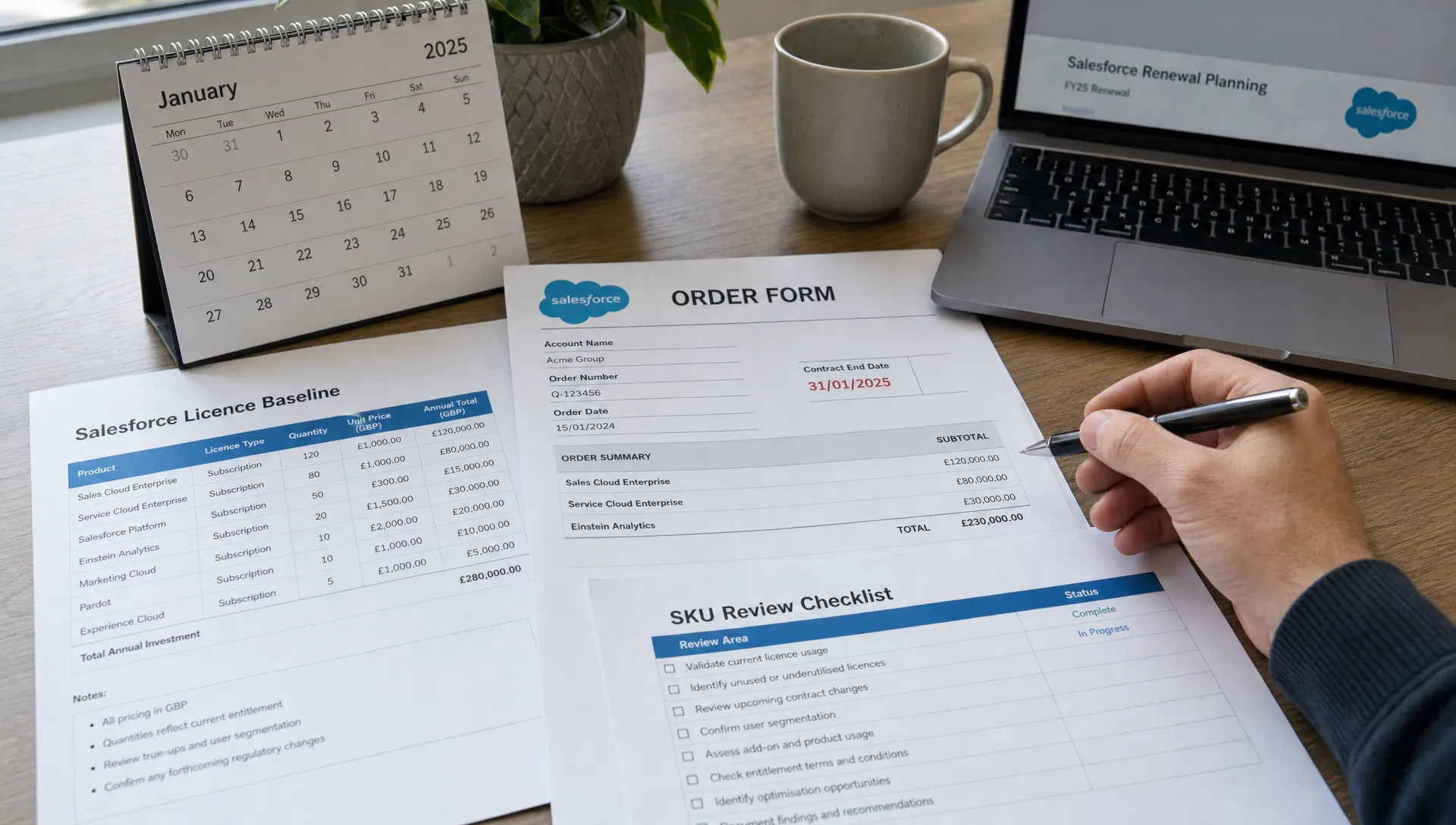
You need a verified licence baseline, a SKU audit, a clear approval process and confirmed decision-maker availability before the year-end window opens. These let you evaluate an offer against an agreed requirement rather than discovering what the business needs while the seller is asking for a signature.
The licence baseline should distinguish what you have contracted, what is allocated and what is being used. Those are different measures. An unallocated licence is a review item, not proof that your contract lets you remove it immediately.
The SKU audit should reconcile the order forms with the products the business intends to retain. Where a SELA bundles products, establish the requirement within the bundle rather than treating the headline commitment as sufficient evidence.
To see which licences go unused before you enter that window, Dioro, our own Salesforce analytics tool, gives you a SKU audit and usage insight.
| Preparation item | What you need to establish |
|---|---|
| Licence baseline | Contracted quantities, allocation and evidence of use |
| SKU audit | Which products are required and where scope remains unresolved |
| Contract timeline | End dates, applicable notice provisions and proposed changes |
| Approval plan | Who can approve scope, spend and contractual changes |
Who needs to be available for the Salesforce fiscal year end?
Your finance approver, procurement lead, legal reviewer and Salesforce owner need agreed decision dates and named cover before the final weeks of January. You do not need every reviewer in every discussion, but you do need clarity about who can resolve each outstanding issue.
As CFO, ask for a concise decision paper showing the current commitment, the proposed commitment, changes to scope or term and unresolved conditions. If a critical approval is unavailable, do not present an accelerated signature as a credible option until that gap is resolved.
Frequently asked questions
The reporting calendar does not override your contract or guarantee a better offer.
Is Salesforce's fiscal year the same as the calendar year? No, Salesforce's fiscal year runs from February to January, whereas the calendar year runs from January to December. Its reporting deadline is therefore separate from a December calendar year-end.
Does every Salesforce renewal fall on 31 January? No, your renewal date follows your order forms, not Salesforce's reporting calendar. Check the signed documents rather than inferring your deadline from an account team's request to close in January.
Will I always get a better price near the year-end? No, it depends on the deal and the contract, and no outcome is guaranteed. Preparation matters more than the date because you need an agreed requirement and the ability to evaluate the complete proposal, not just its headline discount.
Can I sign early just to hit the year-end? Whether you can or should sign early depends on the deal and the contract, and no outcome is guaranteed. Preparation matters more than the Salesforce fiscal year end: review any reset term and the effect on your existing commitment before approving an early renewal.
SaaSed is a specialist Salesforce procurement and commercial advisory company. We work with enterprise buyers on Salesforce renewals, contract negotiation, licensing decisions, commercial strategy and cost optimisation — with the aim of improving commercial control and removing cost that serves no purpose. For an overview of how we support renewals, see Salesforce procurement advisory.
Check your timing with a 3-minute readiness assessment: Find your renewal window.
Want this kind of intel on your renewal?
Don’t head into your next software negotiation alone
Contact Us