Who Signs Off Your Salesforce Deal, and Why It Is Not Your AE
Your account executive carries the request, but may not control the approval. Map both sides of the deal, make exceptions easy to assess and give the CFO a full-term commitment rather than a headline discount.

Persona: Head of Procurement
Target query: Who approves a Salesforce deal
Meta title: Who Signs Off Your Salesforce Deal? Not Your AE
The person discussing your Salesforce contracts is not necessarily the person approving the exceptions within them. Your account executive (AE) manages the sales conversation and takes requests through internal approvals. Before you negotiate, establish what needs approval inside Salesforce and who can authorise the resulting commitment on your side.
Who actually approves your Salesforce deal?
Your AE is the route into the approval process, not the final authority for every proposed concession. Deal desk helps assess commercial structure and exceptions. Sales management and other functions may also need to approve a request, according to its terms and the authority delegated internally.
There is no single approval ladder you should assume applies to every transaction. A price exception, an unusual payment schedule and a change to contractual liability raise different questions. Legal may need to review contractual departures; finance may need to assess financial terms. Deal desk can help coordinate that process without being the sole decision maker.
Ask your AE which parts of the proposal are already approved, which need an exception and which functions must review them. You do not need confidential approval thresholds or direct access to every approver. You need a reliable route, a clear request and an honest status.
That approval route belongs within the wider Salesforce contract negotiation process, rather than becoming a last-minute explanation for a stalled signature.
What does “this is the best deal I can do” actually mean?
For Salesforce contracts, treat that statement as information about the AE’s current authority or approved position, not proof that every possible exception has been exhausted. It may describe the offer they can issue now. It does not, by itself, tell you what has been submitted for further approval.
The useful response is not to accuse the AE of withholding something. Ask: “Is this the best approved position on the current structure, or has our specific alternative been reviewed and declined?”
Those are different outcomes. An unsubmitted request needs a clear rationale. A declined request needs an explanation of the constraint, so you can decide whether changing the scope, term or payment structure would help.
Further escalation does not guarantee a better offer. Nor does a more senior conversation automatically reopen a settled decision. Your aim is to establish whether there is a workable approval path, not to keep asking for another person until someone agrees.
How should you package an exception for Salesforce contracts?
Give the AE a proposal they can carry through approvals without reconstructing your business case. State the scope, the requested change, the reason for it and what your organisation can genuinely commit to in return. Keep confirmed requirements separate from possible future demand that nobody has yet approved.
For example, establish the licence baseline before discussing an expanded order. If your Salesforce owner has validated the required Sales Cloud Enterprise seats, identify that quantity and distinguish it from any proposed growth. A larger commitment should not become the default simply because it makes the commercial proposal easier to approve.
A useful submission might say: “Our approved scope is the attached licence baseline. We are requesting the revised payment schedule shown, with no change to the subscription quantity. Our internal decision can follow once finance confirms that schedule.”
That gives the internal reviewers something concrete to assess. It is stronger than “procurement needs a better deal”, which leaves the AE to guess what would secure agreement.
Avoid changing several conditions after each revised offer. Where your requirements do change, identify what changed and why. Otherwise, both sides can end up approving different versions of the same proposal.
Who is the hidden decision maker on your side?
The hidden decision maker is someone whose approval is necessary but whose requirements have not entered the negotiation. In Salesforce contracts, that can be the person controlling budget, accepting contractual risk or confirming that the purchased licences meet operational needs. Finding them after the offer is approved creates avoidable rework.
Before the first pricing conversation, separate four responsibilities: validating demand, approving expenditure, accepting legal risk and signing the agreement. One person may hold several responsibilities, but a job title alone does not establish authority. Your internal delegation rules and the size and nature of the commitment determine the route.
Ask each decision maker what would prevent approval. A budget owner might accept the annual charge but reject the payment timing. The Salesforce owner might support the licence count but reject an assumed product substitution. Legal might need a specific contractual issue resolved before signature.
Module 1 of our Salesforce renewals crash course covers “The Hidden Decision Maker” as part of a free crash course that requires registration.
Be explicit about when finance and IT both need to sign off. A proposal is not internally agreed merely because procurement and the budget holder like the headline figure.
What number does the CFO need before approving the deal?
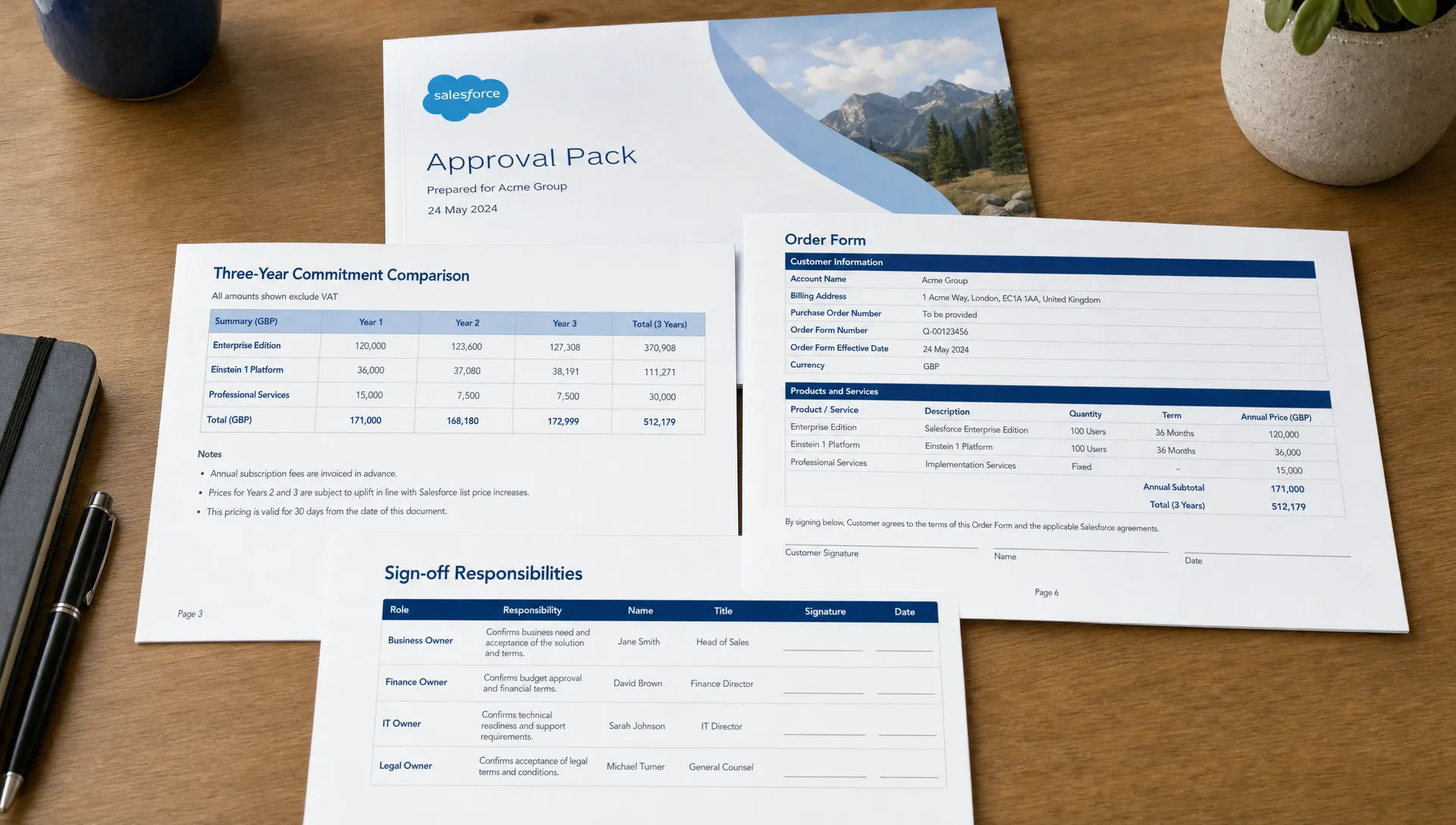
Give the CFO the total contractual commitment, the payment schedule and a like-for-like comparison with the alternative. Include any binding increases or additional purchases in that commitment. A first-year saving is not enough if later years reverse it, and an annualised figure can conceal when cash actually leaves the business.
When presenting Salesforce contracts, distinguish subscription charges, payment dates and assumptions about future purchases. Show what is binding, rather than allowing a sales illustration or an unapproved growth forecast to become the financial baseline.
Consider this illustrative three-year comparison. These are invented figures for explanation, not Salesforce benchmarks. Assume identical scope and exclude VAT and additional services.
| Contract year | Comparison baseline | Proposed commitment |
|---|---|---|
| Year 1 | £120,000 | £110,000 |
| Year 2 | £120,000 | £125,000 |
| Year 3 | £120,000 | £140,000 |
| Full-term total | £360,000 | £375,000 |
The proposal reduces the first-year charge by £10,000 but increases the full-term commitment by £15,000. Neither number tells you the payment dates, which still need to be shown separately.
The approval note should explain that difference plainly. It should also identify any unresolved terms and the consequence of declining the proposal. Do not present a planning assumption about the next renewal as an agreed renewal price.
A CFO should be able to approve a defined commitment with stated conditions, not infer the commitment from a discount percentage.
What should you check before the first pricing conversation?
Before discussing price, confirm the buying scope, your approval route and the conditions under which you can sign. For Salesforce contracts, this gives the AE a credible request to take forward and prevents your own team from reopening settled points after the commercial terms have been reviewed internally.
Use this short checklist:
- Confirm the current order forms, subscription end dates and applicable notice requirements.
- Validate the licence baseline with the Salesforce owner, separating required seats from possible growth.
- Identify who approves expenditure, accepts legal risk and has signing authority.
- Ask each approver to state their non-negotiable conditions.
- Agree the full-term commitment and payment information finance needs.
- Ask the AE which requested terms require internal approval.
- Name one person to control proposal versions and consolidate your responses.
You do not need every answer before speaking to the AE. You do need to know which answers are missing, who owns them and whether they could change the request.
What proves that an approved offer is ready to sign?
A verbal assurance that a deal is approved is not enough to release your own signature. Check that the final order form and agreed contractual documents reflect the approved scope, charges, dates and exceptions. Then confirm that the same version has completed your internal commercial, financial and legal approval process.
Check the governing documents against the version of the Salesforce subscription terms incorporated into your agreement. The public documentation is a reference point, not a substitute for identifying the terms that actually govern your purchase.
Pay particular attention to concessions discussed in correspondence. If a concession matters to your decision, have the appropriate reviewer confirm where and how it is documented. Do not assume it survives unchanged into the final order form.
Some Salesforce agreements deserve a harder commercial and legal review, particularly where the commitment or flexibility is difficult to understand. An internal Salesforce approval does not replace that review on your side.
The final handover should therefore identify the approved document version, any remaining conditions and the authorised signatory. Procurement should not have to reconstruct these details from an email chain when a signature request arrives.
What else should you know about deal approval?
The remaining questions concern authority, access and timing. Keep those separate: knowing that an offer has internal approval does not establish your own authority to sign, and knowing who reviews an exception does not mean you need a direct meeting with them. The practical test is whether the requested terms are approved and documented.
Can the AE approve anything themselves? They may have delegated authority within established parameters. Do not assume that authority extends to your requested exception. Ask what is approved now and what still needs review.
Should procurement insist on speaking directly to deal desk? Not as a default. Start by giving the AE a complete request and asking for its approval status. Direct discussion may help resolve a specific issue, but access alone does not secure a concession.
Does approval mean every term is settled? No. For Salesforce contracts, confirm which scope and conditions the approval covers. A changed licence quantity, payment schedule or contractual exception may require further review before the offer can be issued or signed.
Want this kind of intel on your renewal?
Don’t head into your next software negotiation alone
Contact Us