How You Should Negotiate a Salesforce Renewal
Your renewal position is built before the first quote arrives. Use a CFO-led sequence to verify usage, align contract dates and secure written protections, then negotiate the discount on a quantity your business can justify.
How You Should Negotiate a Salesforce Renewal
Knowing how to negotiate a Salesforce renewal starts with preparation, sequence and timing, because most of the outcome is decided before your first price conversation. For your budget, the discount is the last step, not the first.
How do I negotiate a Salesforce renewal?
Treat your renewal as a renegotiation of structure before price: establish what you need, when you can change it and which protections must survive into the next term. As CFO, your task is to agree an evidenced commitment, then negotiate the unit rate on that commitment.
- Audit what you actually use, by product and edition.
- Establish the real contract dates and decide on a master end date.
- Take apart each bundle and decide what you will not renew.
- Settle the protections you need in the order form.
- Take the quote and negotiate the discount last, on the quantity you can evidence.
The order matters because each step changes what the next one is worth: a lower rate cannot fix the wrong quantity, product mix or contractual commitment.
How does a Salesforce renewal work?
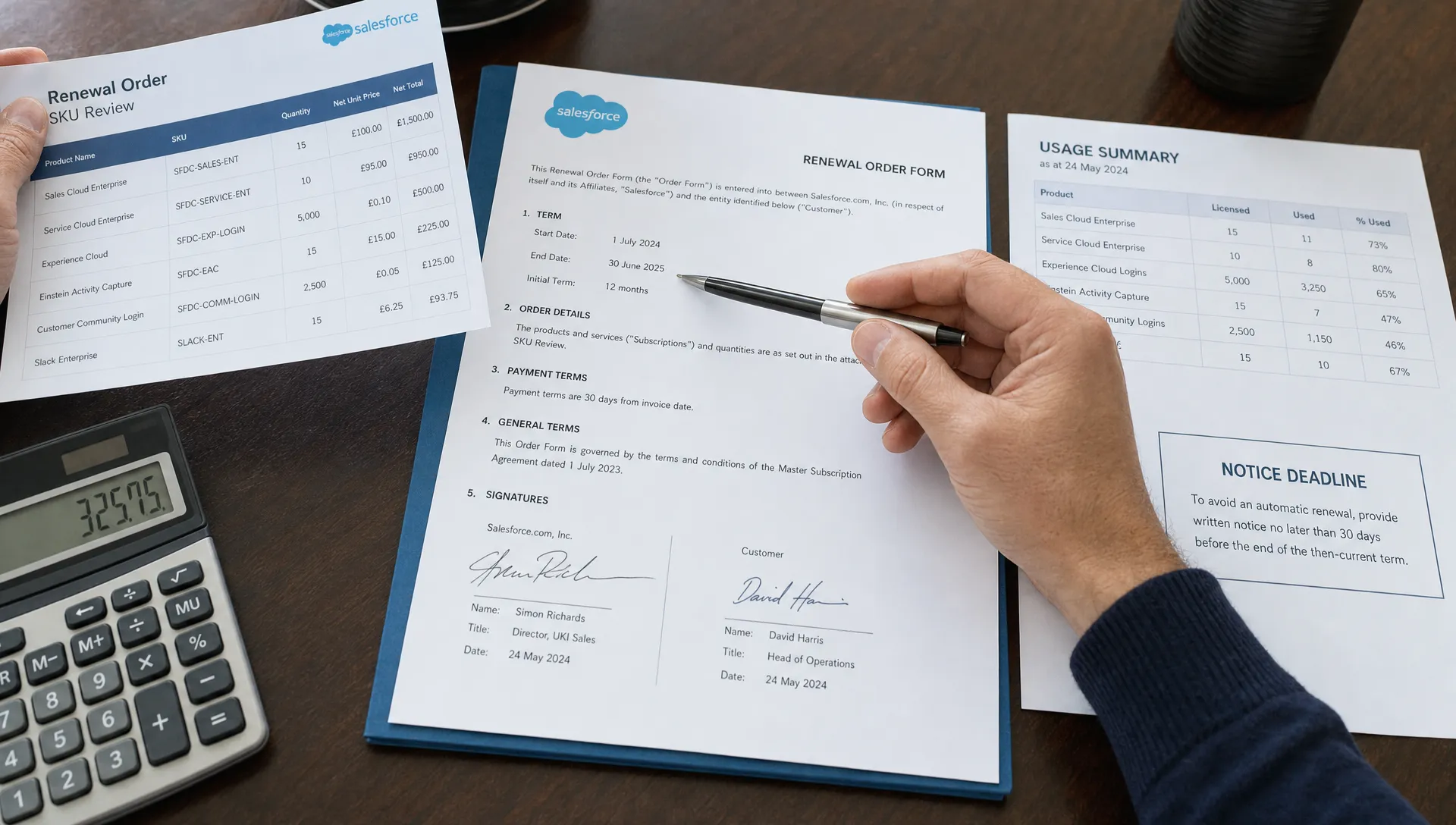
To understand how to negotiate a Salesforce renewal, establish whether your contract auto-renews or needs manual renewal. Salesforce's own renewal FAQ describes a change window opening 90 days before contract end for product additions or removals, term adjustments or non-renewal. Your signed documents determine the deadlines you must meet.
Requests after the relevant cut-off may be too late. Salesforce says the standard renewal term is 12 months and shorter terms need special approval. Check your notice requirements rather than assuming an account conversation preserves your rights.
Choose a master end date across products. Aligning them keeps the estate negotiable as a package; off-cycle renewals split your leverage. Every mid-term addition is a chance to move an end date deliberately.
Start from the lowest edition that meets your actual needs. Check whether a product requires add-ons you did not independently choose, then decide what to remove, downgrade or carve out before discussing its price.
The renewal should reset the commitment, not merely extend it.
When should I start negotiating?
In SaaSed's view, start preparation 12 to 18 months before your contract ends. An 8 to 12 month window is still useful, but leverage shrinks every month after that. This is preparation time, not a recommendation to accept an early renewal or bring forward your commitment.
If you are deciding how to negotiate a Salesforce renewal across several products, allow time for a separate usage review of each. That is why when your Salesforce renewal actually starts is earlier than the account team's price conversation.
Separate preparation from signature. An early renewal proposal needs its own comparison of dates, remaining commitments and protections. Starting early gives you time to challenge the proposal; it does not oblige you to accept it.
Start while you still have time to change what you buy.
What leverage do I have?
Your leverage comes from usage evidence, a credible internal roadmap, timing and an aligned internal position. You do not need to threaten to leave. A costed alternative helps only where it is operationally realistic and accounts for migration work, disruption and overlapping commitments.
Here is an illustrative example of how to negotiate a Salesforce renewal using evidenced quantities, not a benchmark. 500 licences at £120 per user per month cost £720,000 a year. A 10 percent cut on all 500 gives £648,000. Proving 75 are inactive and renewing 425 at a 5 percent cut, £114 per user per month, gives £581,400. This assumes your contract permits quantity reductions without repricing remaining units: check that and put the reduction right in the order form.
Salesforce's fiscal year ends on 31 January. Understanding why 31 January decides your price helps you assess timing pressure, but quarter-end or year-end never guarantees a discount. That pressure may influence the rate without changing the deal structure you need.
Gartner publishes research relevant to these discussions, including Gartner research on negotiating Salesforce renewals.
Evidence gives your request substance; timing alone does not make it achievable.
Who am I actually negotiating with?
You negotiate with the account team, but exceptions can require internal approval, including Deal Desk; an account executive has limited discretion. In practice, how to negotiate a Salesforce renewal depends partly on giving that team an evidenced business justification they can take upwards, rather than expecting them to authorise everything.
Keep one point of contact for commercial communications because Salesforce can speak to stakeholders in parallel. Align your budget and acceptable terms internally, then understand who inside Salesforce approves your deal.
If you hear “standard uplift”, ask where it is written. If a price is “only valid until quarter end”, distinguish the actual quarter-end date from the quote expiry: the former is a fact, while the latter can be a negotiating technique.
If reducing seats triggers a repricing warning, ask for the contractual basis and a written reduction right. If a new product is offered on a co-termed basis, ask which date applies and which rate is held.
Give the account team a case they can take for approval.
What should I negotiate besides the discount?
Negotiate the commitment and its protections: product scope, quantities, renewal dates, reduction rights, price holds and consumption limits. A multi-year term can improve the unit price but reduce flexibility; spend is hard to reduce during a term. Settle quantity and protections before deciding its length.
Ask for line-by-line pricing before accepting a bundle. A headline discount on one product can fund an increase on another, so compare price per unit rather than the bundle total.
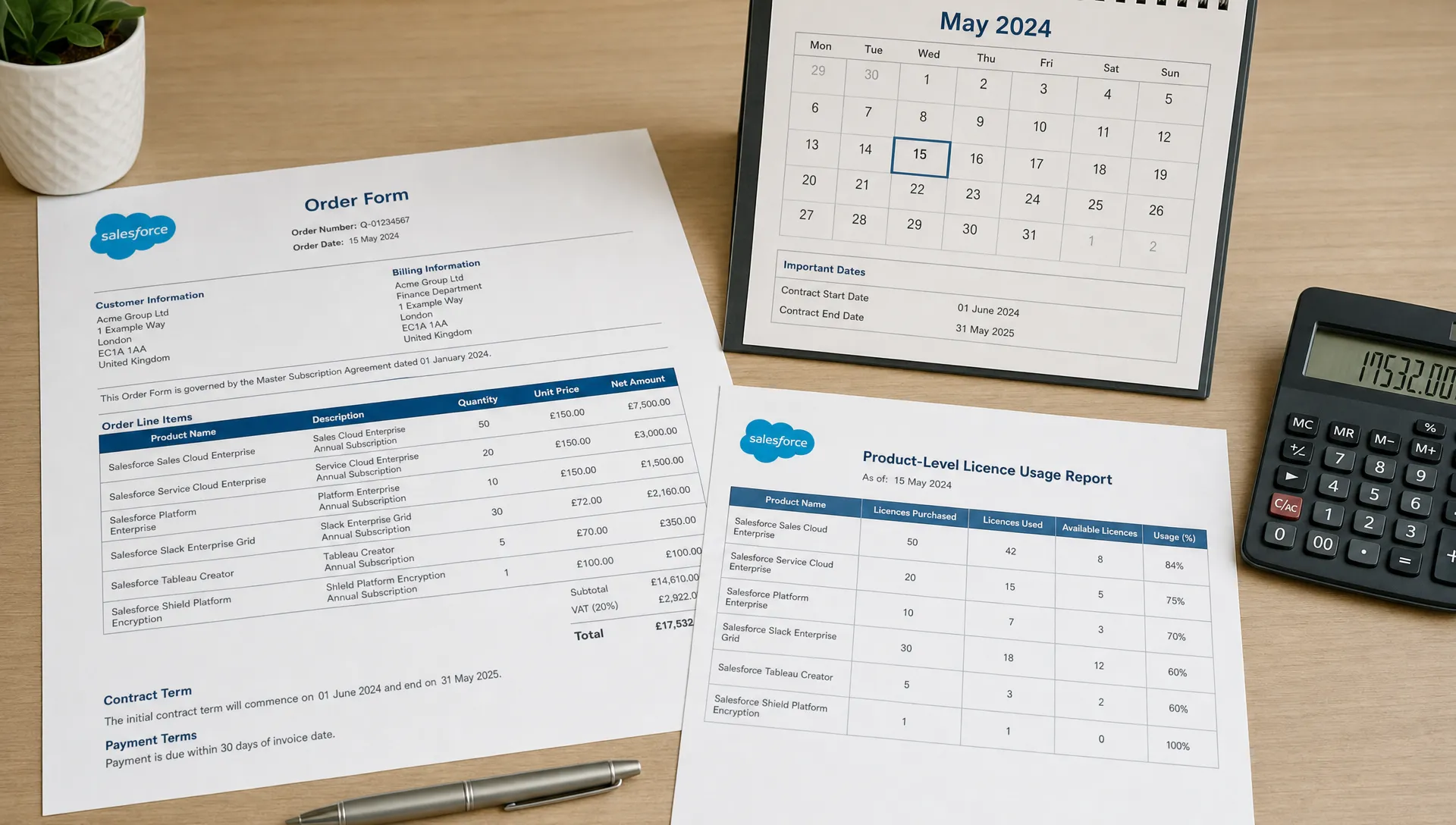
Treat a negotiated price protection, cap, reduction right or price hold as secured only when it is written into the order form. Email, slides and verbal assurances are not substitutes; check your own documents.
For consumption lines, buy against real usage rather than forecast alone, with a written cap and overage rate. Treat proposed Agentforce or Data Cloud additions as separate commercial decisions. Distinguish what is licensed and available today from anything promised or undated.
The written commitment matters more than the headline percentage.
What should I have ready before the first conversation?
Bring a reconciled licence baseline, the signed contract timeline, unbundled pricing, consumption evidence and the protections you need in writing. As CFO, you need a proposed annual commitment and its assumptions, not simply a savings target. Agree those internally before asking Salesforce for a revised quote.
Compare licence totals and used licences in Company Information, then use a last-login user report and Login History to distinguish people from integrations and shared logins. Inactivity alone does not prove a licence is removable. For metered products, use the consumption usage view.
Confirm how to find your Salesforce renewal date against signed documents. Dioro, our own Salesforce analytics tool, gives you a SKU audit and usage insight.
Evidence for how to negotiate a Salesforce renewal
| Preparation item | What you need to establish |
|---|---|
| Licence baseline | Assigned against active, per product and edition |
| Contract timeline and master end date | Contract ends, notice deadlines and the proposed aligned end date |
| Bundle breakdown | Price per line, not the bundle total |
| Consumption and Agentforce position | Real usage against forecast, caps and overage rates |
| Protections to be written into the order form | Agreed price protections, caps, reduction rights and price holds |
Your baseline should explain both the budget request and its contractual assumptions.
Frequently asked questions
These answers clarify how to negotiate a Salesforce renewal without assuming every contract works alike.
Can I negotiate if my contract is on auto-renew? Yes, provided the applicable notice and change deadlines still permit it; the answer depends on the deal and the contract.
Is the first renewal quote Salesforce's best offer? No, you should not assume it is final; what can change depends on the deal and the contract.
Should I sign a multi-year deal for a better discount? No, not for the discount alone: settle quantity and protections first; the answer depends on the deal and the contract.
Should I negotiate the quantity or the discount first? Yes, negotiate quantity first rather than discount, then price that evidenced baseline; the answer depends on the deal and the contract.
SaaSed is a specialist Salesforce procurement and commercial advisory company. We work with enterprise buyers on Salesforce renewals, contract negotiation, licensing decisions, commercial strategy and cost optimisation — with the aim of improving commercial control and removing cost that serves no purpose. For an overview of how we support renewals, see Salesforce procurement advisory.
Check your timing with a 3-minute readiness assessment: Find your renewal window.
Want this kind of intel on your renewal?
Don’t head into your next software negotiation alone
Contact Us