What a Salesforce Uplift Cap Actually Protects You From
A renewal cap can limit a price increase without limiting your total bill. See which contract lines it protects, where exclusions can reopen your budget and what to prepare before renewal talks.

What a Salesforce Uplift Cap Actually Protects You From
A Salesforce uplift cap is a negotiated limit on a specified renewal price increase, covering only the products, pricing basis and period defined in your contract. As CFO, your useful question is not just how low the cap is, but how much of your renewal budget it actually protects.
What is a Salesforce uplift cap in my contract?
A cap limits the increase Salesforce can apply to a defined price at a specified renewal, if your agreement provides that protection. It is not automatically a ceiling on your total invoice, and the protection may apply only where the renewal meets conditions written into the clause.
The protected number could be an agreed net unit price, rather than a discount against a list price that may change. You need the clause to identify the starting number and the calculation, not merely promise that renewal pricing will be “protected”.
Check the clause alongside the order form and any amendment. Understanding when your Salesforce renewal actually starts helps you complete that review before a renewal proposal has become your budget assumption.
The cap is only as useful as the price and renewal it actually covers.
What does an uplift cap actually protect me from?
It can protect you from an otherwise larger increase on the existing subscription lines covered by the clause. For budgeting, that gives you an upper limit on one component of the renewal, provided the relevant products, quantities and other contractual conditions remain within its scope.
Your Salesforce uplift cap does not tell you whether the underlying licence baseline is sensible. It tells you how one agreed price may move. A cap applied to unnecessary subscriptions can still leave you paying for spend you should have removed.
For example, renewing the same covered licence lines at the same quantities may give you a defensible maximum for their renewal charge. Keep that calculation separate from additional users, new products and any charges outside the cap, then reconcile both to the proposed invoice.
Use the cap to forecast covered prices, not to validate the whole purchase.
What does an uplift cap not protect me from?
An uplift cap does not necessarily protect you against changes in what you buy, how usage is charged or which products qualify for renewal protection. Your total commitment can rise even where the covered renewal increase stays within its limit. Each exclusion needs its own budget treatment.
Read your Salesforce uplift cap separately from any promise about future product scope. A replacement SKU may introduce a different commercial starting point, while an add-on may have its own pricing and renewal treatment.
| Situation | What to check in your contract |
|---|---|
| Renewal increase on existing lines | Which baseline and lines are covered, and which conditions can remove protection? |
| Edition changes or repackaged SKUs | If Enterprise or Unlimited maps to Core, Advanced or Max, does protection follow the replacement SKU? |
| Mid-term add-ons | Are add-on prices covered now, at co-termination or only at a later renewal? |
| Consumption products such as Agentforce Flex Credits | Does the cap cover the credit rate, and how are usage increases or overages charged? |
| A cap that covers one term only | Does protection expire after the next renewal, with later terms left open? |
Ask for a written comparison of the current order form and the proposed one, showing what stays protected, what changes and what falls outside the clause.
A capped increase on existing lines is not a capped future commitment.
Why does the uplift conversation land in Salesforce's fiscal Q4?
The conversation may land there because Salesforce's fiscal year ends on 31 January, making November to January its fiscal Q4. If your renewal decision overlaps that period, the timetable may become more compressed. That does not mean the cap itself has to be negotiated in Q4.
A Salesforce uplift cap needs its own approval timetable. Understanding why 31 January decides your price helps you distinguish Salesforce's selling calendar from yours. Quarter-end or year-end timing can help a negotiation, but it never guarantees a discount or improved contractual protection.
An early-renewal request deserves a separate comparison: what do you gain, what commitment moves forward and does the existing cap survive? Do not let price protection disappear into a discussion focused only on the signature date.
Use the fiscal calendar as context, not as a substitute for preparation.
Do I have an uplift cap in my current contract?
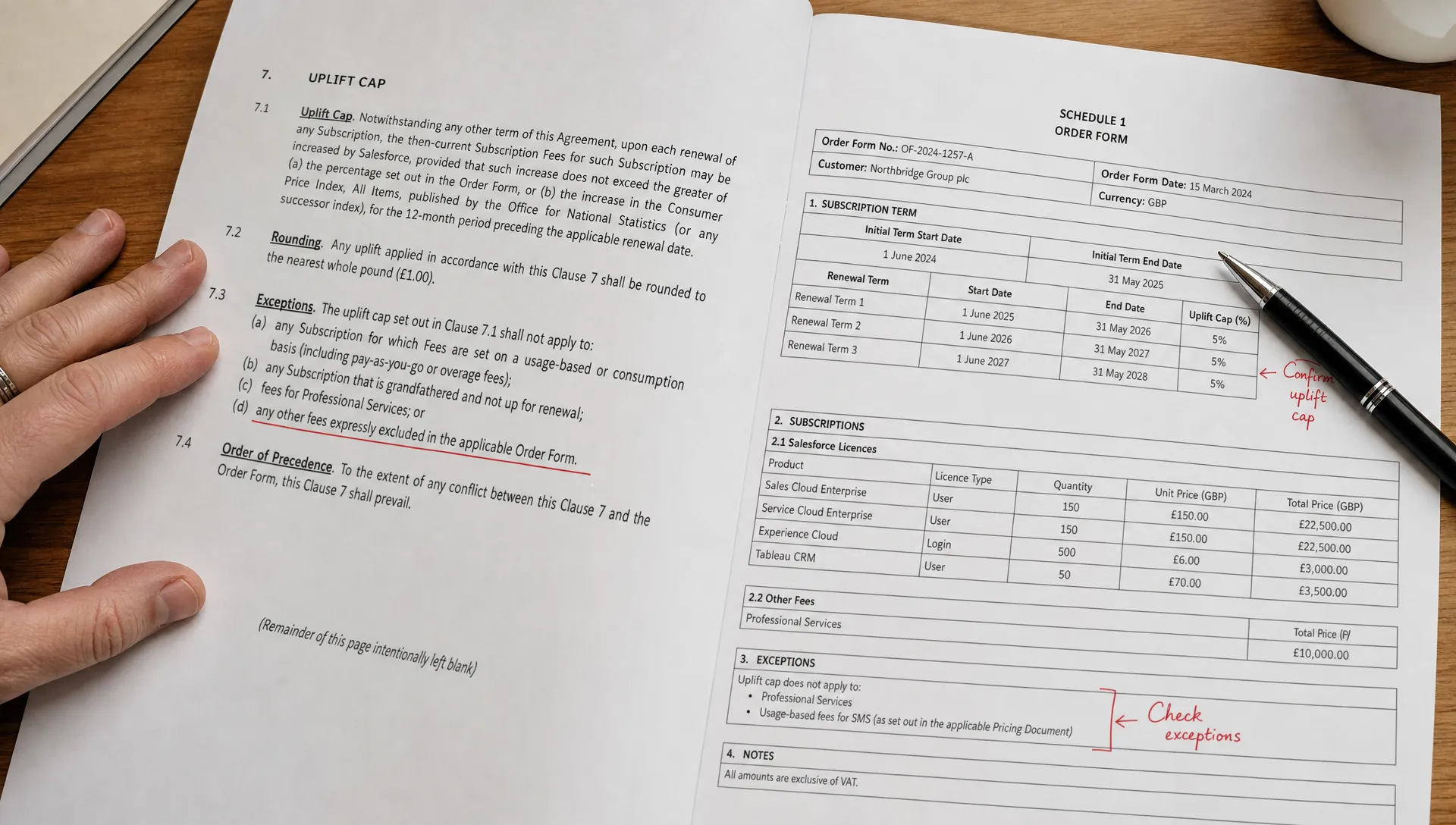
You have a cap only if the documents governing your purchase give you one. Find the wording, establish which order forms it covers and check whether later amendments alter it. Do not treat an account team's summary or a previous renewal outcome as proof of protection.
Start with how to find your Salesforce renewal date so the clause is tied to the right contract end date. Then check the renewal provision, any price-protection wording and the document-precedence clause, if there is one.
Salesforce publishes subscription terms on its legal agreements page; use your executed documents to establish which version governs your purchase. Record the covered lines, calculation basis, duration and conditions. Have your legal team resolve conflicting wording before finance relies on it.
Until those details are clear, keep the budget protection marked as unconfirmed.
How do I negotiate an uplift cap?
Negotiate the cap as a defined contractual outcome, not a verbal concession. Ask for the protected baseline, covered SKUs, duration and exceptions to be recorded together. For your budget, a lower headline limit is not automatically better than broader protection that survives the changes you expect.
Start by modelling your Salesforce renewal uplift against a consistent baseline. Then test quantity reductions, additional users and a replacement SKU. The agreed cap needs to remain intelligible in each scenario, even where a scenario is expressly outside its scope.
Understanding who inside Salesforce approves your deal helps you ask for the right approval, rather than repeatedly revising a number with someone who may not control the clause. Request the proposed wording with the commercial offer so finance and legal can assess them together.
Negotiate the scope and calculation with the number, not after agreeing it.
What should I have ready before the uplift conversation?
To assess your Salesforce uplift cap, have a reconciled contract baseline, a usage view and a documented approval timetable ready. Begin renewal preparation 12 to 18 months before the contract end date, so you can test protection against expected changes before a signature deadline narrows your choices. Give finance a range, not an unexplained total.
Your pack should connect current net prices and quantities to the renewal scenario, with exceptions separately valued. Dioro, our own Salesforce analytics tool, gives you a SKU audit and usage insight.
Show the protected like-for-like renewal, the spend outside protection and any proposed longer commitment. As CFO, ask what additional liability you accept for that protection, including spend you may no longer need if requirements change during the commitment.
Approve the cap against the full commitment, not against the renewal increase alone.
Frequently asked questions
These answers distinguish a Salesforce uplift cap from a complete budget guarantee; your signed wording remains decisive.
Does every Salesforce contract have an uplift cap? No. Treat protection as unconfirmed until you find applicable wording; its inclusion and scope depend on the deal and the contract.
Does an uplift cap stop Salesforce raising list prices? No. It may protect covered renewal prices without controlling published prices; the effect on your bill depends on the deal and the contract.
Can I negotiate a cap in the middle of a term? Yes. You can request an amendment, but Salesforce does not have to accept it; the outcome depends on the deal and the contract.
Is a cap worth trading for a longer commitment? Yes, if the protection outweighs the additional liability and covers what you expect to retain; that judgement depends on the deal and the contract.
SaaSed is a specialist Salesforce procurement and commercial advisory company. We work with enterprise buyers on Salesforce renewals, contract negotiation, licensing decisions, commercial strategy and cost optimisation — with the aim of improving commercial control and removing cost that serves no purpose. For an overview of how we support renewals, see Salesforce procurement advisory.
Check your timing with a 3-minute readiness assessment: Find your renewal window.
Want this kind of intel on your renewal?
Don’t head into your next software negotiation alone
Contact Us