When SaaS Advisory Adds Value Before a Major Renewal
Major Salesforce renewals are shaped long before the supplier proposal lands. Learn when outside advisory support helps finance, IT and procurement find waste, risk and negotiating room early.

A major renewal is rarely won in the final pricing call. By then, the supplier knows your deadline, your current footprint and often more about your buying history than your own internal team has had time to review. SaaS advisory adds value when it gives finance, IT and procurement a cleaner view of the deal before the negotiation becomes compressed.
For Salesforce, the stakes are usually high because the contract is not one line item. It may include multiple clouds, editions, add-ons, support terms, data products, sandbox capacity, integrations and user populations that have changed since the last agreement. The question is not only whether the discount is fair. The better question is whether the organisation is about to renew the right estate, on the right terms, with enough evidence to push back where needed.
Where SaaS advisory adds value before renewal talks
The work should start before the renewal proposal arrives. Once a supplier has framed the renewal around its preferred quantities, products and deadline, every later challenge becomes harder. If the contract is material, complex or politically sensitive, external help can give the internal team time and structure.
That does not mean every renewal needs a full outside review. It means the largest renewals should be treated differently from routine purchases. As covered in SaaSed’s guidance on software renewals that need attention earlier than you think, the risk often appears months before expiry, not in the final week.
It tests whether the baseline is true
Most renewal discussions begin with a baseline: current spend, current licences and current contract terms. The problem is that this baseline is often accepted too quickly. Teams may rely on an account team summary, last year’s purchase order or a spreadsheet that does not reconcile with actual usage.
The practical job of SaaS advisory is to challenge that baseline before it hardens into the supplier’s starting point. Are all SKUs still active? Are they mapped to real users or teams? Do contract quantities match the current operating model? Are there legacy products that nobody wants to defend, but nobody has removed?
A good baseline is not a procurement formality. It is the difference between negotiating from evidence and negotiating from memory.
It separates demand from habit
Enterprise software estates grow in layers. New teams come in, projects pause, integrations change and acquired licences remain in place long after the original case has moved on. Salesforce is especially exposed to this because it often touches sales, service, marketing, operations and analytics.
A renewal should not assume that today’s number of users is tomorrow’s requirement. Salesforce’s own documentation distinguishes between different user and feature licence types, which is why entitlement mapping matters more than a simple headcount. For reference, Salesforce explains licence categories in its Help guidance on available user licence types.
The value of the review is not to cut for the sake of cutting. It is to separate licences that support real work from licences that remain because renewal mechanics reward inertia.
| Signal before renewal | Why it matters | What to check |
|---|---|---|
| Several clouds or add-ons sit under one agreement | Bundled complexity can hide weak fit | Product ownership, usage and business case by SKU |
| User counts have grown faster than adoption | Spend may reflect provisioning rather than value | Login patterns, role fit and inactive users |
| The supplier is proposing a longer term | Extra years can reduce flexibility | Price protections, volume commitments and exit points |
| Internal owners disagree on need | The supplier may hear mixed messages | One internal position before commercial talks |
| The previous renewal was rushed | Old concessions or risks may have carried forward | Contract terms, amendments and uplift clauses |
What a good review should uncover
A useful SaaS advisory review should not produce a thick report that nobody uses. It should leave the buying team with a short list of facts, risks and choices. If it cannot help decision-makers act, it has missed the point.
For Salesforce, the useful findings tend to sit in three areas: contract structure, usage reality and negotiation room.
Commercial terms that quietly shape the outcome
Price per licence is visible. Contract terms are less visible, but often more important. Renewal caps, auto-renewal notice periods, co-terming rules, minimum commitments, support levels, payment timing and product substitution rights can all change the economics of the deal.
Some terms also affect future bargaining power. A three-year commitment may look tidy in this year’s budget, but if it locks the organisation into the wrong mix of products, the cost shows up later as inflexibility. This is why contract evidence should be reviewed alongside usage evidence, not after it.
For a deeper look at early warning signs in agreements, SaaSed’s article on contract analytics that reveal renewal risk early gives a useful frame.
Shelfware that looks harmless until it renews
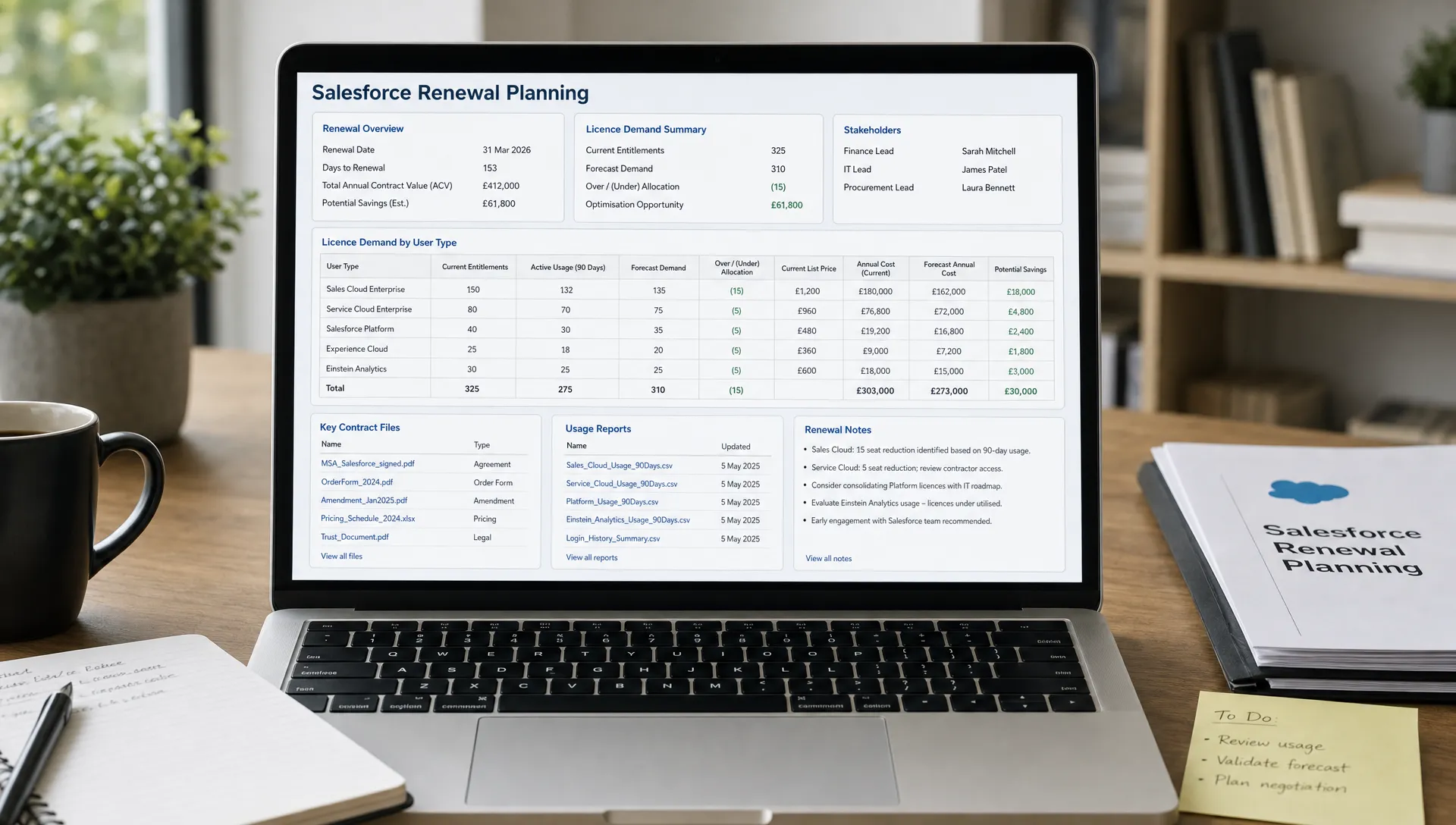
Unused licences are easy to ignore while they sit inside an existing contract. They become expensive when they renew for another term. The difficult part is proving what is truly unused, what is lightly used but necessary and what appears unused because the data is incomplete.
A disciplined review should look at inactivity, role mismatch, duplicate access, seasonal use and planned projects. It should also avoid crude assumptions. A user who logs in rarely may still need access for approvals or compliance. Another user who logs in daily may only need a lower tier.
Internal constraints that affect negotiation
The supplier is not the only source of pressure. Internal deadlines, budget cycles, board reporting, transformation programmes and audit concerns can all limit room to move. Good preparation makes these constraints visible early.
If a CIO needs continuity, procurement needs commercial options and finance needs cost certainty, the renewal strategy has to hold all three together. A review should show where the organisation can take a firm position and where it genuinely has limited room.
When outside advice is probably not needed
SaaS advisory is not a badge of maturity. Sometimes it is unnecessary. If the spend is low, the SKU set is simple, usage is clear and the renewal terms have already been reviewed by a capable internal team, external help may add cost without much benefit.
It is also a poor fit when the organisation only wants someone to chase a bigger discount in the final days. Late intervention can still find issues, but the best savings and risk reductions usually come from changing the shape of the renewal, not just pressing harder on price.
A sensible test is to ask whether the internal team already has four things: a reconciled contract baseline, reliable usage data, a clear view of future demand and a negotiation position agreed by finance, IT and procurement. If the answer is yes, outside support may not be needed. If one or more is missing, advisory work may pay for itself by avoiding a weak commitment.
How CFOs, CIOs and procurement should use the work
The best SaaS advisory work gives each owner better questions, not a script to follow. CFOs need to understand cost exposure and budget risk. CIOs need to protect continuity and architecture choices. Procurement needs a commercial position that can survive supplier pressure.
This is where the renewal becomes a buying decision, not an administrative event. SaaSed has written more on this in its piece on how to make your Salesforce renewal a better buying decision, which is often the more useful mindset for large agreements.
| Owner | What they need from the review | Decision it supports |
|---|---|---|
| CFO | Spend baseline, waste estimate and future cost scenarios | What budget should be approved and on what terms |
| CIO | Product fit, user need and technical dependencies | What must be protected for service continuity |
| IT lead | Licence mapping, access patterns and admin realities | What can be changed without operational disruption |
| Procurement lead | Commercial risks, negotiation levers and timing | How to run the renewal discussion with control |
The work should also produce a common language. If finance talks only about cost, IT talks only about continuity and procurement talks only about discount, the supplier can respond to each concern separately. A shared evidence base makes the internal position harder to split.
A practical timeline for a major Salesforce renewal
If SaaS advisory is brought in late, it can still help clarify the deal. But the stronger use is earlier, when the team can change assumptions before the supplier proposal becomes the anchor.
| Time before renewal | Useful work | Why it helps |
|---|---|---|
| 9 to 12 months | Gather contracts, amendments and order forms | Establish the true commercial baseline |
| 6 to 9 months | Review usage, shelfware and licence fit | Find waste before quantities are locked |
| 3 to 6 months | Agree future demand and negotiation priorities | Create one internal position |
| 1 to 3 months | Test supplier proposal against evidence | Push back with facts, not preference |
| Final month | Resolve open terms and approval risks | Avoid rushed concessions at signature |
The exact timeline depends on contract size and internal governance. A listed business with several Salesforce clouds may need more time than a smaller firm renewing a narrow Sales Cloud estate. The principle is simple: the more material the commitment, the earlier the commercial facts should be checked.
Questions to ask before bringing in advisory support
Before appointing anyone, ask what evidence they will need, what output they will provide and how they will work with your internal team. Vague advice is not enough for a large renewal. You need someone who can read the contract, understand the SKU structure and help the organisation decide what to do next.
Ask whether the review will cover usage, commercial terms and renewal risk together. Ask how confidentiality is handled. Ask what the team will need from Salesforce administrators, finance and procurement. Ask how findings will be translated into a negotiation plan that your own team can defend.
A good adviser should be comfortable saying where there is no issue. If every finding is presented as a crisis, the work will lose credibility quickly.
Frequently Asked Questions
What does SaaS advisory usually include before a renewal? It usually includes contract review, SKU and licence analysis, usage checks, commercial risk assessment and preparation for supplier negotiations. For Salesforce, it should connect contract evidence with real usage and future demand.
How early should a major Salesforce renewal be reviewed? For a large or complex Salesforce agreement, 6 to 12 months is sensible. That gives enough time to audit usage, agree internal priorities and challenge the supplier proposal before the deadline becomes the main source of pressure.
Is advisory support only useful if we want to reduce licences? No. Licence reduction is only one possible outcome. The review may also find that the organisation needs different products, cleaner terms, better price protection or a more defensible multi-year structure.
Who should own the renewal review internally? It should be shared by finance, IT and procurement. One team may coordinate the work, but a strong renewal position needs cost, operational and commercial evidence to be considered together.
Before your next Salesforce renewal
A major renewal deserves more than a last-minute price discussion. The strongest position comes from knowing what you own, what you use, what you need next and where the commercial risks sit.
If you would like an outside view before renewal talks begin, SaaSed offers a complimentary Salesforce audit conversation. It is a practical first step to understand where your current agreement may need closer attention before you commit again.
Want this kind of intel on your renewal?
Don’t head into your next software negotiation alone
Contact Us