Contract Analytics That Reveal Renewal Risk Early
Renewal risk usually builds long before the proposal arrives. This article shows how finance, IT and procurement teams can use contract evidence, usage data and clear ownership to spot Salesforce renewal problems early.
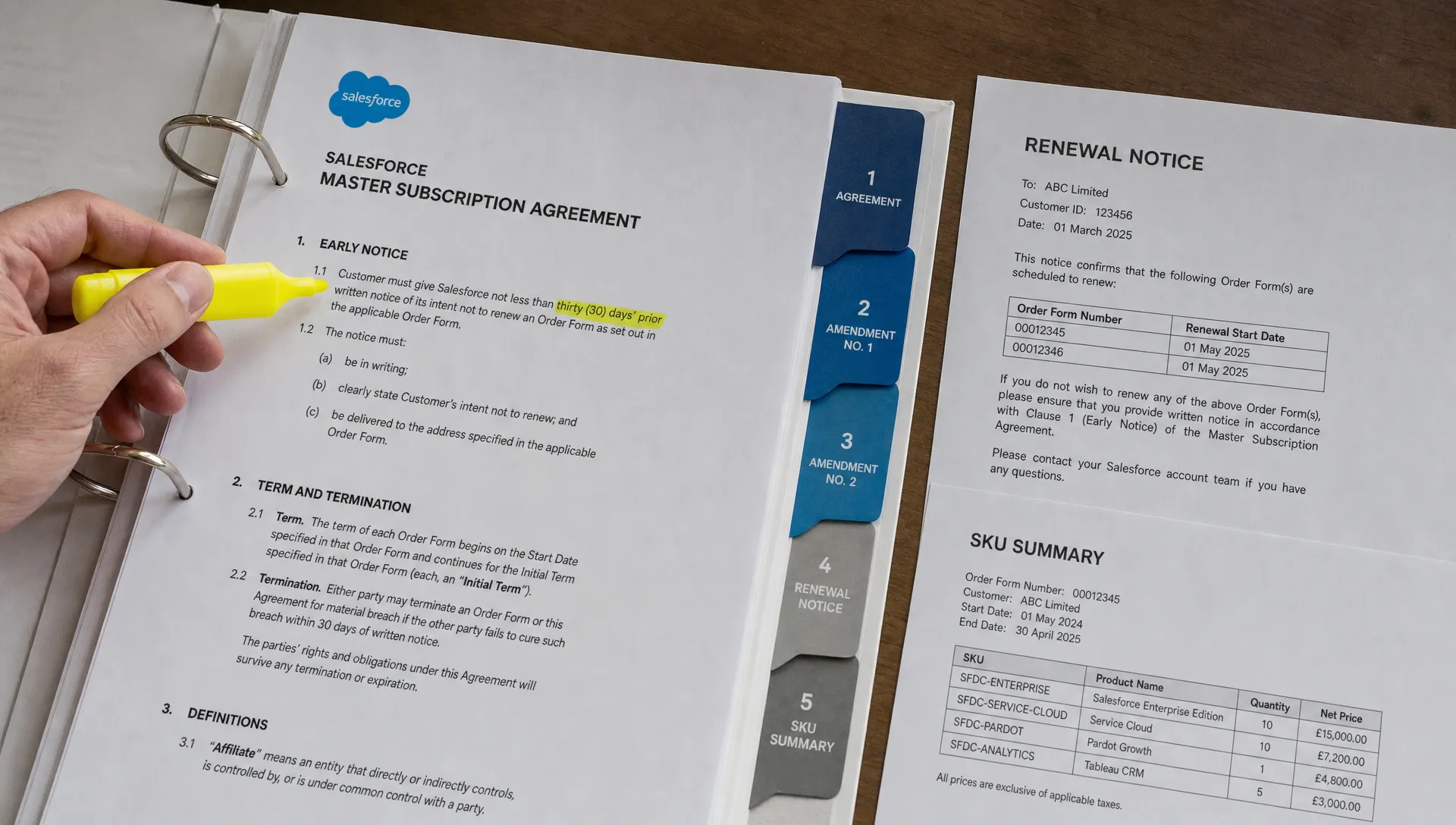
Renewal risk rarely appears on the renewal date. It usually builds quietly through unclear order forms, unused licences, bundled SKUs, missed notice dates and assumptions nobody has checked for months. Good contract analytics gives finance, IT and procurement a shared view of those risks before the room gets small and the commercial choices get expensive.
For Salesforce customers, that early view matters because the contract is not just a legal record. It is a map of commitments, dependencies and commercial leverage. If the map is incomplete, renewal discussions become reactive. If it is structured and reviewed early, the team can separate what the business genuinely needs from what has simply accumulated.
Why renewal risk appears earlier than the renewal date
Most renewal pressure starts long before the supplier sends a proposal. A department asks for extra seats. A product is added to solve a narrow use case. A pilot becomes part of the baseline. A discount is accepted against a longer term. None of these decisions may be wrong at the time, but together they can create a renewal position that is harder to defend.
This is where contract analytics earns its place. It turns the contract estate into usable evidence: what was bought, why it was bought, how it renews, which clauses create friction and which commitments no longer match demand.
Without that evidence, senior stakeholders tend to debate opinions. Sales teams believe the platform is business critical. Finance sees a rising run rate. IT sees operational dependency. Procurement sees a compressed timeline. All may be right, but the renewal decision needs a single evidence base, not four separate versions of the truth.
If your team is already close to a Salesforce renewal, SaaSed’s guide to Salesforce contract renewal risks to catch early is a useful companion to this article.
What contract analytics should reveal before renewal risk hardens
The aim is not to create a beautiful dashboard. The aim is to find the points where a renewal could become more costly, less flexible or harder to govern. For Salesforce, contract analytics should answer a few plain questions early enough for the answers to matter.
Baseline risk: what are you actually renewing?
A weak baseline is one of the easiest ways to lose control. Teams often look at the latest invoice or the current subscription value and assume that is the full picture. It rarely is.
The baseline should bring together order forms, amendments, product schedules, renewal notices, co-termination terms and any commercial side letters. Salesforce’s own Agreements and Terms page is a useful official reference point for understanding how legal documents and service terms are organised, though each customer’s signed paperwork remains the critical source.
Contract analytics should help identify gaps between the signed position and the working assumption. For example, a team may believe a product can be reduced at renewal, but the contract may include minimum commitments or linked commercial terms that make that reduction harder in practice.
Commitment risk: where does spend outrun need?
Commitment risk is not only about unused licences. It can sit in product editions, add-ons, sandbox capacity, support packages, storage, API usage and historical bundles that made sense under an old operating model.
The practical question is simple: if you had to approve the current Salesforce estate from scratch today, would the shape look the same? If the answer is unclear, the contract needs deeper review.
Contract analytics helps expose where the commercial baseline has drifted from current demand. It will not tell you which products are strategically valuable on its own, but it will show where finance and IT need to challenge the renewal scope.
The renewal risk signals worth tracking
A strong renewal review does not need hundreds of indicators. Too many metrics slow the conversation down. The better approach is to track a small number of risk signals that connect directly to commercial decisions.
| Risk signal | What it may indicate | Why it matters before renewal |
|---|---|---|
| Large variance between purchased and assigned licences | Shelfware or poor licence fit | Creates a basis for right-sizing discussions |
| Low adoption in high-cost SKUs | Product value may not support current spend | Helps prioritise stakeholder challenge |
| Multiple amendments across the term | Contract complexity and hidden dependencies | Makes renewal modelling harder if not mapped |
| Early notice requirements | Loss of termination or reduction options | Compresses decision-making if missed |
| Price uplift or discount expiry language | Higher future run rate | Needs CFO visibility before budget lock |
| Bundled products with unclear allocation | Weak cost ownership | Makes internal chargeback and accountability harder |
| Co-termination across products | Negotiation dependency | Reducing one item may affect others |
| Unclear support or success entitlements | Value leakage | Paid entitlements may not be used or understood |
These signals do not automatically mean the contract is poor. They mean the renewal deserves attention. Contract analytics gives the team a way to prioritise which issues need executive discussion, which need legal review and which need usage validation.
A useful test is whether each risk signal has an owner. If nobody owns the evidence, it will probably become a late-stage negotiation problem.
Combine contract evidence with usage, not guesswork
Contract terms and usage data are often reviewed separately. That is a mistake. A contract may look commercially tidy until it is compared with real consumption. Usage may look healthy until it is compared with the licence type, edition or bundle being paid for.
Contract analytics is most useful when it connects the signed entitlement to actual behaviour. For Salesforce, that means looking beyond total licence counts and asking whether users are in the right products, whether high-cost roles are active and whether add-ons have clear owners.
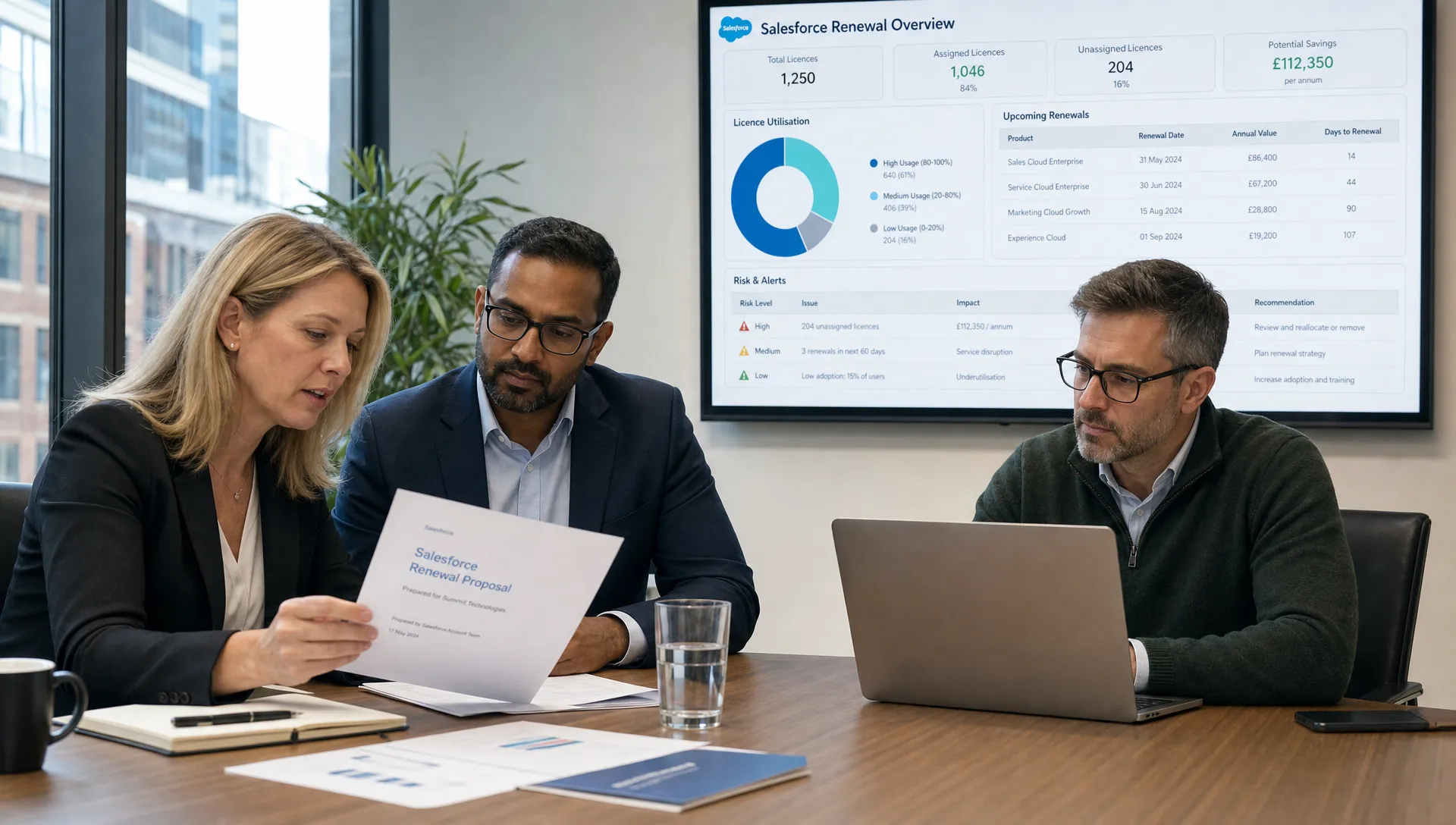
The finance view
Finance needs to understand the forward cost exposure. That includes current annual recurring spend, likely uplift, discount expiry, committed growth, foreign exchange considerations where relevant and any multi-year obligations.
The point is not to cut spend blindly. The point is to know which parts of the contract are defensible. Some licences may be underused because a rollout is delayed but still necessary. Others may sit untouched because ownership disappeared after a reorganisation. The financial response should differ.
The IT and business view
IT needs to know which products are operationally embedded, which are technically redundant and which create support load. Business owners need to confirm whether the original use case still exists.
Contract analytics can surface the questions, but the answers need human judgement. A low-use product supporting a regulated or board-level process may be worth keeping. A heavily assigned product with poor active use may need redesign, training or removal.
For a broader evidence approach across Salesforce renewals, SaaSed’s article on how Salesforce analytics can strengthen renewal decisions explores how finance, IT and procurement can work from the same facts.
Build a simple contract analytics workflow
The most effective workflow is usually disciplined rather than elaborate. Start early, keep the dataset clean and make sure every finding connects to a renewal decision.
A practical workflow often looks like this:
- Gather the full contract pack, including order forms, amendments, terms, schedules and renewal notices.
- Build a SKU-level baseline that shows quantity, edition, unit price, discounts, term dates and renewal mechanics.
- Map each product or SKU to an internal owner who can confirm business purpose.
- Compare purchased entitlements with assigned licences, active usage and planned demand.
- Flag clauses that affect renewal flexibility, price, termination rights or product reductions.
- Turn findings into negotiation positions, not just observations.
This work should start months before renewal, not weeks. By the time a formal proposal arrives, the team should already know its walk-in position: what to keep, what to challenge, what to remove and what must be protected.
Contract analytics also helps prevent false precision. If the data quality is weak, say so early. A clean uncertainty is better than a confident but fragile number in front of the CFO.
If timing is your immediate concern, the article on why contract review should start months before renewal sets out the practical reasons to begin well ahead of the deadline.
What not to automate away
Automation can speed up extraction, comparison and risk flagging, but it cannot replace commercial judgement. A clause may be standard but still painful in context. A discount may look attractive but restrict future flexibility. A bundle may reduce the headline price but weaken cost ownership.
Contract analytics should support the people around the table, not remove them from the work. Procurement brings negotiation discipline. IT understands operational dependency. Finance tests affordability and value. Legal reads the risk in the actual language. Business owners confirm whether the platform still supports the outcomes originally promised.
There is also a behavioural point. Late renewals invite narrow thinking. Teams focus on avoiding disruption, not improving the deal. Early analysis creates room for better questions, including whether the current Salesforce shape still fits the business plan.
Gartner’s definition of IT asset management is a helpful reminder that software control is a lifecycle discipline, not a once-a-year purchasing task.
How to turn findings into renewal action
A risk register is only useful if it changes behaviour. Once the evidence is clear, group findings by action type.
Some findings need supplier engagement, such as price uplift challenges, bundle transparency or SKU alternatives. Some need internal decisions, such as whether a product owner can justify continued spend. Others need legal or procurement review, especially if renewal rights, termination windows or reduction limits are unclear.
Contract analytics should therefore produce a short decision pack, not a large spreadsheet nobody wants to read. A good pack gives executives the commercial baseline, the main renewal risks, the value at stake and the decisions required before negotiation starts.
For CFOs, CIOs and procurement leaders, the best renewal work is not louder negotiation. It is earlier preparation. The more precise the evidence, the less the organisation has to rely on pressure in the final month.
Frequently Asked Questions
What is contract analytics in a Salesforce renewal context? Contract analytics is the structured review of contract documents, commercial terms, SKU data, renewal mechanics and related usage evidence to identify risk before renewal negotiations begin.
How early should we start reviewing renewal risk? For a material Salesforce renewal, start several months before the renewal date. Larger estates, complex bundles, multi-year terms or internal governance requirements may need even more time.
Is contract analytics the same as a usage audit? No. A usage audit shows how software is assigned or consumed. Contract analytics shows what the organisation is commercially committed to. The strongest renewal evidence comes from combining both.
Who should own the process? Procurement often coordinates the process, but finance, IT, legal and business owners all need defined roles. Renewal risk usually crosses functions, so ownership must be shared without becoming vague.
What is the biggest mistake teams make? The common mistake is treating the renewal proposal as the starting point. By then, notice windows may be tight, internal demand may be unclear and negotiation options may already be narrower than they needed to be.
Final thought: make renewal risk visible while there is still time
The value of contract analytics is not in the analysis itself. It is in giving your team time to act. When renewal risk is visible early, the discussion changes from “Can we get this signed?” to “What should we renew, on what terms and with what evidence?”
If you want a clear outside view of your Salesforce contract position before renewal pressure builds, SaaSed offers a complimentary Salesforce audit conversation. Bring the contract questions that are already on your mind, and we will help you understand where the risk may be hiding.
Want this kind of intel on your renewal?
Don’t head into your next software negotiation alone
Contact Us