Software Renewals That Need Attention Earlier Than You Think
Renewal pressure usually starts long before the quote arrives. This guide shows CFOs, CIOs and procurement leaders which software renewals deserve earlier scrutiny, what evidence to gather and how to avoid negotiating from a corner.

Most software renewals do not become expensive on the renewal date. They become expensive when nobody notices that the useful work should have started months earlier.
By the time a supplier sends a quote, several levers may already have gone quiet. Cancellation windows may be closed. Budget may already be locked. Technical teams may have no time to validate alternatives. Business owners may still be defending licences that no longer match how people work.
For CFOs, CIOs and procurement leaders, the better question is not, "When does this contract expire?" It is, "When do we need evidence, options and internal agreement?"
That date is usually earlier than the one on the contract.
The real renewal date is not the signature date
The signature date is the final mile. The operational renewal date is the point at which your leverage starts to expire.
That leverage is not only about price. It includes the time to clean up user data, challenge poor SKU fit, confirm future demand, understand contractual limits, build an alternative position and decide what the organisation is actually prepared to change.
A rushed renewal tends to narrow the conversation to one question: "Can we get a better discount?" A prepared renewal allows better questions: "Do we still need this mix? Are we paying for the right users? What has changed since the last agreement? What risk do we accept if we do nothing?"
Those questions are much harder to answer in the final 30 days.
Which software renewals need attention first?
Not every renewal deserves the same depth of review. A small tool with low spend, clean usage data and an easy exit path does not need a steering group six months out. But some renewals carry enough cost, dependency or contractual risk to justify earlier work.
Use a simple triage. The earlier the renewal could affect budget, operations or negotiating position, the earlier it belongs on the calendar.
| Renewal type | Sensible review window | Why it needs earlier attention |
|---|---|---|
| CRM and revenue platforms, including Salesforce | 9 to 12 months | Licence mix, business dependency, integrations, add-ons, data growth and renewal clauses can all affect the outcome. |
| ERP, finance and HR systems | 9 to 12 months | Switching is hard, user permissions are sensitive and operational risk is high. |
| Security, identity and compliance tools | 6 to 9 months | Coverage gaps, audit obligations and risk appetite need early agreement. |
| Collaboration and developer platforms | 4 to 6 months | User counts can drift quickly, especially after hiring freezes, restructures or tool consolidation. |
| Specialist point solutions | 3 to 4 months | These may be simple, unless auto-renewal terms or duplicate functionality create avoidable spend. |
| New AI, data or automation add-ons | 6 to 9 months | Adoption may still be uncertain, and commercial models can mature faster than internal governance. |
The review window is not the negotiation window. It is the period in which finance, IT, procurement and business owners get clear enough to negotiate well later.
Why earlier attention changes the outcome
Time improves renewal outcomes because evidence takes time. Usage reports are rarely enough on their own. Someone needs to interpret whether inactive users are genuinely unused, whether a higher-tier licence is needed for a role, whether a team is about to expand and whether an add-on is embedded or merely familiar.
Options also take time. If a platform is business-critical, no sensible team wants to threaten change casually. But even a limited options view changes the conversation. It shows where the organisation has flexibility, where it does not and what trade-offs are real.
Internal alignment takes time too. Procurement cannot fix a strategic software renewal alone in the final fortnight. Finance may care about budget shape. IT may care about stability and architecture. Business teams may care about continuity. Legal may care about renewal language and liability. None of that is difficult if started early. It becomes painful when compressed.
This is the quiet problem with software renewals. They look administrative until they are not.
Warning signs that a renewal is already late
A renewal does not need to be days from expiry to be late. It may already be late if the supplier controls the pace, the data is unclear or the internal position is still unsettled.
Common warning signs include:
- The first serious renewal meeting is supplier-led.
- The current order form has not been reconciled against actual users.
- Finance, IT and business owners disagree on what is essential.
- A cancellation or reduction deadline is inside the next 90 days.
- Pricing conversations have started before requirements are settled.
- The renewal is being treated as an admin task, despite high spend or operational dependency.
- Nobody can explain which licences are inactive, mis-tiered or held for future plans.
If two or more of these are true, the renewal deserves attention now, even if the expiry date still feels distant.
Software is not exempt from normal procurement discipline
In physical supply chains, teams understand lead times. If a production line depends on precision components from a specialist shaft and roller manufacturer, nobody waits until a critical part fails before reviewing tolerances, availability and risk. The work happens before pressure sets the price.
Strategic software is different in form, but not in principle. The cost of waiting is not always a broken machine. It may be a closed reduction window, a missed budget cycle, a supplier-led quote or a licence estate nobody has time to challenge.
The discipline is the same: know what you have, know what you need and know where you still have room to move.
A practical timeline for important software renewals
For high-value or business-critical platforms, a 9 to 12 month view is not excessive. It does not mean months of meetings. It means creating enough space for the work that protects the decision.
12 to 9 months out: establish the baseline
Start by gathering the full contract pack: master agreement, order forms, amendments, product terms, renewal clauses, support terms and any side letters. Then build a plain-English baseline of what is owned, who uses it, when it renews, what can change and what cannot.
This is also the right moment to identify the decision owners. If a renewal touches revenue operations, customer service, data, finance and security, those voices need to be known early. They do not all need to attend every meeting, but their assumptions should not appear for the first time in the final negotiation.
9 to 6 months out: test usage and demand
This is where many renewals become clearer. Compare assigned licences with active use. Look for users in the wrong edition, inactive accounts, duplicate tools, unused add-ons and teams that have changed since the last agreement.
For Salesforce and other large platforms, usage needs context. A low-login user may still need occasional access for compliance or management reasons. A dormant integration user may be critical. A premium SKU may be justified for one role and wasteful for another. The review should be careful, not crude.
If you want a fuller operating model for this stage, SaaSed has written separately on what a strong SaaS renewal process looks like.
6 to 3 months out: define the commercial position
By this point, the organisation should know its preferred scope, acceptable fallback and genuine walk-away limits. This is also when benchmarking, budget modelling and scenario planning become useful.
The goal is not to create theatre. It is to stop negotiating from uncertainty. If you know where you can reduce, where you must retain and where you might expand, the supplier conversation becomes more balanced.
Final 90 days: negotiate, do not discover
The last 90 days should not be spent finding order forms, discovering hidden add-ons or debating who owns a licence pool. This period is for closing gaps, testing the offer, agreeing terms and documenting the decision.
If the discovery work is still happening here, procurement is being asked to recover leverage that should have been protected earlier.
What to review before speaking to the supplier
A good renewal review is not a long academic exercise. It should produce a clear commercial story that internal stakeholders can understand and defend.
Before the first serious supplier conversation, review:
- Current entitlements, including editions, add-ons, storage, sandboxes and support levels.
- Actual usage, including active users, inactive users, permission sets and role fit.
- Contractual levers, including notice periods, renewal mechanics, price uplifts and reduction rights.
- Future demand, including hiring plans, restructures, market changes, transformation work and product roadmap needs.
- Historical commitments, including ramp schedules, co-terming, swaps, special discounts and prior concessions.
- Internal alternatives, including process change, consolidation, deferral or technical simplification.
For Salesforce, start with your executed documents, but do not ignore the official source materials. Salesforce maintains its own agreements and terms, which can help teams understand the wider contractual framework behind their order forms.
The most valuable finding is often not one large mistake. It is a pattern of small mismatches: a team that kept licences after a project ended, an add-on that was never adopted, a premium edition assigned by habit, a bundle nobody has unpacked. For a deeper look at those quiet leakages, see what SaaS software costs get missed before renewal.
Why Salesforce renewals deserve particular care
Salesforce renewals need early attention because the platform often sits close to revenue, service and customer data. It is rarely a simple single-line subscription.
Many organisations have multiple clouds, editions, add-ons, sandboxes, integrations and historical order forms. Commercial decisions made years ago can still shape today's renewal. A discount may be attached to volume. A product may be bundled with something more useful. A support level may have become normal without anyone checking whether it still fits. A planned business change may make a renewal look smaller or larger than it really is.
This is why Salesforce renewal work should start with the estate, not the quote. The question is not simply whether Salesforce is valuable. In most cases, it is. The sharper question is whether the organisation is buying the right shape of Salesforce for the next term.
That requires contract analysis, SKU review, usage audit and a sober view of future demand. It also requires early attention to the clauses that can reduce flexibility. SaaSed has covered several of these issues in Salesforce contract renewal risks to catch early.
How to make early renewal work without creating bureaucracy
Early attention does not mean turning every renewal into a programme. The best approach is light, regular and disciplined.
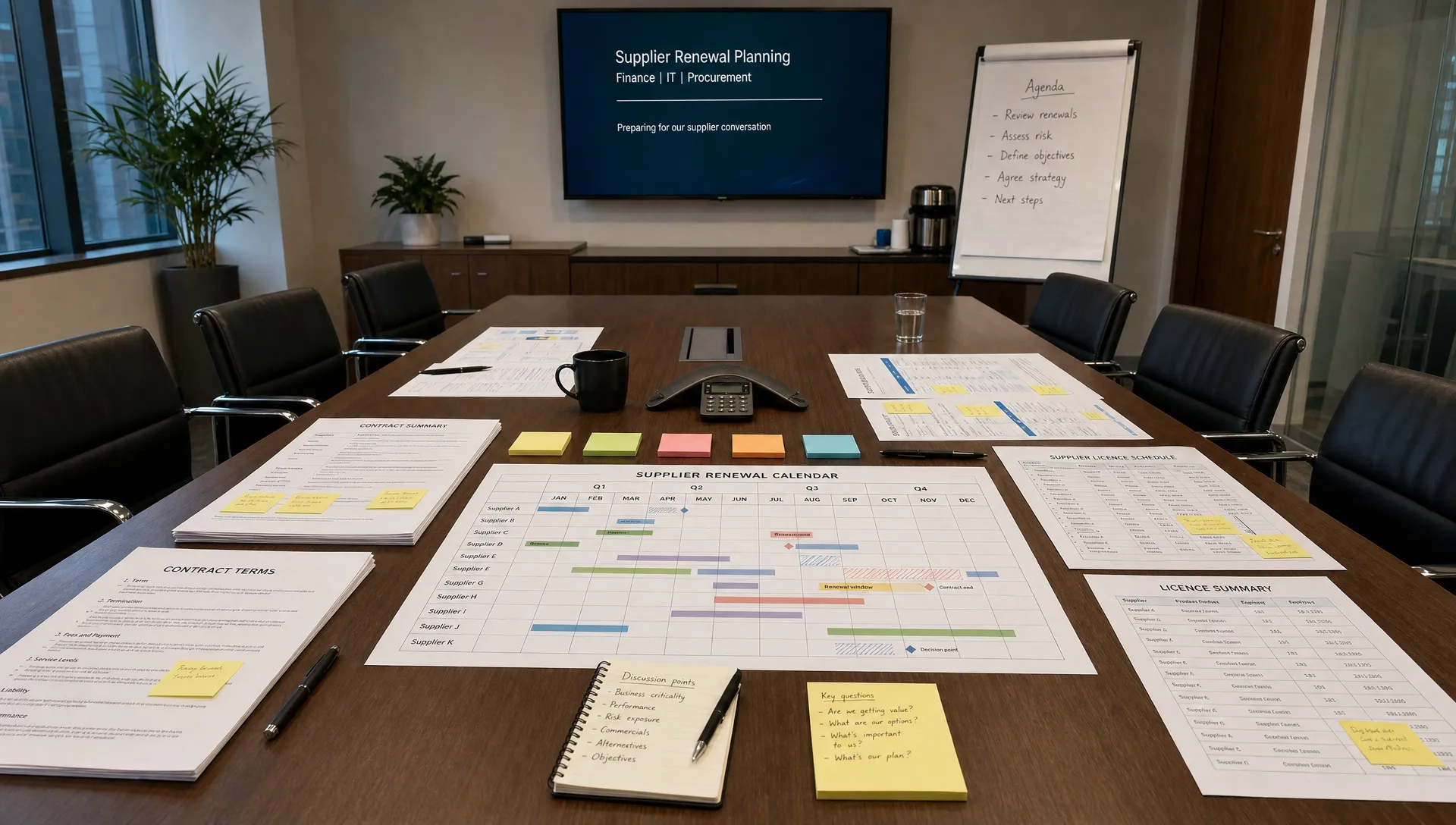
Start with a renewal calendar that shows expiry dates, notice dates and budget deadlines. Then assign one commercial owner and one technical owner for each strategic platform. Their job is not to control every decision. It is to ensure the right evidence exists before the supplier conversation becomes urgent.
A simple monthly renewal review can be enough. Which contracts renew in the next 12 months? Which have notice periods inside the next quarter? Which need usage analysis? Which require executive alignment? Which can be left alone because the risk is low?
This rhythm prevents the two worst renewal behaviours: panic and autopilot. Panic makes teams accept poor terms because time is short. Autopilot makes teams renew yesterday's estate even when the business has changed.
The middle ground is better. Calm, early, evidence-led.
Frequently Asked Questions
How early should we start reviewing software renewals? For strategic or high-value platforms, start 9 to 12 months before expiry. For simpler tools, 3 to 6 months may be enough, provided there are no strict notice periods or complex dependencies.
Which software renewals need the earliest attention? Platforms with high spend, business-critical workflows, complex licensing, auto-renewal clauses, usage uncertainty or limited switching options should move to the front of the queue.
Is a renewal review still worth doing if we know we will renew? Yes. Renewing the platform does not mean renewing the same licence mix, terms or commercial structure. Some of the best outcomes come from reshaping the estate, not replacing the tool.
Who should own software renewal preparation? Procurement should usually coordinate the commercial process, but finance, IT and business owners all need to contribute. The strongest position comes from shared evidence, not departmental opinion.
What makes Salesforce renewals different from other SaaS renewals? Salesforce often combines strategic business dependency with complex SKUs, multiple clouds, add-ons, integrations and historical order forms. That makes early contract and usage review especially important.
A calmer renewal starts before the quote
Software renewals reward preparation. Not noise. Not last-minute pressure. Preparation.
If a renewal matters to budget, operations or strategic flexibility, the work should begin before the supplier frames the conversation. Gather the contract, test the usage, understand the SKU mix, agree the future need and protect the dates that matter.
For Salesforce renewals, that early clarity can materially change the quality of the commercial conversation. If you would like a second pair of eyes on your estate, SaaSed offers a complimentary Salesforce audit conversation to help you see what deserves attention before renewal talks begin.
Want this kind of intel on your renewal?
Don’t head into your next software negotiation alone
Contact Us