How Salesforce Software Spend Becomes Hard to Defend
Salesforce spend rarely becomes indefensible overnight. It gets there when contracts, usage and business ownership drift apart, leaving leaders with a large renewal and thin evidence. This article shows where that drift starts and how to rebuild a sharper case before renewal.

Salesforce often starts with a clean argument. Sales need one place to manage pipeline. Service needs case handling. Leadership needs better visibility. The investment is visible, justified and usually urgent.
The difficulty comes later. After several releases, acquisitions, team changes, licence upgrades, add-ons and renewals, the same Salesforce software budget can become harder to explain. Not because Salesforce has stopped mattering, but because the evidence behind the spend has gone stale.
For CFOs, CIOs and procurement leaders, this is the uncomfortable part of a mature Salesforce estate. The question is no longer, "Do we need Salesforce?" It is, "Can we still defend this shape of spend, at this price, under these terms, for the next contract period?"
Spend is not the problem. Weak evidence is.
A large Salesforce bill is not automatically a bad bill. Some organisations should protect significant Salesforce spend because the platform supports revenue, service, compliance, integration or customer data quality.
What makes the spend hard to defend is a lack of current evidence. The contract says one thing, admin data says another, business owners remember a third version and finance sees only the invoice.
Defensible spend normally has four things behind it:
- A clear view of what the organisation owns
- Evidence of what is actually used
- Named business owners for the value being claimed
- A realistic alternative if the current commercial position is challenged
When one of these is missing, the renewal conversation becomes harder. When all four are missing, negotiation becomes mostly reactive.
That is when Salesforce spend starts to feel less like a managed investment and more like a large recurring obligation.
How Salesforce software spend loses its story
The first sign is usually not waste. It is ambiguity.
Nobody can quite explain why a specific product was bought, why a licence count grew, why a premium edition was chosen or why a bundle still needs to exist in its original form. The individual decisions may have been sensible at the time. The problem is that the story has not been updated as the business changed.
A typical Salesforce estate has three layers that drift at different speeds.
| Layer | What usually changes | Why it becomes hard to defend |
|---|---|---|
| Contract layer | Products, editions, bundles, renewal dates, discount structures and term commitments | Commercial terms are often understood by only a few people and may not match current use |
| Usage layer | Active users, feature adoption, integrations, automation, storage and support patterns | Admin data can show activity, but not always business value or necessity |
| Value layer | Sales motions, service models, reporting needs, operating structure and ownership | The original business case may no longer reflect how teams work today |
Most organisations look at one layer at a time. Finance looks at cost. IT looks at access and architecture. Business teams look at local usefulness. Salesforce looks at contract expansion and future roadmap.
The defence becomes strong only when the three layers are brought together before renewal pressure arrives.
The original business case goes out of date
A Salesforce purchase is often made during a period of change. A new CRM strategy. A transformation programme. A service redesign. A push for better pipeline discipline. The budget is approved against that moment.
Two or three years later, the organisation may have different regions, different sales teams, new routes to market, changed reporting requirements or a different customer service model. Yet the contract may still reflect the original plan.
This is where leaders can get trapped. They try to defend today's renewal with yesterday's justification. That rarely works under scrutiny.
A better question is: which parts of the original case still hold, which parts have changed and which parts have quietly disappeared?
The answer may protect some spend and challenge other areas. That is healthy. A strong renewal position does not require every line item to be perfect. It requires honesty about what still earns its place.
Licence growth becomes normalised
Licence growth rarely looks dramatic month by month. A new team needs access. A project adds temporary users. A manager asks for extra reporting seats. A region moves onto the platform. Nobody wants to block business activity, so the request is approved.
Over time, the licence base becomes a record of accumulated exceptions.
Some users are highly active and central to operations. Some log in occasionally. Some have access because nobody wanted to remove it. Some may be sitting on licence types that are broader than their role requires.
Salesforce has detailed licence types, permission concepts and product-specific entitlements. Salesforce's own user licence documentation is useful for understanding the technical landscape, but commercial defensibility needs one more step: mapping access back to real work.
That means asking whether users need the licence they have, whether they need any licence at all and whether the business process supported by that access is still worth the current cost.
This is not a criticism of administrators. In many companies, admins are asked to keep the business moving, not to police commercial efficiency. The governance issue sits higher up.
Add-ons become permanent before anyone notices
Add-ons are often bought for good reasons. A team needs better forecasting, analytics, CPQ capability, marketing functionality, AI capability, service improvements or data tools. The issue is not the first purchase. It is what happens after the urgent need has passed.
Small additions can become permanent budget lines without a fresh value check. Some are renewed because they are bundled into a wider agreement. Some remain because ownership is unclear. Some are used by a small group, but paid for at a scale that no longer fits.
If this sounds familiar, it is worth looking closely at the specific patterns behind software add-ons that quietly inflate Salesforce spend, especially before add-on value is blended into a larger renewal story.
The practical question is simple: if this add-on had to be approved again today, with today's usage and today's priorities, would it pass?
If the answer is unclear, it should not be treated as automatically protected spend.
Bundles blur the commercial picture
Bundles can be useful. They can also make it harder to see what you are really paying for.
A bundled Salesforce agreement may include products with very different value profiles. Some are core. Some are experimental. Some were included to reach a commercial threshold. Some may have been positioned as attractive because the incremental price looked low compared with the headline discount.
At renewal, the bundle can become a defence problem. If leadership asks what would happen if one component were removed, the answer may be difficult because the pricing, dependencies and discount logic are not transparent enough.
This is why certain Salesforce agreements deserve a harder review well before commercial discussions intensify. The review is not just legal. It is financial, operational and strategic.
A contract can look tidy on paper and still be awkward to defend if nobody can explain the trade-offs inside it.
The value owner disappears after implementation
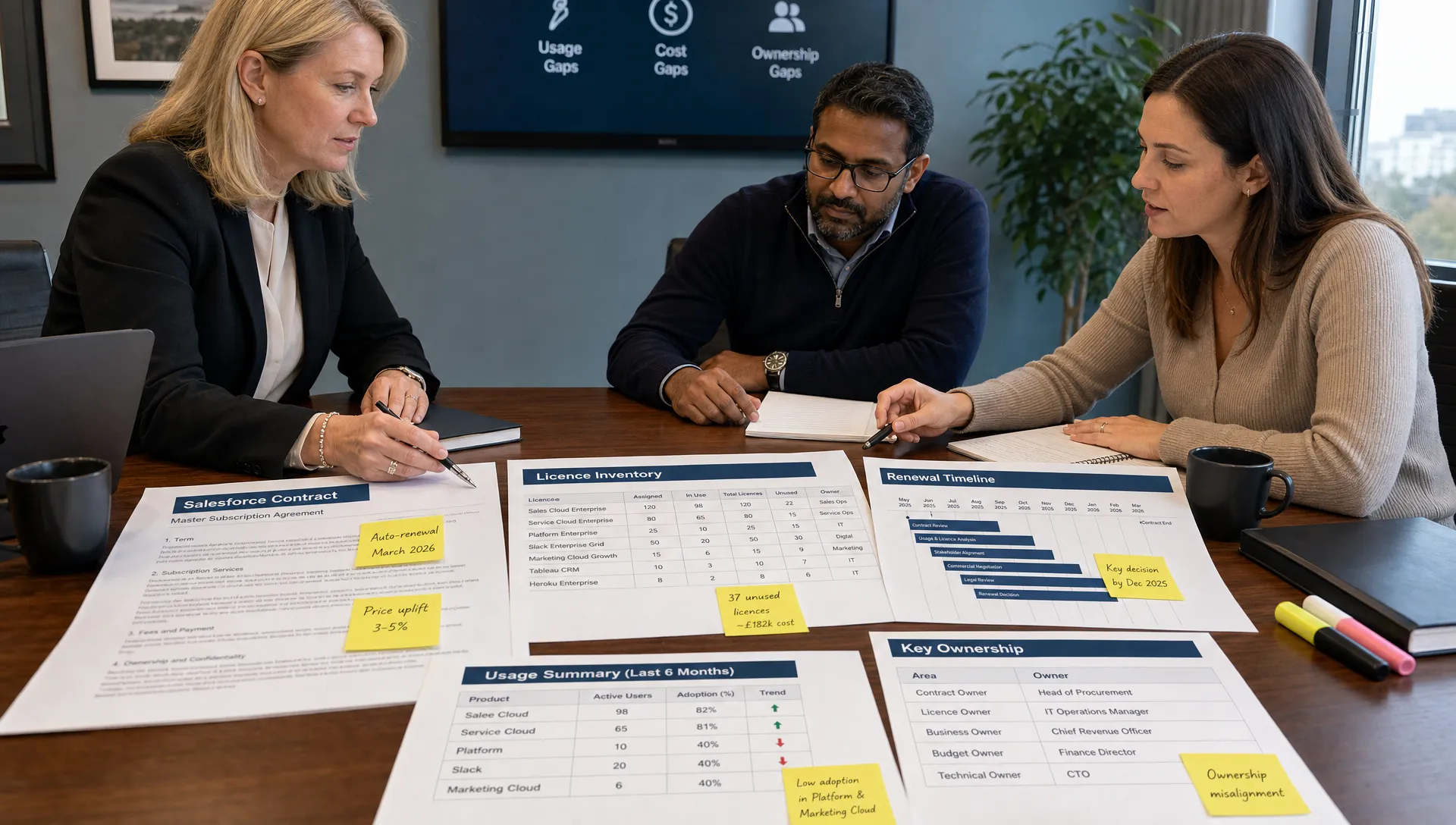
During implementation, ownership is visible. There is a steering group, a programme sponsor, process leads and clear objectives. After go-live, ownership often becomes softer.
The platform stays. The budget stays. The sponsor may move role. The project team disbands. Business teams adapt the system locally. A year later, procurement asks for evidence before renewal and the answers are spread across several functions.
This creates a defence gap. IT can explain the system. Finance can explain the cost. Procurement can explain the contract. But who explains the business value by SKU, licence group or capability?
For sales-led organisations, this matters even more because CRM value is tied to revenue execution. If teams are investing in clearer prospecting, conversion signals and customer timing, the Salesforce estate should be judged by how well it supports those motions, not simply by how many seats exist.
A weak ownership model turns useful software into a difficult budget conversation.
Renewal pressure exposes the gaps
Most Salesforce spend becomes hard to defend because the serious review starts too late.
By the time the renewal is close, the internal team is under pressure. Salesforce has its forecast. Business stakeholders are worried about disruption. IT does not want to risk service continuity. Procurement is asked to improve the commercial outcome without enough time to rebuild the evidence base.
Late reviews tend to produce shallow arguments:
- "We use Salesforce every day."
- "The business cannot operate without it."
- "We have already invested too much to change."
- "The discount looks reasonable compared with list price."
Some of these statements may be true. They are just not enough.
A stronger renewal argument separates critical value from inherited spend. It shows where the platform is essential, where usage is marginal, where terms create risk and where the organisation has credible negotiation choices.
That work takes time because it requires data, judgement and internal alignment.
What makes Salesforce spend defensible again
The aim is not to cut blindly. It is to make the next renewal easier to explain and harder to overpay.
A good pre-renewal review usually produces a small set of practical outputs.
| Output | What it should answer | Who needs it most |
|---|---|---|
| Contract baseline | What do we own, under what terms and until when? | Procurement and finance |
| Licence and SKU map | Which users and teams consume which products? | IT, operations and procurement |
| Usage evidence | What is active, dormant, underused or misaligned? | IT and business owners |
| Value classification | Which capabilities are critical, useful, optional or unclear? | CFO, CIO and executive sponsors |
| Negotiation position | What can we protect, challenge, trade or remove? | Procurement and commercial leadership |
This is where commercial clarity becomes more than a phrase. It is the evidence set that lets leaders decide what deserves budget protection and what should be challenged before renewal terms harden.
The best reviews are not adversarial. They are disciplined. They give Salesforce a clearer buyer to negotiate with and give internal stakeholders a cleaner way to make decisions.
The questions each leader should ask
CFOs, CIOs and procurement leaders do not need to ask the same questions. They need compatible answers.
| Role | Questions worth asking before renewal |
|---|---|
| CFO | Which parts of this spend can be tied to current revenue, service, risk or operating priorities? What would we stop funding if this were a new request today? |
| CIO | Does our current licence and product mix match the architecture, support model and roadmap we actually need? Where are we paying for complexity we no longer want? |
| Procurement leader | Which terms, bundles, uplift structures, commitments or renewal mechanics reduce our room to manoeuvre? What leverage do we have before the vendor conversation starts? |
| Business owner | Which Salesforce capabilities are genuinely embedded in team performance, and which are merely familiar? |
These questions are uncomfortable in the right way. They do not assume waste. They test the strength of the case.
Common traps that weaken the defence
The first trap is treating last year's contract file as the baseline. It is only a starting point. A defensible baseline includes current users, product ownership, usage patterns, renewal constraints and business relevance.
The second trap is measuring adoption without context. Login data can help, but it does not prove value. A lightly used feature may be critical for compliance or executive reporting. A heavily used product may still be over-licensed. Usage needs interpretation.
The third trap is defending every SKU equally. This makes the whole budget look weaker. Mature buyers separate essential capability from negotiable spend. They know what to protect and where to push.
The fourth trap is assuming the best negotiation happens at the table. By then, much of the outcome has already been shaped. The real work happens when the organisation builds its evidence, aligns internally and decides its trade-offs before the vendor process narrows the options.
Frequently Asked Questions
Why does Salesforce software spend become difficult to defend? It becomes difficult when contract scope, actual usage and business value drift apart. The platform may still be important, but leaders lack clear evidence to justify the current mix of licences, products and terms.
Is high Salesforce spend always a sign of waste? No. High spend can be appropriate when Salesforce supports critical revenue, service, data or compliance processes. The issue is whether the organisation can prove which parts of the spend still create value.
When should a Salesforce renewal review start? Earlier than most teams think. A meaningful review needs time to gather contract data, usage evidence, stakeholder input and negotiation options. Starting only when renewal quotes arrive usually limits leverage.
Who should own Salesforce spend defensibility? It should be shared. Finance owns budget discipline, IT owns technical fit, procurement owns commercial leverage and business leaders own value. If one group carries the whole argument alone, the renewal case is usually weaker.
A calmer way to defend the next renewal
Salesforce spend becomes hard to defend when the organisation has to explain a mature estate with fragmented evidence. The answer is not panic, blame or blunt cuts. It is a clear commercial review before the renewal conversation becomes crowded and rushed.
SaaSed helps organisations examine Salesforce contracts, SKUs, usage and negotiation options with the benefit of specialist Salesforce procurement experience. If your next renewal needs a sharper evidence base, you can book a complimentary Salesforce audit conversation and talk through where the spend may need protection, challenge or a closer look.
Want this kind of intel on your renewal?
Don’t head into your next software negotiation alone
Contact Us