Vendor Negotiation: What to Settle Before Price Talks Begin
A better discount cannot fix an unclear buying decision. Agree scope, approval limits and acceptable trades before Salesforce price talks begin. This guide helps finance, IT and procurement build a position they can defend together.

Good vendor negotiation starts with decisions the buying team has already made. Before discussing a discount, you need an agreed scope, a credible alternative, clear approval boundaries and a way to compare offers. Without those, a lower price can still leave you buying too much, accepting unwanted commitments or returning to the same argument at the next renewal.
For CFOs, CIOs and procurement leaders, the immediate task is not to settle every contract clause. It is to agree what the organisation needs, what it can trade and what it cannot accept. Then establish the facts with Salesforce before asking for a commercial proposal.
Settle your position, not the deal. You should enter price talks with room to negotiate, but without unresolved internal disagreements that the vendor can end up resolving for you.
Agree the outcome before choosing a discount target
“Improve the renewal” is not a usable instruction. Finance may mean lower committed spend. IT may mean retaining access to essential functionality. Procurement may mean removing an automatic renewal provision or securing more flexibility.
All three can be reasonable, but they are not interchangeable.
Choose a primary objective and identify the conditions that must hold alongside it. For example: reduce the next contractual commitment while preserving the capabilities used by customer-facing teams and avoiding unnecessary purchases ahead of deployment.
This gives vendor negotiation a clear objective rather than a collection of competing requests.
A percentage discount is a poor substitute for that objective. It measures movement against a reference price, not whether the purchase fits your needs. A larger discount can accompany more licences, additional products or a longer commitment.
Write down how success will be measured: total committed spend, necessary coverage, acceptable risk and flexibility at the next decision point. Keep the list short enough that your approvers can actually use it.
Establish the demand you are willing to fund
Separate the existing purchase from the future requirement. Your current order form records what was bought, not necessarily what should be renewed.
Build a demand baseline around named user groups, required capabilities and realistic deployment dates. Ask business owners to validate the requirement rather than simply carry forward their previous allocation.
An unused licence is a reason to investigate, not automatic proof that it can be removed. The user may be seasonal, the allocation may support a forthcoming deployment or a different licence type may be needed. IT should confirm dependencies before procurement treats a reduction as available.
Separate confirmed demand from possible growth. A proposed rollout without an accountable owner or approved implementation plan should not quietly become committed expenditure.
Vendor negotiation becomes more disciplined when the team can distinguish a validated requirement from a forecast it has not yet approved.
Where future demand is uncertain, decide which commercial questions to raise: staged purchasing, additional quantities later or another structure that fits deployment. Treat these as requests to test with Salesforce, not rights you already possess.
The output should be one agreed baseline, with assumptions and uncertainties visible. Price that baseline first. Assess expansion separately.
Decide who can approve, concede and communicate
A buying team can agree its objectives and still weaken its position through inconsistent messages.
Someone tells Salesforce that a three-year term is acceptable. Someone else suggests budget is available for another product. Procurement then discovers that both comments have become assumptions in the proposal.
Before vendor negotiation begins, assign ownership of the external conversation and the authority to make each type of concession.
This does not mean shutting IT or business stakeholders out. It means distinguishing technical discussion from commercial commitment. A product evaluation should not imply an approved purchase, and a planning estimate should not become a promised volume.
A workable division of responsibility is:
- Finance: approves the spend envelope and financial treatment.
- IT and business owners: validate requirements, dependencies and delivery assumptions.
- Procurement: coordinates proposals, exchanges and the negotiation record.
- Legal and relevant control owners: assess contractual, privacy and security requirements within their remit.
Name the final approver and the escalation route for exceptions. Also agree who may discuss term length, purchase volumes and signing dates with the vendor.
These are practical controls, not another committee. They prevent the commercial negotiation habits that weaken your position, particularly informal commitments and conflicting signals.
Separate acceptable trades from non-negotiable requirements
Not every preference deserves the same weight. Classify your position before the first proposal arrives.
A longer term might be acceptable if demand is stable and the complete commercial package justifies the commitment. Buying an unapproved product to access a headline discount is a different proposition. So is accepting a contractual risk that the appropriate owner has not reviewed.
Use three categories: requirements, conditional trades and preferences. Requirements define what the organisation must have. Conditional trades are concessions you could make for a specified return. Preferences are useful improvements that should not derail an otherwise sound agreement.
For vendor negotiation, a concession should have an agreed condition attached rather than being offered simply to keep the discussion moving.
For example, the team might be willing to consider a longer term only if the quantities remain appropriate, the pricing treatment is clear and the overall commitment stays within an approved limit. That is a position to explore, not an instruction to accept any multi-year offer.
Legal, privacy and security matters need their own authorised review. They should not become procurement bargaining chips by default.
Record the proposed exchanges internally. Otherwise, it is easy to give away certainty on term or volume before receiving anything definite in return.
Make the alternative credible enough to use
Your alternative does not have to be replacing Salesforce. For an organisation with substantial integrations and established processes, an immediate platform switch may be neither practical nor economical.
More credible options might include deferring an optional purchase, reducing validated excess quantities where contractually available or declining an expansion that lacks an approved business case.
Each option needs a feasibility check. What notice is required? Who would carry out the change? What would it cost? Would it affect operations? Is the option actually available under the applicable agreement?
Do not threaten an action that the organisation cannot approve or deliver. Equally, do not assume that current usage obliges you to accept every proposed addition.
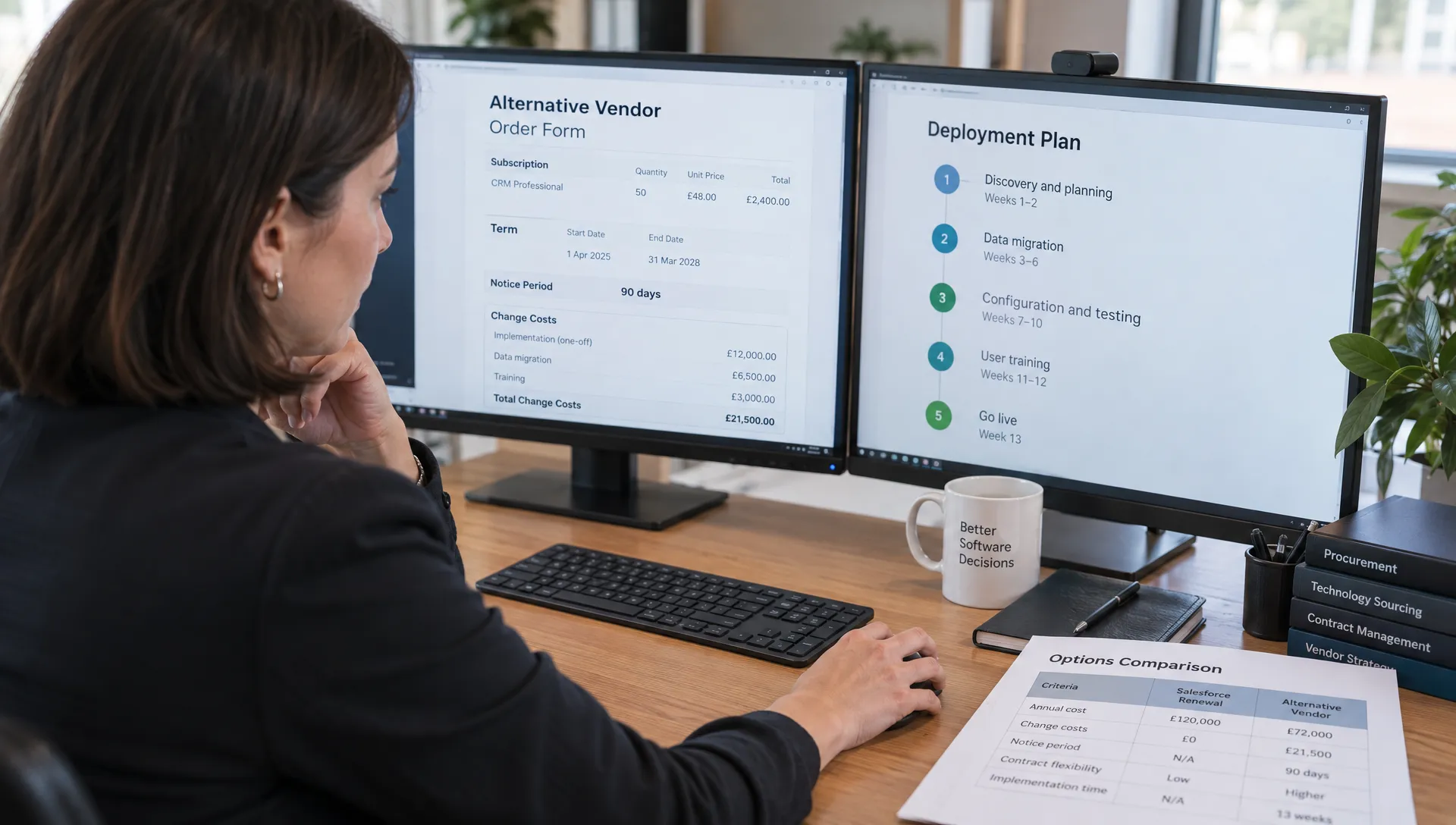
Assign an owner to validate each alternative before it is used externally. Where there is no realistic alternative to renewing a core service, acknowledge that internally and focus the discussion on the parts of the purchase you can still change.
Resolve vendor assumptions before comparing prices
An accurate internal baseline is only useful if Salesforce is quoting against it.
Ask the account team to confirm the proposed products, editions, quantities, service dates and term. Establish which parts of the offer are optional and which commercial conditions depend on the package remaining intact.
If an offer includes a signing deadline, ask what changes after that date. Do not treat an unverified deadline as a reason to bypass approval.
Vendor negotiation is easier to evaluate when the quoted scope and conditions are explicit, rather than reconstructed from calls and emails.
Salesforce’s official agreements page is a useful reference for its published contractual documents. It does not replace reviewing your executed agreement, order forms and applicable amendments to establish which terms govern your purchase.
Where an answer affects the buying decision, ask for it in writing. If you need a contractual right, make sure it appears in the applicable contractual documentation, rather than relying on an informal assurance.
The detailed checks in reviewing a vendor contract before approval help distinguish a sales explanation from a commitment the organisation can rely on.
Agree how offers will be compared
Set the comparison method before receiving competing packages. Otherwise, the most attractive headline number can become the default measure of success.
Consider a hypothetical annual purchase. One offer provides 100 licences at £900 each, totalling £90,000. Another provides 80 licences at £1,100 each, totalling £88,000.
The first has the lower unit price. The second has the lower annual spend. Neither is automatically better: you still need to establish whether 80 licences meet the requirement and whether the products, rights and other charges are equivalent.
For vendor negotiation, compare offers against the same demand assumptions and show any differences separately.
Include the full contractual commitment, not just the first-year figure. Identify price changes, additional charges, minimum quantities and any costs required to make the proposal usable. For consumption-based products, show the usage assumptions and exposure if actual consumption differs.
A compact internal mandate can capture the decisions:
| Decision | What must be agreed before price talks |
|---|---|
| Buying objective | The outcome that matters most and the conditions attached |
| Required scope | Validated products, quantities and deployment dates |
| Spend boundary | The approved commitment and treatment of additional costs |
| Acceptable exchanges | Concessions available only for a defined return |
| Alternative | A feasible option, with its costs and constraints understood |
| Approval authority | Who can agree the deal and authorise exceptions |
Keep targets and limits internal. The vendor needs a clear requirement, not unrestricted access to your negotiating boundaries.
A readiness check before the first price meeting
The test is straightforward: can finance, IT, procurement and legal assess the same proposal without first reopening the buying decision?
They should be able to identify what is being purchased, why it is needed, how the commitment is measured and who can approve deviations. Unresolved issues should have owners and a route to resolution, not disappear beneath a request for a better discount.
You do not need perfect information to start a discussion. You do need to know which uncertainties could change your position. Keep those visible and avoid making commitments that depend on answers you have not received.
Frequently asked questions
Should we disclose our budget before asking for a quote? Not automatically. First establish the scope and request a proposal against it. If sharing a budget constraint serves a specific purpose, agree internally what to disclose and why. Your maximum approval limit is not necessarily the amount you should spend.
What if Salesforce will only offer pricing for a bundled package? Ask for the package scope and conditions in writing. Request a quote for your validated requirement as well, then assess whether any additional products have an approved use and whether the total commitment is justified. Do not assume the bundle can be separated on the same terms.
Can we negotiate while internal approvals are still underway? Yes, provided the discussion is clearly exploratory and nobody makes commitments beyond their authority. State which matters remain subject to approval, and do not let a provisional quantity or signing date become an assumed agreement.
Enter price talks with an agreed position
The purpose of preparation is not to script every exchange. It is to make vendor negotiation accountable to a buying decision your organisation has already tested.
SaaSed supports Salesforce contract and SKU review, usage analysis and renewal negotiations. If you want to test your position before discussing price, book a complimentary Salesforce audit conversation to review the assumptions, waste and commercial risks worth addressing first.
Want this kind of intel on your renewal?
Don’t head into your next software negotiation alone
Contact Us