How Salesforce Quoting Can Change Revenue Cloud Costs
A quote is not just an admin document in Revenue Cloud. It can lock in SKU mix, usage assumptions and renewal terms that change spend for years.

Salesforce quoting is often treated as the last administrative step before a deal is approved. In Revenue Cloud, that view is too narrow. The quote can decide which SKUs are bought, how quantities ramp, what discounts survive amendments and how much flexibility the buyer keeps at renewal. For CFOs, CIOs and procurement leaders, the quote is not just a sales document. It is a cost model in commercial clothing.
Salesforce itself positions Revenue Cloud around quote-to-cash, bringing configuration, pricing, quoting, contracts, billing and revenue processes closer together. That integration can be useful, but it also means small quoting choices can travel a long way. A line item selected today can become a recurring obligation, a renewal baseline or an awkward clean-up exercise two years later.
Why Salesforce quoting changes Revenue Cloud economics
A Revenue Cloud quote does more than calculate a number. It records product selection, discount logic, contract dates, billing treatment, amendments and approval history. Each of those fields can affect what the customer pays now and what the customer can negotiate later.
The practical issue is that Revenue Cloud costs are rarely driven by list price alone. They are shaped by the buying path. A discounted bundle may look efficient in the first year, yet create waste if the organisation only uses part of it. A ramp may help with budget timing, yet set a higher renewal floor. An amendment may solve an urgent operational problem, yet reset co-termination or dilute a previously negotiated concession.
This is why finance and procurement teams should look at quoting data before the renewal pack lands. Once the commercial discussion has started, there is less time to separate genuine demand from inherited quote mechanics.
For useful context on how product, usage and contract structure can move price, SaaSed has also covered how Salesforce pricing changes across products and contracts.
Where quoting decisions become cost decisions
In practice, Salesforce quoting affects Revenue Cloud spend through a few repeatable patterns. None of them are unusual. The cost comes from leaving them untested.
SKU mix and bundle design
The first question is not whether the discount is attractive. It is whether the quoted products match actual business need. Revenue Cloud often sits beside Sales Cloud, Service Cloud, Data Cloud, integrations and other Salesforce products. When those products are bundled, the quote can make it harder to see which components are essential and which are optional.
A bundle can also hide different value profiles. Some licences may be heavily used every day. Others may be bought for a small user group, a future phase or an assumption that never materialised. If the quote only shows the blended commercial outcome, procurement loses the SKU-level detail needed to challenge waste.
Ramps, floors and quantity commitments
Ramps can make a business case easier to approve because the initial year looks manageable. The trade-off is that later years may carry committed increases before usage has caught up. In a multi-year Revenue Cloud deal, the quote can effectively pre-approve future spend.
The risk is that Salesforce quoting becomes the place where optimistic adoption plans turn into contractual minimums. A sensible review compares quoted ramps with named projects, hiring plans, migration dates and historic adoption data. If those inputs are soft, the ramp should not be treated as firm demand.
Amendments and co-termination
Amendments are a common source of commercial drift. Teams add users, adjust products or change timing during the term. Each amendment can affect renewal baseline, co-termination dates and discount treatment.
The operational team may view an amendment as a quick fix. Finance may only see the impact when the renewal forecast changes. That gap is avoidable if amendment quotes are reviewed with the same discipline as the original transaction.
The quoting fields worth testing before renewal
Revenue Cloud quoting data can help a buyer understand not only what was purchased, but why the cost base looks the way it does. The following checks are simple, but they often reveal whether the quote reflects real demand or inherited assumptions.
| Quoting area | Why it changes cost | What to test before renewal |
|---|---|---|
| Product selection | Bundles and add-ons can become recurring spend | Which SKUs are actively used and owned by the business? |
| Quantity | Committed volumes may exceed current need | How many users or units are assigned, active and necessary? |
| Ramp schedule | Future years can rise automatically | Does each ramp step match a funded adoption plan? |
| Discount logic | Discounts may not apply to later amendments | Are all concessions preserved across new quote lines? |
| Contract dates | Misaligned terms can weaken renewal control | Are products co-termed in a way that helps negotiation? |
| Billing treatment | Timing can affect cash flow and budget visibility | Does billing align with internal budget cycles? |
| Approval history | Exceptions may explain unusual pricing | Which approvals created non-standard terms or dependencies? |
The aim is not to slow the business down. It is to stop preventable cost becoming embedded. A quote that cannot be explained clearly is rarely a strong starting point for renewal negotiation.
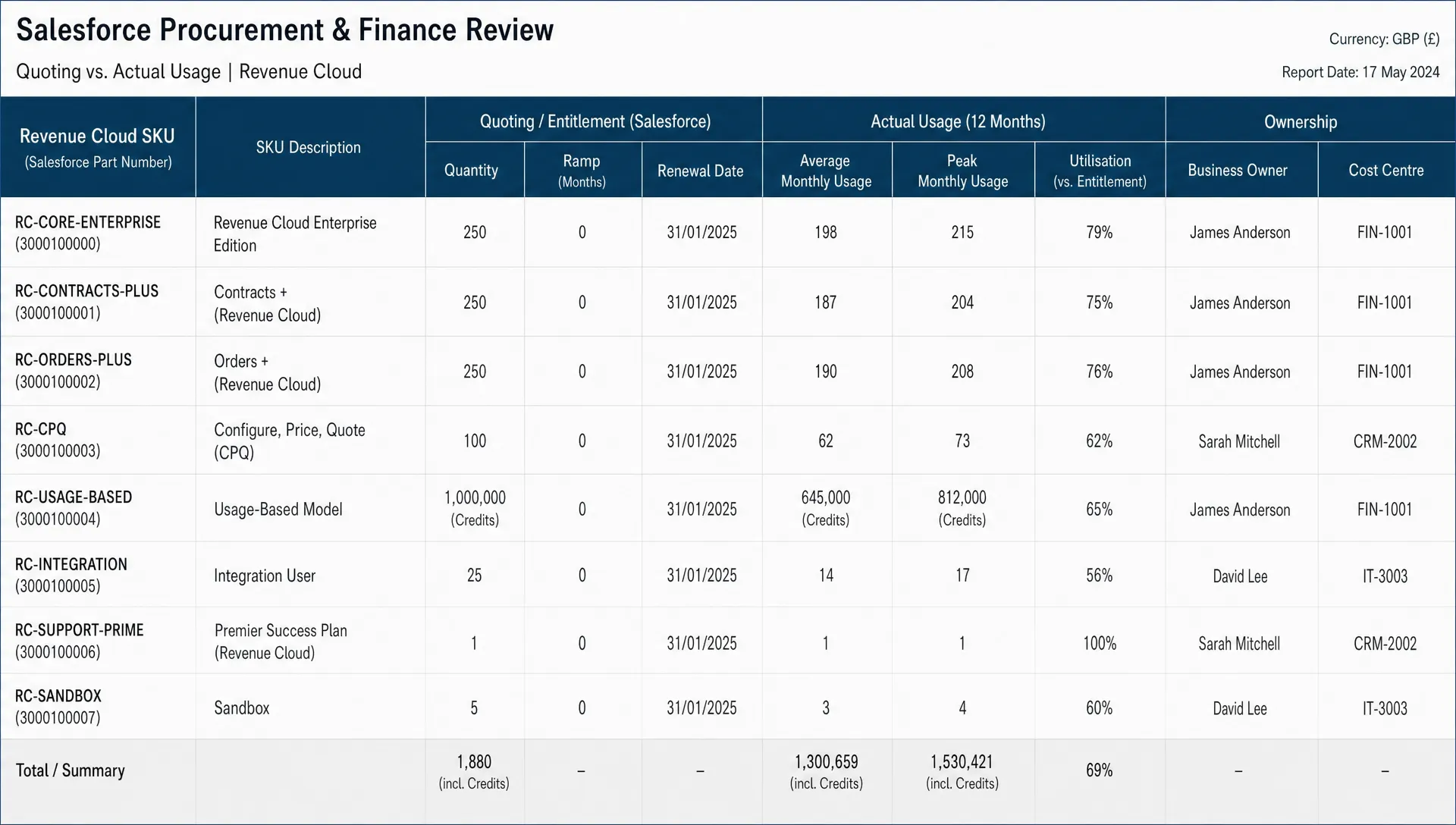
When quoting hides shelfware
At renewal, Salesforce quoting can expose shelfware if the team looks below the headline contract value. Quote line items, amendments and historical approvals often show the moment when spend diverged from usage.
Shelfware is not always caused by poor buying. Sometimes the business case was reasonable when the quote was approved, then priorities changed. A rollout slipped. A team reorganised. A product owner left. The problem is allowing those old assumptions to become the new baseline without evidence.
For Revenue Cloud, this matters because CPQ, Billing and related products can carry configuration, implementation and process dependencies. A licence may appear unused because a project stalled rather than because the product has no value. That distinction matters. The commercial response to stalled adoption is different from the response to a product the business no longer needs.
A good review separates three categories: used and needed, bought but under-used and no longer justified. The negotiation position should then follow the evidence, not the historic quote.
SaaSed has explored this renewal-specific issue in more depth in its guide to unlocking leverage in Revenue Cloud renewals.
Governance questions before the next quote is accepted
A clean Salesforce quoting process should make commercial accountability visible before approval. That does not require a heavy committee. It does require the right questions at the right time.
Before approving a new Revenue Cloud quote, finance, IT and procurement should agree on the following points:
- Which business owner is accountable for each quoted product?
- Which quoted quantities are based on actual usage rather than forecast demand?
- Which discounts or protections are conditional on term length, bundle size or minimum volumes?
- Which quote lines could become shelfware if a project is delayed?
- Which amendments would change the renewal baseline or remove existing concessions?
- Which terms should be negotiated now because they will be harder to fix later?
These questions are deliberately plain. They work because they force the organisation to connect the quote to operating reality. If no one can answer who owns a product or why a quantity is needed, the buyer has found a negotiation point.
The official Salesforce Revenue Cloud overview is a useful reference for understanding the breadth of the platform. Buyers should then map that breadth against their own usage, contract structure and renewal risk.
How to prepare a stronger Revenue Cloud negotiation
Use Salesforce quoting data as evidence, not just background. The most useful renewal preparation usually starts several months before the renewal date, when there is still time to validate usage, challenge bundle logic and model alternatives.
A disciplined preparation phase usually includes contract review, SKU analysis, usage audit, amendment history and a view of upcoming business demand. The point is to build a fact base that finance, IT and procurement can all stand behind. Without that alignment, negotiation becomes a debate about opinions. With it, the buyer can separate necessary spend from avoidable spend.
This is also where contract terms matter. Automatic renewal, uplift clauses, minimum quantities, usage limits and true-up language can all change the value of a quote. If the current contract limits flexibility, the next quote should be used to improve the position rather than simply refresh the old one. SaaSed’s breakdown of SaaS contract clauses that drive up Salesforce costs is a useful checklist for this review.
Strong negotiation is not about being difficult. It is about knowing what you need, what you use and what you are prepared to change.
What good looks like
Good Salesforce quoting discipline gives the buyer three things: visibility, control and credible options. Visibility means the organisation can see product-level cost and usage. Control means amendments, ramps and renewal baselines are reviewed before they harden into commitments. Credible options mean the buyer can reduce, restructure or defer spend without damaging the operating model.
For CFOs, that supports budget accuracy. For CIOs, it protects the architecture from commercial decisions made in haste. For procurement leaders, it creates a clearer route to negotiation leverage.
The strongest outcome is rarely the lowest quoted price in isolation. It is a Revenue Cloud agreement that reflects actual demand, preserves flexibility and avoids paying for assumptions that no longer hold.
Frequently Asked Questions
What is the link between Salesforce quoting and Revenue Cloud cost? The quote defines products, quantities, discounts, dates and amendment treatment. Those choices can become recurring commitments, which means the quoting process can materially change future Revenue Cloud spend.
Should finance review every Salesforce quote? Finance does not need to manage every operational detail, but it should review material quotes, amendments and renewals where quantities, ramps, bundles or contract terms affect future cost.
Can a strong discount still be a bad outcome? Yes. A high discount on products the business does not use well can still create waste. The better test is value against usage, flexibility and renewal position.
When should a Revenue Cloud quote review start? Start before the supplier renewal motion begins, ideally while there is still time to audit usage, test business ownership and model alternative quantities or structures.
Before the next quote becomes your baseline
Revenue Cloud cost control starts before the renewal negotiation. It starts when the quote is still open to challenge and the organisation can ask whether each product, quantity and term is justified.
If you want a second pair of eyes on your Salesforce contract, SKU position or renewal readiness, SaaSed offers a complimentary audit conversation. You can speak with SaaSed about a complimentary Salesforce audit conversation before the next quote becomes your new baseline.
Want this kind of intel on your renewal?
Don’t head into your next software negotiation alone
Contact Us