How Salesforce Pricing Changes Across Products and Contracts
Salesforce pricing is not one neat rate card. Product model, usage metric and contract structure all affect the bill, so buyers need to separate list price from the commercial commitments that shape renewal cost.
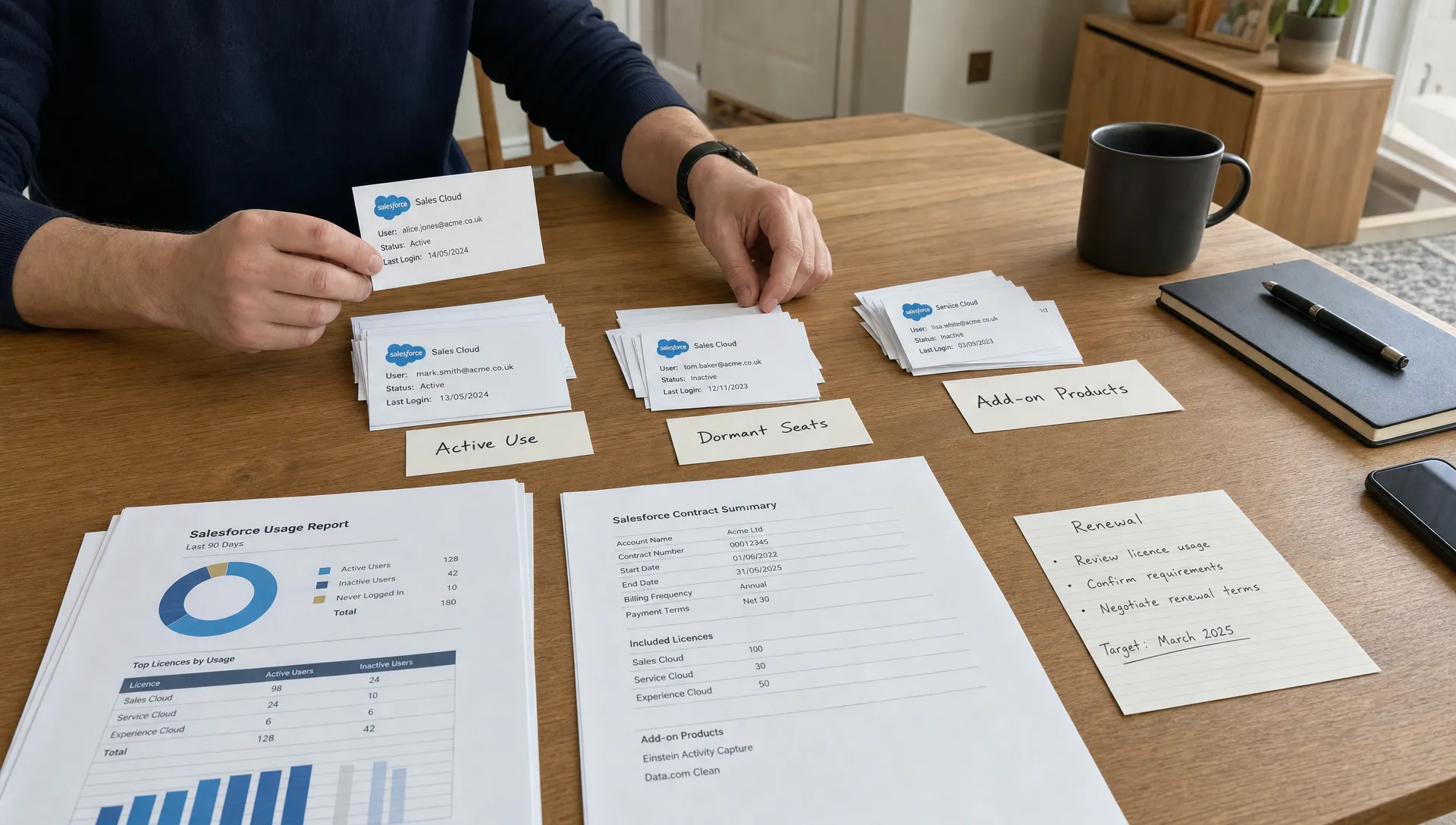
For most leadership teams, Salesforce pricing becomes hard to read when it stops being a clean licence count. One product may be priced per named user, another by consumption, another through a broad enterprise agreement with ramps, floors and bundled rights. The invoice may say Salesforce, but the commercial mechanics underneath can be very different.
That matters because the most expensive Salesforce decisions are often not the obvious ones. A discounted SKU can still be poor value if the entitlement is wrong. A simple per-user cloud can become costly if renewal uplifts and minimum quantities lock in unused licences. A broad agreement can look efficient until the business discovers it cannot scale down.
Pricing Salesforce properly means pricing the contract, not just the SKU.
Public Salesforce pricing is only the starting point
Salesforce publishes list prices and edition details across many of its products. Those pages are useful for orientation, especially when comparing editions or checking whether a quoted product belongs in a standard cloud, industry cloud or add-on family. The Salesforce UK editions and pricing pages are a sensible place to start.
They are not, however, a reliable forecast of your renewal outcome.
Enterprise Salesforce pricing changes once commercial context enters the room. Volume, term length, renewal date, historic discounting, bundled products, growth commitments and contract structure all influence the final number. Two organisations can buy the same named product and end up with very different cost exposure.
The practical question is not simply, “what does this SKU cost?” It is, “what commitment are we making, how flexible is it and what happens at renewal?”
Salesforce products do not all use the same pricing logic
Salesforce is a portfolio, not a single application. Sales Cloud and Service Cloud are often the first products buyers associate with Salesforce pricing, but many larger estates also include platform licences, integration products, data products, marketing tools, AI features, industry-specific clouds and support plans.
Each category can carry a different commercial model.
Core clouds are usually easier to benchmark
Sales Cloud and Service Cloud are commonly priced around named users and editions. In simple terms, a user receives a defined bundle of rights, with higher editions providing broader functionality. This makes them easier to benchmark than some newer or more consumption-led products.
Even so, core cloud pricing can become messy. A business may have full CRM licences for users who only need light access, or a premium edition where only a narrow group uses the added functionality. Procurement teams often focus on the discount percentage, but the bigger issue may be whether the licence mix reflects how people actually work.
A 35 percent discount on the wrong edition is still a bad buy.
Platform and add-on products change the cost base
Platform licences, sandbox capacity, security products, CPQ, Revenue Cloud, Field Service and industry cloud components can shift the cost model away from a clean CRM seat count. These products are often justified by specific operational needs, which is reasonable, but they also create dependency.
Once a process is built around a particular add-on or cloud, the buyer may have less room to remove it later. This is why CIOs and IT leads need to understand not only what is deployed, but what is genuinely embedded. There is a difference between a SKU that is technically assigned and a SKU that the organisation cannot operate without.
Data, integration and marketing products are harder to forecast
Some Salesforce products are more sensitive to business activity, architecture and data design than to headcount. Marketing products may depend on contacts, messaging or channel volumes. Integration tools may depend on capacity, transactions or connected systems. Data Cloud and related capabilities can introduce consumption patterns that are not obvious when the contract is signed.
This is where a usage audit becomes more than housekeeping. If the cost driver is activity rather than users, finance needs a forecast based on actual behaviour. IT needs to know which design choices create more consumption. Procurement needs to ensure the contract has enough control before usage starts to climb.
AI and consumption pricing need stronger governance
Agentic AI, Data Cloud usage and credit-based features make the pricing discussion more dynamic. These models are not inherently bad. They can be fairer than buying large numbers of licences for occasional use. The risk is that consumption can grow faster than budget ownership.
If your Salesforce estate includes Agentforce or related AI consumption, it is worth reviewing the mechanics carefully. We have covered that topic separately in our breakdown of how Flex Credits and tokens can affect your Salesforce bill.
The simple rule is this: when the pricing unit changes, the governance model must change with it.
| Product area | Common pricing pattern | Main risk for buyers | What to check before renewal |
|---|---|---|---|
| Sales Cloud and Service Cloud | Named user and edition-based | Paying for too many users or too rich an edition | Active usage, role fit and edition necessity |
| Platform and add-ons | User, feature or capacity-based | Add-ons becoming embedded but under-reviewed | Dependency, assignment and business owner validation |
| Marketing products | Contact, message, channel or edition-based | Volumes growing without budget visibility | Contact definitions, send volumes and data hygiene |
| Integration and data products | Capacity, transaction or consumption-based | Architecture driving unexpected cost | Actual consumption, growth assumptions and caps |
| AI and automation | Credit, token or usage-based | Spend moving faster than approval processes | Governance, forecast model and overage treatment |
Contracts change Salesforce pricing as much as products do
The same Salesforce product can behave very differently under a standard subscription, a broad enterprise arrangement or a multi-year ramp. Contract structure determines how much flexibility you keep, how much growth you pre-commit and how exposed you are if the business changes direction.
For a deeper comparison of the main structures, our guide to Salesforce Standard Agreements, SELA and AELA models explains how each one affects control and renewal leverage.
Standard subscription agreements
A standard subscription agreement is often easier to read. You buy defined products, quantities and terms. The link between SKU and cost is usually clearer, which helps finance teams track the baseline.
The trade-off is that the buyer may have less scope for broad access or large-volume discounts. If the estate grows quickly, incremental purchases can become fragmented. Co-terming those additions into the main renewal may help administratively, but it can also create a larger renewal event later.
The contract details matter. Auto-renewal terms, uplift language, minimum quantities and notice periods can alter the commercial outcome even when the product mix looks stable.
SELA and AELA structures
A Salesforce Enterprise Licence Agreement or broader access-style structure can make sense for organisations with large, predictable usage and a clear deployment plan. It can reduce friction when teams need access across several products.
The risk is commitment without absorption. If the agreement includes a high spend floor, aggressive ramp or bundled products that are not fully adopted, the buyer may carry shelfware for years. The issue is rarely the acronym itself. SELA and AELA structures can work, but only when the commitment is tied to a credible adoption plan and a clean view of existing usage.
If you are assessing this route, our article on how Salesforce SELA pricing models affect renewal costs goes further into ramps, floors and bundled commitments.
Multi-year ramps and co-terming
Ramps can be useful when there is a genuine rollout plan. They become expensive when future quantities are treated as aspiration rather than evidence. A three-year growth schedule may look manageable in year one, then become difficult if hiring slows, business units reorganise or a deployment takes longer than planned.
Co-terming can also hide cost. When add-ons are aligned to the main renewal date, the first partial term can feel small. At renewal, those same additions land as full-year commitments. CFOs should look at the annualised run rate, not only the current-year invoice.
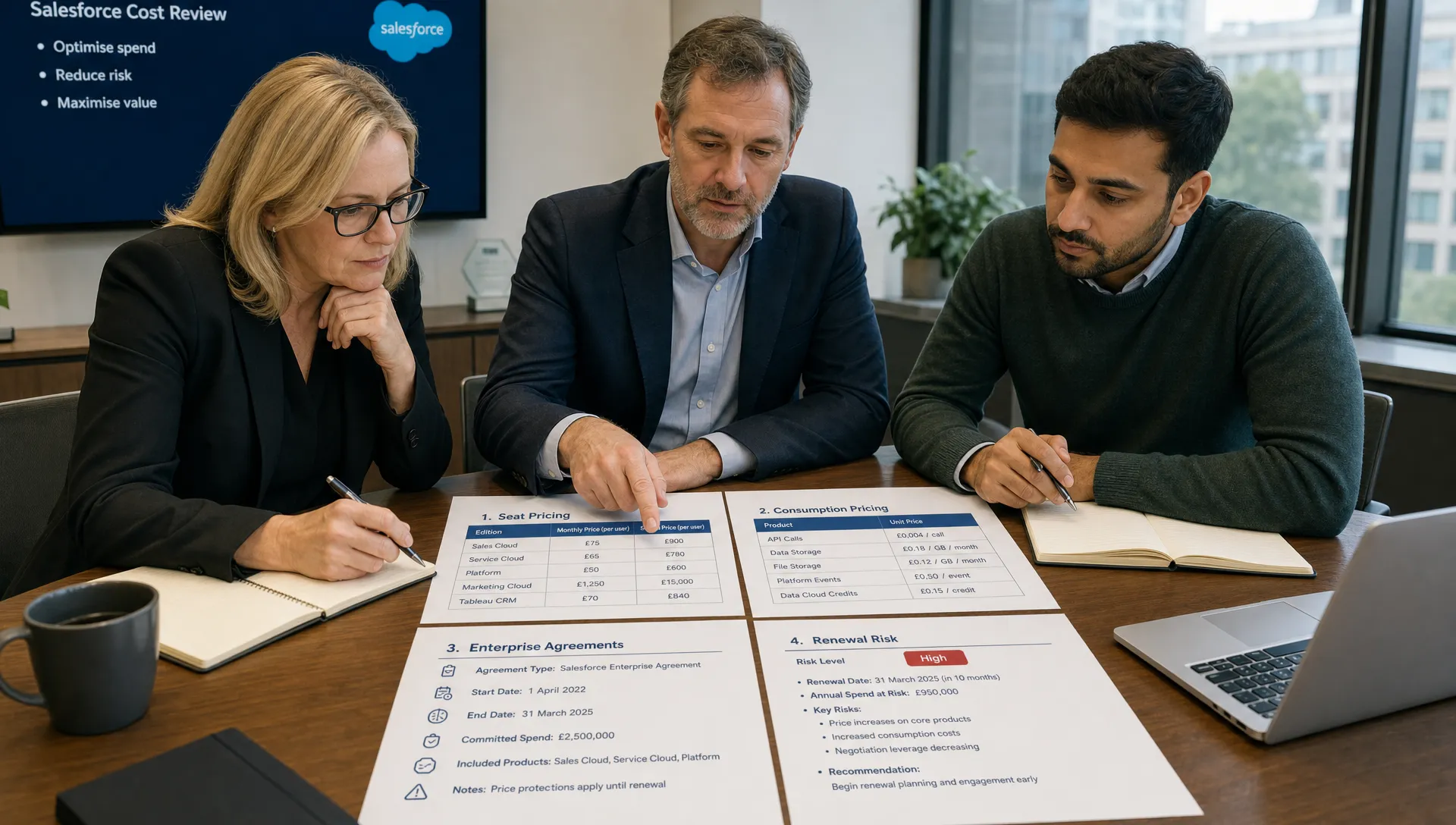
Why two companies can pay differently for the same Salesforce product
Salesforce pricing is negotiated within context. The product name may be identical, but the commercial result is shaped by several variables that are easy to miss if the review starts too late.
Historic discounting sets the anchor
Your current discount can help or hurt. If your organisation received a strong discount in a previous deal, the renewal conversation may focus on defending that position. If the old discount was weak, the renewal may offer room to improve, but only if you can show credible alternatives, usage evidence and a disciplined buying plan.
A weak baseline tends to compound. Each renewal uplift is applied to a starting point that may already be inefficient.
Bundle logic can blur the real price
Bundles can be commercially attractive, but they make it harder to see what each product is really costing. A product may appear inexpensive because value has been shifted elsewhere in the deal. At renewal, that can create problems if you want to remove one element but keep another.
This is why SKU-level transparency matters. Finance may approve a total contract value, but IT and procurement need to understand which products are carrying the economics.
Support plans and success services affect total cost
Salesforce spend is not limited to product licences. Support and success plans can form a meaningful part of the commercial package. These services may be valuable, especially for complex estates, but they should still be reviewed against actual usage and need.
The question is not whether support is good or bad. It is whether the support tier fits the organisation’s maturity, internal capability and dependency on Salesforce.
Contract terms define your downside risk
A good unit price can be undermined by a poor contract term. If quantities cannot be reduced, unused licences remain a cost. If uplift language is too broad, future years become harder to control. If audit, true-up or usage limit terms are unclear, the organisation may carry risk it has not budgeted for.
Salesforce publishes its standard legal materials through its official legal agreements page, but enterprise order forms and negotiated terms can vary. The order form is often where the commercial detail sits.
For a practical view of early warning signs, see our guide to Salesforce contract renewal risks to catch early.
How to review Salesforce pricing before a renewal
A good Salesforce pricing review is not a last-minute discount chase. It is a structured review of demand, usage, contract obligations and negotiation leverage.
Start with the estate you have, not the estate people assume you have. The most useful work often comes from reconciling the contract against real usage and business ownership. That means comparing purchased quantities with assigned licences, assigned licences with active use and active use with business value.
A disciplined review usually covers five areas.
- Build a clean SKU inventory: Capture every Salesforce product, quantity, edition, add-on, support line and contract end date. Do not rely only on invoice totals.
- Match spend to usage: Identify unused licences, lightly used editions, inactive users, duplicate capability and products without a clear business owner.
- Separate committed spend from optional spend: Some items may be removable at renewal, while others are tied into minimums, ramps or bundled structures.
- Model the renewal baseline: Calculate current annualised run rate, contracted uplift, ramp impact and likely full-year cost of co-termed additions.
- Prepare negotiation evidence early: Salesforce negotiations work better when the buyer can show usage data, adoption reality, future demand and a clear decision process.
The point is not to make the smallest possible Salesforce estate. The point is to fund the estate you actually need, with enough flexibility for the next contract period.
What each leadership role should ask
Salesforce pricing touches finance, technology and procurement at the same time. Each function sees a different part of the risk.
| Role | Core question | Why it matters |
|---|---|---|
| CFO | What is our true annualised Salesforce run rate after ramps, uplifts and full-year add-ons? | Budget exposure is often higher than the current invoice suggests |
| CIO or IT lead | Which products are business-critical, underused or technically embedded? | Removal decisions need technical and operational context |
| Procurement leader | Which terms limit our ability to reduce, re-scope or challenge renewal pricing? | Negotiation leverage depends on contract rights and timing |
| Business owner | Which capabilities are delivering measurable value? | Licence demand should reflect actual process adoption |
A shared view prevents a common renewal problem: finance challenges the number, IT defends the platform, procurement negotiates the paperwork and no one has a single version of the truth.
Common mistakes when reading Salesforce pricing
The first mistake is treating list price as the main benchmark. List price is useful, but the real benchmark is the price you pay for the rights you use, under the terms you have accepted.
The second mistake is focusing only on discount percentage. A larger discount can still produce a worse result if it is tied to a longer term, higher minimum, bundled shelfware or a steep ramp.
The third mistake is reviewing the estate too close to renewal. By then, notice windows may have passed, internal usage data may be incomplete and the supplier has a better read of your urgency than you do.
The fourth mistake is assuming all Salesforce products can be governed like Sales Cloud seats. Consumption products, AI credits, data services and integration capacity need a different operating rhythm. Someone needs to own forecast, approval and monitoring.
Frequently Asked Questions
Why does Salesforce pricing vary so much between products? Salesforce products use different pricing units. Some are based on named users, some on editions, some on capacity and some on consumption. The right review depends on the product family and the commercial metric in the order form.
Is Salesforce list pricing a reliable benchmark? It is a useful reference point, but not a complete benchmark. Enterprise pricing is influenced by discount history, volume, term length, bundled products, renewal timing and negotiated contract terms.
Can a low Salesforce unit price still be a bad deal? Yes. A low unit price can still create poor value if the organisation buys too many licences, accepts an unsuitable edition, commits to unused products or loses flexibility at renewal.
Do SELA or AELA agreements always reduce Salesforce costs? No. They can be effective when usage is broad, predictable and well governed. They can also increase waste if the agreement includes high minimum commitments, weak adoption or bundled products the business does not use.
When should a Salesforce pricing review start before renewal? Ideally, several months before the renewal date. The review needs time for usage analysis, stakeholder alignment, contract review and negotiation planning. Starting late usually reduces leverage.
A calmer way to approach the next Salesforce pricing discussion
Salesforce pricing is manageable when the review is grounded in facts: what you own, what you use, what the contract requires and what the business will genuinely need next. The hard part is pulling those facts together before the renewal conversation sets the frame.
If you would like an independent view of your Salesforce contract, SKU mix and renewal position, you can book a complimentary Salesforce audit conversation. We will help you identify where the pricing risk sits and what should be reviewed before commercial talks begin.
Want this kind of intel on your renewal?
Don’t head into your next software negotiation alone
Contact Us