Is Salesforce AELA the New SELA?
Salesforce AELA may look like the next SELA, but the risk profile is different. This guide explains how agentic licensing changes pricing, data dependency and renewal leverage for enterprise buyers.

Salesforce has spent two decades training enterprise buyers to think in users, clouds, editions and SKUs. Agentforce changes the commercial centre of gravity. The question is no longer only, “How many people need access?” It is also, “How much autonomous work will run through the Salesforce ecosystem?”
That shift matters because the old licence architecture was built around humans. Sales reps, service agents, marketers, admins and platform users each carried commercial weight. In an AI operating model, some of that human workflow may be compressed, automated or rerouted through agents.
A Salesforce AELA, short for Agentic Enterprise License Agreement, is Salesforce’s answer to that tension. It appears designed to give large customers broad access to Agentforce, Data Cloud and related platform capabilities through a large, multi-year enterprise commitment rather than a narrow per-seat or per-conversation purchase.
For CFOs, CIOs and procurement leaders, the issue is not whether Agentforce is useful. It may be. The real issue is whether the commercial structure matches the organisation’s actual AI roadmap, data architecture and renewal leverage.
Complexity is a tax on the unknown. If they can’t convince you, they’ll confuse you. AELA is exactly the kind of structure where buyers need to separate architecture from enthusiasm, and roadmap from revenue protection.
What Is a Salesforce AELA?
Direct answer: A Salesforce AELA is an enterprise-wide commercial agreement designed to support broad deployment of autonomous AI agents, Data Cloud infrastructure and foundational Salesforce ecosystem integration for a negotiated flat commitment. Unlike standard consumption models, where organisations pay against agent conversations or related usage units, AELA shifts the buyer into a larger upfront framework built around platform-wide AI capacity.
AELA is best understood as a commercial architecture, not a public price list. Terms will vary by customer, estate size, products in scope, region, timing and the level of executive sponsorship inside the account.
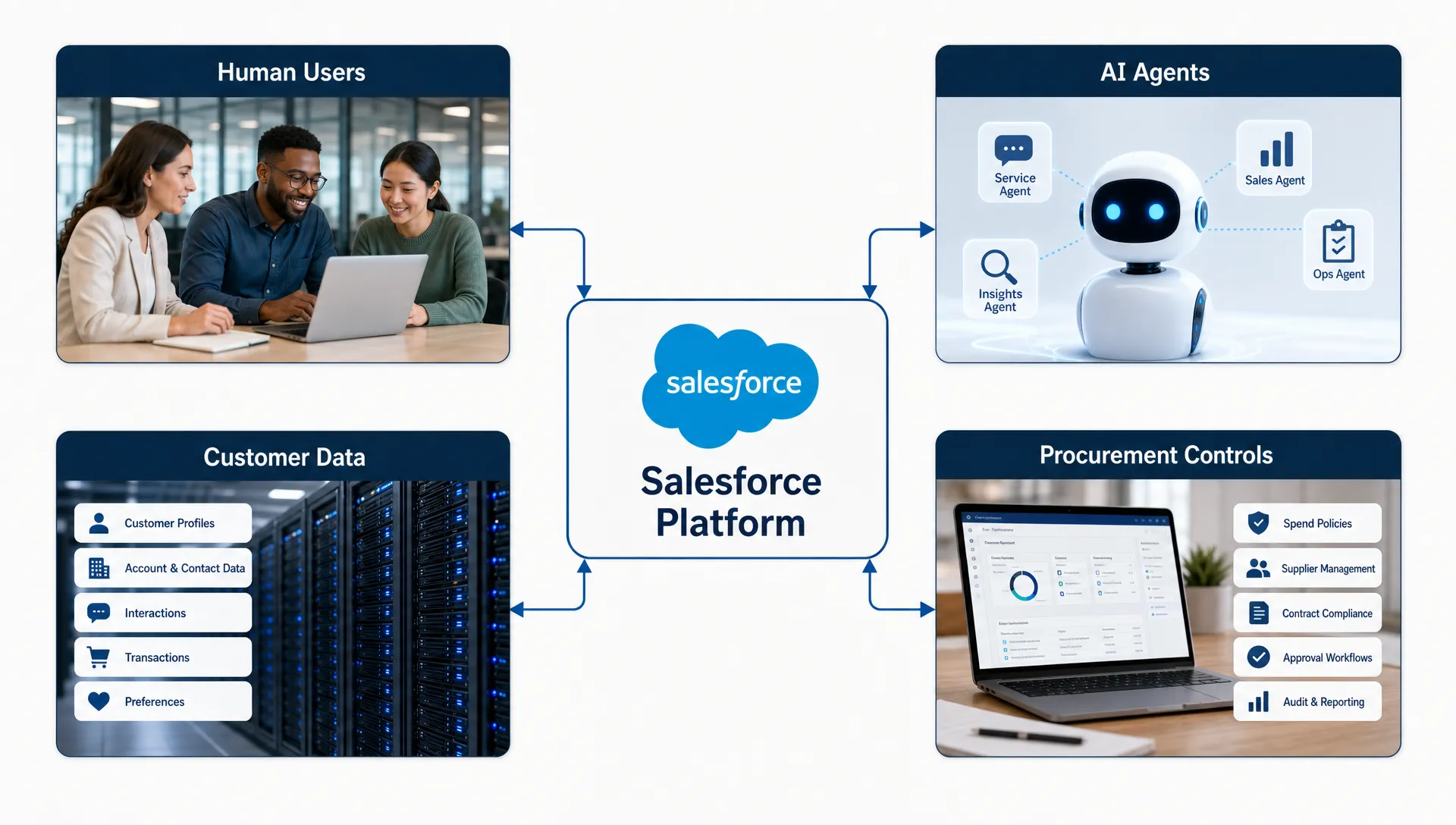
Salesforce’s public positioning around Agentforce as a platform for autonomous AI agents gives useful context. Agentforce is not merely another feature bolted onto Sales Cloud or Service Cloud. It is a new layer intended to perform work across customer-facing and operational processes.
That creates a pricing problem. If AI agents resolve service cases, qualify leads, draft responses, update records and orchestrate workflows, then the old seat-count logic becomes less reliable as a revenue base. AELA answers that problem by commercialising the capacity of the AI-enabled platform rather than only the number of human users sitting in front of it.
How is AELA different from per-conversation Agentforce pricing?
In a metered model, the buyer pays as usage grows. That can be attractive when adoption is uncertain because the commercial exposure stays closer to real activity.
In an AELA model, the buyer usually accepts a larger committed baseline in return for broader deployment rights, simplified internal charging and fewer visible adoption brakes. The trade-off is simple: you reduce friction for internal teams, but you may also move spend ahead of proven demand.
That is not automatically bad. For an enterprise with a mature Salesforce estate, governed data foundations and a credible 24-month AI roadmap, it may be sensible. For a company still testing use cases, cleaning data and debating operating ownership, it can become an expensive forecast disguised as a strategic platform decision.
Is AELA the New SELA?
Direct answer: AELA is the successor to SELA in commercial ambition, but not in commercial mechanics. SELA bundled users and products across the Salesforce estate, while AELA shifts the baseline towards agentic capability, data activation and enterprise-wide AI capacity.
A traditional Salesforce SELA, or Salesforce Enterprise Licence Agreement, was built around scale. It bundled large populations of users, multiple clouds and often a negotiated set of products such as Sales Cloud, Service Cloud, Platform, Slack, Tableau or MuleSoft. The commercial conversation was still anchored in human access, even when the bundle became complex.
AELA changes the anchor. It does not simply ask, “How many users will need Salesforce?” It asks, “How much of your operating model will run on Salesforce agents, Salesforce data and Salesforce orchestration?”
That distinction is not cosmetic. It changes what the buyer is really buying.
With SELA, the hidden risk was often shelfware. You might commit to more licences, editions or adjacent products than the organisation could absorb. With AELA, the hidden risk is architectural dependency. You may commit to a future operating model before your business has proved that it wants that model, can govern it, or should source it entirely from Salesforce.
For readers who want the broader commercial context, SaaSed has already mapped the wider shift in Salesforce commercial structures from standard agreements to SELA and AELA. This article goes deeper into the architectural procurement consequences of AELA specifically.
Why would Salesforce move from seats to agents?
The seat model is exposed when automation becomes credible. If AI can handle work that previously required incremental human licences, seat growth becomes a weaker predictor of vendor revenue.
AELA gives Salesforce a way to protect and expand enterprise spend even if employee licence demand flattens. It reframes the value baseline from “number of users” to “amount of work the Salesforce platform can automate”.
This is why buyers should look past the surface narrative. The vendor may describe AELA as simplification. Procurement should also recognise it as revenue continuity.
Neither interpretation is unfair. Both can be true at the same time.
AELA vs. SELA: What Is the Difference?
Direct answer: SELA is mainly a licence consolidation structure for human users and legacy Salesforce product SKUs. AELA is an AI-era platform commitment that blends agent deployment, data infrastructure and ecosystem dependency into a larger commercial frame.
The structural evolution is easiest to see through the pricing metric. SELA made large estates easier to package by turning many individual licences into an enterprise construct. AELA goes further by attempting to commercialise the future work capacity of AI agents.
That makes the negotiation harder. In a SELA negotiation, the buyer can usually test the proposal against known inputs: deployed users, inactive users, product adoption, contracted SKUs, ramp schedules and business unit demand.
In an AELA negotiation, many inputs are probabilistic. The buyer must estimate future agent volume, use case maturity, data readiness, workflow redesign, business adoption, compliance controls, AI governance and the likelihood that Salesforce will remain the preferred AI execution layer.
That is a much more speculative deal model.
How does AELA solve Salesforce’s AI monetisation problem?
AI creates a paradox for enterprise SaaS vendors. If AI increases productivity, buyers may need fewer seats. If fewer seats are needed, traditional subscription growth becomes harder.
AELA resolves that paradox by charging for AI-enabled capacity and ecosystem commitment rather than relying solely on headcount-linked access. In practical terms, it protects Salesforce’s commercial floor while giving the customer permission to scale agentic workflows without negotiating every incremental use case.
The buyer should not object to Salesforce monetising value. Vendors are entitled to be paid for meaningful capability. The procurement concern is whether the payment structure reflects value actually captured by the customer, or value the customer is merely expected to capture later.
What Are the Strategic Traps of the AELA Structure?
Direct answer: The main risks of AELA are not only price, but dependency, internal option loss and renewal-floor expansion. The agreement can look efficient in year one while quietly narrowing the buyer’s future sourcing choices.
AELA creates a particular kind of procurement problem because the commercial logic is attractive. If a flat enterprise fee makes Agentforce feel “already paid for”, internal teams may naturally default to it for AI use cases. That can be useful where standardisation is the goal. It can also crowd out better-fit tools before they receive a fair evaluation.
The following risks deserve board-level visibility before signing.
- Integration Gravity: A flat, broad AELA fee can create an internal Salesforce AI monopoly. Once business units are told that Agentforce is covered under the enterprise deal, procurement may find it hard to approve specialist AI tools later, even when those tools are better suited to a particular workflow.
- Data Dependency Lock-in: AELA will often increase reliance on Salesforce Data Cloud or adjacent data services as the context layer for agents. Salesforce describes Data Cloud as a way to unify and activate customer data, which may be valuable, but deeper data centrality also raises future switching costs.
- The Baseline Floor Mirage: “Unlimited” can sound like the removal of constraints, but enterprise agreements often carry minimum commitments, scope assumptions, architectural dependencies and renewal baselines. At the three-year renewal, the starting point may be the AELA floor, not actual realised value.
- The Forecasting Gap: Agentic usage is hard to forecast because most organisations do not yet know which AI use cases will survive compliance, adoption and operational scrutiny. If the AELA is priced on optimistic use-case volume, the buyer carries the risk of under-adoption.
- The Governance Drag: Autonomous agents touch data quality, security, permissions, auditability, customer experience and operational controls. If those governance layers are immature, broad commercial access may accelerate experimentation faster than the organisation can safely govern it.
The critical point is not that these risks make AELA unsuitable. They mean AELA needs to be evaluated as architecture, not as a discount vehicle.
A useful parallel comes from brand and market positioning. Strong challengers do not buy a category narrative just because the incumbent names it well; they test whether the narrative serves their own growth plan. That same discipline applies here: test whether the vendor's narrative serves your growth plan before you commit to it.
AELA vs. SELA: How Do the Architectures Compare?
Direct answer: SELA is primarily a bundled licence framework for scaling Salesforce across known user populations. AELA is a broader AI platform commitment that prices future automation capacity and data dependency, often before demand is fully proven.
The table below shows the core architectural difference from a procurement lens.
| Commercial Attribute | Salesforce SELA (Legacy) | Salesforce AELA (Agentic) |
|---|---|---|
| Core Pricing Metric | User seats, editions, product SKUs and enterprise licence scope | Agentic capability, AI usage capacity, data infrastructure and platform-wide deployment rights |
| Primary Value Driver | Standardisation, volume discounting and estate consolidation across Salesforce products | Acceleration of autonomous workflows, AI adoption and data-driven orchestration across the Salesforce ecosystem |
| Hidden Procurement Risk | Shelfware, bundled products, rigid ramps and over-licensed user populations | Architectural lock-in, uncertain AI demand, Data Cloud dependency and high renewal floors |
| Renewal Predictability | Easier to model because usage, seats and product adoption are measurable | Harder to model because agent value, use-case survival and data architecture maturity are less predictable |
The table highlights why AELA should not be treated as a simple evolution of SELA. SELA consolidation can often be audited through current-state data. AELA requires current-state data plus a credible view of future operating design.
If you need a more direct commercial comparison, SaaSed’s analysis of Salesforce SELA vs. AELA and the agentic AI cost paradigm covers the cost mechanics in more detail.
When Does a Salesforce AELA Make Commercial Sense?
Direct answer: A Salesforce AELA makes sense when the organisation has a validated, near-term roadmap for deploying AI agents across material Salesforce workflows. It is weaker when the roadmap is exploratory, the data layer is unsettled, or the business wants freedom to compare best-of-breed AI tools.
AELA can be a rational structure for certain large enterprises. The problem is not the framework itself. The problem is signing it before the organisation has earned the right to simplify.
The strongest AELA candidates usually have several conditions in place.
| Readiness Area | What Good Looks Like | What Should Worry Buyers |
|---|---|---|
| AI roadmap | Prioritised use cases with owners, timelines, risk ratings and expected value | A long list of ideas with no sequencing or accountable business owner |
| Data architecture | Clear role for Salesforce Data Cloud in the enterprise data model | Competing data platforms, unclear ownership or unresolved data quality issues |
| Governance | Security, legal, compliance and operational teams involved before contract signature | Procurement asked to approve commercial terms before governance has assessed risk |
| Adoption economics | Modelled comparison between metered usage and AELA commitment | AELA justified mainly by “unlimited” language or fear of future price increases |
| Exit leverage | Defined renewal guardrails, termination options and decoupled pricing where possible | A single bundled number with no clear way to challenge value at renewal |
The last row is often the most important. AELA can remove visible unit pricing from the conversation, which makes the deal easier to present and harder to interrogate. Procurement should resist that opacity.
Ask for the assumptions. Ask for the model. Ask how the price changes if Data Cloud scope, agent volume, business units or included products change. If the answer is vague, the risk has not disappeared. It has only moved into the renewal.
What Is the SaaSed Calibration Strategy Before Signing an AELA?
Direct answer: The SaaSed calibration strategy is to test AELA against actual usage, credible AI demand, data readiness, benchmarked pricing and renewal-floor exposure before changing contract structure. The aim is not to block AELA, but to make sure the buyer understands what they are giving up in return for commercial simplicity.
A good AELA negotiation starts before Salesforce frames the decision as urgent. Once the vendor has tied AELA to executive innovation goals, competitive fear or a renewal deadline, the buyer’s room to calibrate narrows.
SaaSed recommends four practical tests.
What is the current Salesforce estate really using?
Start with the existing contract and SKU map. Identify active users, inactive users, underused licences, duplicative products, permission-set sprawl, support entitlements, add-ons and contractual dependencies.
This matters because AELA proposals are often built on the current commercial baseline. If the baseline already contains waste, the AI-era agreement may simply preserve that waste in a more sophisticated wrapper.
A clean SKU and usage review gives the buyer a fact base before any AI premium is discussed. SaaSed’s work around Salesforce negotiation tactics that improve leverage follows the same principle: negotiation strength comes from evidence, not from late-stage pressure.
Which AI use cases are real in the next 24 months?
AELA should be tested against a 24-month roadmap, not a five-year vision deck. The further out the benefit, the more likely the buyer is funding uncertainty.
The use-case list should distinguish between automation that is technically possible and automation the business is ready to operate. A support agent summarising cases may be near-term. A fully autonomous account management workflow may be much further away. Those two use cases should not carry the same commercial weight.
What must sit inside Salesforce, and what should remain contestable?
Not every AI workflow belongs inside Salesforce. Some may sit better in the contact centre stack, data platform, document layer, ERP environment, engineering tools or specialist vertical applications.
Before signing AELA, procurement should map which domains genuinely benefit from Salesforce-native agentic execution and which domains should remain open to alternative suppliers. This is the antidote to integration gravity.
What happens at renewal if adoption underperforms?
This is the uncomfortable question, and it should be asked early. If the organisation signs a three-year AELA and only half the expected use cases mature, what is the renewal basis?
Buyers should seek clarity on renewal floors, price protections, scope flexibility, carve-outs, reporting, benchmarking rights and the ability to decouple components. The aim is to avoid a situation where year-three pricing is anchored to year-one optimism rather than realised value.
What Should CFOs, CIOs and Procurement Leads Ask Salesforce?
Direct answer: Buyers should ask Salesforce to make the commercial assumptions behind AELA explicit and testable. If the proposal depends on future AI value, the contract should show how that value will be measured, governed and adjusted.
Good questions change the tone of the negotiation. They move the conversation from belief to evidence.
- What is included: Which products, agents, environments, data services, sandboxes, support tiers and integrations are included in the AELA scope?
- What is excluded: Which usage types, overages, premium capabilities, add-ons or future releases may still create incremental spend?
- What is the baseline: Which existing contract values, products and renewal assumptions are being used to construct the AELA price?
- What is the value model: Which use cases justify the commitment, and what quantified value is attached to each one?
- What is the exit path: How can the organisation reduce, decouple or restructure the agreement if the AI roadmap changes?
These are not hostile questions. They are adult questions for a large, multi-year commitment.
Frequently Asked Questions About Salesforce AELA
Is Salesforce AELA officially replacing SELA? Not necessarily. AELA is better viewed as an AI-era commercial framework that may sit alongside or supersede SELA for certain large enterprise customers. Whether it replaces SELA depends on the account strategy, Salesforce estate and proposed contract structure.
Is AELA cheaper than paying per Agentforce conversation? It can be cheaper if usage is high, adoption is broad and the organisation genuinely needs enterprise-wide AI agent deployment. It can be more expensive if adoption is uncertain, use cases remain narrow or the business has not validated the value of an all-Salesforce AI architecture.
What is the biggest procurement risk in a Salesforce AELA? The biggest risk is not only overpaying in year one. It is accepting a renewal floor and data dependency structure that weakens future leverage.
Should CFOs approve AELA as an innovation investment? Only if the innovation case is supported by a measurable operating plan. AELA should not be approved because AI is strategically important in general; it should be approved because specific Salesforce-native agentic use cases justify the commitment.
How early should buyers assess an AELA proposal? Ideally 9 to 12 months before renewal. AELA needs more time than a standard renewal because it touches data architecture, operating design, governance and long-term sourcing strategy.
Conclusion: Is Salesforce AELA the New SELA?
Direct answer: AELA is the new SELA only in the sense that it is Salesforce’s next large-enterprise commitment model. In substance, it is more consequential because it can shape AI architecture, data dependency and renewal leverage for years.
Enterprises should not rush into AELA because of FOMO, vendor pressure or a fear that they will miss the AI window. The better test is quieter and more disciplined: does the next 24 months genuinely require an all-Salesforce autonomous ecosystem?
If yes, AELA may be a useful structure. If not, a metered model, narrower pilot, staged commercial pathway or decoupled renewal may preserve more option value.
Before moving from SELA or a standard Salesforce agreement into AELA, build the fact base. Audit the current estate. Benchmark the proposal. Validate the roadmap. Stress-test the renewal floor. Then negotiate from evidence.
SaaSed helps large Salesforce customers do exactly that through independent contract analysis, SKU review, usage audit, benchmark assessment and negotiation support. If you are considering AELA or being steered towards it, start with a complimentary Salesforce audit conversation before the commercial architecture becomes difficult to unwind.
Want this kind of intel on your renewal?
Don’t head into your next software negotiation alone
Contact Us