
Is Salesforce AELA the New SELA?
Salesforce AELA may look like the next SELA, but the risk profile is different. This guide explains how agentic licensing changes pricing, data dependency and renewal leverage for enterprise buyers.
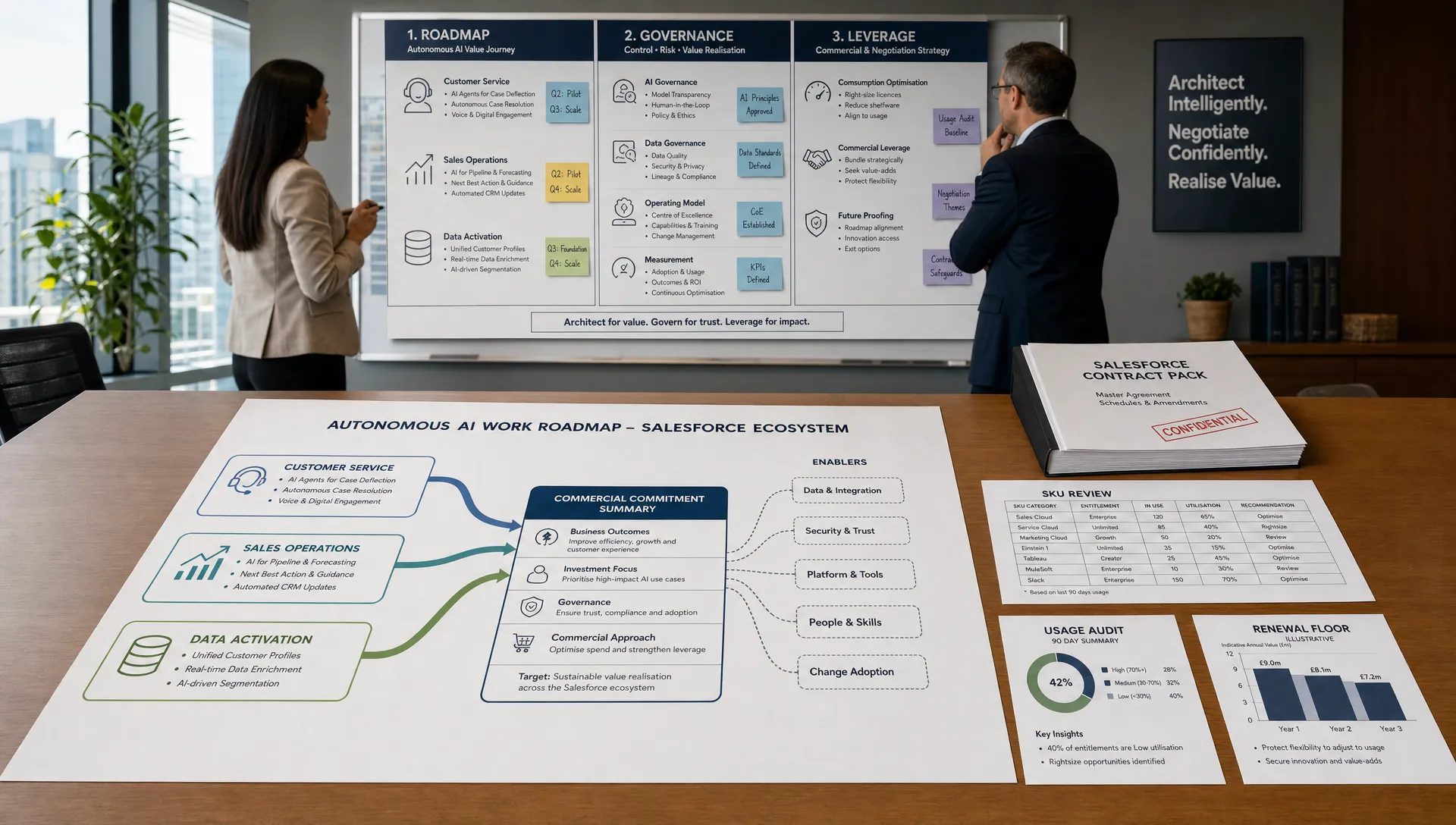
AELA vs. SELA: How Do the Architectures Compare?
Direct answer: SELA is primarily a bundled licence framework for scaling Salesforce across known user populations. AELA is a broader AI platform commitment that prices future automation capacity and data dependency, often before demand is fully proven.
The table below shows the core architectural difference from a procurement lens.
| Commercial Attribute | Salesforce SELA (Legacy) | Salesforce AELA (Agentic) |
|---|---|---|
| Core Pricing Metric | User seats, editions, product SKUs and enterprise licence scope | Agentic capability, AI usage capacity, data infrastructure and platform-wide deployment rights |
| Primary Value Driver | Standardisation, volume discounting and estate consolidation across Salesforce products | Acceleration of autonomous workflows, AI adoption and data-driven orchestration across the Salesforce ecosystem |
| Hidden Procurement Risk | Shelfware, bundled products, rigid ramps and over-licensed user populations | Architectural lock-in, uncertain AI demand, Data Cloud dependency and high renewal floors |
| Renewal Predictability | Easier to model because usage, seats and product adoption are measurable | Harder to model because agent value, use-case survival and data architecture maturity are less predictable |
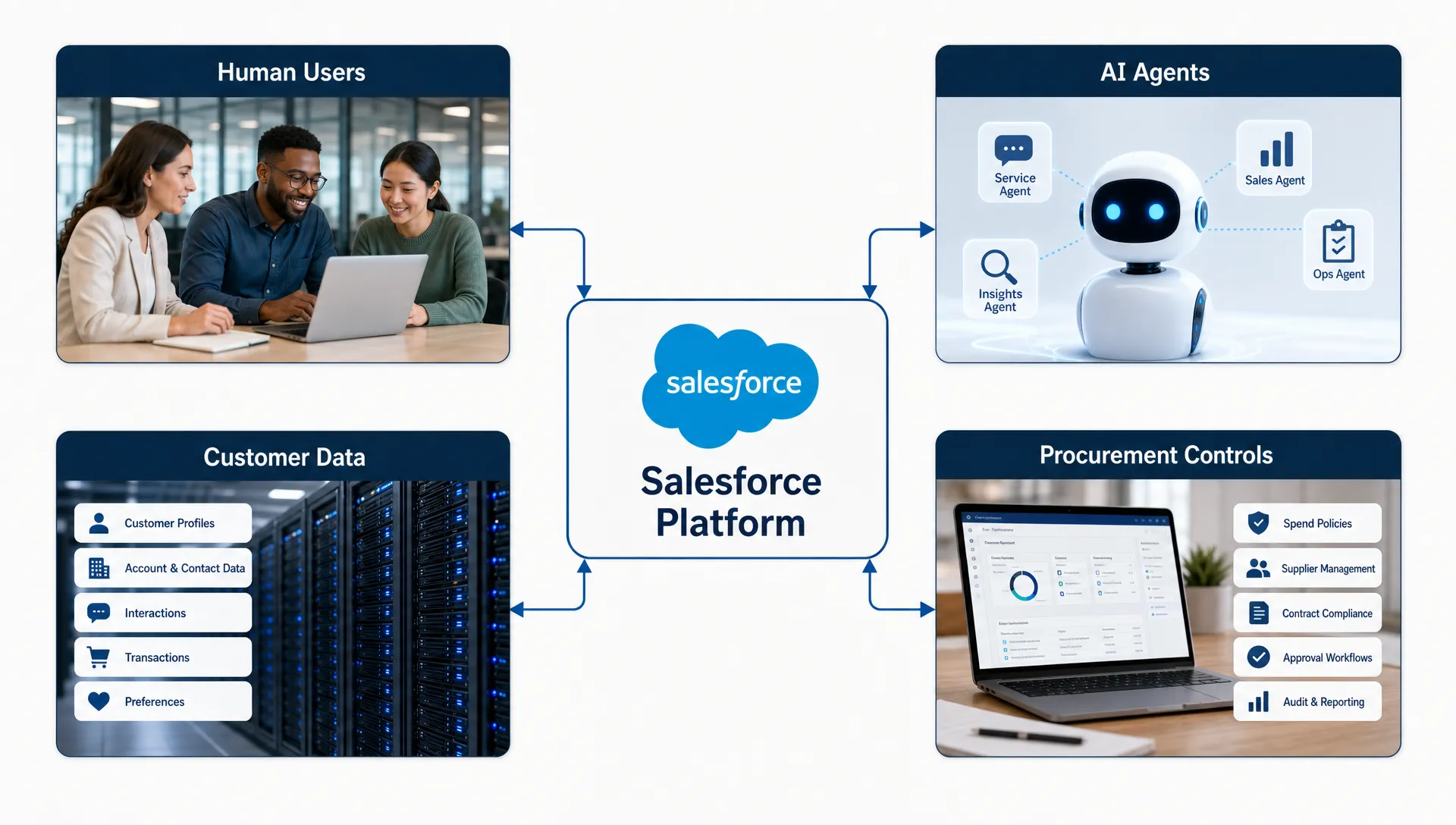
The table highlights why AELA should not be treated as a simple evolution of SELA. SELA consolidation can often be audited through current-state data. AELA requires current-state data plus a credible view of future operating design.
If you need a more direct commercial comparison, SaaSed’s analysis of Salesforce SELA vs. AELA and the agentic AI cost paradigm covers the cost mechanics in more detail.
When Does a Salesforce AELA Make Commercial Sense?
Direct answer: A Salesforce AELA makes sense when the organisation has a validated, near-term roadmap for deploying AI agents across material Salesforce workflows. It is weaker when the roadmap is exploratory, the data layer is unsettled, or the business wants freedom to compare best-of-breed AI tools.
AELA can be a rational structure for certain large enterprises. The problem is not the framework itself. The problem is signing it before the organisation has earned the right to simplify.
The strongest AELA candidates usually have several conditions in place.
| Readiness Area | What Good Looks Like | What Should Worry Buyers |
|---|---|---|
| AI roadmap | Prioritised use cases with owners, timelines, risk ratings and expected value | A long list of ideas with no sequencing or accountable business owner |
| Data architecture | Clear role for Salesforce Data Cloud in the enterprise data model | Competing data platforms, unclear ownership or unresolved data quality issues |
| Governance | Security, legal, compliance and operational teams involved before contract signature | Procurement asked to approve commercial terms before governance has assessed risk |
| Adoption economics | Modelled comparison between metered usage and AELA commitment | AELA justified mainly by “unlimited” language or fear of future price increases |
| Exit leverage | Defined renewal guardrails, termination options and decoupled pricing where possible | A single bundled number with no clear way to challenge value at renewal |
The last row is often the most important. AELA can remove visible unit pricing from the conversation, which makes the deal easier to present and harder to interrogate. Procurement should resist that opacity.
Ask for the assumptions. Ask for the model. Ask how the price changes if Data Cloud scope, agent volume, business units or included products change. If the answer is vague, the risk has not disappeared. It has only moved into the renewal.
What Is the SaaSed Calibration Strategy Before Signing an AELA?
Direct answer: The SaaSed calibration strategy is to test AELA against actual usage, credible AI demand, data readiness, benchmarked pricing and renewal-floor exposure before changing contract structure. The aim is not to block AELA, but to make sure the buyer understands what they are giving up in return for commercial simplicity.
A good AELA negotiation starts before Salesforce frames the decision as urgent. Once the vendor has tied AELA to executive innovation goals, competitive fear or a renewal deadline, the buyer’s room to calibrate narrows.
SaaSed recommends four practical tests.
What is the current Salesforce estate really using?
Start with the existing contract and SKU map. Identify active users, inactive users, underused licences, duplicative products, permission-set sprawl, support entitlements, add-ons and contractual dependencies.
This matters because AELA proposals are often built on the current commercial baseline. If the baseline already contains waste, the AI-era agreement may simply preserve that waste in a more sophisticated wrapper.
A clean SKU and usage review gives the buyer a fact base before any AI premium is discussed. SaaSed’s work around Salesforce negotiation tactics that improve leverage follows the same principle: negotiation strength comes from evidence, not from late-stage pressure.
Which AI use cases are real in the next 24 months?
AELA should be tested against a 24-month roadmap, not a five-year vision deck. The further out the benefit, the more likely the buyer is funding uncertainty.
The use-case list should distinguish between automation that is technically possible and automation the business is ready to operate. A support agent summarising cases may be near-term. A fully autonomous account management workflow may be much further away. Those two use cases should not carry the same commercial weight.
What must sit inside Salesforce, and what should remain contestable?
Not every AI workflow belongs inside Salesforce. Some may sit better in the contact centre stack, data platform, document layer, ERP environment, engineering tools or specialist vertical applications.
Before signing AELA, procurement should map which domains genuinely benefit from Salesforce-native agentic execution and which domains should remain open to alternative suppliers. This is the antidote to integration gravity.
What happens at renewal if adoption underperforms?
This is the uncomfortable question, and it should be asked early. If the organisation signs a three-year AELA and only half the expected use cases mature, what is the renewal basis?
Buyers should seek clarity on renewal floors, price protections, scope flexibility, carve-outs, reporting, benchmarking rights and the ability to decouple components. The aim is to avoid a situation where year-three pricing is anchored to year-one optimism rather than realised value.
What Should CFOs, CIOs and Procurement Leads Ask Salesforce?
Direct answer: Buyers should ask Salesforce to make the commercial assumptions behind AELA explicit and testable. If the proposal depends on future AI value, the contract should show how that value will be measured, governed and adjusted.
Good questions change the tone of the negotiation. They move the conversation from belief to evidence.
- What is included: Which products, agents, environments, data services, sandboxes, support tiers and integrations are included in the AELA scope?
- What is excluded: Which usage types, overages, premium capabilities, add-ons or future releases may still create incremental spend?
- What is the baseline: Which existing contract values, products and renewal assumptions are being used to construct the AELA price?
- What is the value model: Which use cases justify the commitment, and what quantified value is attached to each one?
- What is the exit path: How can the organisation reduce, decouple or restructure the agreement if the AI roadmap changes?
These are not hostile questions. They are adult questions for a large, multi-year commitment.
Frequently Asked Questions About Salesforce AELA
Is Salesforce AELA officially replacing SELA? Not necessarily. AELA is better viewed as an AI-era commercial framework that may sit alongside or supersede SELA for certain large enterprise customers. Whether it replaces SELA depends on the account strategy, Salesforce estate and proposed contract structure.
Is AELA cheaper than paying per Agentforce conversation? It can be cheaper if usage is high, adoption is broad and the organisation genuinely needs enterprise-wide AI agent deployment. It can be more expensive if adoption is uncertain, use cases remain narrow or the business has not validated the value of an all-Salesforce AI architecture.
What is the biggest procurement risk in a Salesforce AELA? The biggest risk is not only overpaying in year one. It is accepting a renewal floor and data dependency structure that weakens future leverage.
Should CFOs approve AELA as an innovation investment? Only if the innovation case is supported by a measurable operating plan. AELA should not be approved because AI is strategically important in general; it should be approved because specific Salesforce-native agentic use cases justify the commitment.
How early should buyers assess an AELA proposal? Ideally 9 to 12 months before renewal. AELA needs more time than a standard renewal because it touches data architecture, operating design, governance and long-term sourcing strategy.
Conclusion: Is Salesforce AELA the New SELA?
Direct answer: AELA is the new SELA only in the sense that it is Salesforce’s next large-enterprise commitment model. In substance, it is more consequential because it can shape AI architecture, data dependency and renewal leverage for years.
Enterprises should not rush into AELA because of FOMO, vendor pressure or a fear that they will miss the AI window. The better test is quieter and more disciplined: does the next 24 months genuinely require an all-Salesforce autonomous ecosystem?
If yes, AELA may be a useful structure. If not, a metered model, narrower pilot, staged commercial pathway or decoupled renewal may preserve more option value.
Before moving from SELA or a standard Salesforce agreement into AELA, build the fact base. Audit the current estate. Benchmark the proposal. Validate the roadmap. Stress-test the renewal floor. Then negotiate from evidence.
SaaSed helps large Salesforce customers do exactly that through independent contract analysis, SKU review, usage audit, benchmark assessment and negotiation support. If you are considering AELA or being steered towards it, start with a complimentary Salesforce audit conversation before the commercial architecture becomes difficult to unwind.
Want this kind of intel on your renewal?
Don’t head into your next software negotiation alone
Talk to the team