A Salesforce Case Example for Procurement Leaders
This anonymised Salesforce case example shows how a procurement team moved from price pressure to leverage. It covers the contract review, usage audit, stakeholder alignment and practical negotiation choices that changed the renewal outcome.

Most Salesforce renewals become expensive for ordinary reasons. The contract is hard to read. Usage data arrives late. Business owners ask for growth without owning the demand. By the time procurement enters the room, the deal has already been framed around the vendor’s proposal.
This Salesforce case example is anonymised and simplified, but it reflects a pattern procurement leaders will recognise. It is not a story about beating up a supplier. It is about replacing ambiguity with facts before commercial positions harden.
If you prefer a named case study, the PHMG renewal conversation with CFO Matthew Toynton shows how this diagnostics-first approach looks in practice. The example below focuses on the procurement mechanics behind the outcome.
The case: a good platform, a messy renewal
An EMEA services business was seven months from its Salesforce renewal. Salesforce was embedded in sales, service and marketing operations. Nobody disputed the strategic value of the platform. The concern was more precise: the renewal proposal assumed more growth, more products and a longer commitment than the business could properly justify.
For confidentiality, the figures below are rounded and illustrative. The pattern matters more than the exact numbers.
| Area | Starting point | Procurement risk |
|---|---|---|
| Annual Salesforce spend | About €2.8m | Proposed renewal showed a low double-digit increase |
| Products in scope | Sales Cloud, Service Cloud, CPQ, marketing automation and integrations | Hard to see which products were essential and which were legacy additions |
| Contracted users | 1,050 core users | User count had grown faster than active adoption |
| Active users | 742 users active in the prior 90 days | Potential shelfware, but not all inactive users were removable |
| Renewal timing | Seven months before expiry | Enough time to prepare, but not enough time to drift |
The CIO’s position was sensible: do not damage a platform the business relies on. The CFO’s position was equally sensible: do not approve another large renewal based on inherited assumptions. Procurement’s task was to make both positions live in the same room.
The first mistake they avoided: negotiating the quote too early
The account team’s first proposal was not unreasonable on the surface. It offered a three-year renewal, a protected discount and additional capacity for future teams. That is often how Salesforce renewals are framed: continuity, protection and growth.
The procurement lead did not counter with a number. That was the important move.
A premature counter would have accepted the vendor’s framing. Instead, procurement paused the commercial discussion and built an internal fact base. The question changed from ‘what discount can we get?’ to ‘what are we actually buying, using and willing to commit to?’
That shift sounds small. It is not. In Salesforce renewals, leverage rarely comes from one clever line in a negotiation call. It comes from knowing where the proposal does not match reality.
For a wider view on this preparation work, SaaSed’s guide to Salesforce negotiation tactics that improve leverage covers the same principle in more detail: start early, build the evidence and avoid negotiating inside someone else’s assumptions.
What the audit found
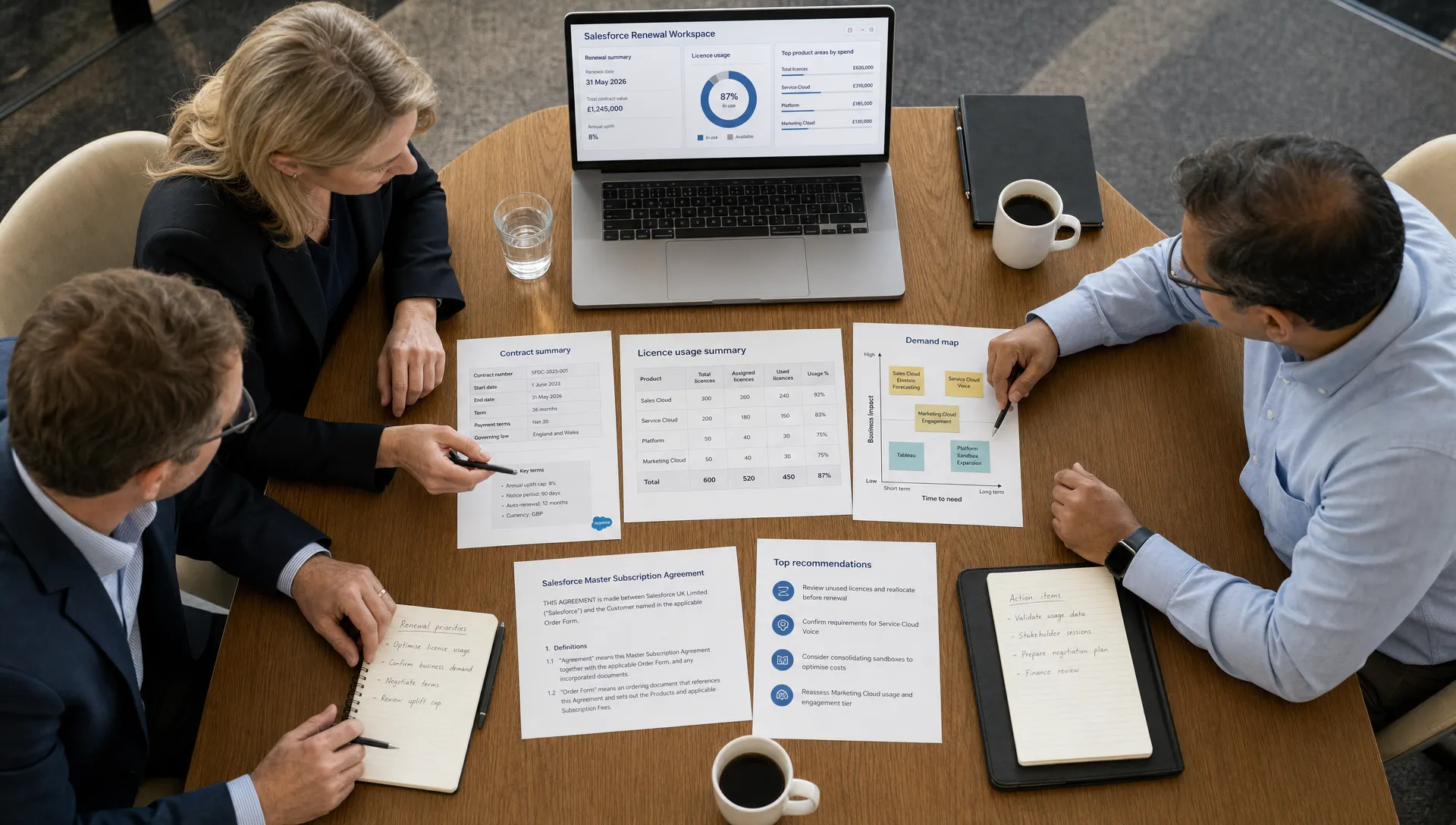
The team ran the review across contract terms, SKUs, user activity, stakeholder demand and commercial history. They did not treat every unused licence as waste. Some inactive accounts were seasonal. Some were tied to compliance processes. Some belonged to users who had changed roles but still needed access occasionally.
That distinction matters. A careless licence cut can create operational noise and make procurement look blunt. A good audit separates genuine waste from necessary flexibility.
| Finding | Commercial meaning | Procurement action |
|---|---|---|
| 168 assigned users had no login in 90 days | Possible shelfware, but needed business validation | Reviewed by department owner before removal decisions |
| 92 users appeared to have a licence or access profile above their actual need | Potential licence mismatch | Tested whether lower-cost alternatives or process changes were realistic |
| Proposed growth was not tied to named hiring plans | Future demand was speculative | Separated approved demand from forecast demand |
| Add-on products had uneven adoption | Bundle value was unclear | Asked for line-item economics and renewal flexibility |
| Renewal language made future downsizing difficult | Risk would compound at the next renewal | Pushed for cleaner renewal terms and clearer product-level pricing |
Licence type matters because it controls permissions, capability and cost. Salesforce’s own documentation on available user licence types is a useful reference point when procurement, IT and business owners are testing whether the estate still matches actual work patterns.
The audit also surfaced a softer issue: nobody internally owned the full Salesforce demand picture. Sales wanted flexibility. Service wanted stability. Marketing wanted room to experiment. Finance wanted predictability. IT wanted fewer exceptions.
None of these views was wrong. The problem was that the supplier was the only party stitching them into one commercial story.
The procurement move: create a clean buying position
Procurement’s useful contribution was not simply to challenge cost. It was to make the internal position coherent.
The team divided demand into three categories: must-have capacity, likely near-term demand and speculative demand. Only the first category was allowed into the committed renewal baseline. Likely demand could be priced as an option. Speculative demand stayed outside the commitment.
This changed the conversation. Instead of debating whether the business was growing, the parties debated which growth was approved, funded and timed.
The same habit exists in other risk-heavy fields. In public contracting, for example, legal teams often begin with audit-led risk identification before advising on the next move. SaaS procurement benefits from the same discipline: understand exposure first, then negotiate.
The negotiation: four changes that mattered
The commercial discussion improved because procurement brought choices, not complaints.
- Committed demand was reduced to what the business could defend. The renewal baseline excluded users and products that had no confirmed owner, budget or operational need.
- Future growth was priced separately. The business still protected its ability to expand, but it did not pay upfront for uncertain demand.
- Bundled economics were challenged. Procurement asked for clearer product-level pricing so that future decisions would not be trapped inside a single blended number.
- Internal approvals were sequenced before vendor deadlines. Finance, IT and business owners agreed the walk-away points, acceptable trade-offs and non-negotiable terms before the final commercial round.
The fourth point is often overlooked. Vendor deadlines are not automatically bad. They can help both sides close. But deadlines become costly when they arrive before the buyer has agreed its own position.
What changed in the outcome
This was not a case of saying no to Salesforce. The organisation still renewed. It still saw Salesforce as a central platform. The difference was that the renewal reflected current reality rather than inherited spend.
| Original deal shape | Revised buying position | Why it was better |
|---|---|---|
| Three-year commitment based on broad growth assumptions | Commitment based on validated current and funded near-term demand | Reduced the risk of paying early for uncertain users |
| Blended bundle with limited visibility | More clarity on product-level economics | Improved governance for future changes |
| Renewal proposal anchored on discount protection | Negotiation anchored on usage, demand and flexibility | Shifted focus from headline discount to total commercial fit |
| Business owners consulted late | Business owners validated demand before final negotiation | Reduced internal disagreement during approval |
The cash impact came less from one dramatic concession and more from several practical corrections. Unused licences were addressed. Future demand was treated as an option, not a certainty. Product economics became easier to govern. Renewal terms were reviewed with the next renewal in mind.
That last point matters. A good Salesforce deal is not only cheaper today. It is easier to manage tomorrow.
Lessons for procurement leaders
A Salesforce renewal is not a normal software purchase. It sits close to revenue, customer operations and executive reporting. That makes the procurement role more sensitive, but also more valuable.
The lessons from this case are simple.
- Start with the contract, not the quote.
- Treat usage data as evidence, not as a blunt cutting tool.
- Ask business owners to validate demand in writing.
- Separate committed need from optional future capacity.
- Challenge bundles when they reduce visibility or future control.
- Align CFO, CIO and procurement positions before the final vendor round.
The best procurement leaders do not frame the renewal as IT versus finance. They frame it as disciplined buying for a platform the business intends to keep.
This is also why timing matters. Six to nine months before renewal is usually far better than six weeks. The earlier window gives procurement time to inspect terms, challenge assumptions, test demand and prepare the internal approval path without panic.
What this case example is not saying
It is not saying every Salesforce estate is bloated. It is not saying every bundle is bad. It is not saying the lowest possible price is the best outcome.
It is saying that Salesforce spend deserves the same discipline as any other large commercial commitment. If a renewal proposal assumes growth, the buyer should know who owns that growth. If the contract makes future downsizing hard, the buyer should understand that before signing. If a bundle hides weak adoption, the buyer should ask for clarity before the next term begins.
A strong procurement position is calm, factual and early. It gives the supplier a cleaner brief. It gives the CFO fewer surprises. It gives the CIO a better chance of protecting capability without carrying unnecessary cost.
Frequently Asked Questions
What is a good Salesforce case example for procurement teams? A useful case example shows how the buyer built a fact base before negotiating. The important details are contract terms, SKU structure, user activity, product adoption, demand ownership and renewal timing.
How early should procurement start preparing for a Salesforce renewal? Six to nine months before renewal is a sensible window for many organisations. Larger estates, complex bundles or multi-year enterprise arrangements may need more time.
Is shelfware always safe to remove? No. Some inactive users may be seasonal, compliance-related or tied to occasional workflows. Validate usage findings with business owners before reducing licences.
Should the CIO or procurement lead the Salesforce renewal? Neither should work alone. IT should define operational need and platform risk. Procurement should structure the commercial process. Finance should test affordability and approval logic.
What is the biggest mistake in Salesforce renewal negotiations? The most common mistake is negotiating the vendor’s proposal before the buyer has built its own position. That usually weakens leverage and narrows the conversation to discount.
A practical next step
If your Salesforce renewal is within the next year, the useful question is not whether the proposal looks fair. It is whether your team can defend the demand, the terms and the commercial structure before negotiation begins.
SaaSed helps organisations review Salesforce contracts, usage, shelfware and renewal risk before the commercial conversation hardens. If you would value a calm second view, you can book a complimentary Salesforce audit conversation and bring the renewal into focus before the pressure starts.
Want this kind of intel on your renewal?
Don’t head into your next software negotiation alone
Contact Us