What Salesforce Sales Agreements Mean for Commercial Teams
Salesforce Sales Agreements can tighten forecasting, but they also expose weak data, loose commitments and renewal risk. This guide shows what CFOs, CIOs and procurement leaders should check before they rely on them.

For commercial teams, the sales agreements Salesforce records are not just operational notes inside CRM; they are where expected customer commitments, product volumes, revenue timings and account plans start to harden into commercial assumptions. Used well, they help sales, finance, operations and procurement work from the same version of expected demand. Used loosely, they can make forecasts look cleaner than the underlying commitments really are.
That distinction matters. A Sales Agreement in Salesforce can support better account planning, but it is not a substitute for a signed contract, a pricing review or a hard look at whether the Salesforce estate itself is commercially sound.
What Salesforce Sales Agreements are
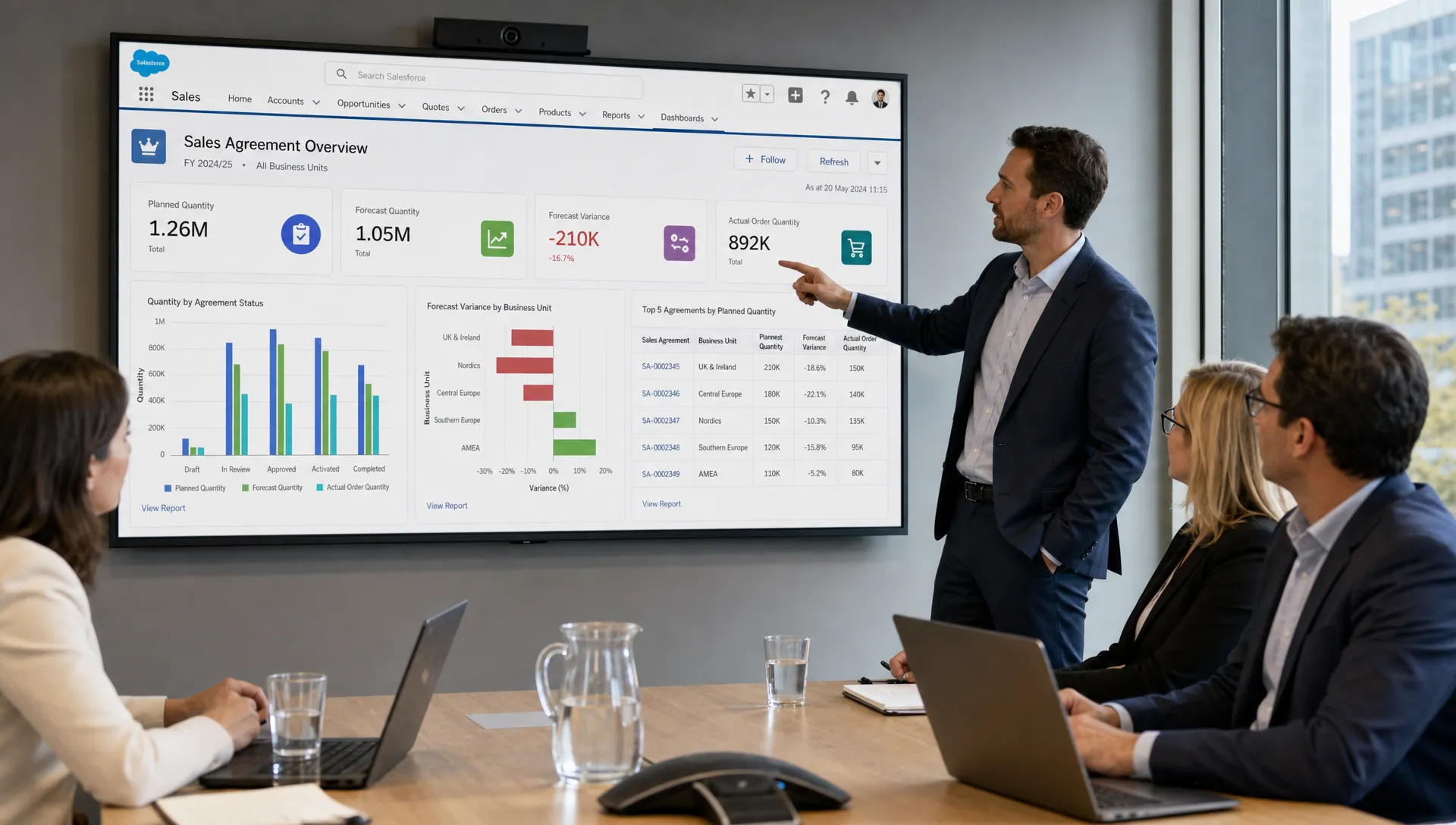
Sales Agreements are commonly associated with Salesforce Manufacturing Cloud. In practical terms, they let teams track planned product quantities and revenue for an account over a defined period, then compare those plans with actual orders or realised activity.
Salesforce’s Sales Agreements documentation describes them as a way to manage run-rate business and monitor planned versus actual performance. That is useful for organisations where revenue depends on repeated purchases, framework commitments, account-level forecasts or longer commercial cycles.
For a CFO, this is about forecast quality. For a CIO, it is about whether Salesforce is being used as the system of record for important commercial data. For procurement, it raises a different question: if teams depend on this functionality, is the Salesforce contract structured in a way that supports genuine business value rather than just more licence consumption?
How sales agreements Salesforce records differ from signed contracts
A frequent mistake is treating a Salesforce Sales Agreement as though it has the same weight as the legal agreement with the customer. It usually does not. It is a commercial planning record, not the negotiated contract itself.
A signed customer contract defines rights, obligations, pricing, liability, payment terms and termination mechanics. A Salesforce Sales Agreement reflects what the business expects to happen across products, accounts and periods. It may mirror the contract closely, but only if the data, governance and integration work are sound.
| Item | What it usually means | Commercial risk if misunderstood |
|---|---|---|
| Signed customer contract | The legal source of obligations and rights | Teams may assume flexibility that does not exist |
| Salesforce Sales Agreement | Operational record of planned quantities or revenue | Forecasts may be treated as firmer than they are |
| Order or invoice data | Evidence of actual customer activity | Gaps between plan and actual may appear too late |
| Salesforce subscription agreement | Your organisation’s contract with Salesforce | Cost may rise even when business value is unclear |
This is why Sales Agreements should sit within a clear commercial governance model. They can improve visibility, but only when the business is honest about what the data represents.
Why commercial teams care
Used carefully, sales agreements Salesforce records can give commercial teams a clearer view of account commitments, likely revenue movement and product-level demand. That can help sales leaders move beyond vague pipeline commentary and give finance something more structured to challenge.
The value is not just better reporting. It is a better conversation. When the account team, finance lead and operations owner can all see the same planned quantities, actual orders and variance, disputes move from opinion to evidence.
Better forecast discipline
Sales Agreements can make forecast assumptions visible. Instead of relying only on opportunity close dates or account manager judgement, teams can track expected quantities or revenue across time.
That helps finance ask sharper questions. Are expected volumes based on a contractual minimum, a customer forecast, a historical run rate or a sales ambition? Those are very different levels of confidence.
Stronger account reviews
For commercial leaders, Sales Agreements can support more practical account reviews. The conversation can move from “is the customer happy?” to “which products are underperforming against agreed expectations, which periods show risk and which commitments need executive attention?”
This is particularly useful where large accounts buy repeatedly across a year. It can also help spot whether the sales team is depending on future volume that has not yet been secured.
Cleaner handoffs between teams
Sales Agreements can improve the handoff between sales, revenue operations, finance and fulfilment teams. When planned quantities and revenue are visible in Salesforce, downstream teams can see what the account team has committed to pursue or support.
The trap is assuming that a visible record is an accurate record. Visibility without ownership simply makes weak data easier to circulate.
Where risk creeps in
The sales agreements Salesforce supports are only as reliable as the commercial discipline around them. If the inputs are soft, the outputs will look polished but still be commercially weak.
Three risk areas deserve particular attention: data quality, contractual alignment and Salesforce cost exposure.
Weak baselines
If historical order data is incomplete or product mapping is inconsistent, the baseline inside the Sales Agreement may be wrong from the start. Finance may then challenge the forecast without realising the issue is upstream data hygiene rather than sales judgement.
This is not a Salesforce problem on its own. It is a governance problem. Someone must own whether the baseline reflects signed commitments, historic demand or aspirational growth.
Loose links to real contract terms
A Sales Agreement can show planned revenue, but it may not show the contractual nuance behind that revenue. Minimum commitments, price protections, rebate structures, termination rights and renewal conditions may sit elsewhere.
That matters because commercial teams can overstate certainty if they only look at the Salesforce record. Procurement and legal teams should be clear about which clauses determine the customer’s actual obligation.
Salesforce spend that follows process dependence
Once a team builds important commercial processes around Salesforce Sales Agreements, that capability can become part of the renewal discussion. More users, more integrations and more reliance on specific clouds or objects can all affect leverage.
That does not mean the functionality is a problem. It means the business should understand the commercial consequences before dependency becomes expensive to unwind. If your team is reviewing the wider Salesforce model, it may help to compare how different structures work in practice, including Standard Agreement, SELA and AELA models.
The questions CFOs, CIOs and procurement should ask
When sales agreements Salesforce data is used in commercial decision-making, each leadership function should test a different part of the chain. The point is not to slow the business down. It is to stop a planning tool becoming an unchecked source of financial confidence.
| Role | Core question | What to look for |
|---|---|---|
| CFO | Can we trust the revenue assumptions? | Clear distinction between contracted, forecast and aspirational volume |
| CIO | Is the data model sustainable? | Clean integrations, ownership of master data and controlled customisation |
| Procurement | Does this increase Salesforce dependency? | Licence impact, renewal leverage and avoidable shelfware |
| Sales leadership | Does this improve account execution? | Measurable variance tracking and accountable follow-up |
| Legal | Does the record reflect the signed contract? | Alignment with pricing, commitments and termination terms |
These questions are most useful before the process is fully embedded. Once sales, finance and operations rely on a Salesforce workflow every month, it becomes much harder to separate genuine value from inherited habit.
What this means for Salesforce renewal planning
Commercially, sales agreements Salesforce functionality can also influence your own negotiation with Salesforce. If the business sees Sales Agreements as important, that may support continued investment. If usage is patchy or poorly governed, it may be one more example of paid-for capability that has not matured into value.
This is where CFOs and procurement leaders should resist two easy mistakes. The first is dismissing functionality because adoption is low. Low adoption may reflect poor rollout rather than poor fit. The second is accepting high-level adoption claims without checking whether the records are complete, current and used in decisions.
Before a renewal, teams should ask whether Sales Agreements are tied to measurable outcomes. Are they improving forecast accuracy? Are account reviews better? Are order variances spotted earlier? Are commercial risks escalated sooner? If the answer is unclear, the renewal position should reflect that uncertainty.
This sits neatly within a broader principle: your Salesforce strategy is stronger when the commercial picture is clear. SaaSed has covered that wider point in a guide to building Salesforce strategy around commercial clarity.
A practical operating model
The best use of sales agreements Salesforce offers is not technical. It is behavioural. The tool works when people agree what the records mean, who updates them and how the business acts when planned and actual performance diverge.
A sensible operating model should cover four things.
- Ownership: Name the function responsible for Sales Agreement accuracy, not just system administration.
- Source of truth: Define which data comes from signed contracts, which comes from customer forecasts and which comes from internal sales assumptions.
- Review cadence: Use Sales Agreements in regular account and finance reviews, not only at quarter-end.
- Renewal evidence: Track whether the functionality supports measurable business outcomes before Salesforce renewal discussions begin.
Procurement should also look at the contractual side of the Salesforce estate. If Sales Agreements are part of a wider set of clouds, SKUs and commercial commitments, the agreement itself may deserve a harder review. We have written separately about Salesforce agreements that deserve a harder review, especially where bundled products or broad commitments make value harder to prove.
Common implementation pitfalls
Sales Agreements often disappoint when they are treated as a configuration task rather than a commercial design decision. The object can be set up, fields can be populated and dashboards can be built, but none of that guarantees better decisions.
A common issue is over-customisation. Teams add fields to capture every possible nuance, then usage drops because maintaining the record becomes too heavy. Another issue is under-integration, where actual order data is not fed back reliably. In that case, planned versus actual reporting becomes manual work dressed as automation.
There is also a governance problem around optimism. Sales teams may prefer to record expected growth rather than firm customer commitments. That is not inherently wrong, provided the record makes the confidence level clear. If optimism and obligation look the same in Salesforce, finance will eventually lose trust in the process.
FAQ
Are Salesforce Sales Agreements the same as customer contracts? No. They can reflect customer commitments, but they are operational records inside Salesforce. The signed legal contract remains the source of enforceable rights and obligations.
Which teams should own Salesforce Sales Agreements? Ownership usually needs to be shared. Sales may own account assumptions, finance should challenge forecast treatment, operations may validate actuals and IT should govern the data model. One named business owner should still be accountable for accuracy.
Do Sales Agreements affect Salesforce renewal negotiations? They can. If the business relies on the functionality and can prove value, that supports the case for continued investment. If usage is weak or the data is unreliable, it should be part of the renewal challenge.
What should procurement review before accepting more Salesforce spend linked to Sales Agreements? Procurement should check usage, licence requirements, integration dependencies, shelfware risk and whether the functionality is tied to measurable commercial outcomes. The aim is not to block investment, but to make sure the spend follows value.
Can Sales Agreements improve forecast accuracy? They can improve forecast discipline by making assumptions and variances more visible. Accuracy still depends on clean data, honest confidence levels and regular review by the teams responsible for the numbers.
A final word for commercial teams
Salesforce Sales Agreements can be useful, but they should not be allowed to blur the line between planned revenue, contractual commitment and commercial hope. For CFOs, CIOs and procurement leaders, the work is to connect the operational record to the legal reality, the data model and the Salesforce cost base.
If your organisation is approaching a Salesforce renewal, reviewing underused functionality or trying to understand whether your current SKU mix supports real value, SaaSed can help you look at the contract and usage picture before decisions harden. For a calm, practical starting point, book a complimentary Salesforce audit conversation.
Want this kind of intel on your renewal?
Don’t head into your next software negotiation alone
Contact Us