How to Build a Salesforce Support Team With Clear Ownership
Clear ownership turns Salesforce support into a controlled operating model, not just a ticket queue. This guide shows CFOs, CIOs and Procurement leaders how to assign decisions, protect renewals and reduce avoidable commercial risk.
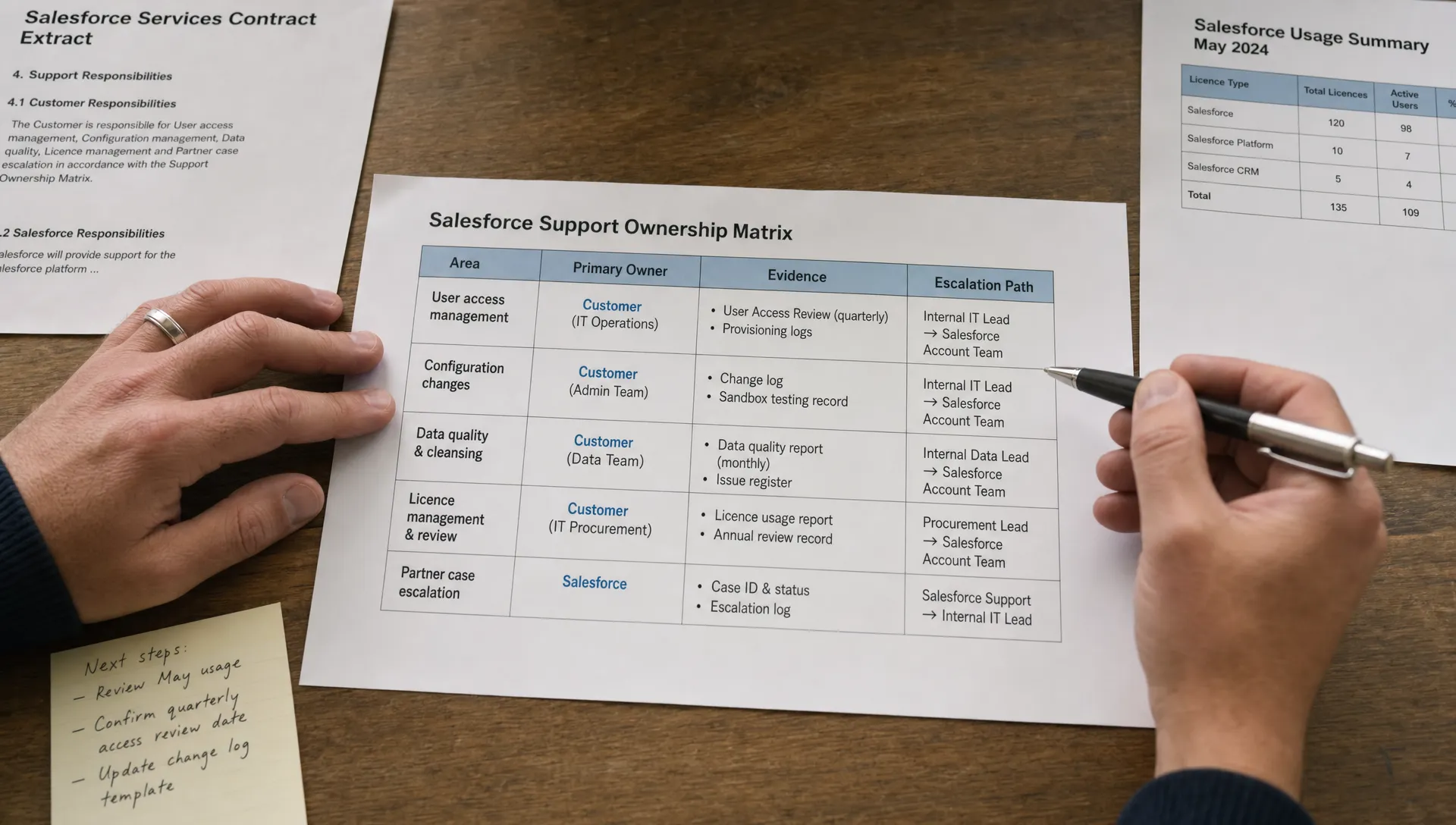
Salesforce can become hard to support for reasons that have little to do with ticket volume. A Salesforce support team breaks down when ownership is unclear: IT fixes symptoms, Sales Ops changes fields, Finance questions licences and Procurement enters the renewal late. Clear ownership turns support from a queue of requests into a controlled operating model, with named decisions, usable evidence and fewer surprises when the commercial conversation starts.
For CFOs, CIOs and Procurement leaders, the aim is not to create another layer of process. The aim is to know who owns which decisions before cost, risk or user frustration exposes the gap.
What a Salesforce support team should own
The first mistake is treating support as a purely technical function. Salesforce support includes administration, data quality, access control, change management, release planning, licence hygiene and escalation to Salesforce or a third party. Some of that sits naturally with IT. Some belongs with business operations. Some must be visible to Finance and Procurement.
A useful ownership model separates support into four lanes:
- Run: keeping the platform stable, secure and usable.
- Change: managing enhancements, configuration and release discipline.
- Commercial control: checking licences, SKUs, shelfware and renewal exposure.
- Decision governance: deciding which requests deserve budget, priority or escalation.
No single person needs to do all of this. But someone must own each lane, and those owners need to work from the same version of the Salesforce estate.
If Salesforce has become too embedded to manage informally, it is worth stepping back and treating it as enterprise software, not an admin tool. SaaSed’s guide on how to govern Salesforce as enterprise software is a useful companion to this operating model.
Start with decisions, not job titles
A Salesforce support team should be designed around decisions the business repeatedly needs to make. Job titles vary by organisation, but the decisions are familiar: who can approve a new integration, who can change the data model, who can add users, who can challenge an unused SKU and who signs off renewal inputs.
When these decisions are left implicit, support becomes personal. The loudest stakeholder gets the change. The admin becomes the unofficial product owner. Procurement receives licence counts without usage context. Finance sees the invoice, but not the operational evidence behind it.
A simple ownership table is often enough to expose the gaps.
| Support area | Primary owner | Evidence needed | Escalation trigger |
|---|---|---|---|
| User access and permissions | IT or Salesforce admin lead | User roles, profiles and permission sets | Privileged access risk or audit concern |
| Configuration changes | Platform owner | Change request, impact assessment and release notes | Cross-cloud impact or security concern |
| Data quality | Business process owner | Duplicate rates, required field compliance and process exceptions | Reporting errors affecting management decisions |
| Licence and SKU review | Finance, IT and Procurement jointly | Assigned licences, active usage and contract terms | Renewal window within 6 to 9 months |
| Partner or Salesforce escalation | Platform owner with Procurement visibility | Ticket history, commercial impact and severity | Missed SLA, recurring issue or contractual dispute |
This table is not a full RACI. It is a starting point. The point is to make ownership visible enough that weak spots can be fixed before they become renewal leverage for the vendor.
Define the platform owner carefully
Every enterprise Salesforce environment needs a platform owner. This should not be a ceremonial title. The platform owner holds the line between business demand, technical design and commercial discipline.
In smaller teams, the platform owner may also manage the admin queue. In larger organisations, the role is closer to a product owner for the Salesforce estate. They do not approve every small request, but they own the rules for what gets changed, when it gets changed and how impact is assessed.
The platform owner should have enough seniority to say no. Not forever, not defensively, but clearly. A request that creates reporting risk, adds unnecessary complexity or requires another paid SKU should be challenged before it enters delivery.
A Salesforce support team with a weak platform owner often drifts into configuration sprawl. Fields multiply. Automations overlap. Integrations become harder to test. The commercial consequence arrives later, when the organisation discovers it is paying for products that support old designs nobody wants to defend.
Salesforce’s own Well-Architected guidance is helpful here because it frames architecture as a balance of trust, ease and adaptability. Support ownership should follow the same logic: stable enough to protect the business, flexible enough to support change and disciplined enough to avoid unnecessary cost.
Keep licence ownership close to support
Licence management should not sit in a spreadsheet that only appears three months before renewal. It belongs close to day-to-day support because usage patterns, role changes and process adoption show up there first.
This does not mean admins should negotiate contracts. It means the Salesforce support team should create the evidence that Finance and Procurement need: which users are active, which features are used, which teams have stopped using certain products and which SKUs are tied to future projects rather than current value.
The distinction matters. A licence can be assigned but barely used. A cloud can be strategically important but under-adopted. A product can be unused because of poor enablement, not because the business no longer needs it. Without support evidence, all three cases look the same during renewal discussions.
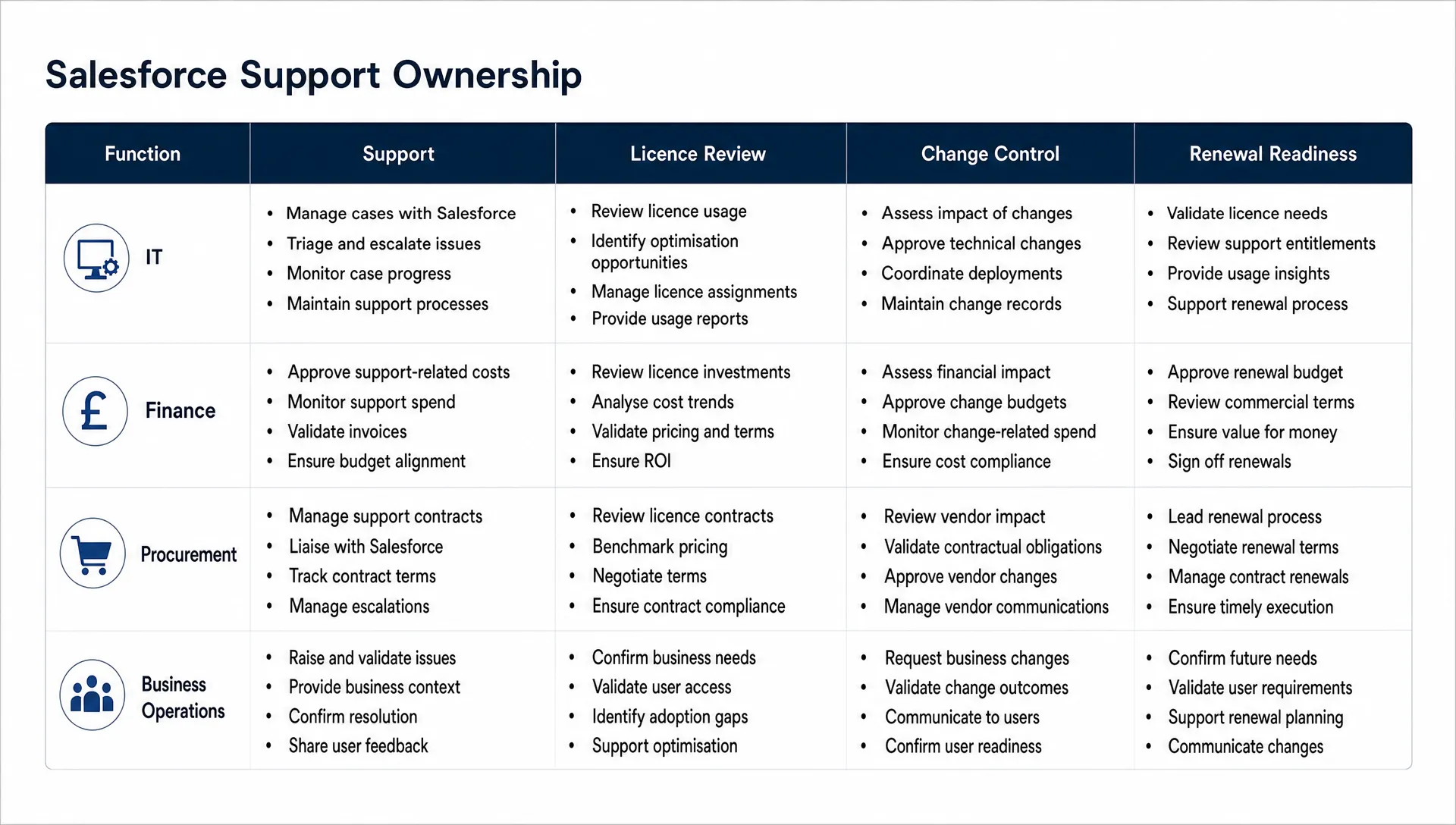
For renewal planning, the support function should produce a clean baseline of contracts, SKUs, assignments, active usage and known risks. If that baseline does not exist, the business enters commercial discussions with opinion rather than evidence. SaaSed covers this wider preparation in how to build a support strategy before Salesforce renewal.
Put intake rules between demand and delivery
Most Salesforce support queues contain several types of work: break-fix tickets, access requests, reporting issues, minor enhancements, major changes and commercial questions disguised as technical requests. If every item enters the same queue, the team loses control.
The answer is not a complicated intake process. It is a small set of rules that tell users what kind of request they are making and what evidence is required.
For example, a reporting fix may need a sample report and business impact. A new field may need a named process owner and downstream reporting check. A new integration may need security review, data ownership and budget approval. A request for another Salesforce product should trigger commercial review before it becomes a technical project.
A Salesforce support team should make these intake rules visible to business users. This reduces friction because people know what good requests look like. It also protects the team from becoming the place where unclear business decisions are quietly converted into configuration.
Good intake rules create a useful record. Over time, the pattern of rejected, deferred and approved requests tells leadership where Salesforce is strained, where process ownership is weak and where demand is starting to create commercial risk.
Decide what belongs inside the team and what does not
Internal ownership does not mean every support capability must be internal. Many enterprise teams use a blend of internal admins, business process owners, Salesforce Success Plans, system integrators and independent commercial support.
The important point is to retain control of decision rights. External partners can help with delivery, technical depth, health checks and specialist review. They should not become the only people who understand the estate, the only source of renewal evidence or the default approver of additional complexity.
Use external support when the work needs scarce expertise, independent challenge or short-term capacity. Keep ownership internal for platform direction, business prioritisation, access policy, licence decisions and renewal posture.
If you are weighing different support structures, SaaSed’s comparison of SFDC support models for enterprise teams sets out the trade-offs without assuming one model fits every organisation.
The practical test is simple: if a supplier left tomorrow, would your organisation still know what it owns, what it uses, what is risky and what must change before renewal? If the answer is no, the support model is carrying too much knowledge outside the business.
Measure support by control, not activity
Ticket closure is useful, but it is not enough. A Salesforce support team can close hundreds of tickets and still leave the organisation with poor data, weak licence control and avoidable renewal pressure.
Better measures show whether support is reducing operational and commercial noise. CFOs and CIOs do not need a long dashboard. They need a few indicators that show whether the platform is becoming easier to run and easier to buy well.
| Measure | What it tells leadership | Review rhythm |
|---|---|---|
| Active licence usage | Whether assigned products are being used | Monthly or quarterly |
| Ageing enhancement backlog | Whether demand is being governed or ignored | Monthly |
| Recurring incident themes | Where configuration or process design is weak | Monthly |
| Access exceptions | Whether permission governance is drifting | Monthly |
| Renewal evidence readiness | Whether Finance and Procurement can support negotiation claims | Quarterly, then monthly inside 6 months of renewal |
The last measure is often neglected. Renewal evidence readiness asks a direct question: if Salesforce asked tomorrow why you want to remove, reduce or restructure part of the contract, could you prove your case? If not, support has work to do before the commercial team can negotiate cleanly.
Build the cadence around the renewal date
Salesforce support should run all year, but its commercial discipline should tighten as renewal approaches. Six to nine months out, the support team should be able to provide a reliable view of usage, known shelfware, unresolved adoption issues, open escalations and products tied to future plans.
Three to six months out, the same group should help Finance and Procurement separate must-have capability from negotiable spend. This is where clear ownership pays off. The platform owner can defend what is essential. Business owners can explain adoption issues. Procurement can challenge renewal assumptions with evidence instead of late-stage pressure.
A Salesforce support team should not wait until the account team presents a renewal proposal to start this work. By then, internal uncertainty becomes visible. The better route is to create the evidence early, agree the buying position internally and only then enter the external negotiation with discipline.
This is also where support and procurement need a shared language. Support should not speak only in tickets and fields. Procurement should not speak only in price and term. The shared language is usage, risk, dependency and value.
Frequently Asked Questions
Who should own Salesforce support in an enterprise? Ownership should sit with a named platform owner, supported by IT, business process owners, Finance and Procurement. The platform owner should control rules, priorities and design discipline, but licence and renewal decisions should remain cross-functional.
How large should a Salesforce support team be? Size depends on user count, number of clouds, integration complexity, regulatory requirements and change volume. A smaller organisation may need one strong owner with part-time business and procurement support. A larger estate usually needs dedicated admin, architecture, business analysis and commercial review capability.
Should Salesforce licence management sit with IT or Procurement? It should be shared. IT and support teams understand assignment, usage and dependency. Procurement understands contract structure, renewal timing and negotiation risk. Finance should be involved where budget ownership, cost allocation or material savings are in play.
What is the biggest warning sign that ownership is unclear? Repeated changes with no named business owner are a clear warning sign. Other signs include unused licences that nobody will release, conflicting reports, urgent renewal decisions based on stale data and support tickets that reveal unresolved process ownership.
When should a Salesforce support team prepare for renewal? The evidence work should begin at least six to nine months before renewal. Complex estates may need more time, especially where there are multiple clouds, heavy integrations, disputed usage or a history of last-minute buying decisions.
Build ownership before the renewal calendar takes over
Clear Salesforce ownership is quiet when it works. Requests are routed properly. Licence evidence is current. Change is challenged before it becomes cost. Finance, IT and Procurement can see the same estate from different angles without arguing over basic facts.
That is the standard to aim for. Not perfection, just enough discipline that support protects the platform and improves the next buying decision.
If you want an independent view of your Salesforce estate before the next renewal, SaaSed can help with contract review, SKU analysis, usage evidence and commercial risk. Start with a complimentary Salesforce audit conversation.
Want this kind of intel on your renewal?
Don’t head into your next software negotiation alone
Contact Us