Do You Need Contract Renewal Software or a Better Process?
Renewal tools can improve visibility, but they cannot replace ownership, usage evidence or commercial judgement. This guide helps finance, IT and procurement leaders decide whether Salesforce renewal issues need software, process repair or both.

Contract renewal software can be helpful, but it rarely fixes the real reason renewals go wrong. For CFOs, CIOs, IT leads and procurement teams, the bigger problem is often not a missing reminder. It is a weak baseline: unclear ownership, scattered order forms, poor usage evidence, rushed stakeholder input and no agreed negotiation position until the supplier is already driving the timetable. Software may expose those gaps faster. It will not close them by itself.
The question is not whether renewal tooling has value. It does. The sharper question is whether your organisation needs a tool, a process reset or both. For Salesforce in particular, where products, editions, add-ons, consumption items and renewal terms can create a complicated commercial picture, the answer depends on what is breaking today.
Where contract renewal software genuinely helps
Contract renewal software is useful when the basic renewal mechanics are failing. If dates are missed, notice periods are buried, contract documents sit across inboxes and no one has a reliable view of upcoming obligations, a system of record can remove a lot of avoidable pain.
A good tool can help centralise agreements, trigger renewal alerts, assign owners, track approval steps and give finance better forward visibility. For organisations managing hundreds of SaaS agreements, that alone can be worth the effort. It reduces dependence on individual memory and makes renewal activity less fragile when people move roles.
For Salesforce, the value is slightly different. The renewal date is only one part of the problem. You also need to understand which order forms apply, what products are included, which terms govern pricing and what has changed since the last negotiation. Salesforce publishes its standard commercial documentation through Salesforce's own agreements and terms, but your actual position depends on the documents you signed, the amendments you accepted and the commercial history behind them.
Software is strong at organising that evidence. It is weaker at interpreting what the evidence means.
What software does not decide for you
A renewal tool cannot tell you whether your Salesforce estate still matches the business. It cannot decide whether unused licences are genuine shelfware, temporary underuse or capacity you still need. It cannot judge whether a bundle is protecting value or hiding spend that should be challenged.
This is where many teams buy technology too early. They expect contract renewal software to create discipline, but the organisation has not agreed what discipline looks like. The tool becomes another place to store incomplete information.
Before relying on automation, leadership needs answers to a few hard questions:
- Who owns the renewal outcome: finance, IT, procurement or the business function using the platform?
- What is the current commercial baseline, including all order forms, amendments and product quantities?
- Which licences, add-ons and clouds are actually being used?
- What would the organisation remove, retain or renegotiate if the renewal were due today?
- What is the internal walk-away position, even if switching away from Salesforce is not realistic in the short term?
If those answers are missing, the renewal problem is not primarily a software problem. It is a governance problem.
The process test before you buy
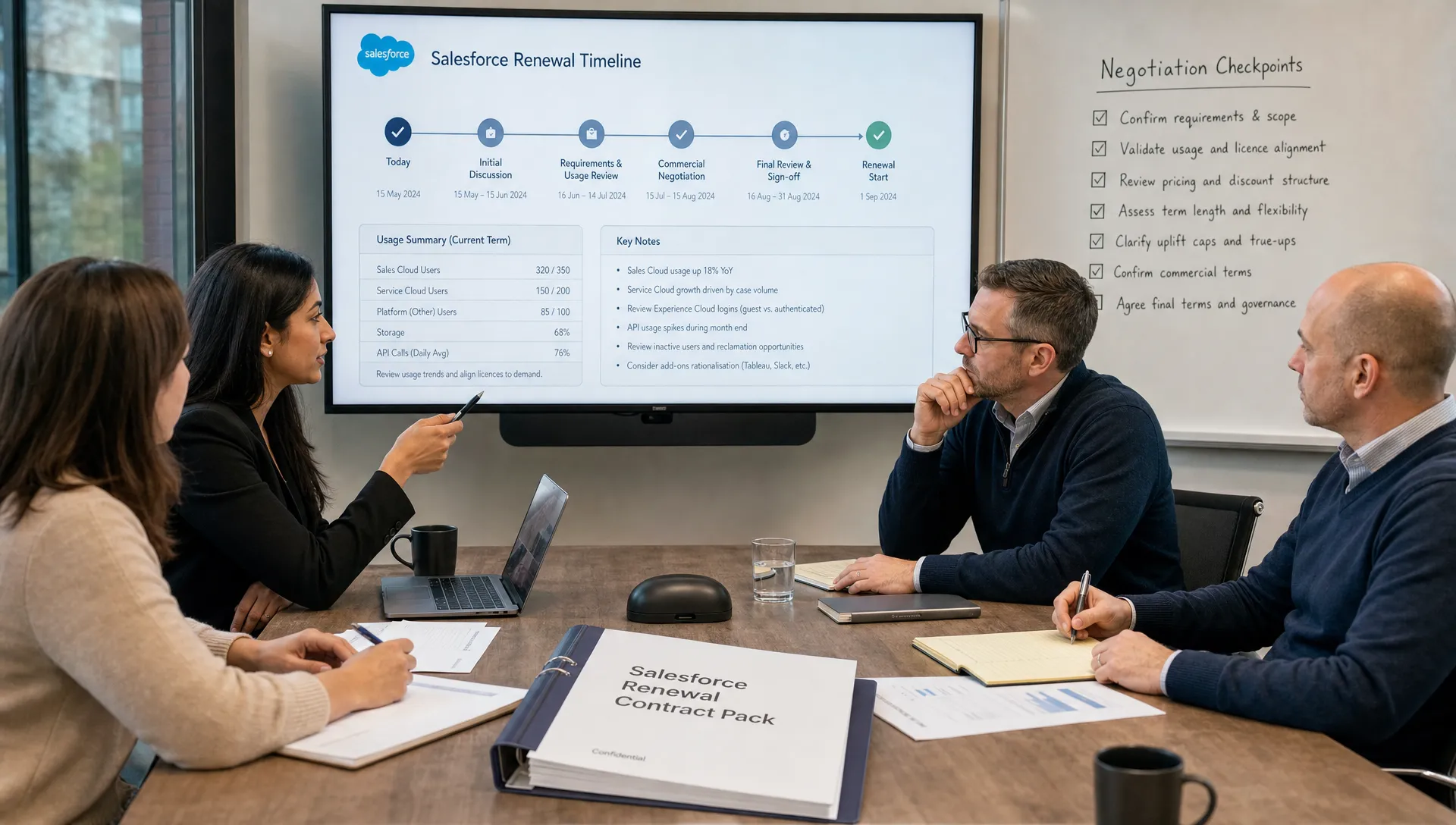
A clean process does not need to be elaborate. It does need to be early, evidence-led and owned. The strongest Salesforce renewal teams work backwards from the renewal date, not forwards from the supplier proposal.
If your current approach starts only when the account team sends pricing, you are already negotiating from a thinner position. SaaSed has written separately on why contract review should start months before renewal, but the short version is simple: commercial leverage takes time to build. Usage data, stakeholder alignment and viable options do not appear in the final fortnight.
A practical process should include five stages: contract collection, usage review, stakeholder challenge, commercial position setting and negotiation control. Each stage should produce a decision, not just a document. For example, a usage review should not end with a dashboard. It should end with a view on what is underused, what is business-critical and what needs further investigation.
The table below is a useful way to separate tool needs from process gaps.
| Symptom | What a tool may solve | What a better process must solve |
|---|---|---|
| Renewal dates are missed | Alerts, task owners and central tracking | Clear accountability for acting on alerts |
| Documents are scattered | Repository and metadata capture | Validation of which terms actually apply |
| Stakeholders respond late | Workflow reminders | Earlier business engagement and decision rights |
| Usage data is unclear | Data attachments and reporting fields | Interpretation of usage against business need |
| Supplier proposal arrives first | Timeline visibility | Internal negotiation position before supplier framing |
| Costs keep rising | Spend visibility | SKU challenge, demand review and commercial trade-offs |
The distinction matters. Buying software to fix ownership rarely works. Fixing ownership first makes the software far more valuable.
When the tool is the right answer
There are clear cases where contract renewal software should be part of the answer. If your organisation has a large SaaS portfolio, multiple subsidiaries, decentralised buying or frequent renewal surprises, tooling can provide much-needed control.
It is especially useful when finance needs a forward view of committed spend and procurement needs a reliable renewal calendar. It also helps legal and IT avoid last-minute searches for documents that should have been stored centrally from the start.
For Salesforce-heavy estates, a tool can support a more disciplined record of products, quantities, terms and renewal events. Public Salesforce pricing pages, such as Salesforce's UK edition and pricing information, may help teams understand standard packaging, but signed commercial terms often differ from public pages. A structured repository helps keep that distinction clear.
The tool is the right answer when the process already has owners, but execution is too manual. It is less likely to help when no one agrees what good looks like.
When the process is the real constraint
A process problem usually shows up as repeated surprise. Not surprise that the renewal exists, but surprise about what the organisation is committed to.
Common signs include finance discovering uplift late, IT finding unused licences after the proposal is issued, procurement being asked to negotiate without a clean baseline or business owners defending products they have not reviewed in detail. These are not solved by another workflow. They are solved by better preparation.
Contract renewal software will not challenge an internal stakeholder who wants to renew everything because it is easier. It will not push back on a bundle that no longer reflects your operating model. It will not decide whether a three-year term is worth the commercial trade-off.
That judgement needs a small, disciplined group with access to facts and the authority to make decisions. For Salesforce renewals, that often means finance, IT, procurement, legal and senior business owners looking at the same evidence early enough to disagree productively.
If you need a broader framework for this, SaaSed's guide to what a strong SaaS renewal process looks like sets out the operating rhythm in more detail.
A Salesforce-specific view: the risk is not just missing the date
Salesforce renewals deserve particular care because the commercial structure can be dense. A customer may have core clouds, add-ons, integrations, sandbox capacity, support entitlements, data products, consumption-based items and contract-specific protections all sitting in the same renewal discussion.
The risk is not only paying for unused licences. It is renewing a commercial architecture that no longer matches the business. That can happen when new teams have been added, old products remain in place, purchased capacity has not translated into adoption or the original business case has changed.
The strongest use of contract renewal software is as part of a wider evidence system: it stores the documents, flags the milestones and helps the team maintain control. The review still needs human judgement. Someone has to read the order forms, compare them with usage, check the negotiation history and decide where the supplier has leverage and where the customer does.
This is also where commercial risk can hide. Auto-renewal mechanics, price uplift language, co-terming choices, minimum commitments and product substitution limits can all affect your options. SaaSed's article on Salesforce contract renewal risks to catch early is a useful companion if you suspect the issue is deeper than renewal tracking.
A simple decision framework
If you are deciding whether to buy tooling, start with the failure pattern. Be honest about what has gone wrong in the last two renewal cycles.
If the failures were administrative, software may be the right next step. Missed dates, incomplete document storage, poor task tracking and weak reporting are all legitimate tool problems. You still need governance, but technology can make the work easier to sustain.
If the failures were commercial, start with the process. A late negotiation, weak usage evidence, unclear internal priorities or a supplier-shaped proposal are signs that the organisation needs a better renewal operating model before it needs more software.
If you already own contract renewal software and still feel exposed, treat that as useful evidence. The issue is probably not visibility. It is the conversion of visibility into decisions. That means agreeing who can challenge demand, who can approve trade-offs and who is responsible for preparing the negotiation position before the supplier proposal arrives.
A fair decision rule is this: buy software when the team knows what to do but needs a better way to manage volume. Fix the process when the team is still debating what to do, who decides or what evidence counts.
How to improve the process without waiting for a new system
You do not need a full technology project to improve the next Salesforce renewal. Start with a simple renewal file that contains the complete contract pack, current product list, quantities, prices, renewal dates, notice terms, known uplift language and owner names.
Then build a usage view. It does not need to be perfect on day one, but it should be good enough to separate obvious shelfware from areas that need business review. Compare assigned licences with active use, look at adoption patterns and ask business owners to explain where spend is still justified.
Next, agree the commercial narrative internally. This should include what you value, what you do not need, what you may need later and what trade-offs you are willing to consider. Without that narrative, the negotiation becomes reactive.
Finally, set a timetable that gives procurement room to work. If the first serious internal meeting happens after the renewal quote arrives, the supplier has already shaped the discussion. A better process gives your team time to shape it first.
Frequently Asked Questions
Is contract renewal software worth it for Salesforce renewals? It can be, especially if your organisation struggles with renewal calendars, document storage or approval tracking. For Salesforce, it should support a wider review of SKUs, usage, terms and negotiation options rather than replace that work.
What should we fix before buying a renewal tool? Fix ownership, evidence quality and decision rights first. If no one is accountable for the renewal outcome, a tool will only make the lack of ownership more visible.
Can software identify Salesforce shelfware? Some tools can help store or display usage data, but shelfware analysis still needs interpretation. Low usage may indicate waste, poor enablement, seasonal demand or a product that is assigned to the wrong group.
When should the Salesforce renewal process start? For material Salesforce agreements, start several months before the renewal date. Larger or more complex estates may need even more time, especially if the contract pack is incomplete or stakeholder alignment is weak.
Who should own the renewal process? Procurement often manages the commercial process, but finance, IT, legal and business owners all need defined roles. The owner should have the authority to coordinate evidence, challenge demand and prepare the negotiation position.
Conclusion: choose the constraint before choosing the tool
The best answer is rarely software or process in isolation. Most organisations need both, but not always in the same order.
If your renewal problem is visibility, contract renewal software may be a sensible investment. If your problem is judgement, timing, ownership or negotiation readiness, the process needs attention first. For Salesforce renewals, that distinction can be expensive to ignore.
SaaSed helps organisations review Salesforce contracts, usage, SKUs and renewal risk before negotiation pressure builds. If you would value a calm outside view on your next renewal, you can arrange a complimentary Salesforce audit conversation.
Want this kind of intel on your renewal?
Don’t head into your next software negotiation alone
Contact Us